

Hyperbaric oxygen therapy (HBOT) is defined as the inhalation of near-100% oxygen at pressures above normal atmospheric levels, and its role in HBOT immune modulation is to act as a context-dependent regulator of immune cell function rather than a simple stimulant or suppressant. By altering oxygen tension within tissues, HBOT triggers oxygen-sensing pathways that reshape immune metabolism and rebalance immune cell populations, including regulatory T cells (Tregs) and pro-inflammatory Th17 cells. A 2026 narrative review synthesising 39 studies confirmed that these effects span autoimmune diseases, chronic inflammation, and cancer. For anyone researching immune modulation therapy or exploring how advanced therapies can support long-term health, understanding this mechanism is the foundation for everything that follows.
What are the cellular mechanisms behind HBOT-driven immune modulation?
HBOT drives immune change at the cellular level through oxygen tension sensing, metabolic shifts, and transcriptional reprogramming. When tissues are exposed to elevated oxygen, immune cells detect this change and alter their metabolic programmes, moving between glycolysis and oxidative phosphorylation (OXPHOS). This metabolic remodelling directly influences which immune cell types are produced and how active they become.
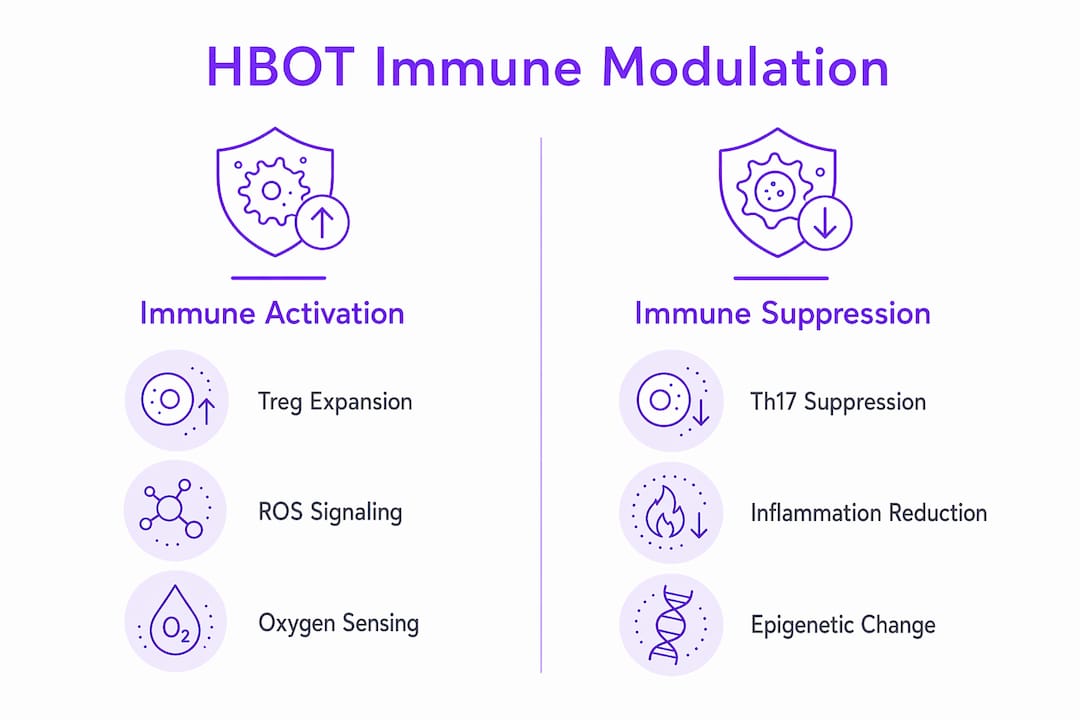
Reactive oxygen species (ROS) generated during HBOT act as signalling molecules rather than purely damaging agents. At controlled doses, ROS activate antioxidant enzymes such as superoxide dismutase (SOD) and stimulate immune regulatory pathways. Mitochondrial dynamics, including fusion, fission, and autophagy, are also altered, affecting the energy supply and survival of immune cells.

Tregs expand under HBOT conditions, while Th17 inflammatory pathways are suppressed. Epigenetic changes, including DNA methylation and histone modification, influence immune cell lineage decisions over repeated sessions. This means the effects of HBOT are not simply acute but can persist and accumulate with consistent treatment.
| Immune cell or pathway | Effect of HBOT |
|---|---|
| Regulatory T cells (Tregs) | Expansion and enhanced suppressive function |
| Th17 inflammatory pathway | Suppression, reducing pro-inflammatory signalling |
| NF-κB and NLRP3 inflammasome | Inhibited, lowering systemic inflammation |
| Mitochondrial function | Protected and optimised via metabolic remodelling |
| ROS signalling | Stimulates immune activation at precise doses |
Pro Tip: The timing and frequency of HBOT sessions matter significantly. Because immune outcomes depend on the metabolic state of the tissue being treated, sessions scheduled during active inflammatory flares may produce different results than maintenance sessions in a stable patient.
How does HBOT affect autoimmune and chronic inflammatory diseases?
HBOT’s most clinically documented immune effects appear in autoimmune and chronic inflammatory conditions, where its ability to expand Tregs and suppress pro-inflammatory cytokines offers genuine therapeutic potential. Studies show that HBOT reduces IL-6 and TNF-α levels, two cytokines central to conditions such as fibromyalgia, vasculitis, and rheumatic diseases. Patients in these studies reported symptomatic improvements alongside low rates of adverse events.
In experimental autoimmune myocarditis models, HBOT suppressed NF-κB and NLRP3 inflammasome signalling, protected mitochondria from oxidative damage, and enhanced Treg responses. This multimodal immune modulation represents a meaningful shift from targeting a single pathway to recalibrating the broader immune environment. The implication is that HBOT may be particularly valuable where multiple inflammatory mechanisms are active simultaneously.
Conditions where HBOT has shown potential immune benefit include:
- Fibromyalgia: Reduced pain and inflammatory markers in clinical studies
- Vasculitis: Improved tissue oxygenation and reduced immune-mediated vessel damage
- Experimental autoimmune myocarditis: Suppressed inflammasome activity and enhanced immune tolerance
- Rheumatic diseases: Symptomatic relief linked to cytokine reduction
- Chronic inflammatory conditions: Improved tissue repair via HIF-1 signalling and VEGF-driven angiogenesis
One important caution: the evidence base remains largely preclinical or drawn from small human studies. Protocol inconsistency across research sites and limited long-term human data mean that broad clinical recommendations are premature. Randomised controlled trials (RCTs) with standardised protocols are still needed before HBOT can be positioned as a first-line immune modulation therapy for autoimmune disease.
What is the evidence for HBOT’s role in cancer immune modulation?
HBOT’s interaction with the tumour microenvironment is one of the most actively researched areas in hyperbaric therapy immune support. Solid tumours are frequently hypoxic, and this low-oxygen state drives the expression of HIF-1α, a transcription factor that promotes tumour survival and suppresses immune attack. HBOT reduces HIF-1α and PD-L1 expression, effectively removing two of the tumour’s key immune evasion tools.
Beyond molecular targets, HBOT breaks down physical barriers within tumours, including dense extracellular matrix structures, and shifts the balance of immune cell infiltration towards tumour-killing cells. A 2023 review found that combining HBOT with PD-1 antibody immunotherapy produced 91% tumour inhibition in preclinical models. That figure reflects the synergistic potential when oxygen delivery and immune checkpoint blockade are combined rather than used separately.
However, the picture is not straightforward. ROS generated by HBOT have a dual nature: at the right dose they stimulate immune activation, but at excessive levels they can paradoxically support tumour growth or damage healthy tissue. A 2026 study published in Nature Chemical Biology revealed that tumour metabolic programmes, including ketone-body metabolism via OXCT1, interact non-linearly with oxygen-based treatments, meaning increased oxygenation does not always enhance immunogenicity.
| Factor | HBOT benefit in cancer | Limitation or caution |
|---|---|---|
| Tumour hypoxia | Relieves oxygen deficit, reducing HIF-1α | Effect varies by tumour metabolic state |
| PD-L1 expression | Reduced, improving immune cell access | Not consistent across all tumour types |
| Immune cell infiltrate | Shifts towards tumour-killing cells | Requires combination with immunotherapy |
| ROS production | Stimulates immune activation at correct dose | Excessive ROS may support tumour growth |
| Radiotherapy toxicity | Mitigates side effects in surrounding tissue | Limited evidence as a radiosensitiser |
A 2026 systematic review of 42 studies involving 2,785 patients found HBOT most effective for radiation toxicity mitigation rather than as a consistent radiosensitiser. This distinction matters: HBOT in cancer is best understood as an adjunctive therapy that improves the conditions for other treatments, not a standalone intervention.
What factors influence HBOT immune outcomes and clinical integration?
The immune response to HBOT is not uniform. Pressure level, session duration, and treatment frequency all shape the magnitude and direction of immune change. A patient with high baseline inflammation will respond differently from one in remission, because the metabolic environment of their immune cells differs fundamentally. This context-dependent modulation is the defining characteristic of HBOT’s immune effects.
Synergy with other therapies is a growing area of interest. HBOT combined with PD-1 blockade immunotherapy shows particular promise, as the oxygen-rich environment created by HBOT enhances the conditions under which checkpoint inhibitors operate. In radiotherapy, HBOT reduces toxicity to surrounding healthy tissue, improving patient tolerance of treatment. Understanding these interactions with concurrent therapies is critical for designing safe and effective protocols.
Key practical considerations for anyone exploring HBOT include:
- Pressure and duration: Higher pressures and longer sessions do not automatically produce better immune outcomes; precise dosing is required
- Patient baseline: Existing inflammation load and tissue oxygenation levels affect how strongly HBOT modulates the immune response
- Treatment frequency: Consistent sessions allow epigenetic changes to accumulate, but gaps in treatment may reduce sustained benefit
- Combination therapy: HBOT works best alongside immunotherapy, radiotherapy, or targeted anti-inflammatory protocols rather than as a sole intervention
- Adverse events: Mild risks include barotrauma and temporary myopia; serious adverse events are rare but require medical supervision
- Protocol standardisation: The absence of universally agreed protocols remains the biggest obstacle to translating research into clinical practice
Pro Tip: Before starting HBOT for immune health purposes, consult a clinician familiar with both hyperbaric medicine and your specific condition. The dosing regimen that benefits one patient may be ineffective or counterproductive for another.
How does HBOT’s immune modulation translate into broader health benefits?
Beyond specific diseases, HBOT’s ability to reduce chronic inflammation and support tissue repair has implications for general immune health and longevity. HBOT modulates HIF-1 signalling, VEGF, and nitric oxide pathways, supporting angiogenesis and endothelial progenitor cell recruitment. These effects contribute to faster wound healing, reduced inflammatory burden, and improved cellular resilience over time.
Emerging research is also examining how HBOT-mediated oxygenation influences the gut microbiome and its interaction with the immune system. Oxygen availability in gut tissues affects microbial composition, which in turn shapes systemic immune tone. This microbiome-immune axis is an area where HBOT’s anti-ageing immune benefits may prove particularly significant in the coming years.
Promising future research directions include:
- Multi-omics integration: Combining genomic, proteomic, and metabolomic data to map individual immune responses to HBOT
- Immune-metabolic profiling: Identifying which patients are most likely to benefit based on their baseline metabolic and immune state
- Microbiome-HBOT interactions: Understanding how oxygenation changes affect gut bacteria and downstream immune regulation
- Standardised clinical protocols: Developing agreed pressure, duration, and frequency guidelines to enable meaningful cross-study comparison
- Long-term human trials: Moving beyond preclinical models to gather durable evidence on immune outcomes in human populations
The overarching message is one of cautious optimism. HBOT is not a cure-all, but the mechanistic evidence supporting its role in immune regulation is growing steadily and deserves serious attention from both clinicians and patients.
Key takeaways
HBOT modulates immunity by altering oxygen tension, which remodels immune cell metabolism, expands Tregs, suppresses pro-inflammatory pathways, and produces context-dependent outcomes across autoimmune and oncologic conditions.
| Point | Details |
|---|---|
| Mechanism of action | HBOT shifts immune metabolism between glycolysis and OXPHOS, influencing T-cell lineage and inflammatory signalling. |
| Autoimmune benefit | Treg expansion and cytokine suppression (IL-6, TNF-α) offer real potential in fibromyalgia, vasculitis, and myocarditis. |
| Cancer context | HBOT reduces HIF-1α and PD-L1, improving immunotherapy conditions, but tumour metabolic state determines actual benefit. |
| Dosing matters | Pressure, duration, and frequency must be tailored to the patient’s baseline inflammation and concurrent treatments. |
| Adjunctive role | HBOT produces its strongest immune outcomes when combined with immunotherapy or radiotherapy, not used in isolation. |
Why I think HBOT deserves more nuanced attention than it gets
People tend to frame HBOT as either a miracle therapy or an overhyped wellness trend. Neither position reflects what the science actually shows. What I find genuinely compelling about the evidence is that HBOT does not simply “boost” immunity. It recalibrates it, and the direction of that recalibration depends on the patient’s oxygen and metabolic state at the time of treatment.
That nuance is what makes HBOT so interesting and so easy to misrepresent. In autoimmune conditions, you want more immune tolerance and less inflammatory drive. In cancer, you want more immune activation against the tumour. HBOT can support both goals, but only when the protocol is matched to the clinical context. Applying the same session parameters to both situations and expecting the same result is a mistake I see discussed far too often.
The 2026 research on ketone-body metabolism and OXCT1 in hepatocellular carcinoma is a good example of why oversimplification is dangerous. More oxygen does not automatically mean better immune outcomes in cancer. The tumour’s own metabolic programme can redirect those effects entirely. That is not a reason to dismiss HBOT. It is a reason to invest in proper mechanistic research and individualised protocols. I am genuinely optimistic about where this therapy is heading, but that optimism has to be grounded in rigorous science, not enthusiasm. Be wary of common hyperbaric therapy misconceptions and always seek qualified guidance before starting a programme.
— Mark
Explore HBOT and wellness therapies at Live5dhealth
Live5dhealth is a wellness centre, luxury spa, gym, and retreat in Boyle, County Roscommon, Ireland, offering a range of therapies designed to support immune health and overall vitality. Whether you are exploring hyperbaric oxygen therapy in Ireland for the first time or looking to complement an existing health programme, the team at Live5dhealth can guide you towards the right approach for your individual needs.

From immune-supporting natural supplements to restorative spa experiences combining sauna, steam, and cold plunge, Live5dhealth brings together the therapies that work best in combination. Visit the luxury spa and wellness centre to discover how a personalised, evidence-informed approach to immune health can help you feel your best.
FAQ
What is the role of HBOT in immune modulation?
HBOT modulates immunity by altering oxygen tension in tissues, which triggers metabolic remodelling, expands regulatory T cells, and suppresses pro-inflammatory pathways including NF-κB and Th17 signalling. A 2026 narrative review of 39 studies confirmed these effects span autoimmune, chronic inflammatory, and oncologic conditions.
Does HBOT boost or suppress the immune system?
HBOT acts as a context-dependent regulator rather than a straightforward stimulant or suppressant. In autoimmune conditions it promotes immune tolerance, while in cancer it can enhance immune activation against tumours, depending on the patient’s metabolic state and treatment protocol.
How does HBOT help with cancer immunotherapy?
HBOT reduces HIF-1α and PD-L1 expression in tumour microenvironments, improving immune cell access to cancer cells. Combined with PD-1 antibody therapy, preclinical studies recorded 91% tumour inhibition, though results vary by tumour type and metabolic programme.
What are the risks of HBOT for immune conditions?
Mild adverse events such as barotrauma and temporary myopia are the most commonly reported risks. A review of 42 studies found serious adverse events to be rare, but medical supervision is required, particularly when HBOT is combined with immunotherapy or chemotherapy.
How many HBOT sessions are needed for immune benefits?
There is no universally agreed protocol, as session number, pressure, and duration depend on the condition being treated and the patient’s baseline immune state. Translational research highlights that protocol inconsistency remains the primary obstacle to standardised clinical recommendations.