
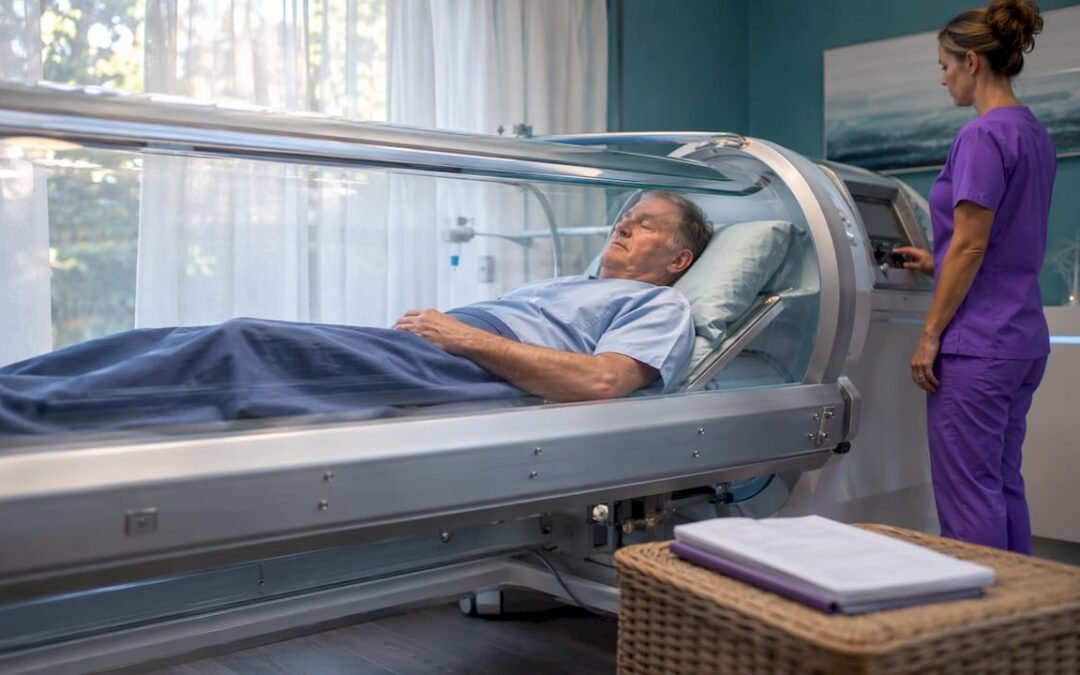
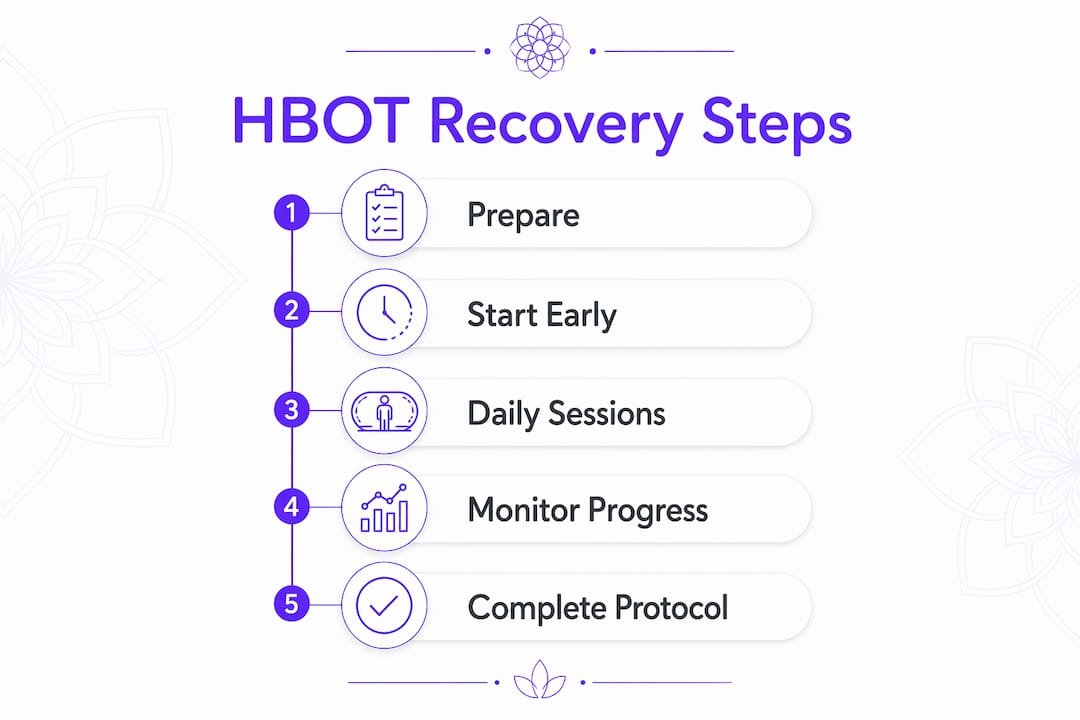
Most patients benefit from daily hyperbaric oxygen therapy (HBOT) sessions starting shortly after surgery, running for about an hour to an hour and a half per session at moderate pressure, typically five times per week. The typical course generally involves multiple sessions, though complex cases or reconstructive procedures may require extended treatment. Getting this timing right matters enormously: HBOT works by flooding tissues with dissolved oxygen precisely when the body’s inflammatory and proliferative healing phases are most active, and that window is finite.
Here is what a standard HBOT post-surgery recovery protocol looks like in practice:
- Session duration: Approximately one hour to an hour and a half, including compression and decompression phases
- Pressure: Moderate atmospheric pressure with 100% oxygen
- Frequency: Around five sessions per week, adjusted for individual tolerance and surgery type
- Total sessions: Multiple sessions are typical for surgical recoveries; reconstructive or radiation-related cases may require more sessions
- Start timing: Ideally early post-surgery, once wound closure and haemostasis are confirmed
- Coordination: Every protocol should be agreed between the hyperbaric team and your operating surgeon before treatment begins
Live5dhealth emphasises that no two protocols are identical. Your surgeon’s guidance, your wound status, and your overall health all shape the final plan.
Table of Contents
- How HBOT sessions work and why they accelerate surgical healing
- What clinical benefits can you expect from HBOT after surgery?
- When should you start HBOT, and how often?
- Risks, contraindications, and how to stay safe during HBOT
- What does the clinical evidence say about HBOT for surgical recovery in the UK?
- How to integrate HBOT into your post-surgical recovery plan
- Key takeaways
- Why HBOT’s timing matters more than most patients realise
How HBOT sessions work and why they accelerate surgical healing
The process itself is straightforward. You lie or sit inside a pressurised chamber, the pressure rises gradually to the therapeutic level, and you breathe pure oxygen through a mask or hood for the session duration. At the end, the chamber depressurises slowly before you exit. The whole experience is calm and non-invasive, and most patients find it far less daunting than they expect.

The biology underneath is where things get genuinely interesting. Under normal atmospheric conditions, oxygen travels almost entirely bound to haemoglobin in red blood cells. At 2.0–2.4 ATA, oxygen dissolves directly into blood plasma at much higher concentrations, reaching tissues that compromised circulation cannot adequately supply. This is precisely why HBOT is used post surgery: surgical trauma often disrupts local blood flow, leaving wound beds starved of the oxygen they need to repair.
The downstream effects are wide-ranging:
- Oedema reduction: The hyperoxic environment triggers mild vasoconstriction, which reduces post-operative swelling without compromising tissue perfusion
- Fibroblast activation: Elevated oxygen tension stimulates fibroblasts to produce collagen, the structural protein that knits wounds closed
- Angiogenesis: New capillary growth into the wound bed restores long-term circulation, a process HBOT accelerates through upregulation of vascular endothelial growth factor (VEGF)
- Ischemia-reperfusion injury: HBOT modulates the damaging oxidative cascade that occurs when blood flow returns to oxygen-deprived tissue after surgery, protecting cells from secondary injury
- Antimicrobial defence: High tissue oxygen levels restore the oxidative killing capacity of white blood cells, strengthening the wound’s natural defences against infection
Understanding oxygen’s role in wound healing helps you appreciate why HBOT is not simply about breathing more oxygen. It is about delivering that oxygen to the exact tissues that need it most, at the exact moment they are trying to rebuild.
What clinical benefits can you expect from HBOT after surgery?
The benefits patients notice most in the early sessions are reduced swelling, less bruising, and a meaningful drop in pain levels. These are not placebo effects. The vasoconstriction and anti-inflammatory mechanisms described above produce measurable reductions in post-operative oedema within the first few sessions, and many patients report feeling noticeably more comfortable by the end of the first week of treatment.
Beyond comfort, the clinical outcomes that matter most to surgeons include:
- Faster wound closure: Enhanced oxygen delivery accelerates the proliferative phase of healing, reducing the time wounds remain open and vulnerable
- Graft and flap survival: In reconstructive and plastic surgery, HBOT is particularly well-evidenced for supporting threatened skin flaps and grafts, where marginal blood supply puts tissue at risk
- Reduced infection risk: Restored leukocyte function in hypoxic wound sites lowers the likelihood of post-operative infection, a major driver of surgical complications
- Improved scar quality: Evidence from systematic reviews and meta-analyses reports lower rates of flap congestion and improved scar remodelling when HBOT is added to standard care
- Strength and function recovery: A 2025 randomised trial demonstrated that HBOT reduced limb swelling and muscle damage after total knee arthroplasty, accelerating quadriceps strength recovery compared with controls
Cosmetic and reconstructive procedures often use HBOT with prolonged protocols, though these applications are largely off-label and typically not covered by insurance. For FDA/UHMS-approved indications such as compromised flaps, radiation necrosis, and complex wound healing, the evidence base is considerably stronger. Routine post-surgical swelling in otherwise healthy patients has a less robust body of clinical trial data, though the mechanistic rationale remains sound.
When should you start HBOT, and how often?
Timing is the variable that most patients underestimate. Starting HBOT early, ideally within 24–72 hours of surgery, targets the inflammatory phase directly, when the body’s healing machinery is most responsive to oxygen-driven signals. Waiting several weeks reduces the therapy’s impact on the critical early stages of repair.

That said, early initiation requires clinical clearance. Your wound must be closed, bleeding must be controlled, and your surgeon must confirm that pressurisation is safe given your specific procedure and health status.
| Surgery type | Typical session count | Recommended frequency | Usual start timing |
|---|---|---|---|
| Orthopaedic (e.g. knee replacement) | Multiple sessions | About 5 per week | Early post-op when safe |
| Reconstructive / flap surgery | Extended sessions | About 5 per week | As early as clinically safe |
| Cosmetic surgery | Multiple sessions | About 5 per week | Early post-op when safe |
| Complex wound / radiation damage | Extended sessions | About 5 per week | As directed by hyperbaric team |
| General surgical recovery | Several sessions | 3–5 per week | Within first week post-op |
Practical scheduling considerations include:
- Five sessions per week is the standard, but three sessions per week can be appropriate for patients with transport limitations or lower-complexity procedures
- Session length stays at 60–90 minutes regardless of surgery type; the pressure and total session count vary instead
- Reassessment points should be built into the protocol at sessions 5 and 10, allowing the hyperbaric team to adjust based on wound progress
- Patient screening before each session checks for new contraindications such as respiratory infections or ear problems that could make pressurisation unsafe that day
Pro Tip: Book your first five sessions before you leave hospital if possible. Having appointments confirmed removes one barrier to adherence during the early post-operative period, when fatigue and discomfort can make it tempting to skip.
Risks, contraindications, and how to stay safe during HBOT
HBOT has an excellent safety record when delivered within recommended parameters, but it is not without risks. Knowing what to watch for helps you manage them confidently rather than feel alarmed.
The most common side effect is ear barotrauma, a feeling of pressure or discomfort in the ears during compression. It occurs because the middle ear must equalise with the rising chamber pressure, and ear barotrauma is preventable through simple techniques: swallowing, yawning, or performing the Valsalva manoeuvre (gently pinching your nose and blowing softly). Hyperbaric staff will teach you these before your first session. Mastering them early markedly improves comfort and adherence throughout the course.
Absolute and relative contraindications include:
- Untreated pneumothorax: A collapsed lung is the one absolute contraindication; pressurisation can be life-threatening in this situation
- Recent ear surgery: Certain middle-ear procedures preclude pressurisation until healing is confirmed
- Specific lung diseases: Conditions that trap air in the lungs (such as severe emphysema with bullae) increase the risk of barotrauma
- Active respiratory infection: A cold or sinus infection makes ear and sinus equalisation difficult and painful; sessions should be postponed until resolved
- Certain medications: Some drugs interact with high-pressure oxygen; your hyperbaric team will review your full medication list
A point that cannot be overstated: HBOT is an adjunct to your standard post-surgical care, not a replacement for it. Wound dressings, activity restrictions, prescribed medications, and follow-up appointments with your surgeon all remain non-negotiable. Patients who treat HBOT as a shortcut and neglect conventional care consistently achieve worse outcomes. The full list of contraindications is worth reviewing with your hyperbaric team before your first session.
What does the clinical evidence say about HBOT for surgical recovery in the UK?
The evidence base for HBOT in surgical recovery is strongest in three areas: compromised flaps and grafts, radiation-damaged tissue, and delayed or complex wound healing. These are also the indications formally recognised by the FDA and the Undersea and Hyperbaric Medical Society (UHMS), which carry direct relevance for UK clinicians assessing whether HBOT is appropriate for a given patient.
A 2025 narrative review published in PMC, covering 38 studies from January 2020 to November 2025, confirmed that HBOT modulates redox signalling, downregulates pro-inflammatory pathways, and optimises VEGF dynamics, improving matrix quality and microvascular integrity across surgical specialties. The review noted that standard clinical regimens of 2.0–2.5 ATA for 60–90 minutes per session, totalling 20–40 sessions, carry a favourable safety profile with mostly mild, reversible adverse events.
| Clinical area | Evidence strength | Key outcome reported |
|---|---|---|
| Compromised flaps and grafts | Strong | Improved flap survival, reduced necrosis |
| Radiation tissue injury | Strong | Improved healing in irradiated fields |
| Orthopaedic surgery | Moderate | Reduced swelling, faster strength recovery |
| Cosmetic / aesthetic surgery | Moderate | Fewer complications, faster recovery |
| General post-surgical wound healing | Moderate | Accelerated closure, reduced infection |
Transcutaneous oxygen measurement (TCOM) is increasingly used in advanced hyperbaric programmes to predict whether a patient will respond to HBOT. TCOM values below 40 mmHg indicate tissue hypoxia at the wound site, identifying patients most likely to benefit from therapy. This non-invasive test is becoming a standard part of patient selection in UK hyperbaric units, improving both clinical outcomes and resource allocation.
The honest picture is that evidence heterogeneity remains a challenge. Studies vary in pressure settings (2.0–3.0 ATA), session duration (60–120 minutes), and total exposure (10–60 sessions), making direct comparison difficult. The mechanistic rationale is compelling and consistent; the clinical trial data, while positive, still lacks the large-scale randomised controlled trials that would cement HBOT as a first-line recommendation across all surgical contexts.
How to integrate HBOT into your post-surgical recovery plan
Getting the most from HBOT requires treating it as one component of a coordinated recovery plan, not a standalone treatment. The coordination between your surgeon and hyperbaric provider is the single most important structural factor in a successful protocol. When these two teams communicate directly, they can align session timing with wound healing milestones, flag concerns early, and adjust the protocol without gaps in care.
Practical steps for building an effective integrated plan:
- Pre-treatment assessment: Confirm surgical clearance, review contraindications, and establish baseline wound status before session one
- Nutritional support: Protein, vitamin C, and zinc are the three nutrients most directly linked to collagen synthesis and wound repair. Adequate intake amplifies HBOT’s tissue-building effects. Magnesium supplementation also supports cellular energy metabolism during recovery
- TCOM monitoring: Use transcutaneous oxygen measurement at baseline and at reassessment points to confirm tissue oxygenation is improving and to justify continuing or adjusting the session count
- Progress reviews: Schedule formal reassessments with both your surgeon and hyperbaric team at sessions 5 and 10, or sooner if wound status changes unexpectedly
- Complementary therapies: Evidence supports combining HBOT with platelet-rich plasma (PRP) or negative pressure wound therapy (NPWT) in complex cases, where the combined effect on granulation and collagen deposition exceeds either therapy alone
- Lifestyle adherence: Avoid smoking throughout the protocol. Smoking constricts blood vessels and directly counteracts HBOT’s circulatory benefits, reducing tissue oxygen delivery between sessions
Pro Tip: Ask your hyperbaric team to share a written summary of your session progress with your surgeon after every fifth session. This simple communication habit prevents protocol drift and keeps both teams aligned on your recovery trajectory.
Customising the protocol based on surgery type is where clinical judgement matters most. An orthopaedic patient recovering from knee replacement needs a different session count and monitoring approach than someone recovering from a free flap reconstruction. The HBOT health benefits relevant to each surgery type differ in emphasis, and your protocol should reflect that specificity rather than applying a generic template.
Key takeaways
A well-timed HBOT post-surgery recovery protocol, starting within 24–72 hours of surgery at 2.0–2.4 ATA for 60–90 minutes per session, five times weekly, gives your body the oxygen-rich environment it needs to heal faster and with fewer complications.
| Point | Details |
|---|---|
| Start early for best results | Begin HBOT within 24–72 hours post-surgery, once wound closure and haemostasis are confirmed. |
| Standard session parameters | 60–90 minutes per session at 2.0–2.4 ATA pressure, five times per week. |
| Session count varies by case | Most patients need multiple sessions; reconstructive or radiation cases may require additional sessions. |
| Safety screening is non-negotiable | Pre-treatment checks and ongoing monitoring prevent ear barotrauma and catch contraindications early. |
| Nutrition amplifies outcomes | Adequate protein, vitamin C, and zinc support collagen synthesis alongside HBOT sessions. |
Why HBOT’s timing matters more than most patients realise
The conversation around HBOT in surgical recovery tends to focus on the chamber itself: the pressure, the oxygen, the sessions. What gets far less attention is the narrow biological window in which HBOT delivers its most significant benefits. The inflammatory phase of wound healing, typically the first 72 hours post-surgery, is when the body is most receptive to oxygen-driven modulation. Miss that window by starting HBOT two or three weeks post-operatively, and you are largely working with tissue that has already committed to a healing trajectory, for better or worse.
This is not an argument against late-start HBOT. For chronic wounds, radiation injury, and compromised grafts, HBOT remains highly effective well beyond the acute phase. But for patients recovering from elective or planned surgery, the opportunity to intervene early is real and frequently missed, often because HBOT is not discussed pre-operatively or because patients assume they need to be fully recovered before starting any additional therapy.
The other underappreciated variable is adherence. A 20-session protocol completed consistently over four weeks produces meaningfully different outcomes than the same 20 sessions spread over three months with frequent gaps. Tissue healing is a continuous biological process, and interrupting the oxygen stimulus repeatedly disrupts the angiogenic and fibroblast signals HBOT is designed to sustain. Scheduling, transport, and cost are real barriers for many patients in the UK, and addressing them before treatment begins rather than mid-course is the practical difference between a protocol that works and one that underdelivers.
Live5dhealth’s approach to post-surgical HBOT centres on exactly this kind of preparation: clear pre-treatment planning, surgeon collaboration, and honest patient education about what the therapy can and cannot do. Recovery after surgery is not passive. HBOT gives you a genuinely powerful tool to support it, but only when used with the right timing, the right frequency, and the right team around you.
If you are preparing for surgery or currently in recovery and want to explore how HBOT could support your healing, Live5dhealth offers expert guidance on hyperbaric therapy and complementary wellness treatments to help you build a recovery plan that works for you.

Explore Live5dhealth’s supplements range to support your nutritional needs during recovery, including options for protein, zinc, and vitamin C that complement your HBOT sessions.