

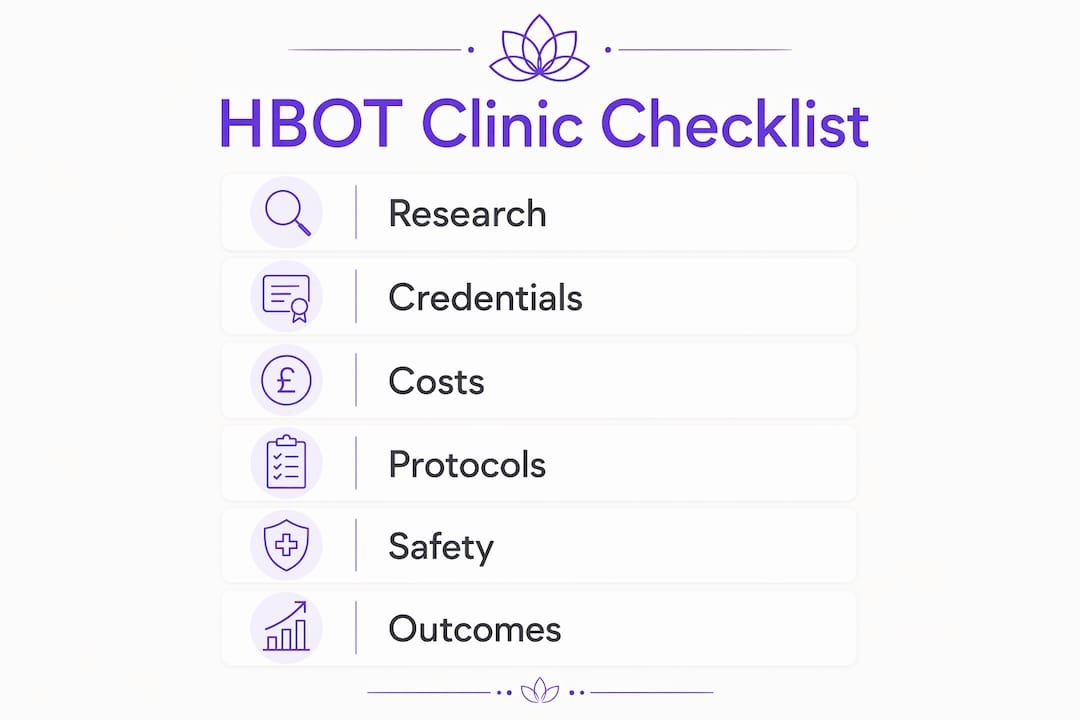
Before you book a single session of hyperbaric oxygen therapy, get clear answers to these questions: Who is the named medical director and what are their hyperbaric medicine credentials? Is the facility UHMS-accredited or can it show documented safety protocols? What chamber type and maximum pressure in ATA do you use, and is the oxygen source 100% medical-grade? Can you provide a written, itemised estimate, and explain the typical course length recommended for your condition? Is a physician present or reliably on-call during every session, and what are your emergency procedures? What contraindications apply to my circumstances, and how do you measure outcomes? Can I try a single session before committing to a full package? Do you accept insurance or provide paperwork for reimbursement?
- Who is the named medical director and what are their hyperbaric credentials?
- Is the facility UHMS-accredited or does it follow documented, inspected safety protocols?
- What chamber type, maximum ATA, and oxygen source do you use?
- How many sessions does the protocol require, and what is the total written cost?
- Is a physician present or on-call during every session?
- What are the emergency procedures and evacuation protocols?
- What contraindications apply to my health history?
- How do you measure progress before, during, and after treatment?
- Can I book a single trial session before committing?
- Do you accept insurance or provide itemised receipts for reimbursement?
Table of Contents
- What to ask an HBOT clinic: your full consultation checklist
- How do you know if a clinic’s answers are trustworthy?
- What to bring and expect on the day
- Which contraindications and side effects should you ask about?
- What reputable clinics document and what Live5dhealth recommends you request
- Key takeaways
- Asking clinical questions without feeling out of your depth
- Authoritative resources to verify and share with your clinic
What to ask an HBOT clinic: your full consultation checklist
Bringing a structured list of hyperbaric therapy questions to a consultation transforms a potentially overwhelming conversation into a confident, informed one. Here is how to organise your enquiries by theme.
Credentials and medical oversight
- Ask for the medical director’s full name, qualifications, and whether they hold formal sub-certification in undersea and hyperbaric medicine.
- Confirm whether the director is full-time on-site or consultative only. A named, verifiable medical director with hyperbaric training is the single most important trust signal; evasiveness here is a serious red flag.
- Ask about technician certification: look for CHT (Certified Hyperbaric Technologist) or CHRN (Certified Hyperbaric Registered Nurse) credentials.
Accreditation and governance
- Verify UHMS accreditation or request written protocols, inspection logs, and the date of the last site visit.
- In the UK, ask how the clinic’s safety programme aligns with Care Quality Commission expectations and whether it is registered with the CQC.
Chamber and protocol specifics
- Request the chamber type: hard-shell monoplace, hard-shell multiplace, or soft-shell. Medical-grade HBOT typically operates between 2.0 and 3.0 ATA with 100% medical oxygen; wellness “mild” chambers often use lower pressures and concentrated air, which affects expected results.
- Ask for the ATA figure in numbers, not just marketing descriptors like “mild.” Ask about session length, frequency, and how air breaks are managed.
- Understand the HBOT sessions per week recommended for your condition and whether the protocol follows published clinical guidelines.
Safety and emergencies
- Ask who is physically present during sessions and what their emergency training covers.
- A physician on-site or reliably on-call, clear emergency protocols, and staff trained in hyperbaric emergency response are non-optional safety features.
- Request details on evacuation procedures, how adverse events are reported, and whether the clinic has a transfer agreement with a nearby hospital.
Costs and financing
- Request a written, itemised estimate that covers the initial assessment, any mandatory pre-treatment tests, per-session price, package discounts, and the cancellation and refund policy.
- Ask whether HSA, FSA, or UK health cash plan equivalents can be applied, and whether the clinic handles insurance prior authorisation on your behalf.
Outcomes and measurement
- Ask how the clinic measures progress: pre- and post-treatment assessments, imaging, functional tests, or validated outcome tools. Authoritative checklists recommend asking at what point the clinic will evaluate whether treatment is working.
- Ask how many patients with your specific condition they have treated and whether they share anonymised outcome summaries.
Trial options and logistics
- Ask whether a single trial session is available before you commit to a full package. Reputable clinics tend to welcome this question — it signals confidence in their service.
- Ask what to bring, how to prepare, what consent and screening forms look like, and what aftercare is recommended after the first session.
Pro Tip: Print this checklist and bring it to the consultation. Ask for written answers to the cost and protocol questions so you can compare offers reliably when you get home.
How do you know if a clinic’s answers are trustworthy?
Knowing what to ask is only half the task. Judging the quality of the answers is where most wellness clients feel uncertain.
Trust signals to listen for
- A named, verifiable medical director with documented hyperbaric training and a clear on-site role.
- UHMS accreditation or, for private wellness centres, a detailed written safety programme with inspection records.
- Published protocol details: specific pressure in ATA, oxygen purity percentage, session duration, and frequency.
- Technicians holding CHT or CHRN certification and routine equipment maintenance logs.
- A written, itemised estimate that accounts for every fee, including mandatory screenings.
- Pre- and post-objective assessments using validated tools, and a willingness to share de-identified patient outcomes.
Red flags that warrant a second look
- Vague answers about pressure, such as describing chambers only as “mild” without stating an ATA figure.
- Refusal or inability to name the medical director or share their credentials.
- No written estimate, or a clinic that applies the same protocol to every condition regardless of indication.
- Dismissiveness when you ask about contraindications or emergency procedures.
Pro Tip: Cross-check UHMS facility listings independently. In the UK, verify clinician licences via the General Medical Council register. Ask for the chamber’s CE marking details where relevant.
What to bring and expect on the day
Preparation makes your first session smoother and gives you more time to ask the questions that matter.
- Documents: referral letters, current medication list, previous imaging or test results, photo ID, and any insurance authorisation paperwork.
- What the clinic will do: medical history review, informed consent, baseline assessments (vital signs, oxygen saturation, possibly spirometry or chest imaging), and a technician safety brief.
- What to wear: loose, cotton clothing with no oils, perfumes, or cosmetics. Synthetic fabrics are not permitted in the chamber.
- Session flow: arrival and check-in, pre-treatment briefing, monitored time in the chamber, post-session debrief, and immediate aftercare instructions.
- If something feels wrong: ask on arrival who to speak to during a session, how quickly a physician can respond, and where the written emergency procedures are posted.
For a fuller picture of what to expect from HBOT treatment, including session-by-session guidance, Live5dhealth has a dedicated guide worth reading before your appointment.

Which contraindications and side effects should you ask about?
Every reputable clinic will screen you for contraindications before your first session. Knowing what to expect from that screening helps you prepare honest, complete answers.
- Absolute contraindications: untreated pneumothorax is the clearest example. Ask the clinic to walk you through their full screening list and confirm they check for it before treatment begins.
- Relative contraindications and precautions: certain respiratory conditions, recent ear or sinus surgery, some chemotherapy agents, and pregnancy all require careful assessment. Ask how the clinic obtains medical clearances for these situations.
- Common side effects: barotrauma affecting the ears or sinuses is the most frequently reported. Temporary visual shifts can occur with extended protocols. Ask how often complications arise in their practice and what mitigation steps they use for oxygen toxicity risk.
- Screening tests: ask which tests are required before your first session (chest X-ray, spirometry, ECG) and whether those costs are included in the written estimate.
- Managing complications: ask about on-site oxygen protocols, staff training for emergency decompression, and whether the clinic has a formal transfer agreement with a nearby emergency department.
A detailed overview of hyperbaric therapy contraindications is available from Live5dhealth if you want to arrive at the consultation already familiar with the key screening criteria.
What reputable clinics document and what Live5dhealth recommends you request
A credible clinic will not hesitate to share the following in writing. Use this as your documentation checklist.
- UHMS accreditation certificate or equivalent safety programme documentation with inspection records.
- The medical director’s name, qualifications, and CV.
- Chamber specifications: maximum ATA, oxygen delivery method, and equipment maintenance log.
- Session protocol details: pressure, duration, frequency, expected number of sessions for your indication, and the evidence base or study references supporting that protocol.
- An itemised written estimate covering assessments, per-session costs, package pricing, mandatory tests, and cancellation terms.
- Pre- and post-objective outcome measures, anonymised outcome summaries, and the clinic’s criteria for stopping or modifying treatment.
A clinic that cannot produce a written protocol, a named medical director, and an itemised estimate is not yet ready to treat you safely. These are not unreasonable requests — they are the baseline of responsible care.
Live5dhealth’s education pages on HBOT health benefits and the role of HBOT in mental health can help you frame your questions and understand what realistic outcomes look like before you walk through the clinic door.
Ready to explore HBOT as part of a wider wellness programme? Live5dhealth’s luxury spa and wellness centre in Boyle, County Roscommon, pairs advanced therapies with a genuinely restorative environment. You can also explore Live5dhealth’s retreat programmes in Ireland if you are looking for a multimodal approach to recovery and renewal.
This article is general information, not medical advice. Confirm current clinical guidelines and your personal suitability for HBOT with a qualified healthcare professional before beginning treatment.
Key takeaways
Choosing an HBOT clinic safely requires verifying credentials, chamber specifications, written costs, and outcome measures before you commit to any package.
| Point | Details |
|---|---|
| Medical director is the first question | Ask for a named director with verifiable hyperbaric credentials; evasiveness is a red flag. |
| Chamber specs must be numeric | Confirm maximum ATA and oxygen source in numbers, not marketing language. |
| Get everything in writing | Request an itemised estimate covering all tests, per-session costs, and cancellation terms. |
| Outcome measures matter | Ask how and when the clinic will assess whether treatment is working for your condition. |
| Trial session is a fair ask | A single trial session before a full package reveals the clinic’s confidence and transparency. |
Asking clinical questions without feeling out of your depth
There is a version of this process that feels intimidating — walking into a clinical setting and firing off questions about ATA pressures and CHT certifications. But it does not have to feel that way, and it should not.
The most effective approach is simply to bring a printed list and frame your questions as genuine curiosity rather than a test. Most good practitioners welcome an engaged, prepared client. If a clinic makes you feel awkward for asking about the medical director’s credentials or requesting a written estimate, that reaction itself tells you something important.
What strikes me most, having looked closely at how wellness clients approach HBOT consultations, is how often the experience question gets asked and the safety question does not. People ask “Will I feel relaxed?” before they ask “What is your emergency protocol?” Both matter. A well-run wellness centre integrates both naturally into the conversation — it does not treat clinical rigour and patient comfort as opposites.
Bring your list. Ask for written answers. If the clinic is good, they will hand them to you without hesitation.
Authoritative resources to verify and share with your clinic
- UHMS facility directory: verify accreditation claims independently at the Undersea and Hyperbaric Medical Society’s official directory before your consultation.
- PMC peer-reviewed literature: published research on HBOT pressure and oxygen delivery gives you the clinical parameters to compare against what a clinic tells you.
- Care Quality Commission: the CQC is the UK’s health and social care regulator. Ask any UK clinic how their safety programme aligns with CQC expectations and whether they are registered.
- General Medical Council register: verify the medical director’s licence at the GMC’s online register before booking.
- Live5dhealth education pages: the Live5dhealth guides on what pressurised oxygen does to your body and how to maximise HBOT results are practical starting points for framing your consultation questions.
Pro Tip: Screenshot or print the UHMS facility listing for any clinic you are considering and bring it with you. If their accreditation status differs from what they told you, you have your answer before the session starts.