
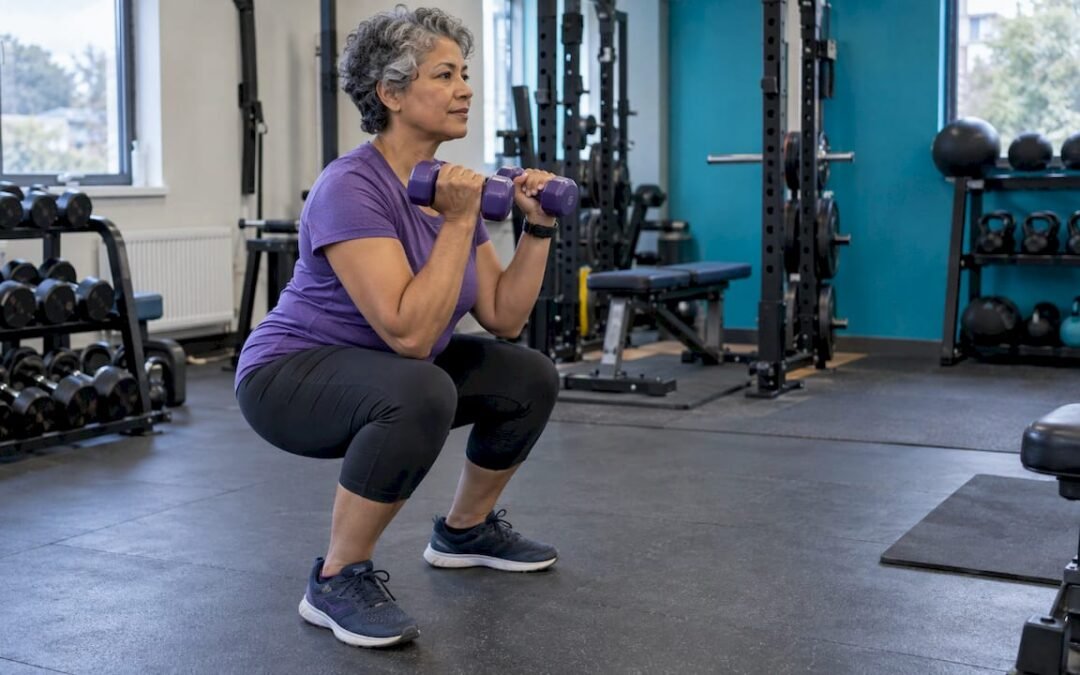
Strength training is one of the most useful things you can do for your bones, and it is safe for most people with osteoporosis when you start gently, build slowly and keep your technique tidy. Lifting weights, using resistance bands or working against your own body weight loads the muscles, tendons and bones. Mayo Clinic notes that this kind of exercise can support bone density and rebuild the back muscles that hold you upright. This guide explains how often to train, which exercises to choose, what to avoid and how to adapt if you have had a fracture.
TL;DR
- Aim for muscle-strengthening exercise two to three days a week, with at least one rest day between sessions, and increase the effort gradually.
- Work all the major muscle groups, including your back, using body weight, resistance bands or free weights.
- Technique comes before load: keep your upper back straight, your core engaged and avoid twisting, forward bending and sit-ups if you are at risk of spinal fracture.
- Have a healthcare professional assess you first, especially after a fracture, with severe bone loss or if cancer treatment has affected your bones.
- Pair strength work with daily weight-bearing activity such as brisk walking, and add balance work to lower your risk of falls.
Table of Contents
- What strength training does for your bones
- How often and how hard to train
- Which exercises to choose
- Are deadlifts and heavy lifting safe?
- Movements to avoid or modify
- Strength training after a fracture or with cancer-related bone risk
- Add weight-bearing activity and balance work
- Recovering well between sessions
- Recover and train with us in Boyle
- Our perspective
- FAQ
- Sources
What strength training does for your bones
Bone is living tissue. It responds to the forces placed on it, and muscles pulling on bone during lifting are one of the strongest signals you can send. That is why guidance from osteoporosis charities treats exercise as part of looking after your bones, alongside nutrition and, where prescribed, medication.
The UK consensus statement on exercise and osteoporosis, Strong, steady and straight, recommends resistance and impact exercise to maximise bone strength, alongside activities to improve balance and posture. It also notes that supervised, progressive resistance training aimed at the spine and hips is likely to have the greatest effect on bone mineral density.
There is a second, quieter benefit. Stronger muscles improve balance and control, which helps you avoid the falls that cause most fractures. The same consensus statement points out that worry about whether exercise is safe can lead people with osteoporosis to do less, which limits function and enjoyment. Done sensibly, training is something you do for confidence as much as for bone.
Women are at the highest risk of osteoporosis, and it is more common after the menopause, according to the Irish Osteoporosis Society. If you are in your forties or fifties, starting a routine now gives you years of benefit.
How often and how hard to train
The Royal Osteoporosis Society recommends strength training two to three days a week with at least one day of rest in between. Start at a level that feels comfortable for your fitness, then raise the intensity step by step. This is called progressive overload: slightly more weight, a little more resistance or an extra set once the current level feels manageable.
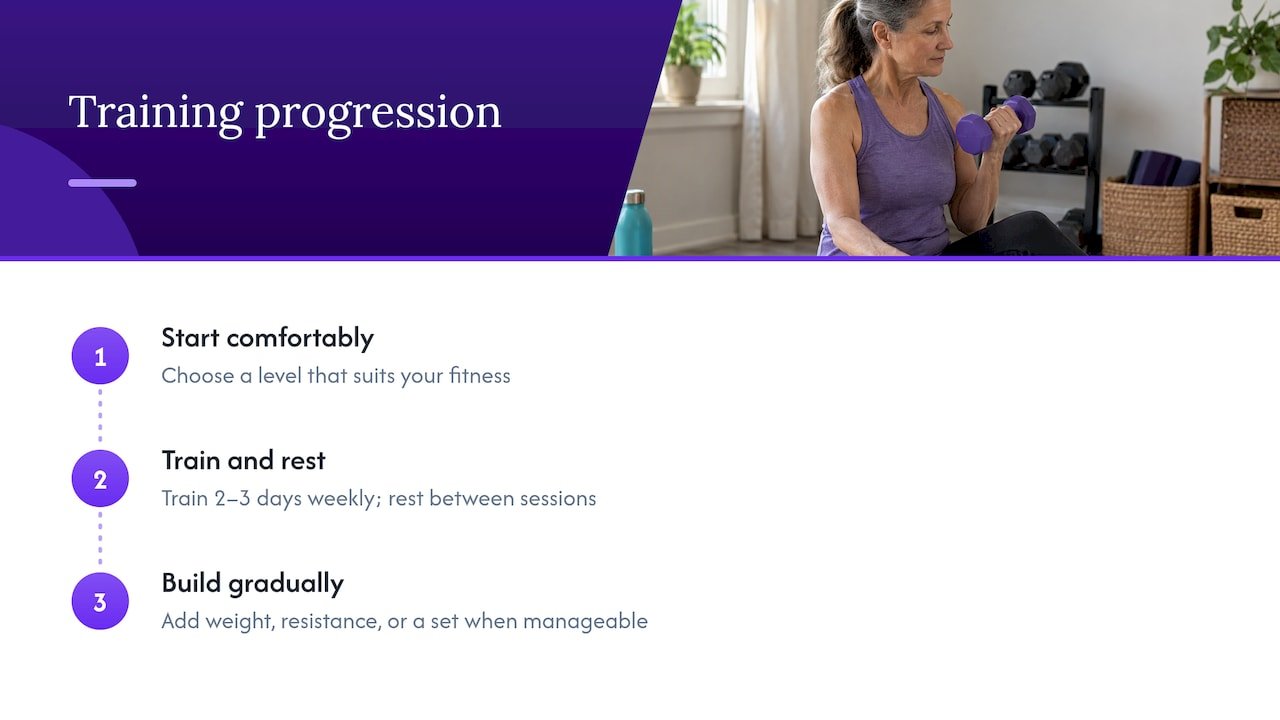
The Irish Osteoporosis Society exercise fact sheet gives the same message: begin at a pace that suits you and build bone strength slowly. There is no prize for rushing.
A simple weekly rhythm
| Day | What to do |
|---|---|
| Monday | Full-body strength session (30 to 45 minutes) |
| Tuesday | Brisk walk and balance practice |
| Wednesday | Rest or gentle stretching |
| Thursday | Full-body strength session |
| Friday | Brisk walk and balance practice |
| Saturday | Optional third strength session or an active outing |
| Sunday | Rest |
This is a template, not a prescription. Your physiotherapist can adjust it to your results, fitness and fracture history.
What the effort should feel like
Some muscle soreness after a session is normal. The International Osteoporosis Foundation advises listening to your body: sharp pain is not normal, and it is a signal to stop and get advice. If you feel sharp back pain during or after exercise, stop that movement and speak to your GP or physiotherapist.
Which exercises to choose
For effective bone health, the Royal Osteoporosis Society says muscle-strengthening exercises should target all major muscle groups, including the back, using body weight, resistance bands or free weights. In practice that means building a session from a handful of movement patterns.
- Legs and hips: sit-to-stand from a chair, supported squats to a bench, step-ups onto a low step, glute bridges.
- Back: rows with a resistance band or light dumbbells, keeping your chest tall.
- Chest and shoulders: wall or incline press-ups, shoulder presses with light weights.
- Core and posture: standing, upright core bracing, wall angels, back extensions held with a straight spine.
- Balance: single-leg stands beside a worktop, heel-to-toe walking.
Start with eight to twelve repetitions of each, once the movement feels smooth. Two sets is a good place to build towards. When the last few repetitions feel easy, add a little resistance.
If you are in the menopause transition and want a structured progression, our 8 to 12 week strength plan for menopause lays out a gradual build. If you are newer to training and want everyday movement patterns, our guide to functional fitness for women covers them in plain terms.
Are deadlifts and heavy lifting safe?
This is one of the most common questions, and the honest answer is that it depends on your bones, your fracture history and your technique. There is no single rule that suits everyone, and the checked guidance is consistent on the principles.
The Royal Osteoporosis Society puts technique ahead of weight and asks you to ‘think straight’: keep your upper back straight and your core muscles engaged while you lift. The Irish Osteoporosis Society advises people with bone loss to avoid using excessive weights, and the UK consensus statement says resistance exercise is ideally supervised, particularly for people who have had vertebral or multiple low-trauma fractures.
So a hip-hinge pattern, such as a light deadlift from a raised position, can be a reasonable part of a programme, but only once a physiotherapist or qualified exercise professional has checked that it suits you and has watched your form. Begin with a very light load, or with bodyweight hip hinges, and progress only while your back stays straight.
Movements to avoid or modify
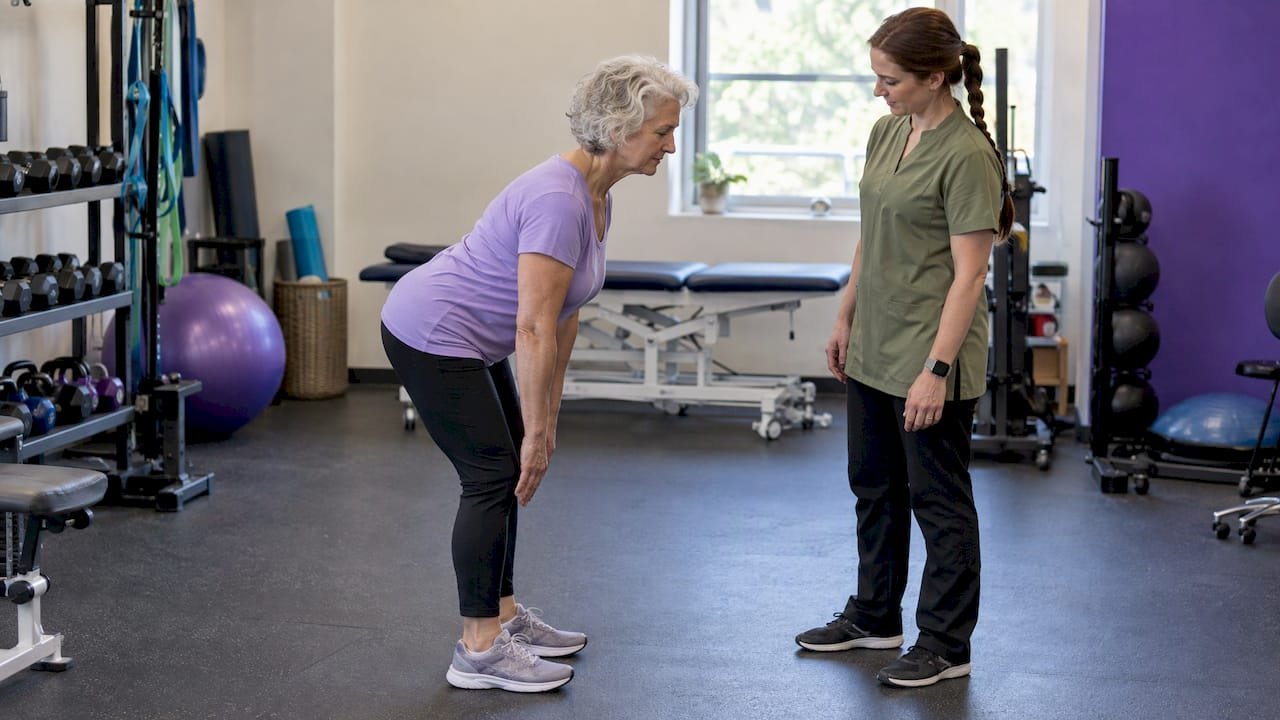
Some everyday and gym movements put the spine under bending or twisting stress. The Irish Osteoporosis Society advises people with bone loss against:
- lifting young children
- twisting the back with the feet planted on the ground
- wearing backpacks
- using trampolines or vibration machines
- touching the toes
- using excessive weights
The International Osteoporosis Foundation adds that sit-ups, twisting movements, abrupt or explosive movements and high-impact loading may not suit people who have, or are at higher risk of, spinal fractures.
That does not mean you have to stop moving. It means swapping the risky version for a safer one. Replace sit-ups with a standing core brace. Replace a seated or standing trunk twist with a controlled walk. Replace toe touches with a hip hinge and a straight back.
Strength training after a fracture or with cancer-related bone risk
If you have had a fracture, your plan should be personal. The Irish Osteoporosis Society advises that people with bone loss should be individually assessed by a healthcare professional to find out which exercises and stretches are safe for them.
After a spinal fracture, the Royal Osteoporosis Society says to keep moving while you recover. Once the bone has healed, do strength and low-impact exercise if you are able to, and talk through your plan with your doctor or physiotherapist. The UK consensus statement recommends lower-impact exercise for people with spinal fractures and individualised physiotherapy advice for those with vertebral or multiple low-trauma fractures.
Cancer and its treatments deserve particular attention. The Irish Osteoporosis Society explains that chemotherapy and radiation cause significant bone loss, that long-term steroid use can affect bone health, and that all cancer patients should be treated preventatively. It also notes that some medicines used in breast cancer treatment affect bone. If this applies to you, ask your oncology team or GP about a bone health review before you begin lifting, and ask for a referral to a physiotherapist who knows your history.
Add weight-bearing activity and balance work
Strength training works best as one part of a wider routine. Guidance from the National Osteoporosis Guideline Group recommends combining regular weight-bearing and muscle-strengthening exercise, with balance-focused or combined programmes for people at risk of falls.
In Ireland, the Irish Osteoporosis Society recommends 30 minutes of appropriate weight-bearing exercise a day for adults, to help muscle strength and balance and reduce the risk of falling and breaking bones. Brisk walking, dancing and stair climbing all count.
What about high-impact exercise? The Royal Osteoporosis Society says it is not specifically recommended for osteoporosis. Moderate-impact activity has been shown to benefit bone, and there is not enough evidence that high-impact work adds more. You get the benefit without the jarring.
Which sport has the highest bone density?
People often ask this because athletes in sports with heavy loading and impact, such as gymnastics and weightlifting, tend to be cited for strong bones. The useful lesson for you is the principle, not the sport: bone responds to load. You do not need to copy an elite athlete. Progressive strength work, daily walking and balance practice are the sensible, adaptable route for someone with low bone density, and a physiotherapist can set the right level for you.
Recovering well between sessions
Rest days are where your body adapts, so treat them as part of the programme. Protein, sleep and gentle movement all support recovery. If you are building your diet around muscle, our guide to the best protein powders for women over 40 explains what to look for. Our recovery workouts plan for over 40s shows how to structure the days in between.
Recover and train with us in Boyle
At Live5DHealth in Boyle, County Roscommon, we have a gym, a luxury sauna, a steam room and a cold plunge spa under one roof. Many members use the sauna and steam room after a training session to wind down. A session in our sauna, steam and cold plunge spa costs €30. If you have bone concerns, speak to your doctor before using heat or cold, and let our team know about any fracture history so we can talk through what suits you.

We also offer red light therapy from €20 to €40 a session and hyperbaric oxygen therapy at €80 to €120 a session. You can see everything we offer, including our retreats, on our wellness centre homepage.
Our perspective
We meet many women over 40 who tell us they stopped lifting because they were frightened of hurting their bones. We understand that fear, and we think the better answer is to move with confidence and the right guidance.
Our approach at Live5DHealth is holistic. Strength work is the foundation, because it builds the muscle and bone loading you need. Around it, we want you to have the things that make a routine easy to keep: good recovery time, clean energised water throughout our facility, a gym, and a calm space in which to rest.
If you are new to this, start small, get your plan checked by your GP or physiotherapist, and give yourself weeks to build. Your best self is built session by session.
Mark
FAQ
Can you build bone density with strength training if you already have osteoporosis?
Strength training can support bone density. The UK consensus statement says supervised, progressive resistance training aimed at the spine and hips is likely to have the greatest effect on bone mineral density. Results vary from person to person, so ask your doctor how it fits with any medication you take.
Is lifting weights safe with osteoporosis?
For most people it can be, when you start at a comfortable level, increase gradually and keep your upper back straight and core engaged. Avoid excessive weights, twisting and forward bending. If you have had a fracture, have an individual assessment first.
How many times a week should I do resistance training?
Two to three days a week, with at least one rest day between sessions, is the recommendation from the Royal Osteoporosis Society. Add daily weight-bearing activity, such as brisk walking, and balance work on the other days.
What should I do if an exercise hurts?
Some muscle soreness afterwards is normal, but sharp pain is not. Stop the movement and speak to your GP or physiotherapist, especially if the pain is in your back.
Sources
- Exercising with osteoporosis: Stay active the safe way, Mayo Clinic
- Strong, steady and straight: UK consensus statement on physical activity and exercise for osteoporosis
- Strength exercise to help make your bones stronger, Royal Osteoporosis Society
- How to exercise safely for bones, Royal Osteoporosis Society
- Exercise fact sheet, Irish Osteoporosis Society
- About Osteoporosis, Irish Osteoporosis Society
- Exercise for bone health and osteoporosis, International Osteoporosis Foundation
- Non-pharmacological management of osteoporosis, National Osteoporosis Guideline Group