
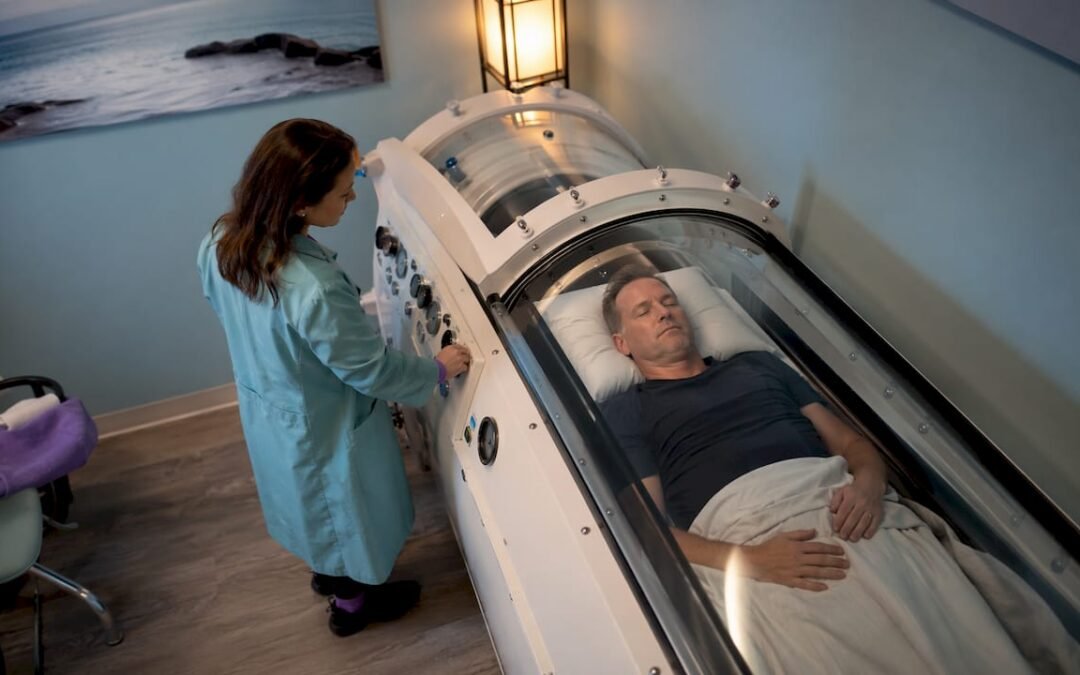
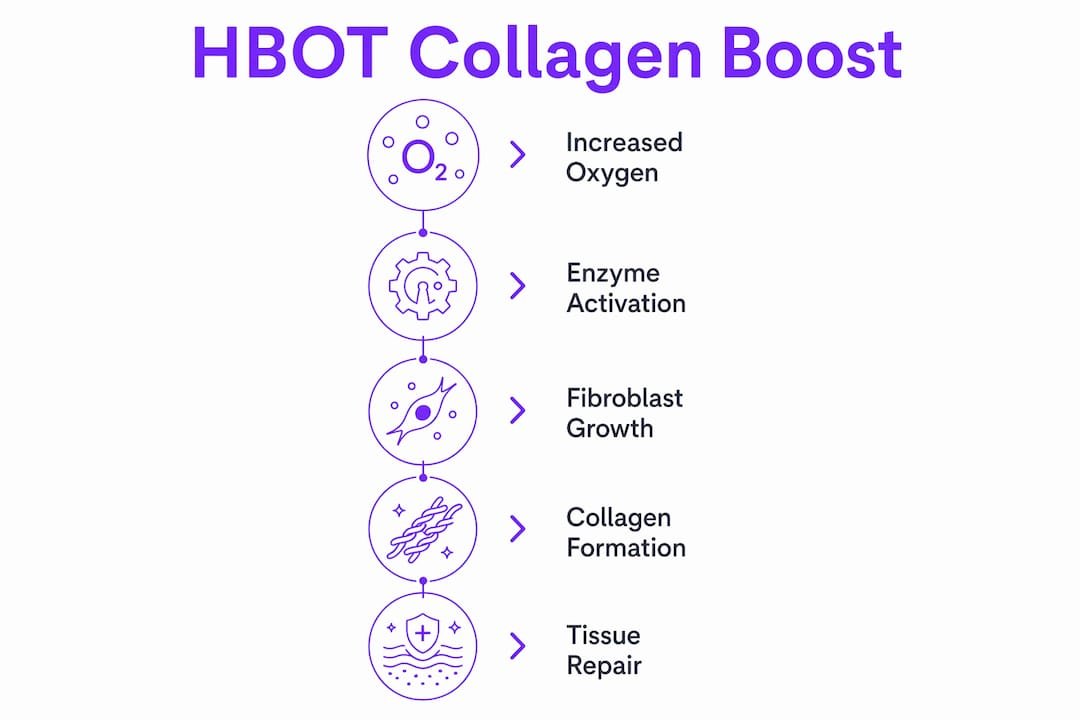
Repeated hyperbaric oxygen therapy (HBOT) raises dissolved oxygen in tissue, activates fibroblasts, and triggers growth-factor cascades involving VEGF and TGF-β, producing measurable increases in collagen density and elastic fibre length in human trials. A 60-session prospective clinical trial found a collagen fibre density increase with an effect size of 1.10 (p<0.001), while Růžička et al. (2021) demonstrated a collagen type III increase of approximately 120% in a wound model. What this means practically:
- Wound repair: accelerated early-phase collagen III deposition shortens repair timelines in chronic and surgical wounds.
- Skin rejuvenation: dermal structural changes, including increased collagen density and elastic fibre length, are detectable on biopsy after intensive protocols.
- Anti-ageing: realistic gains require repeated sessions; a single session produces transient microcirculatory improvements, not structural remodelling.
Table of Contents
- How HBOT boosts collagen synthesis: the biological mechanism
- What the clinical studies actually show
- What protocols are used and when do you see results?
- Safety, side effects and contraindications
- How HBOT works alongside other treatments
- Accessing HBOT in the UK: NHS versus private and what to look for
- Understanding the effect sizes: what the numbers mean for you
- Key takeaways
- A perspective worth sharing
- Live5dhealth: HBOT for collagen health and skin renewal
- Useful sources
How HBOT boosts collagen synthesis: the biological mechanism
The chain starts with physics. Inside a hyperbaric chamber at 2.0–2.5 atmospheres absolute (ATA) breathing 100% oxygen, dissolved oxygen in plasma rises dramatically, reaching tissues that diffusion alone cannot supply at normal atmospheric pressure. That oxygen gradient is the trigger for everything downstream.
Collagen synthesis is chemically oxygen-dependent in a precise way. The enzymes prolyl hydroxylase and lysyl hydroxylase, which hydroxylate proline and lysine residues in procollagen chains, require molecular oxygen and ferrous iron (Fe²⁺) as co-factors. Without adequate oxygen, hydroxylation is incomplete, cross-linking fails, and the resulting collagen fibrils lack the tensile stability that makes them useful in tissue. HBOT supplies the substrate these enzymes need to run at full capacity.
At the cellular level, fibroblasts respond to the elevated oxygen environment by proliferating and upregulating collagen gene expression. Simultaneously, VEGF-mediated angiogenesis creates new capillary networks that sustain oxygen and nutrient delivery long after a session ends, supporting continued collagen deposition across a treatment course. TGF-β, another key growth factor released during HBOT, directly stimulates fibroblast activity and extracellular matrix production.

There is also a subtler mechanism at work: the hyperoxic-hypoxic paradox. Intermittent exposure to high oxygen followed by return to normal pressure creates a hormetic signal that stabilises HIF-1α and mobilises stem cells. This paradox is why HBOT’s regenerative effects are not simply proportional to oxygen dose; the cycling between hyperoxia and normoxia appears to activate repair pathways that continuous oxygen delivery does not. A 2024 Frontiers review confirmed that intermittent hyperoxia can alter the expression of a large fraction of protein-coding genes, including those governing angiogenesis and extracellular matrix remodelling.
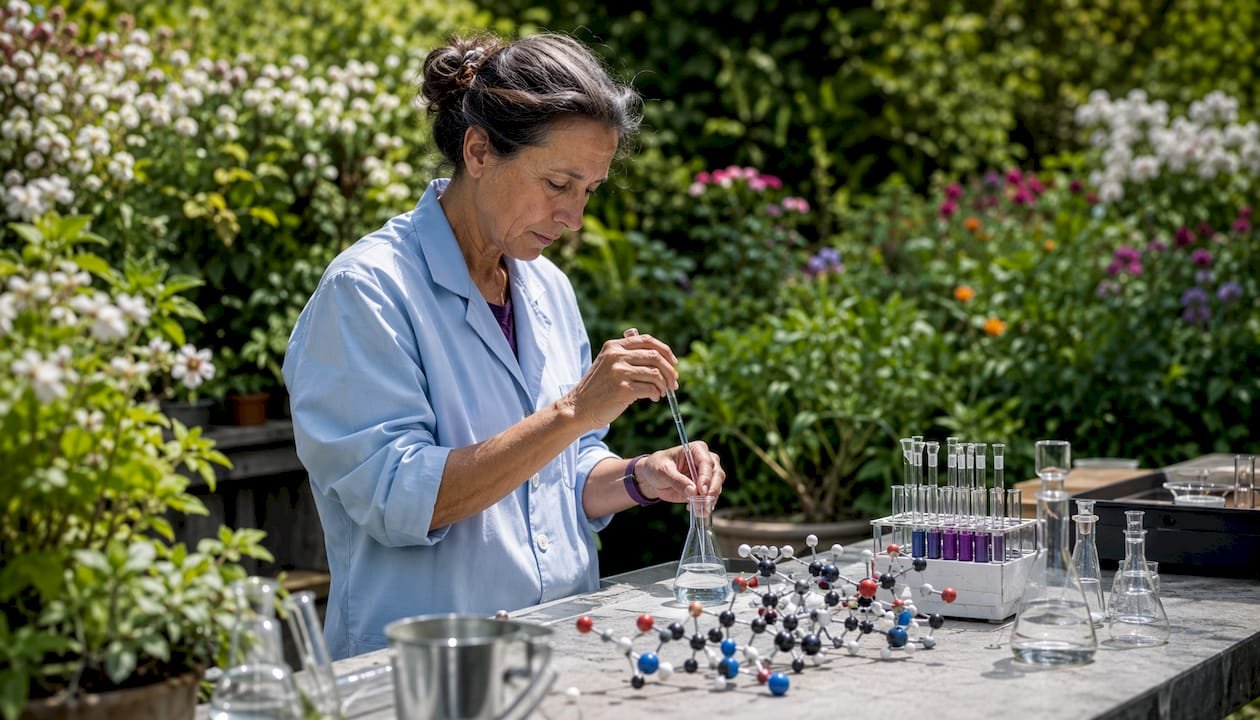
Pro Tip: A single HBOT session improves local circulation and gives skin a temporary brightness, but structural collagen changes accumulate over repeated exposures. Protocols of 20 sessions or more are typically needed before biopsy-detectable changes appear.
For a deeper look at how pure oxygen promotes healing at the cellular level, the Live5dhealth science guide covers the angiogenesis and oxygen-diffusion mechanisms in detail.
What the clinical studies actually show
The evidence base spans animal wound models, prospective human trials, and evidence-based reviews in aesthetic medicine. Here is a summary of the key findings:
| Study | Model / Population | Protocol | Main Collagen Outcome | Key Statistics |
|---|---|---|---|---|
| Růžička et al. 2021 | ZDF rat wound model | Multiple HBOT sessions | Collagen III volume fraction increased ~120% vs controls | — |
| Prospective clinical trial (2021) | Healthy ageing adults | a prolonged course of daily sessions | Collagen fibre density increased; papillary dermis thickness decreased by 27.6% | Effect size 1.10; p<0.001 (density); −27.6% (dermis) |
| Evidence-based review (May 2024) | 17 human studies | Various aesthetic protocols | Elastic fibre length increased; collagen density increased | Elastic fibre effect size 2.71 (p≤0.0001); collagen density effect size 1.10 (p<0.001) |
The animal data from Růžička et al. is particularly instructive about timing. Collagen III peaks early in wound repair, around day five after injury, and is later replaced by type I collagen during remodelling. HBOT appears to accelerate this early-phase deposition, which matters for wound closure speed. Collagen I trends in the same direction but did not reach statistical significance in that model, suggesting HBOT’s strongest early effect is on the provisional matrix rather than final scar architecture.
The prospective human trial also found that senescent cell burden in tissue fell with an effect size of 0.84. Clearing them creates better conditions for ongoing collagen production, making HBOT more than a temporary skin treatment.
The evidence-based review in aesthetic practice also reported that prophylactic preoperative HBOT reduced surgical complications significantly in one observational study (p<0.001), suggesting a practical surgical application beyond purely cosmetic goals.
Limitations worth knowing:
- Most aesthetic studies have small cohorts and heterogeneous protocols, making direct comparison difficult.
- High risk of bias is acknowledged across the 17 human studies reviewed in the 2024 aesthetic review.
- Subjective cosmetic endpoints and long-term durability of collagen changes are less well established than histological metrics.
- Controlled randomised data for many aesthetic indications remain limited.
What protocols are used and when do you see results?
Clinical HBOT for collagen-related goals typically operates at 2.0–2.5 ATA, with sessions lasting 60–90 minutes. The frequency and total session count vary by indication.
For wound healing, daily sessions over two to four weeks are standard, with measurable improvements in tissue oxygenation and early collagen deposition appearing within days to weeks. Chronic wounds, diabetic ulcers, and post-surgical sites respond to this kind of intensive course, and the wound healing guide at Live5dhealth covers the clinical rationale in detail.
For dermal structural changes, the evidence points firmly towards intensive protocols. The 60-session daily protocol used in the major prospective trial produced effect sizes that sporadic sessions simply do not replicate. Biopsy-detectable collagen density increases typically require weeks to months of consistent treatment. The subjective “glow” that many people notice after a handful of sessions reflects transient microcirculatory improvement, not structural remodelling. Expect to wait 8–12 weeks of regular sessions before meaningful dermal changes are measurable.
Pro Tip: When consulting a provider, ask specifically whether the proposed protocol matches the session counts used in published trials. A five-session package may improve circulation temporarily, but it is unlikely to produce the collagen density changes documented in the 60-session prospective trial.
Questions worth raising with any provider:
- What pressure and session duration do you use, and why?
- How do you screen patients before starting a course?
- Do you combine HBOT with other therapies such as red light, and if so, what is the timing rationale?
- Can you share outcome data or photographic evidence from previous patients?
Safety, side effects and contraindications
HBOT has a well-characterised safety profile when delivered by trained staff in properly equipped facilities. The most common adverse effects are:
- Ear and sinus barotrauma: pressure equalisation discomfort during descent; usually mild and manageable with slow pressurisation.
- Transient myopia: temporary short-sightedness that typically resolves within weeks of completing a course.
- Claustrophobia: relevant in monoplace chambers; most clinics can accommodate this with preparation.
- Pulmonary oxygen toxicity: rare at standard clinical pressures but a risk with very high-pressure or extended protocols.
Absolute contraindications include untreated pneumothorax and concurrent use of certain chemotherapy agents (notably bleomycin and doxorubicin) that increase oxygen toxicity risk. Uncontrolled seizure disorders are also a contraindication. Relative contraindications include severe chronic obstructive pulmonary disease, active ear infections, and recent thoracic surgery.
Pre-treatment safety checklist for UK clinics:
- Medical history review covering pulmonary, ENT, and cardiovascular status.
- Screening for contraindicated medications.
- Trained medical supervision present during sessions.
- Emergency protocols for oxygen toxicity and barotrauma in place.
- Clear informed consent covering risks, expected outcomes, and session count.
Pro Tip: Seek immediate medical attention if you experience ear pain with discharge, severe breathlessness during or after a session, or any focal neurological changes such as visual disturbance or limb weakness. These are rare but require prompt assessment.
Safety practice in specialist centres includes pre-treatment screening for pulmonary and ENT risk, in-session monitoring by trained medical staff, and emergency protocols for oxygen toxicity or barotrauma. These measures materially reduce adverse events when followed consistently.
How HBOT works alongside other treatments
HBOT pairs well with surgical and aesthetic procedures when the timing is right. Preoperative HBOT, typically a short course in the weeks before surgery, pre-loads tissue with oxygen and reduces the inflammatory burden, which supports graft take and lowers postoperative complication rates. The observational data on prophylactic use before abdominoplasty is one of the more compelling surgical applications in the aesthetic literature.
Postoperatively, HBOT accelerates healing by sustaining angiogenesis and supporting the collagen deposition phase. The key timing principle is that HBOT’s effect on HBOT and inflammation reduction is most valuable in the early repair window, while structural collagen changes accumulate over a longer course. Combining HBOT with energy-based devices such as laser or radiofrequency is generally timed so that the acute inflammatory phase from the device has settled before HBOT sessions resume, typically 48–72 hours post-procedure.
Red light therapy is a natural complement to HBOT. Both modalities support mitochondrial function and tissue repair, and combining them may produce additive effects on fibroblast activity. The benefits of red light anti-ageing therapy are well documented in their own right, and clinics offering both can sequence them on the same day without conflict.
Pro Tip: Avoid concurrent use of HBOT with agents that increase oxygen toxicity risk, including bleomycin and disulfiram. Always disclose your full medication list to the supervising clinician before starting a course.
A note on topical oxygen and normobaric oxygen therapies: these deliver oxygen to the skin surface but do not raise dissolved plasma oxygen to the levels HBOT achieves at 2.0–2.5 ATA. The biological signalling differences are significant. HBOT produces systemic hyperoxia, activates HIF pathways through the hyperoxic-hypoxic paradox, and drives angiogenesis at depth. Topical oxygen improves surface hydration and may support wound healing locally, but it does not replicate the fibroblast activation and growth-factor cascades that make HBOT effective for dermal collagen remodelling.
Accessing HBOT in the UK: NHS versus private and what to look for
NHS provision of HBOT in the UK is limited to specific clinical indications, primarily decompression illness, carbon monoxide poisoning, clostridial infections, and certain non-healing wounds. Aesthetic and anti-ageing applications fall outside NHS commissioning, so anyone seeking HBOT for skin rejuvenation or collagen-related goals will need a private clinic.
When choosing a provider, look for:
- Equipment type: monoplace or multiplace chambers; both can deliver therapeutic pressures, but multiplace chambers allow staff to be present with the patient.
- Medical supervision: a qualified clinician should be responsible for pre-treatment assessment and in-session oversight, not just a wellness practitioner.
- Credential checks: ask whether the facility follows British Hyperbaric Association (BHA) guidelines or equivalent standards.
- Infection control: chambers require rigorous cleaning protocols between patients.
- Pre-treatment assessment: a thorough medical history review is non-negotiable before starting any course.
- Aftercare and outcome tracking: reputable clinics offer follow-up assessments and can share outcome data.
Cost expectations vary. Private HBOT courses for aesthetic purposes are not publicly listed at a standard rate, and pricing depends on session count, chamber type, and clinic location. Ask for a full cost breakdown before committing to a course, and be cautious of clinics that cannot explain their protocol rationale in clinical terms.
When wound care is the goal, a GP referral to a tissue viability nurse or vascular specialist is the appropriate starting point. NHS wound care teams can assess whether HBOT is clinically indicated and refer to specialist centres accordingly.
Understanding the effect sizes: what the numbers mean for you
An effect size of 1.10 for collagen fibre density is large by conventional standards. Cohen’s d benchmarks place 0.8 as a “large” effect, so 1.10 represents a clinically meaningful change in tissue structure, not a marginal statistical signal. The elastic fibre length effect size of 2.71 is exceptional, indicating that HBOT’s impact on elastic fibre architecture is even more pronounced than its effect on collagen density.
These figures come from a prospective trial using histological scoring of skin biopsies, which is the gold standard for measuring dermal structural change. Subjective assessments and photographic comparisons, while useful clinically, are more susceptible to placebo effects and observer bias. The biopsy data matters because it confirms that the changes HBOT produces are real at the tissue level.
The limitations are equally important to state plainly. The 60-session trial involved healthy ageing adults under a specific protocol; extrapolating those effect sizes to shorter courses, different populations, or different chamber types is not supported by the current evidence. The 2024 aesthetic review, which covered 17 human studies, noted that high risk of bias is present across much of the aesthetic literature, and long-term durability of collagen changes beyond the treatment period has not been established. This is not a reason to dismiss the therapy; it is a reason to choose a provider who understands the evidence and sets expectations accordingly.
Key takeaways
HBOT increases collagen synthesis through oxygen-dependent enzymatic pathways, fibroblast activation, and VEGF-driven angiogenesis, with a collagen density effect size of 1.10 confirmed in a 60-session prospective trial.
| Point | Details |
|---|---|
| Core mechanism | Elevated dissolved oxygen enables prolyl/lysyl hydroxylase activity, fibroblast proliferation, and VEGF-driven angiogenesis. |
| Strongest evidence | 60-session trial: collagen density effect size 1.10 (p<0.001); elastic fibre length effect size 2.71 (p≤0.0001). |
| Realistic timeline | Biopsy-detectable dermal changes require weeks to months of consistent sessions; wound repair benefits appear sooner. |
| Safety first | Screen for pulmonary, ENT, and medication contraindications before starting; use only medically supervised facilities. |
| Live5dhealth approach | Live5dhealth offers HBOT with medical screening, protocol options for wound care and aesthetic goals, and complementary therapies including red light therapy. |
A perspective worth sharing
The conversation around HBOT and skin ageing often gets pulled in two directions: breathless enthusiasm from wellness marketing on one side, and reflexive scepticism from clinicians who have not looked at the recent trial data on the other. Neither serves you well.
What the evidence actually shows is more nuanced and, frankly, more interesting than either camp admits. The effect sizes from the 60-session prospective trial are genuinely large. An effect size of 1.10 for collagen density is not a marginal finding; it is the kind of number that would make any dermatologist pay attention if it came from a pharmaceutical trial. The elastic fibre data is even more striking. The problem is not the biology; it is the protocol discipline required to get there.
Most people who try HBOT for skin reasons do a handful of sessions, notice a pleasant glow, and either conclude it works brilliantly or that it does nothing lasting. Both conclusions miss the point. The glow is real but transient. The structural collagen changes are also real but require the kind of committed, intensive protocol that most aesthetic clinics do not offer or explain clearly. That gap between what the science supports and what is actually delivered in practice is where informed patients can make better decisions.
The other underappreciated angle is the senescent cell clearance. Reducing the burden of senescent cells in ageing tissue is not a cosmetic footnote; it is a meaningful biological intervention that improves the environment for every other repair process. HBOT’s ability to do this alongside collagen remodelling is what separates it from surface-level treatments.
Live5dhealth: HBOT for collagen health and skin renewal
At Live5dhealth in Boyle, County Roscommon, HBOT is delivered as part of a medically grounded wellness programme, not a quick-fix package. Every client begins with a thorough medical screening to confirm suitability, review contraindicated medications, and agree on a protocol that matches their goal, whether that is wound recovery, dermal rejuvenation, or cellular anti-ageing support.
Protocol options range from shorter introductory courses to intensive programmes aligned with the session counts used in published trials. HBOT at Live5dhealth can be combined with red light therapy and other modalities available at the centre, creating a sequenced approach that supports fibroblast activity from multiple directions.
Realistic outcomes are discussed at consultation: structural collagen changes require consistent, repeated sessions, and the team will tell you that plainly.
If you are ready to explore what a properly structured HBOT course could do for your skin health or recovery, book a consultation at Live5dhealth’s luxury wellness centre or browse the healing retreats in Ireland that incorporate HBOT as part of a multi-day programme.
Useful sources
- Prospective clinical trial: HBOT and skin ageing pathophysiology (PubMed, 2021) — 60-session trial in healthy ageing adults; quantifies collagen density, elastic fibre, and senescent cell outcomes with effect sizes and p-values.
- Růžička et al. 2021: HBOT and collagen III in ZDF rat wounds (PMC) — animal wound model showing ~120% increase in collagen III volume fraction; clarifies early-phase collagen subtype dynamics.
- Evidence-based review: HBOT in aesthetic practice (Journal of Cosmetic Dermatology, 2024) — aggregates 17 human studies; reports effect sizes for elastic fibre and collagen density; notes risk-of-bias limitations.
- Frontiers in Aging: HBOT regenerative mechanisms and anti-ageing (2024) — reviews gene-expression changes, angiogenesis, and epigenetic modulation from intermittent hyperoxia.
- Johns Hopkins Medicine: Hyperbaric oxygen therapy overview — clinical description of VEGF-mediated angiogenesis and growth-factor mechanisms; useful for patient-facing explanation.
- PMC: HBOT for skin rejuvenation and photoageing — reviews MMP pathways, UV-induced collagen degradation, and the potential of HBOT to counteract photoageing; notes that direct mechanistic evidence remains incomplete.
- FDA: Hyperbaric oxygen therapy — get the facts — regulatory perspective on approved indications and consumer safety considerations.
This article is general information, not medical advice. Confirm current clinical guidelines and your individual suitability with a qualified healthcare professional before starting HBOT.