

Sauna use gives your skin a genuine, if modest, boost: better hydration, a temporary glow and over time a more resilient barrier, but it is not a clinical fix for acne or ageing. Both infrared and traditional saunas can deliver these effects, though heat can aggravate rosacea or eczema if you skip proper aftercare. The real variable is not the sauna itself, it is your routine around it.
TL;DR:
- For skin hydration and barrier gains, aim for 15 to 20 minutes, two to four times weekly; the strongest evidence comes from traditional saunas.
- If heat or humidity triggers breakouts or flushing, infrared’s cooler air may feel easier, but active rosacea, eczema, or recent facial procedures call for caution.
- Rinse sweat off promptly, cleanse gently, then moisturize damp skin; delay retinoids and strong exfoliating acids for a few hours to reduce irritation.
- For 30 to 60 minute sessions, use 300 to 500 mg of sodium; frequent heavy sweating also calls for attention to protein intake.
- Sweating does not replace liver and kidney detoxification; frequent heavy sessions also carry away amino acids, so maintain hydration and adequate protein intake.
Table of Contents
- What sauna heat actually does to your skin
- Infrared vs traditional sauna: which suits your skin?
- How long, how often, and how to hydrate for skin benefit
- Post-sauna skincare: the first 10 minutes matter most
- Clinic protocols and evidence: our approach
- What detoxification actually means when you sweat
- Sauna versus other skin-focused therapies we offer
- What regular sauna use means for your skin long term
- When to be cautious: skin conditions and sauna heat
- Author Mark’s perspective: realistic expectations from sauna for skin
- Book a supervised sauna session or retreat with us
- FAQ
- Sources
What sauna heat actually does to your skin
The clearest evidence comes from a controlled study of regular Finnish sauna users, which found they had higher stratum corneum hydration, a more stable epidermal barrier and a baseline forehead sebum level notably lower than newcomers, alongside faster recovery of transepidermal water loss after each session, according to research on sauna and epidermal barrier function. That is a training effect: your skin adapts to repeated heat exposure the way muscles adapt to repeated load.
The mechanism behind it is circulatory rather than chemical. Heat widens blood vessels near the skin’s surface, which increases cutaneous blood flow and improves microvascular function, and passive heat exposure triggers a transient release of nitric oxide that supports this dilation, according to a comprehensive review of passive heat therapies. More blood reaching the skin means more oxygen and nutrients delivered to the cells doing the repair work, which is part of why your face looks flushed and brighter straight after a session.
What sauna heat does not reliably do is rebuild collagen. There is little robust evidence that heat exposure alone increases human collagen production, and the same review notes that while observational benefits on hydration and barrier function are consistent, evidence for treating active skin disease remains limited and needs more research. Anti-ageing claims tied to sauna use are best treated as indirect: better circulation and hydration support skin that is already healthy, rather than reversing existing damage.
In practical terms, regular sauna use is associated with:
- Higher skin hydration, measured as improved stratum corneum water-holding capacity in long-term users.
- Faster barrier recovery after heat or environmental stress, shown by quicker transepidermal water loss normalisation.
- A transient glow, from increased blood flow rather than any lasting structural change.
A controlled human study found regular Finnish sauna users had a baseline sebum level notably lower than first-time users, alongside a more stable skin barrier, according to this research. That single figure captures the whole story: sauna use trains your skin over time, it does not transform it in one sitting.
Infrared vs traditional sauna: which suits your skin?
Infrared and traditional saunas heat your skin in different ways, and that difference matters more for sensitive skin than for anyone chasing a dramatic result.
A traditional Finnish sauna heats the air around you, often to 80 to 100 degrees Celsius, with humidity that varies depending on how much water is poured on the stones. Your skin responds to that ambient heat with strong vasodilation, which is where most of the circulatory training effect described earlier comes from. An infrared sauna works differently: panels emit radiant heat that penetrates tissue directly, so the room itself stays cooler, typically 45 to 60 degrees Celsius, while you still sweat heavily.
For skin-specific goals, the practical differences are these:
- Acne-prone skin often tolerates infrared better, since lower ambient humidity reduces the damp, occlusive environment that can aggravate breakouts.
- Rosacea-prone skin benefits from infrared’s lower air temperature, which gives you more control over how intensely your face flushes.
- Mature or dry skin tends to respond well to traditional Finnish sauna, where stronger vasodilation and the established training effect on barrier function come into play with consistent use.
Neither type is objectively superior for skin health. The studies behind the hydration and barrier findings were conducted in traditional saunas, so that is where the strongest evidence for a long-term training effect sits, while infrared’s gentler conditions suit people who find high heat or humidity triggers irritation. Choosing between them comes down to how your own skin responds to intensity, not which one is trending.
How long, how often, and how to hydrate for skin benefit
Getting a result without a flare-up comes down to dose and timing, not the sauna itself.
- Keep sessions to 15 to 20 minutes. This is long enough to trigger the circulatory and sweating response without pushing your skin into prolonged irritation, and it mirrors the post-workout recovery protocol used in supervised clinic settings.
- Sauna 2 to 4 times a week for a training effect. The barrier and hydration improvements seen in regular users build up over repeated exposure, not from one occasional long session.
- Hydrate with electrolytes, not just water. For sessions lasting 30 to 60 minutes, a 300 to 500 mg sodium protocol helps replace what you lose through sweat and supports skin that depends on proper fluid balance to stay plump.
- Shorten or skip sessions if you have active rosacea, eczema or a recent facial procedure. Heat is a recognised trigger for rosacea flares, and dermatology guidance recommends cooling strategies and limiting heat exposure for anyone prone to it, according to the American Academy of Dermatology.
If you fall into a sensitive category, sit on a lower bench where the air is cooler, take shorter rounds with breaks, and keep a cool compress on your face rather than avoiding the sauna altogether.
Pro Tip: Set a timer before you go in. Fifteen minutes feels shorter than it is once your skin starts to flush, and overstaying is the easiest way to turn a glow into irritation.
Post-sauna skincare: the first 10 minutes matter most
What you do in the ten minutes after you step out shapes whether the session helps your skin or works against it.
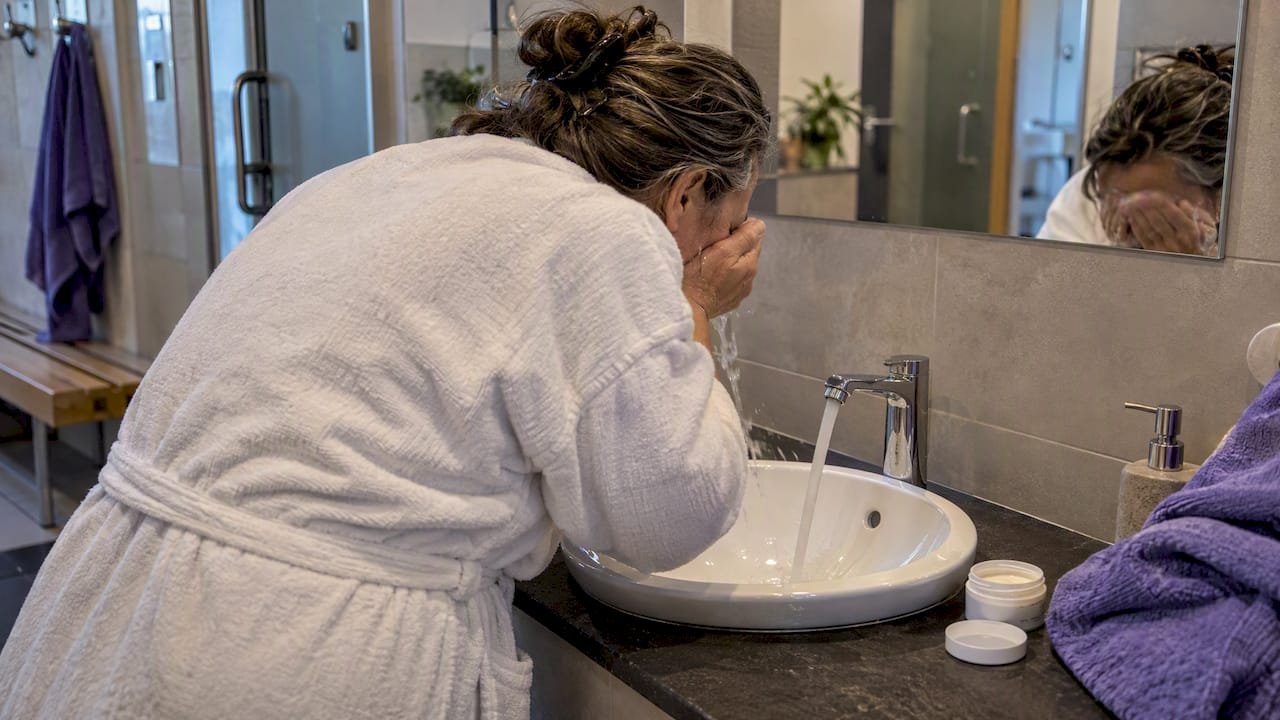
Rinse off straight away. Sweat left sitting on your face can re-clog pores and irritate already-warmed skin, so a quick shower or splash of cool water should come before anything else. Follow with a gentle cleanser rather than anything with active ingredients, since your skin is more permeable while it is still warm.
Moisturise while your skin is slightly damp, favouring lightweight, barrier-supporting ingredients:
- Ceramides and hyaluronic acid help lock in the hydration your skin just gained.
- Retinoids and strong AHAs are worth delaying for a few hours, since warmed, more permeable skin absorbs actives faster and that can tip into irritation.
For sensitive or rosacea-prone skin, stick to a cooling, fragrance-free moisturiser. Acne-prone skin does well with a gel-based, non-comedogenic formula, and mature or dry skin benefits most from a richer cream applied within minutes of rinsing. Partner guidance on skincare layering order is a useful reference if you are rebuilding your routine around this window.
Pro Tip: Keep your rinse-off and moisturiser by the changing room door. If you have to walk far to reach them, that delay is exactly when pores start to re-clog.
Clinic protocols and evidence: our approach
We built our sauna sessions around the same training logic the research supports: short, consistent exposure paired with proper hydration, not long punishing sessions chasing a quick fix.
- Our 15 to 20 minute post-workout sauna protocol is designed for recovery first, with the skin benefits of improved circulation and hydration as a welcome side effect.
- We recommend 300 to 500 mg of sodium for sessions between 30 and 60 minutes, since longer heat exposure increases mineral loss through sweat and proper replacement supports skin that relies on stable hydration to recover well.
- We were named among the top 3 luxury spa providers in Boyle for 2026, and for anyone managing a complex skin condition or combining sauna with other therapies, we always recommend a consultation first.
What detoxification actually means when you sweat
Sweating is often sold as a way to “flush toxins”, and that framing overstates what is really happening. Your liver and kidneys carry out the bulk of systemic detoxification, sweat is primarily a thermoregulatory fluid designed to cool your body, not a filtration system.
That said, sweat is not nutritionally neutral. An elemental analysis of sweat collected during water-filtered infrared sauna sessions found measurable concentrations of both toxic elements, including aluminium, arsenic, cadmium, nickel, lead and mercury, and nutrient elements, with some samples showing higher toxic-element concentrations than those typically reported after exercise or traditional wet saunas, according to this sweat analysis. This matters for skin indirectly: whatever leaves through sweat also needs replacing, particularly sodium and other minerals, to keep your skin’s hydration and barrier function working properly.
There is a lesser-known loss worth knowing about too. Sweat carries amino acids, including glycine and proline, which are also collagen-building precursors, and research shows these losses can differ by sex, with women potentially losing more during frequent heavy sweating, according to research on amino acid loss in sweat. Under some circumstances, this could influence collagen turnover and nitrogen balance over time. The practical takeaway is not to fear sweating, but to treat frequent heavy sauna use as something that calls for attention to both hydration and protein intake, rather than assuming a sauna is pulling impurities out and leaving the rest of your body untouched.
Sauna versus other skin-focused therapies we offer
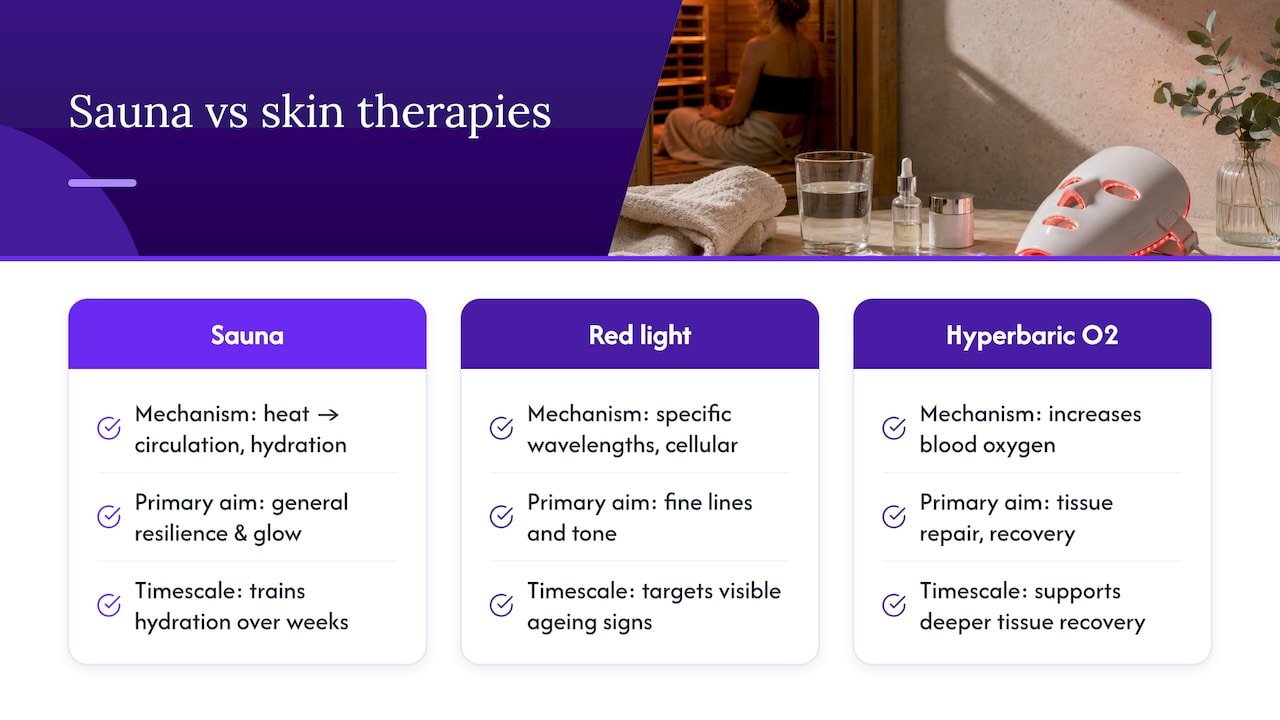
Sauna heat is one route to better circulation and hydration, but it sits alongside other therapies that work through different mechanisms, and understanding the distinction helps you choose well.
Red light therapy uses specific wavelengths of light to work at a cellular level, a more targeted approach than the broad circulatory boost a sauna provides, and it is often chosen specifically for fine lines and skin tone rather than general hydration. Hyperbaric oxygen therapy increases the amount of oxygen your blood can carry, supporting tissue repair in a way that complements, rather than duplicates, what heat and sweating achieve.
None of these therapies cancel each other out. A sauna session trains your skin’s hydration and barrier response over weeks, red light therapy targets specific signs of ageing with focused wavelengths, and hyperbaric oxygen therapy supports deeper tissue recovery. Choosing between them depends on what you are trying to fix: general resilience and glow point you toward sauna, visible fine lines or tone point toward red light, and recovery from injury or intensive physical stress point toward oxygen therapy. Many of our members combine two or three of these across a week rather than relying on one alone.
What regular sauna use means for your skin long term
The benefits of sauna for skin are cumulative, not instant, which is exactly why a single session rarely produces the dramatic before-and-after some marketing suggests.
Over months of consistent use, the same training effect that improves hydration and barrier stability tends to compound. Regular users maintain a more stable transepidermal water loss response and a lower baseline sebum level than people who sauna occasionally, and a systematic review of repeated dry sauna interventions found that while many of the underlying studies are small and the evidence is heterogeneous, consistent patterns of benefit do appear across them, according to this review of dry sauna interventions. That review is also honest about where the evidence stops: optimal frequency and duration for specific skin outcomes are not yet settled, which is why we favour conservative, repeatable protocols over chasing longer or hotter sessions.
Realistically, long-term sauna use works best as part of a broader skin routine rather than as a stand-alone strategy. It supports the hydration and circulation your skin needs to respond well to other things you are doing, good sleep, proper skincare, balanced nutrition, rather than replacing any of them. Think of it as conditioning rather than correction.
When to be cautious: skin conditions and sauna heat
Heat is not universally kind to every skin type, and knowing where to be careful matters as much as knowing the benefits.
Rosacea is the clearest case: heat is a well-documented trigger for flares, and dermatology guidance recommends avoiding overheating and using cooling measures for anyone prone to it, according to the American Academy of Dermatology. If you have active eczema, heat and sweating can worsen itching and inflammation, so shorter sessions with a cool-down break are sensible. Active, inflamed acne can also react poorly to prolonged heat and humidity if sweat is left on the skin too long, which is part of why the immediate rinse-off step matters so much.
Clinic and dermatologist guidance also recommends avoiding sauna sessions for a window before and after procedures like chemical peels or microneedling, since freshly treated skin is more vulnerable to heat-induced irritation, and clinical commentary on sauna and acne emphasises that aftercare, not the heat itself, usually determines whether a session helps or hurts, according to this dermatologist-reviewed commentary. If you are managing any of these conditions, shorter rounds, a lower bench position and a cool compress during the session are simple ways to keep the benefits without the flare.
Author Mark’s perspective: realistic expectations from sauna for skin
I treat sauna as conditioning, not correction. My own week usually includes two or three short sessions with an immediate rinse and moisturiser straight after, and I still see a dermatologist for anything beyond general maintenance. The glow is real. The timeline for anything deeper is measured in months, not minutes.
— Mark
Book a supervised sauna session or retreat with us
We built our sauna, steam and cold plunge space around the same evidence this guide covers: short sessions, proper hydration and skin-safe timing, supervised rather than guessed at.

- Our Sauna, Steam & Cold Plunge Spa day includes guided session timing suited to your skin type; current prices are available on our website.
- Longer stays through our 3, 5 and 10-Day Total Wellness Retreats combine sauna protocols with other therapies for a more complete reset.
- Clinic supervision means electrolyte guidance, session length and combined therapies are matched to you rather than left to a timer.
If skin health is your goal, a guided session with the right aftercare built in gets you further than guesswork at home. Book your spa day with us and start with a session designed around your skin.
This article is general information, not a substitute for advice from a qualified doctor. Consult a qualified healthcare professional about your own circumstances before acting on anything here.
FAQ
Is being in a sauna good for your skin?
Yes, regular sauna use is linked to better skin hydration and a more stable barrier, with one controlled study finding regular users had a baseline sebum level 25% lower than newcomers. It is not a cure for acne or ageing, and aftercare determines most of the benefit.
What is 30 minutes in the sauna equivalent to?
There is no single clinical equivalent, since sauna heat works through circulation and sweating rather than mimicking another activity. A 30 minute session is generally long enough to trigger meaningful sweating and vasodilation, which is why hydration with electrolytes, such as 300 to 500 mg of sodium, is recommended for sessions in that range.
What toxins come out in a sauna?
Sweat carries both nutrient and toxic elements, including measurable amounts of aluminium, arsenic, cadmium, nickel, lead and mercury found in sweat analysed after infrared sauna sessions. Your liver and kidneys still handle most of your body’s detoxification, sweat is primarily there to cool you down.
How often should you sauna for skin?
Two to four sessions a week of 15 to 20 minutes each supports the gradual hydration and barrier improvements seen in regular users. Consistency over weeks matters more than any single long session.
Sources
- Effect of regular sauna on epidermal barrier function and stratum corneum water-holding capacity in vivo in humans: a controlled study
- The multifaceted benefits of passive heat therapies for extending the healthspan: A comprehensive review with a focus on Finnish sauna – PMC