
Ashwagandha, rhodiola, holy basil (tulsi), reishi, maca, and schisandra are the top adaptogens for women managing midlife stress, disrupted sleep, and hormonal shifts. Each targets a slightly different symptom cluster, so matching herb to need matters far more than picking the most popular one.
Here is a quick map to get you started:
- Ashwagandha (Withania somnifera): best for stress, anxiety, and night-time cortisol; typical clinical starting dose is 300 mg twice daily, as used in the 2026 trial
- Rhodiola rosea: best for daytime fatigue and mental burnout; typical research dose 200–400 mg of standardised extract, taken in the morning
- Holy basil / Tulsi (Ocimum sanctum): best for emotional resilience and mild anxiety; commonly taken as a tea or capsule of moderate dose
- Reishi (Ganoderma lucidum): best for sleep quality and immune support; a typical dose of dried extract for evening use
- Maca (Lepidium meyenii): best for libido, mood, and energy; typical daily dose of powder or capsule
- Schisandra (Schisandra chinensis): best for stress-related fatigue and liver support; typical daily dose within the moderate range
UK safety reminder: if you take thyroid medication, HRT, SSRIs, or anticoagulants, or if you have a hormone-sensitive condition, speak with your GP before starting any adaptogen. The Food Standards Agency recommends professional guidance for herbal supplements in these circumstances.
Pro Tip: Start with one adaptogen only. Trying two or three at once makes it impossible to know which herb is helping, or causing side effects.
Table of Contents
- Why midlife changes your stress response, and where adaptogens fit in
- Profiles: what each adaptogen does, what the evidence shows, and how to take it
- How to choose the right adaptogen for your main symptom
- Safety checklist, interactions, and when to see your GP
- What the research shows, including the 2026 ashwagandha trial
- A safe 6-week starter plan for midlife women
- Key takeaways
- A practitioner’s perspective on adaptogens for midlife women
- How Live5dhealth supports midlife women through stress and sleep
- Useful sources and further reading
Why midlife changes your stress response, and where adaptogens fit in
Adaptogens are a class of plants and fungi that help the body resist physical and psychological stress by modulating the hypothalamic-pituitary-adrenal (HPA) axis, the central stress-response system. What makes them distinct is bidirectionality: rather than simply sedating or stimulating, they tend to normalise the stress response, nudging cortisol down when it is too high and supporting energy when it is depleted.
Perimenopause and menopause change the picture significantly. Declining oestrogen and progesterone alter HPA-axis sensitivity, so stressors that felt manageable in your thirties can now trigger noticeably larger cortisol spikes. Sleep architecture shifts too, with lighter sleep stages becoming more dominant and night wakings more frequent. The result is a feedback loop: poor sleep raises cortisol, elevated cortisol worsens sleep, and both amplify hot flushes, anxiety, and cognitive fog.
Adaptogens can interrupt that loop, but they work best when layered on top of solid foundations:
- Consistent sleep and wake times (circadian rhythm support)
- Anti-inflammatory nutrition with adequate protein
- Regular movement, even gentle walking
- Stress-management practices such as breathwork or mindfulness
Think of adaptogens as a targeted amplifier, not a substitute for those foundations. They also do not replace clinical care where HRT or other treatments are indicated. What they offer is a well-evidenced, low-risk complement, particularly for women who want to support their own resilience between appointments or alongside conventional treatment.
Pro Tip: Perimenopause can begin up to a decade before the last period. If your stress tolerance has dropped noticeably in your early-to-mid forties, HPA-axis sensitivity changes may already be a factor worth discussing with your GP alongside any supplement plan.
Profiles: what each adaptogen does, what the evidence shows, and how to take it
The table below summarises the six key adaptogens for midlife women. Detailed profiles follow.
| Adaptogen | Best for | Typical clinical dose | Timing | Evidence strength | Main cautions | Common UK formulations |
|---|---|---|---|---|---|---|
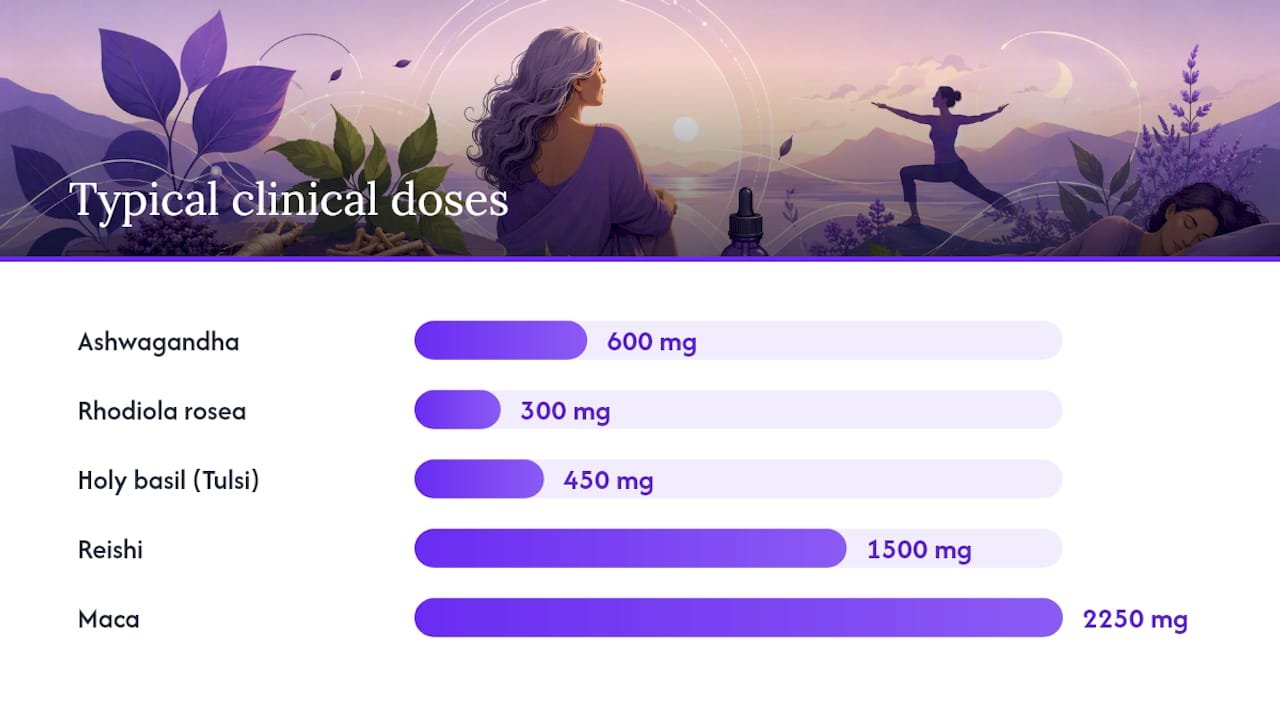
| Ashwagandha | Stress, anxiety, sleep | 300 mg twice daily | Evening (or split AM/PM) | Strong (multiple RCTs) | Thyroid meds, sedatives, pregnancy | Capsule, powder, tincture |
| Rhodiola rosea | Daytime fatigue, burnout | 200–400 mg | Morning only | Moderate (clinical trials) | Stimulating; avoid in bipolar disorder | Capsule, tincture |
| Holy basil / Tulsi | Emotional resilience, mild anxiety | 300–600 mg | Morning or evening | Moderate (clinical + traditional) | Blood thinners, hypoglycaemic drugs | Capsule, tea, tincture |
| Reishi | Sleep quality, immune support | 1–2 g dried extract | Evening | Moderate (immune); weaker HPA data | Anticoagulants, liver conditions | Capsule, powder, tea |
| Maca | Libido, mood, energy | 1.5–3 g | Morning | Moderate (menopausal trials) | Hormone-sensitive cancers | Powder, capsule |
| Schisandra | Stress-fatigue, liver support | 500–1,000 mg | Morning or split | Traditional + emerging | Anticoagulants, pregnancy | Capsule, tincture, tea |
Ashwagandha (Withania somnifera)
Ashwagandha has the strongest clinical evidence base of any adaptogen for midlife women. Its active compounds, withanolides, act on the HPA axis to reduce cortisol and support thyroid hormone balance. A 2026 randomised controlled trial in perimenopausal women used 300 mg twice daily over 56 days and found statistically significant improvements in perceived stress, menopausal symptom scores, and hormonal parameters. The NIH Office of Dietary Supplements confirms this dosing range as the most consistently used across human trials.
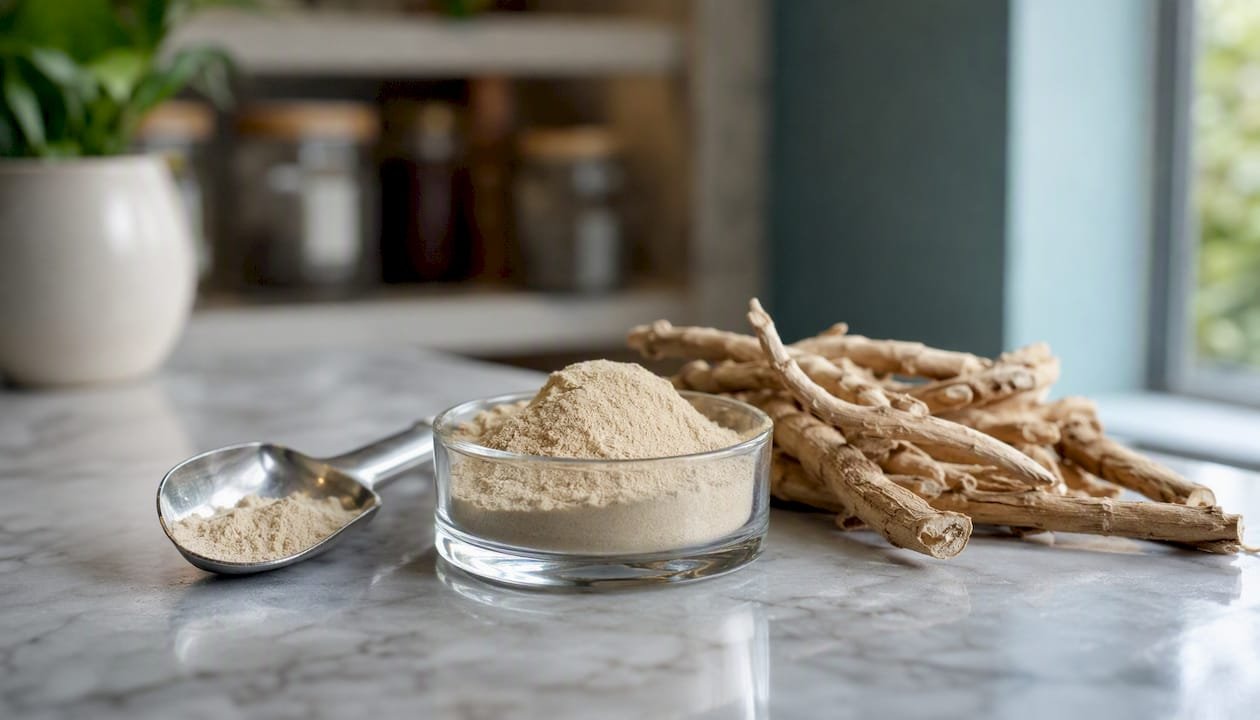
Look for a standardised extract rather than a generic root powder. KSM-66 is a well-researched ashwagandha extract standardised to a defined withanolide content; it is the form used in many of the trials cited above. Generic powders often lack the active-compound concentration needed to reproduce those results, as research on extract standardisation confirms.
Ashwagandha has a calming, “cooling” energetic profile, making it better suited to evening use or a split morning/evening dose. Avoid it if you have thyroid disease without medical supervision, as it can influence thyroid hormone levels.
Rhodiola rosea
Where ashwagandha calms, rhodiola energises. Its active compounds, rosavins and salidroside, support mitochondrial energy production and reduce the perception of effort during mental and physical stress. Clinical evidence supports a dose of standardised extract in moderate amounts for improving fatigue and stress tolerance. Take it in the morning, never in the evening: its stimulating profile can delay sleep onset in midlife women who are already dealing with night wakings.
Rhodiola suits women whose primary complaint is daytime burnout, brain fog, or the feeling of running on empty despite adequate sleep. It is not the right first choice for someone whose main issue is wired-at-night anxiety.
Holy basil / Tulsi (Ocimum sanctum)
Holy basil occupies a gentler middle ground. Revered in Ayurvedic medicine for centuries, it has a growing body of clinical evidence supporting its use for psychological stress and mild anxiety. Typical doses in trials range from 300–600 mg of leaf extract. It is also widely available as a tea in the UK, which suits women who prefer a ritual-based approach to their supplement routine.
Its adaptogenic action centres on reducing cortisol and supporting blood-sugar stability, both of which are relevant in perimenopause when insulin sensitivity can shift. Caution is warranted if you take blood-thinning medication or hypoglycaemic drugs, as holy basil may potentiate their effects.
Reishi (Ganoderma lucidum)
Reishi is an adaptogenic mushroom rather than a plant, and its evidence profile reflects that distinction. Research on medicinal mushrooms shows meaningful immune-modulating and anti-inflammatory effects, along with some sleep-related benefits, but the human evidence for direct HPA-axis modulation is weaker than for ashwagandha or rhodiola. For midlife women, reishi is most useful as a sleep-support and immune-resilience tool rather than a primary stress adaptogen.
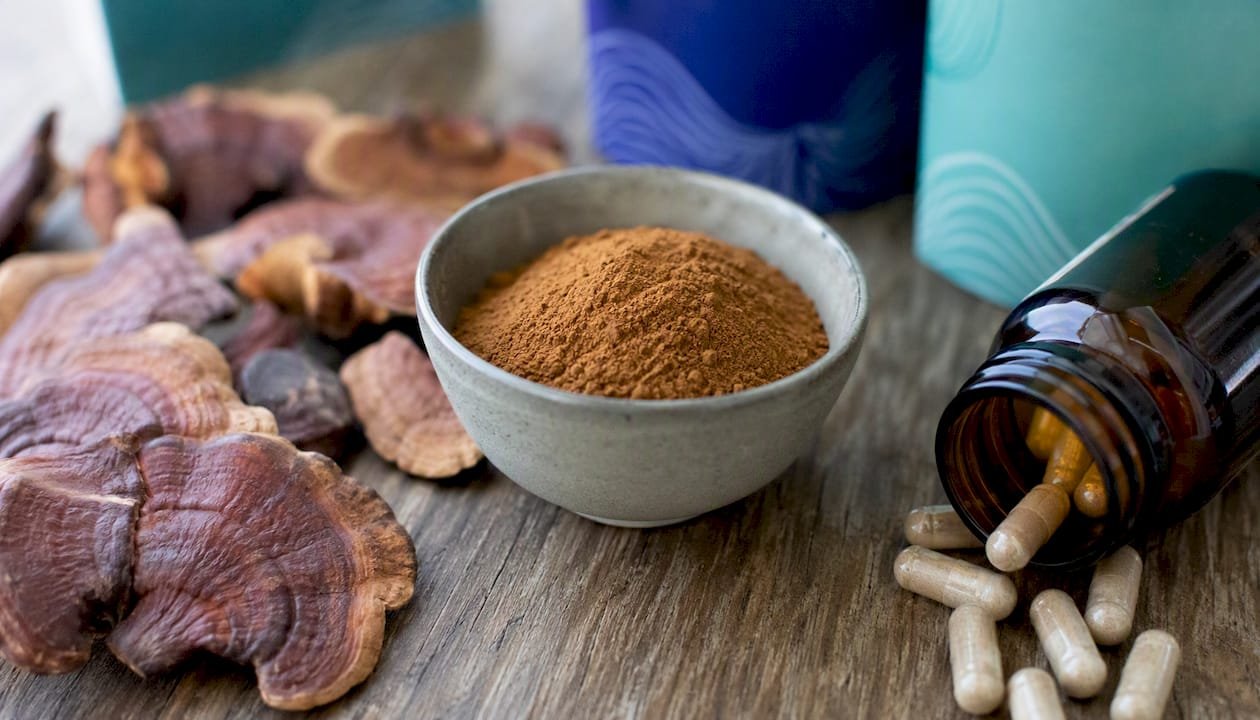
Standard dosing commonly ranges around 1–2 g of dried extract, taken in the evening. Available in the UK as capsules, powders, and teas. Avoid if you take anticoagulants or have a liver condition, and choose products that specify the extract ratio rather than whole mushroom powder.
Maca (Lepidium meyenii)
Maca is technically a root vegetable from the Peruvian Andes, but its effects on menopausal symptoms, particularly libido, mood, and energy, are well enough documented to earn it a place on this list. Several clinical trials in menopausal women have shown improvements in sexual function and psychological wellbeing at doses of 1.5–3 g daily. It does not appear to act directly on oestrogen levels, which makes it potentially safer for women with hormone-sensitive conditions, though caution is still advised and GP guidance recommended.
Maca is widely available in the UK as a powder (often added to smoothies) or capsules. Its earthy, malt-like flavour is distinctive; if you find it unpleasant, capsules are the practical alternative.
Schisandra (Schisandra chinensis)
Schisandra is less well known in the UK than ashwagandha or rhodiola, but integrative practitioners value it for stress-related fatigue, particularly when accompanied by liver strain or digestive disruption. Its lignans support adrenal function and have antioxidant properties. The evidence base is more traditional than clinical, with emerging human studies supporting its use at typical daily dose within the moderate range. It pairs well with rhodiola for women dealing with both physical fatigue and cognitive load, though starting both simultaneously makes it harder to assess individual response.
Available in the UK as capsules, tinctures, and teas. Avoid during pregnancy and with anticoagulant medication.
How to choose the right adaptogen for your main symptom
Symptom-matching is the most practical starting point. Use this as a guide, not a prescription.
| Primary symptom | First-choice adaptogen | Timing | Notes |
|---|---|---|---|
| Wired at night, anxious, poor sleep | Ashwagandha | Evening | Calming profile; pair with magnesium |
| Daytime burnout, brain fog | Rhodiola | Morning only | Stimulating; avoid if sleep is already poor |
| Emotional fragility, mild anxiety | Holy basil / Tulsi | Morning or evening | Gentle; suits tea-based routine |
| Poor sleep quality, low immunity | Reishi | Evening | Weaker stress evidence; strong sleep/immune |
| Low libido, flat mood, low energy | Maca | Morning | Not directly oestrogenic |
| Fatigue with stress and liver strain | Schisandra | Morning or split | Traditional evidence; good with rhodiola |
Product selection checklist
Before buying any adaptogen, run through these checks:
- Reputable supplier: browse practitioner-selected supplements rather than relying solely on high-street brands
For broader supplement safety guidance specific to women over 40, the detox supplements guide for women over 40 covers key principles worth reviewing alongside adaptogen use.
Questions to ask your GP or practitioner
- Do any of my current medications interact with this adaptogen?
- Do I have any thyroid abnormalities that would make ashwagandha unsuitable?
- Is my condition hormone-sensitive in a way that affects maca or schisandra use?
- Should I adjust the timing of my HRT or other hormonal medication relative to this supplement?
- Are there any liver function considerations given my health history?
Safety checklist, interactions, and when to see your GP
Adaptogens are generally well tolerated, but “natural” does not mean risk-free. Several interact with common midlife medications, and some are contraindicated in specific conditions.
When to stop and seek GP review
Stop the adaptogen and contact your GP if you experience:
- Palpitations or a racing heart
- Worsening anxiety or mood instability
- Significant digestive upset lasting more than a week
- Any new or unexplained symptoms that coincide with starting the supplement
What the research shows, including the 2026 ashwagandha trial
The evidence base for adaptogens in midlife women has strengthened considerably over the past decade, though it remains uneven across herbs.
That 56-day trial is notable because it used a standardised extract, measured hormonal outcomes directly, and focused specifically on perimenopausal women rather than a general adult population. The result aligns with earlier systematic reviews identifying ashwagandha and rhodiola as the best-evidenced options for reducing perceived stress and improving fatigue in women.
Rhodiola’s evidence is solid for stress-related fatigue and cognitive performance. A peer-reviewed review confirms benefits at moderate standardized extract doses, with effects typically emerging within weeks of consistent use. Holy basil has a growing clinical evidence base for psychological stress, though most trials are smaller and shorter than those for ashwagandha. Maca’s evidence for menopausal mood and libido is meaningful but limited by small sample sizes.
Reishi sits in a different category. Medicinal mushroom research demonstrates immune and anti-inflammatory effects clearly, but direct HPA-axis modulation in humans is less well established. Schisandra’s evidence remains largely traditional, with emerging clinical studies that have not yet reached the scale of ashwagandha or rhodiola trials.
A clinical review on adaptogen timelines notes that measurable changes typically emerge between 4 and 12 weeks of consistent use. This is worth setting as your personal benchmark: if you notice no change after 8–12 weeks at a consistent dose, the herb may not be the right fit, or the product may lack adequate standardisation. Extract standardisation is the single biggest variable separating clinical-trial results from what many retail products actually deliver.
A safe 6-week starter plan for midlife women
This plan is designed for women starting with one adaptogen. It prioritises clarity: you need to know what is working before adding anything else.
Weeks 1–2: start low and observe
- Choose one adaptogen matched to your primary symptom (use the table in the “How to choose” section above).
- Begin at the lower end of the clinical dose range: for ashwagandha, that means 300 mg once daily in the evening.
- Keep everything else constant: no new supplements, no major dietary changes.
- Start a simple symptom log (see template below).
Weeks 3–4: assess and adjust
- Review your log at the end of week 2. Has sleep onset improved? Is morning anxiety lower?
- If well tolerated with no side effects, increase to the full clinical dose (ashwagandha 300 mg twice daily).
- If you notice digestive discomfort, take the capsule with food and reduce to once daily for another week.
- If symptoms are worsening or new symptoms appear, stop and contact your GP.
Weeks 5–6: consider adding a complementary adaptogen
- Only add a second adaptogen if the first is clearly working and well tolerated.
- A practical pairing: ashwagandha in the evening for sleep and stress, rhodiola in the morning for daytime energy. This “symptom stacking” approach lets you assess each herb’s contribution clearly.
- Continue your symptom log with both herbs noted.
Key takeaways
Ashwagandha at a moderate dosing regimen is best-evidenced for midlife women, supported by a 2026 randomised trial showing significant improvements in stress and menopausal symptoms over several weeks.
| Point | Details |
|---|---|
| Match herb to symptom | Ashwagandha for stress/sleep (300 mg twice daily), rhodiola for daytime fatigue, maca for libido and mood. |
| Standardised extracts matter | Generic root powders often lack the active-compound concentration used in clinical trials. |
| Timeline: 4–12 weeks | Measurable benefits typically emerge between 4 and 12 weeks; do not judge too early. |
| Safety check first | Consult your GP before starting if you take SSRIs, thyroid medication, HRT, or anticoagulants. |
| Live5dhealth supplements | Live5dhealth’s practitioner-selected supplement range offers vetted adaptogen products for midlife women. |
A practitioner’s perspective on adaptogens for midlife women
The most common mistake I see is treating adaptogens as a quick fix for symptoms that actually need a clinical conversation. Ashwagandha will not resolve severe perimenopause if HRT is the appropriate intervention. What adaptogens do well is support the space between: the woman who is managing, but not thriving, and wants a researched, low-risk tool to improve her daily resilience.
The evidence hierarchy matters here. Ashwagandha and rhodiola have earned their place through genuine randomised trials. Holy basil and maca have meaningful supporting evidence. Reishi and schisandra are valuable but should be positioned as complementary rather than primary. Presenting all six as equally evidenced does a disservice to women trying to make informed decisions.
Timing is consistently underestimated. Taking rhodiola in the evening because it is convenient is one of the most common reasons women report that “adaptogens don’t work.” The stimulating profile of rhodiola is not a side effect; it is the mechanism. Matching the herb’s energetic profile to the time of day is as important as the dose.
Finally, the supplement market is crowded with products that bear little resemblance to what was used in trials. A capsule labelled “ashwagandha 500 mg” that contains unstandardised root powder may deliver a fraction of the withanolides that drove the results in the 2026 trial. Standardised extracts, third-party testing, and transparent labelling are not premium extras; they are the baseline for any product worth taking.
Midlife is not a decline. With the right tools, the right timing, and the right professional support, it can be a period of genuine renewal. Adaptogens, used thoughtfully, are one of those tools.
How Live5dhealth supports midlife women through stress and sleep
If you are ready to move beyond generic supplement advice and want support that is tailored to where you actually are in your health, Live5dhealth offers exactly that. Based in Boyle, County Roscommon, the centre combines practitioner-selected adaptogen supplements with in-person therapies, including red light therapy, PEMF, sound therapy, and luxury spa treatments, that directly support the nervous system and sleep quality midlife women need most.

For women who want a more immersive reset, the healing retreats at Live5dhealth are designed around exactly this intersection: stress recovery, hormonal support, and restorative sleep, with expert guidance on which supplements and therapies suit your specific symptom picture. You do not have to piece it together alone. Browse the supplement range or enquire about a retreat to take the next step with confidence.
Useful sources and further reading
The sources below are the primary references cited in this article. Each is linked directly to the original study or guidance page.
| Source | What you will find there |
|---|---|
| 2026 ashwagandha RCT in perimenopausal women (PMC12812913) | Full trial data: 300 mg twice daily, 56-day duration, menopausal symptom and hormonal outcomes |
| NIH Office of Dietary Supplements: Ashwagandha factsheet | Active compounds, trial doses, safety signals, and drug interactions for health professionals |
| Rhodiola rosea clinical review (PMC10147008) | Evidence summary for fatigue and stress tolerance; dosing at 200–400 mg standardised extract |
| Medicinal mushrooms and reishi (PMC6567205) | Immune and anti-inflammatory evidence for reishi; context on HPA-axis data limitations |
| Adaptogen timeline review (PMC9524226) | Clinical evidence that measurable effects emerge between 4 and 12 weeks |
| Extract standardisation and reproducibility (PubMed 27763802) | Why standardised extracts outperform generic powders in reproducing trial results |
| NCCIH: Asian ginseng and potent adaptogens | Cautions and practitioner oversight guidance for potent ginseng-type adaptogens |
| Food Standards Agency (UK) | UK public health guidance on herbal supplements and when to seek GP advice |
This article provides general information only, not medical advice. Confirm current guidance and any supplement choices with your GP or a registered practitioner, particularly if you have an existing health condition or take prescription medication.