
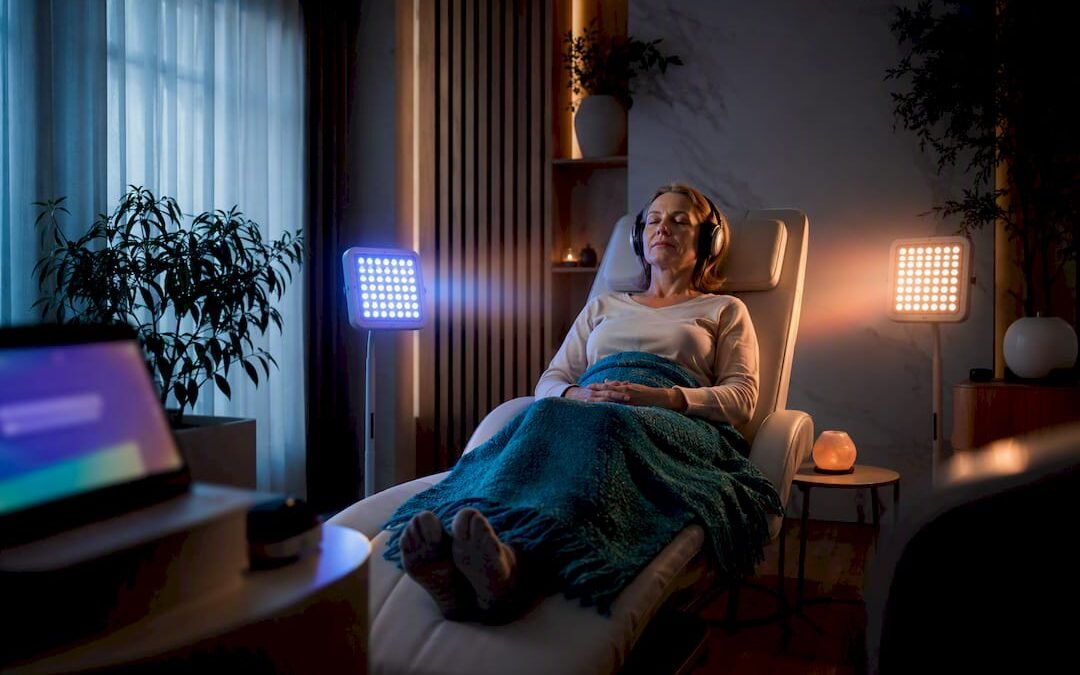
Light and sound therapy uses controlled light frequencies, colours or wavelengths alongside rhythmic audio (binaural beats, sound baths or vibroacoustic tones) to shift brainwave activity, ease tension and support cellular repair. The best-supported benefits sit in relaxation and stress reduction, with emerging but genuinely promising signals for sleep, chronic pain and neurological health. None of it replaces medical care for a diagnosed condition, so treat this as a complement to your clinician’s advice, not a substitute for it.
TL;DR:
- Short-term benefits for stress and anxiety are most reliably supported by sound meditation and singing bowl sessions, which have shown significant mood improvements after just one session.
- Effectiveness for sleep and neurological conditions varies widely, with red light therapy sometimes improving sleep onset but also increasing alertness in some individuals, requiring careful consideration.
- Regular sessions of vibroacoustic therapy have demonstrated immediate pain relief for fibromyalgia, though benefits tend to fade without ongoing treatments.
- Red and near-infrared light therapy doses depend heavily on irradiance and wavelength specifics, making it essential to verify device parameters before use.
- Clearer, larger-scale research and safety certifications are needed before light and sound therapy becomes a mainstream medical treatment, and repeated sessions are generally required for sustainable effects.
Table of Contents
- What are the main types of light and sound therapy?
- Does the evidence differ by condition?
- How do light and sound actually change the brain and body?
- What session lengths and frequencies actually appear in the research?
- Who should avoid light and sound therapy?
- How do you choose a safe therapist or device?
- Where does light and sound therapy come from?
- How does it compare with other complementary therapies?
- What does light and sound therapy typically cost?
- Live5dhealth: how we apply light and sound therapies and who they suit
- Where research is heading next
- Authoritative papers and reviews to read next
- What the research doesn’t tell you yet
- Ready to experience light and sound therapy for yourself?
- Sources
What are the main types of light and sound therapy?
Before you can judge the evidence, you need to know what’s actually being tested. “Light and sound therapy” is an umbrella term covering several distinct approaches, each with its own mechanism and its own research trail.
- Audio-visual entrainment (AVE): flickering light (often through goggles) paired with pulsed tones, designed to nudge brainwave activity towards a target frequency.
- Binaural beats: two slightly different tones played separately into each ear; the brain perceives a third “beat” frequency, which some protocols use to encourage calm or focus. Live5dhealth’s binaural beats protocols are structured around specific goals such as sleep, focus or stress relief.
- Vibroacoustic therapy and sound baths: low-frequency sound delivered through a table, bed, or bowls placed near or on the body, combining audible tone with physical vibration.
- Red and near-infrared light therapy (photobiomodulation): specific wavelengths of light applied to skin or tissue, used for cellular and skin-related outcomes.
- 40 Hz / GENUS gamma stimulation: flickering light and clicking sound delivered at exactly 40 times per second, aimed at entraining gamma brainwaves rather than producing relaxation.
Systems like RoXiva combine light and sound in an immersive session format, layering flicker frequencies with soundscapes to move a person through different brainwave states across a single sitting. Session length varies by modality: AVE and binaural sessions in trials commonly run 10 to 60 minutes, vibroacoustic sessions tend to sit around 20 to 30 minutes, and red light exposures are typically brief, from several minutes up to an hour. Some protocols are strictly supervised in a clinic; others, particularly binaural beats and consumer red light panels, are designed for home use.
Does the evidence differ by condition?
It does, and the differences matter more than most marketing copy admits. Some uses have real, if modest, backing. Others are still firmly in the “promising, not proven” category.
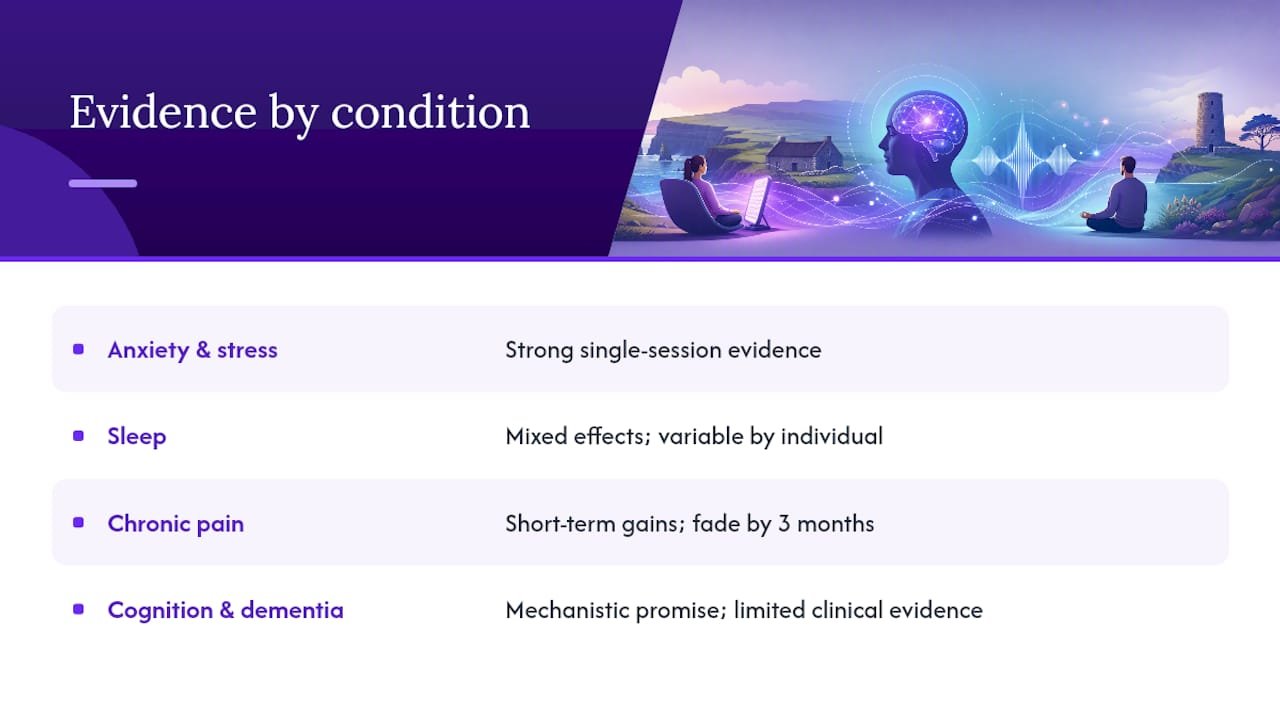
Anxiety and stress. The strongest single-session evidence comes from sound meditation. An observational study of 62 participants found a Tibetan singing bowl session produced significant reductions in tension, anger, fatigue and depressed mood, with every measure improving at P < .001. Binaural beats and AVE protocols show smaller, more variable effects on anxiety, and outcomes appear to depend heavily on the specific frequency and duration used.
Statistic snapshot: In that singing bowl study, tension, anger, fatigue and depressed mood all fell after a single session, one of the clearer short-term mood results in this field.
Sleep. Results here are genuinely mixed, not just under-researched. A randomised study found that exposure to red light before bedtime altered objective sleep structure, shortening sleep onset in some measures while increasing alertness and negative emotion in others. That’s an important nuance: red light isn’t uniformly calming, and response seems to vary between individuals.
Chronic pain, including fibromyalgia. Whole-body vibration and vibroacoustic approaches show some of the most concrete short-term results in this entire field. A trial found immediate improvements in pain intensity, quality of life and motor function in fibromyalgia patients after a 12-week programme, but those gains had faded by the three-month follow-up without further sessions.
Cognition and neurodegenerative disease. This is the frontier. A systematic review of combined photic and auditory stimulation concluded it may induce favourable mental states and augment other therapies, though it covered only a handful of small studies and called for far more trials. Separately, 40 Hz gamma research has moved from curiosity to active investigation: recent reviews describe mechanistic effects on microglia and amyloid clearance pathways that could, in theory, support disease-modifying treatment for conditions like Alzheimer’s. Clinical translation is still early, and nobody credible is calling this a cure.
Across every condition, one pattern repeats: benefits tend to be real but short-lived without repeated sessions, and study sizes remain small enough that individual results vary widely.
How do light and sound actually change the brain and body?
The rationale isn’t mystical, it’s mechanical, and understanding it helps you judge which claims are plausible.
Brainwave entrainment works on the principle that rhythmic sensory input can pull the brain’s electrical activity towards a matching frequency. Slower rhythms (around 7 to 10 Hz, in the alpha to theta range) are associated with relaxed, drowsy states; faster rhythms (14 to 18 Hz, in the beta range) are linked to alertness and focus. This is why a “relaxation” protocol and a “focus” protocol use entirely different pulse rates.
Photobiomodulation, the mechanism behind red and near-infrared light therapy, works differently again. Specific wavelengths are absorbed by mitochondria, the energy-producing structures inside cells, potentially supporting ATP production, improving local blood flow and modulating inflammation. This is a cellular, not a neurological, mechanism.
Gamma entrainment at 40 Hz sits in its own category. Reviews suggest this frequency can influence microglial activity (the brain’s immune cells) and the AQP4 water channels involved in glymphatic clearance, the brain’s waste-removal system. That’s the theoretical bridge between flickering light and clearing pathological proteins, and it’s why 40 Hz research draws serious neuroscience attention rather than wellness-industry hype alone.
Sound has its own separate autonomic pathway. Music and structured sound can shift heart-rate variability and cortisol levels, and personal preference appears to be a genuine moderator of how well sound-based interventions calm the nervous system. A sound you find soothing works better than one imposed on you, which has practical implications for choosing a protocol.
What session lengths and frequencies actually appear in the research?
Marketing copy loves round numbers. Trial protocols are more specific, and the specifics are what you should actually be checking before booking or buying.
Session duration in published research ranges from 10 to 60 minutes depending on modality, and single sessions rarely produce lasting change on their own. The fibromyalgia vibration trial ran for 12 weeks; the singing bowl study measured effects after just one session, then noted they were short-term. Repetition, not novelty, drives durable outcomes.
Frequency matters just as much as duration:
- 7 to 10 Hz is the typical range used for relaxation-focused AVE and binaural protocols.
- 14 to 18 Hz targets alertness and cognitive activation.
- 40 Hz precisely is used for gamma entrainment work, distinct from general relaxation frequencies.
- 630 to 660 nm (visible red) and 830 to 850 nm (near-infrared) are the wavelength bands most used in red light trials, chosen for their tissue penetration depth.
For red light devices, wavelength alone doesn’t tell you much. Irradiance, measured in milliwatts per square centimetre (mW/cm²), determines the actual dose reaching your skin, and two devices quoting the same wavelength can deliver very different results. Before buying, check the specific wavelengths a device actually emits, its irradiance rating, duty cycle, and whether it carries CE marking as evidence of basic safety testing.
Pro Tip: Ask any provider or manufacturer for the exact wavelength, irradiance, and session duration used in the study they’re citing. If they can’t answer, the claim behind their product probably wasn’t tested the way it’s being sold.
Who should avoid light and sound therapy?
Not everyone is a good candidate for flicker-based protocols, and this is where caution has to be explicit rather than assumed.
- Epilepsy or photosensitivity: flickering light, particularly in AVE and 40 Hz protocols, carries a seizure risk for photosensitive individuals; screening questions about seizure history are essential before any flicker-based session.
- Implanted electrical devices, pregnancy, or unstable cardiac conditions: these generally warrant caution and a conversation with a doctor before starting any entrainment or vibroacoustic protocol.
- Auditory sensitivity or tinnitus: sound-based sessions should be approached carefully, with volume and frequency adjusted individually.
- Red light and alertness: red light can increase alertness and negative emotion in some healthy subjects rather than calm them, so evening use isn’t automatically the right choice for every individual.
- Device misuse: cumulative exposure beyond recommended durations hasn’t been well studied, and more isn’t automatically better.
The research itself has limits worth naming plainly: many studies use small samples, protocols vary enough between trials that comparing results directly is difficult, and follow-up periods are often too short to confirm lasting benefit. That’s not a reason to dismiss the field, but it is a reason to keep expectations realistic.
How do you choose a safe therapist or device?
A short checklist beats a long sales pitch every time.
- Ask for protocol specifics. A credible provider can state the exact frequency, wavelength, and session length they use, and explain why.
- Confirm safety screening happens first. You should be asked about seizure history, pregnancy, implanted devices and cardiac conditions before any session begins.
- Check for monitoring. Sessions should include some form of check-in during and after, not just a timer.
- Request the evidence behind the claim. Ask which study or trial the specific protocol is modelled on.
- Clarify expected session numbers. One session rarely changes anything lasting; a realistic provider will tell you that upfront.
For at-home devices, demand the irradiance, wavelength and CE marking in writing, and check the potential side effects before committing to daily use. Red flags include cure-all language, no published protocol, missing safety labelling, or no clinician you can actually contact.
Where does light and sound therapy come from?
The idea of using sound and light for healing isn’t a wellness-industry invention. Sound-based ritual and meditative practice, including singing bowls, stretches back centuries across multiple cultures, long before anyone measured cortisol or heart-rate variability. Colour and light have similarly ancient roots in various healing traditions, though the mechanistic claims made today are entirely modern.

The scientific thread starts in the mid-20th century, when researchers first documented that rhythmic photic stimulation could produce measurable changes in EEG activity, effectively the birth of brainwave entrainment as a testable idea rather than a folk practice. Binaural beats followed in the 1970s, when the perceptual phenomenon of two tones creating a third “beat” frequency was formally described and later adapted into audio protocols.
Red light therapy’s modern history traces to NASA-funded research into wound healing and cellular repair in the 1990s, which shifted photobiomodulation from a niche laser therapy into a technology accessible enough for wellness and skincare use. The most recent chapter is the 40 Hz gamma entrainment research that began gathering serious attention over the past decade, moving light and sound stimulation from relaxation aid into genuine neuroscience territory, with mechanistic studies now probing links to glymphatic clearance and neurodegenerative disease. That trajectory, from ritual to reflex arc to receptor biology, is unusual for a wellness practice, and it’s part of why the field now attracts rigorous academic scrutiny rather than being dismissed outright.
How does it compare with other complementary therapies?
Light and sound therapy sits alongside other complementary approaches such as massage, acupuncture, and hyperbaric oxygen therapy, but it works through a distinct route: sensory entrainment and photobiomodulation rather than manual manipulation or pressure-based gas exchange. Massage and bodywork address muscular tension directly through touch; light and sound therapy addresses the nervous system’s rhythm and, in the case of red light, cellular energy production.
Compared with mindfulness meditation, sound-based sessions offer a more passive entry point. You don’t need to learn a technique, you simply receive the stimulus, which is part of why sound baths and vibroacoustic sessions appeal to people who find silent meditation difficult to sustain. Hyperbaric oxygen therapy, by contrast, targets tissue oxygenation directly and has a different evidence base for neurological conditions than gamma entrainment does, though both are being explored for overlapping conditions like cognitive decline.
None of these therapies is a strict replacement for the others. A pain management plan might reasonably combine vibroacoustic sessions for immediate relief with structured movement and manual therapy for longer-term function, since the fibromyalgia vibration data shows gains fade without follow-up. The honest comparison isn’t which therapy wins, it’s which combination suits your specific goal and how much evidence you’re comfortable acting on for each.
What does light and sound therapy typically cost?
Pricing varies enormously depending on whether you’re buying a device or booking supervised sessions. Consumer-grade red light panels for home use span a wide price range, with cost usually tracking irradiance output and panel size rather than brand name alone. Higher-output, clinically specified panels cost more than small handheld units, and that price gap often reflects a genuine difference in dose delivered, not just marketing.
Immersive light and sound sessions at a wellness centre, combining AVE, binaural audio and guided relaxation in a single sitting, are typically priced per session or bundled into multi-session packages, since repeated exposure is what the evidence supports for lasting benefit. Vibroacoustic and sound bath sessions follow a similar model. Clinical trial participation, where available, is free but requires meeting specific eligibility criteria and accepting a structured research protocol rather than a flexible wellness schedule.
The practical guidance is straightforward: a single session of any modality is a reasonable way to test whether you respond well to it, but budgeting for a course of sessions makes more sense if you’re aiming for the sustained benefits the research actually describes.
Live5dhealth: how we apply light and sound therapies and who they suit
At Live5dhealth, light and sound therapy is offered through RoXiva immersive sessions, structured binaural beats protocols, and red light therapy, each delivered as a standalone session or integrated alongside our other therapies such as hyperbaric oxygen and PEMF. Sessions are guided, with format and duration matched to your goal, whether that’s stress relief, sleep support or general wellness. We also offer a dedicated sound-healing bed experience for a more immersive vibroacoustic session.
If you’re managing a diagnosed condition, we recommend discussing any new therapy with your treating clinician first, and our team can talk through how a session fits alongside your existing care.
Where research is heading next
Trials like NCT05268887 are testing 40 Hz multisensory stimulation in Parkinson’s disease, tracking EEG entrainment and motor outcomes. Expect calls for standardised protocols, larger randomised trials, longer follow-up periods, and clearer device safety certification before any of this becomes mainstream medical practice.
Authoritative papers and reviews to read next
Start with the systematic review on combined photic and auditory stimulation and the 40 Hz gamma therapy review for the clearest picture of where evidence currently stands.
What the research doesn’t tell you yet
Most coverage of light and sound therapy either oversells it as a cure-all or dismisses it as spa-industry noise. Both miss what’s actually interesting here: this is one of the few wellness categories where the mechanistic research is now outpacing the marketing claims, not the other way round. The 40 Hz gamma work is a genuinely unusual case of a relaxation-adjacent technology getting serious neuroscience attention because the biology, microglial activity, glymphatic clearance, looked plausible enough to fund proper trials.
What frustrates me is how rarely providers distinguish between “this calms you down for an afternoon” and “this might, eventually, influence disease progression.” Those are wildly different claims resting on wildly different evidence, and conflating them does a disservice to a field that has real, if narrow, wins. The fibromyalgia vibration data is a good example: immediate relief, genuinely documented, gone within three months without maintenance. That’s not a failure, it’s just an honest description of a therapy that works like a repeated practice rather than a one-off fix.
If you want the benefit, treat sessions the way you’d treat a course of physiotherapy rather than a single pill. Go in with realistic expectations, ask providers for actual protocol details, and be sceptical of anyone promising a permanent result from one sitting.
— Mark
Ready to experience light and sound therapy for yourself?
Reading about frequencies and wavelengths only gets you so far. Live5dhealth can be a practical option for readers who want supervised light and sound therapy with guidance through the protocol before booking, rather than using an unguided consumer device.
Our luxury spa and therapy centre in Boyle combines RoXiva light and sound sessions with red light therapy, hyperbaric oxygen and other complementary treatments under one roof, so you’re not piecing together separate providers to build a sensible programme. If you’d rather immerse yourself fully, our luxury healing retreats build light and sound sessions into a longer, guided programme with proper follow-up, addressing the maintenance issue this article keeps returning to. Get in touch to book a session or ask our team which protocol suits your goals before you commit to anything.
Sources
- Effects of singing bowl sound meditation on mood, tension, and well‑being: An observational study
- Light‑based 40 Hz sensory therapy for brain disorders: physiological basis, therapeutic mechanisms, and future prospects