

Hydrogen inhalation therapy delivers real, measurable benefits for some conditions, particularly hypertension and post-surgical recovery, while research into stroke and chronic respiratory disease remains early and preclinical. Trials show it is well tolerated at controlled concentrations, but flammability limits and the need for accurate dosing mean it belongs in a supervised clinical setting, not a home experiment. If you’re exploring it, look for a provider that measures the fraction of inspired hydrogen (FiH2) rather than just quoting a flow rate.
TL;DR:
- Hydrogen inhalation therapy shows the strongest evidence for reducing blood pressure in hypertensive patients and improving recovery after surgery.
- Reliable dosing depends on measuring the fraction of inspired hydrogen, with a recommended therapeutic window of 1 to 4 percent FiH2, not just flow rate or source concentration.
- Safety data indicates controlled exposure to 2.4 percent hydrogen is well tolerated, but inhalation above 4 percent poses flammability risks and must be managed carefully.
- Most clinical trials use inhalation rather than hydrogen water, as inhalation provides more consistent and systemic benefits, especially for organ protection.
- Patients should inquire about FiH2 measurement, equipment maintenance, staff training, and emergency protocols before starting hydrogen inhalation therapy.
Table of Contents
- What is hydrogen inhalation therapy and how is it delivered?
- How does hydrogen therapy work at a cellular level?
- Clinical evidence: what the trials show, condition by condition
- Safety, dosing, and why FiH2 matters more than flow rate
- What to expect if you’re exploring hydrogen therapy
- Live5dhealth: how we think about hydrogen-related therapies
- Author perspective: cautious optimism, not hype
- Book a supervised session at Live5dhealth
- Sources
- FAQ
What is hydrogen inhalation therapy and how is it delivered?
Molecular hydrogen therapy uses hydrogen gas (H2), the smallest and lightest molecule in existence, as a therapeutic agent. It works by diffusing rapidly through cell membranes and tissue barriers that block larger antioxidant molecules, which is why researchers have spent the last two decades investigating it for everything from sports recovery to critical illness.
There are two broad ways to get hydrogen into your system, and they behave very differently in the body. Hydrogen-rich water (HRW) delivers a small, fixed dose through the gut, where much of it is lost before it reaches circulation. Inhalation, by contrast, sends hydrogen straight into the alveoli and bloodstream within seconds, making it the more relevant route when the goal is acute organ protection or a sustained systemic effect, according to a therapeutic overview of molecular hydrogen gas in critical illness.
Clinically, hydrogen inhalation is delivered through several methods, each suited to a different setting:
- Nasal cannula: the most common outpatient method, often using low to moderate flow rates similar to supplemental oxygen delivery.
- H2 to O2 admixtures: hydrogen blended with oxygen at controlled ratios, frequently used in perioperative and hospital research settings.
- Face mask systems: used where a tighter seal and higher delivered concentration are needed for shorter sessions.
- Ventilator-integrated delivery: applied in intensive care research for critically ill or ventilated patients.
- Electrolysis generators versus premixed medical gas cylinders: electrolysis units split water on-site to produce hydrogen on demand, while premixed cylinders offer a fixed, certified concentration with less variability.
The practical trade-off is straightforward: hydrogen water is simple, portable, and safe for everyday use, but the dose it delivers is small and short-lived. Inhalation offers a far more consistent and clinically significant exposure, which is why most of the trial evidence discussed below, including the hydrogen inhalation research reviewed in clinical outcome studies, relies on inhaled hydrogen rather than water-based alternatives. If your interest is a daily wellness habit rather than a targeted clinical intervention, products like hydrogen water or a hydrogen bottle fill that gap, but they are not a substitute for supervised inhalation protocols.
How does hydrogen therapy work at a cellular level?
Hydrogen’s clinical appeal comes down to a property most antioxidants lack: selectivity. Rather than mopping up every reactive molecule in a cell, hydrogen gas appears to target the most damaging ones, particularly the hydroxyl radical and peroxynitrite, while leaving the reactive oxygen species your body actually needs for immune signalling and cell communication largely untouched.

This matters clinically because blunt-force antioxidants (high-dose vitamin C or E, for instance) can interfere with beneficial oxidative signalling when taken in excess, potentially blunting exercise adaptation or immune response. Hydrogen’s selective action is the reason researchers have proposed it as a “smarter” antioxidant rather than a stronger one.
Three mechanisms show up repeatedly across the preclinical and human literature:
- Selective radical scavenging. Hydrogen neutralises hydroxyl radicals and peroxynitrite, two of the most reactive and tissue-damaging species produced during oxidative stress, without suppressing normal ROS signalling pathways.
- Anti-inflammatory and antiapoptotic signalling. Multiple preclinical and early clinical studies report reduced inflammatory markers and lower rates of programmed cell death (apoptosis) in stressed tissue following hydrogen exposure, according to a review of molecular hydrogen therapy outcomes.
- Mitochondrial protection. Because mitochondria are both a major source and a major target of oxidative damage, protecting them from excess radical activity appears to preserve energy production capacity in stressed cells, a mechanism repeatedly cited to explain hydrogen’s broad organ-protective effects.
A randomised controlled study found that inhaled hydrogen produced a measurable drop in blood reactive oxygen species (ROS) levels both immediately after treatment and again at 24 hours, giving direct human biochemical evidence for the antioxidant effect seen in preclinical models.
Why does this matter beyond a lab measurement? Because oxidative stress and inflammation are implicated in nearly every major disease process researchers have studied, from acute lung injury to neurodegeneration. If a single, well-tolerated molecule can dial down the most damaging radicals in lung tissue, heart muscle after an ischaemic event, or neurons following a stroke, without switching off the immune signalling those tissues still need, that gives a coherent biological reason to test it clinically across organ systems. That is precisely what the trials in the next section attempt to do, with mixed but genuinely encouraging results.
Clinical evidence: what the trials show, condition by condition
The honest picture is uneven. Some conditions have real randomised trial data behind them. Others have a handful of small studies and a lot of preclinical promise. Here is how the evidence actually breaks down.
Hypertension: the strongest real-world signal.
A 24-week observational study following hypertension patients using hydrogen inhalation as an add-on to standard treatment found meaningful blood pressure improvements. Patients in the hydrogen group saw average systolic blood pressure drop by 7.81 mmHg and diastolic pressure drop by 2.89 mmHg compared with controls, alongside higher rates of achieving blood pressure control targets. This is real-world rather than placebo-controlled data, so it needs replication in a blinded trial, but a nearly 8-point systolic reduction over half a year is not a trivial finding for an add-on therapy with a good safety record.
Perioperative and post-surgical recovery: solid randomised evidence.
A randomised, double-blind trial in day-surgery patients tested perioperative hydrogen inhalation against standard care and found the hydrogen group reported better early recovery scores on the QoR-15 quality-of-recovery scale, alongside reduced inflammatory markers including IL-6 and IL-12. This is one of the cleaner pieces of evidence in the whole hydrogen therapy research landscape, precisely because it used a proper blinded design with a hard, patient-relevant endpoint.
Respiratory disease: encouraging but preliminary.
Interest in hydrogen inhalation for respiratory conditions, including COVID-19-related lung injury, COPD, and ARDS, surged during the pandemic. The rationale is sound given hydrogen’s fast alveolar uptake and anti-inflammatory action in lung tissue. However, the human evidence here remains a patchwork of small studies and case series rather than large multicentre RCTs. Reviews covering critical illness applications consistently call for adequately powered trials before hydrogen inhalation can be considered an established respiratory intervention.
Cardiovascular protection beyond blood pressure.
Preclinical work on ischaemia-reperfusion injury, the damage that occurs when blood flow returns to tissue after a blocked artery is cleared, shows hydrogen limiting the burst of oxidative damage that follows reperfusion. Small pilot studies in STEMI (a specific type of heart attack) patients have explored hydrogen as an adjunct during the reperfusion window. The mechanism is plausible and the pilot data is promising, but this remains an emerging area rather than an established protocol.
Neurological conditions: mechanistically compelling, clinically early.
Stroke and other neuroprotection research is largely preclinical at this stage. The biological logic is strong: hydrogen crosses the blood-brain barrier, targets the hydroxyl radicals implicated in reperfusion injury after stroke, and shows antiapoptotic effects on neurons in animal models. Human trials in this area are limited, and this is one of the clearest instances where the science is ahead of the clinical proof.
Metabolic and systemic effects.
Beyond blood pressure, researchers have looked at hydrogen’s effect on general oxidative burden and metabolic markers. The ROS-reduction findings mentioned above sit in this category, showing a measurable systemic biochemical shift rather than a specific disease outcome.
Grading the evidence honestly:
- Promising, with real human trial data: hypertension management, perioperative recovery.
- Plausible and under active investigation: respiratory disease, cardiovascular ischaemia-reperfusion protection.
- Mechanistically strong, clinically early: stroke and broader neuroprotection.
This is the pattern you should expect from any legitimate emerging therapy: strongest where trials have actually been run, weakest where the biology is compelling but the funding for large trials hasn’t caught up yet. Reviews of the overall clinical evidence describe good tolerability across studies as the most consistent finding, with the main gap being adequately powered, multicentre trials for hard clinical endpoints rather than safety concerns.
Safety, dosing, and why FiH2 matters more than flow rate
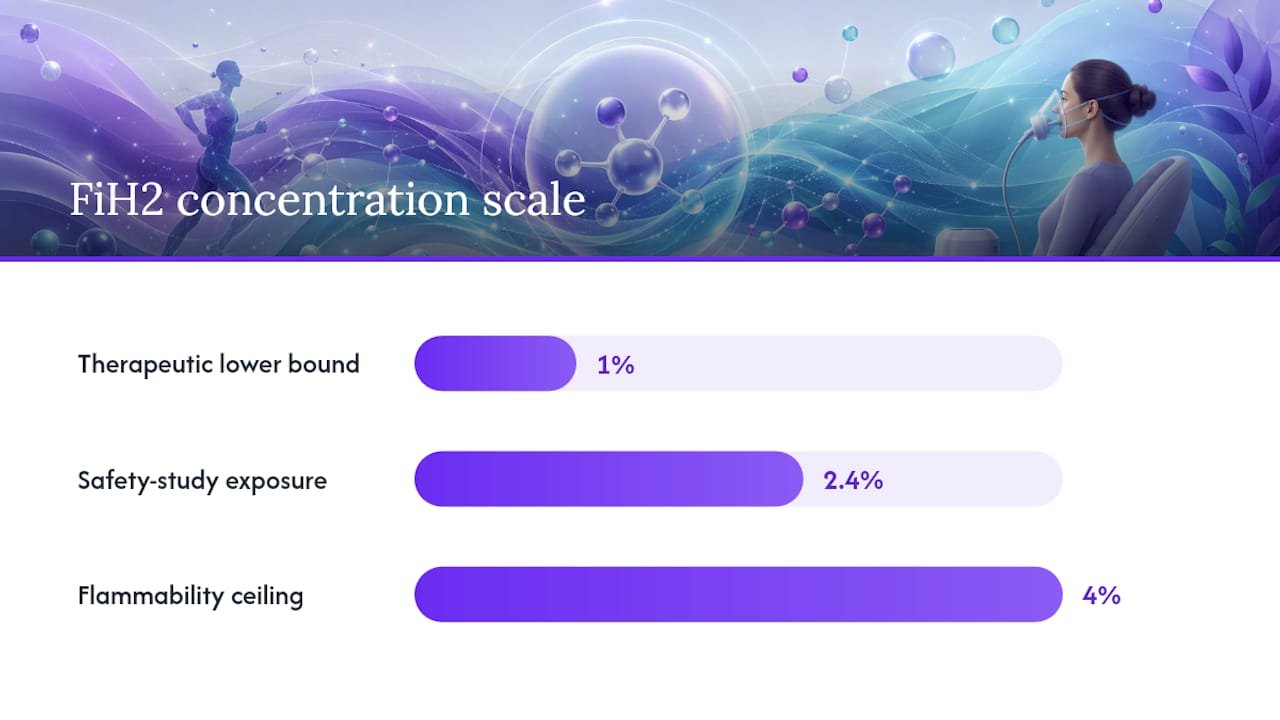
Is hydrogen inhalation safe? The short-term data is reassuring. A controlled safety study exposed healthy adults to 2.4% hydrogen in air, delivered via high-flow nasal cannula, continuously for 24 to 72 hours. That is a genuinely strong tolerability signal for a therapy still working its way through clinical trials.
The bigger safety issue with hydrogen is not physiological, it’s physical. Hydrogen gas becomes flammable and potentially explosive at concentrations above roughly 4% by volume in air. This single fact shapes almost every practical decision a clinic makes: source gas concentration, ventilation design, electrical equipment near the delivery system, and staff training all exist because of that flammability ceiling.
This is where the concept of FiH2, the fraction of inspired hydrogen, becomes genuinely important rather than a technical footnote. A respiratory-physiology modelling paper argues that FiH2 is the clinically meaningful dosing metric, not the concentration of the source gas or the flow rate on the dial. The same flow rate can deliver very different amounts of hydrogen to different patients depending on their minute ventilation, whether they breathe through their nose or mouth, and how well the delivery device seals against dilution from room air. The modelling suggests a practical therapeutic window of roughly 1% to 4% FiH2, balancing meaningful physiological effect against the flammability limit.
| Safety parameter | What the data shows | Practical implication |
|---|---|---|
| Tested exposure duration | 2.4% hydrogen for 24 to 72 hours, no significant adverse events | Supports supervised sessions well within this exposure range |
| Flammability threshold | Becomes unsafe above approximately 4% v/v in air | Clinics must never exceed this regardless of perceived benefit |
| Suggested therapeutic window | Approximately 1 to 4% FiH2 | The target range clinics should aim to estimate or measure, not just guess at |
| Dosing metric that matters | FiH2, not source gas percentage or flow rate alone | A “hydrogen tank at a flow rate” tells you almost nothing without knowing delivered FiH2 |
Pro Tip: Ask any provider what FiH2 your session is targeting, not just what percentage the tank is set to. Two people breathing from the same tank at the same flow rate can receive very different actual doses depending on how they breathe, so a clinic that can’t answer the FiH2 question is likely working from source concentration alone.
Achieving a genuinely therapeutic FiH2 through a simple low-flow nasal cannula is harder than it looks. Minute ventilation, nasal patency, and whether someone breathes through their mouth all drastically change how much hydrogen actually reaches the lungs versus how much is diluted by room air before it’s inhaled. Serious clinical settings either estimate FiH2 using published respiratory modelling equations or measure it directly with inline gas sampling, rather than assuming a flow rate translates predictably into a dose.
Good clinical practice around inhaled hydrogen also depends on operational discipline that has nothing to do with the gas itself: certified source gas documentation, maintenance logs for electrolysis-based generators, staff competency training, and clear emergency protocols. These controls exist precisely because flammability risk, not systemic toxicity, is the main safety variable a clinic needs to manage.
What to expect if you’re exploring hydrogen therapy
Session formats vary depending on the condition being addressed and the clinic’s protocol, but a typical outpatient session runs somewhere between 30 and 90 minutes, delivered via nasal cannula or face mask with vital sign monitoring throughout. Trials investigating chronic conditions like hypertension have used sustained programmes of daily or near-daily sessions over multiple weeks, while perioperative studies use shorter, single-session or brief-course protocols timed around the surgical event.
If you’re considering it, come prepared with the right questions:
- How do you determine my FiH2, and do you measure or estimate it? A provider who can’t answer this is likely working from source gas percentage alone, which is not the same thing as a controlled dose.
- How is the delivery equipment maintained, and is the source gas certified? Electrolysis units need documented maintenance; premixed cylinders need certification records.
- What training do staff have in gas safety and emergency response? Given the flammability threshold discussed above, this isn’t optional.
- What are the emergency procedures if something goes wrong? A legitimate clinic should have a clear, rehearsed answer.
- How does this fit with any other treatment I’m receiving? Hydrogen inhalation is increasingly offered alongside complementary therapies such as hyperbaric oxygen therapy or PEMF, and a good provider should be able to explain how the sessions relate to each other rather than treating them as unrelated add-ons.
Certain situations call for caution or a pause. Pregnancy is one, given the limited safety data specific to that population. Unstable cardiorespiratory status is another, since any inhaled therapy in someone with compromised breathing or circulation needs direct clinician oversight rather than a standardised protocol. If you have a significant heart, lung, or neurological condition, a clinical review before starting is the sensible path, not an optional extra.
Live5dhealth: how we think about hydrogen-related therapies
At Live5dhealth, hydrogen therapy sits within a wider toolkit of oxygen and cellular-support treatments rather than as a stand-alone gimmick. Our wellness centre in Boyle, County Roscommon, offers a genuinely broad range of evidence-informed therapies designed to work together:
- Hyperbaric oxygen therapy (HBOT), which shares some of hydrogen’s anti-inflammatory rationale through a different mechanism, pressurised oxygen delivery.
- PEMF (pulsed electromagnetic field) therapy for cellular and tissue recovery support.
- EWOT (exercise with oxygen therapy) and Brown’s Gas hydrogen therapy, offered as part of a supervised session structure.
- Luxury sauna, steam room, and cold plunge facilities that support broader recovery and circulation goals.
- An online shop stocking hydrogen water systems, electrolyte products, and structured water devices for those wanting a daily wellness routine alongside in-clinic sessions.
We approach device selection and safety with the same principle the research above points to: dosing and delivery matter more than headline concentration numbers. That means prioritising equipment reliability, staff familiarity with the therapies on offer, and a clear conversation with each guest about their health history before any session begins. We don’t claim hydrogen therapy is a cure for anything, and we won’t pretend the evidence is more settled than it is. What we can offer is a considered, supervised environment where you can explore these therapies alongside qualified guidance.
Author perspective: cautious optimism, not hype
The gap between hydrogen therapy’s biological plausibility and its current clinical proof is exactly what makes it interesting, and exactly why I’m wary of anyone selling it as a settled science. The mechanism is genuinely elegant: a molecule small enough to reach anywhere in the body, selective enough to spare the oxidative signalling you actually need. That’s rare in antioxidant research, where the usual failure mode is blunt-force scavenging that does as much harm as good.
But elegance in a lab doesn’t equal proof in a patient. The hypertension and perioperative recovery data are the real story here, not the neuroprotection headlines that circulate more widely. I’d rather see five more trials like the perioperative QoR-15 study than a hundred more preclinical papers on mechanism.
If you try this, do it somewhere that treats FiH2 as seriously as the trials do, and talks to your clinical team first if you have an existing condition. Evidence-based optimism beats blind enthusiasm every time.
— Mark
Book a supervised session at Live5dhealth
Reading about FiH2 and flammability thresholds is one thing, experiencing a properly supervised session is another. Live5dhealth gives you access to hydrogen-related therapies alongside HBOT, PEMF, and recovery facilities in one clinical setting in Boyle, County Roscommon, rather than piecing together devices and guesswork on your own.

An initial consultation focuses on your health history, any contraindications like unstable cardiorespiratory conditions or pregnancy, and a plain conversation about what the current evidence does and doesn’t support for your situation. From there, sessions are scheduled with trained staff overseeing delivery and monitoring. If you’d rather build a fuller reset around it, our multi-day luxury healing retreats combine these therapies with recovery-focused programming. Visit our luxury spa and wellness centre page to see current availability and book your first assessment.
Sources
- Effectiveness and safety of hydrogen inhalation therapy as an additional treatment for hypertension in real-world practice
- Safety of prolonged inhalation of hydrogen gas in air in healthy adults
- Respiratory‑physiology modeling of therapeutic hydrogen inhalation: defining the fraction of inspired hydrogen (FiH2) and flow-rate requirements
- The impact of perioperative hydrogen gas inhalation on postoperative recovery in day surgery patients
FAQ
Is hydrogen inhalation therapy good for you?
Evidence is strongest for hypertension management and perioperative recovery, where controlled studies show measurable benefits, while other conditions remain under active but earlier-stage investigation.
How often should you do hydrogen inhalation therapy?
Trial protocols vary widely by condition, from single perioperative sessions to daily programmes over several weeks in the 24-week hypertension study, so frequency should be set by a clinician based on your goals rather than a fixed rule.
Can you breathe hydrogen safely?
At controlled concentrations, yes: a safety study found no clinically significant adverse events in healthy adults breathing 2.4% hydrogen continuously for up to 72 hours, though concentrations above roughly 4% carry flammability risk and should never be used.
What are the side effects of hydrogen therapy?
Monitored trials report a good tolerability profile with no significant changes in vital signs, lung function, or lab markers during supervised exposure, making flammability and equipment safety the primary risks rather than physiological side effects.
Is hydrogen inhalation therapy available at Live5dhealth?
Hydrogen-related therapy is offered alongside other wellness treatments in a clinical setting, with sessions structured around a client health consultation first.