

Structured water is ordinary H2O that proponents claim has been reorganised into a more stable, hexagonal molecular arrangement with added health benefits. No high-quality human trial has confirmed those benefits, and most supportive evidence comes from animal studies or laboratory observations of water near surfaces, not from drinking treated water. Clean, adequate hydration still does more for your health than any structuring device.
TL;DR:
- Most animal studies showing benefits from structured water are inconclusive and do not prove effects will occur in humans.
- Laboratory evidence confirms water can form an ordered interface next to surfaces, but this does not mean bottled or vortexed water retains those properties in the body.
- Claims about long-lasting water structuring or health benefits lack credible scientific support, with most effects being short-lived or unmeasurable.
- Devices claiming to restructure water through vortexing, magnets, or crystals show only transient and minor changes that do not lead to proven health improvements.
- Maintaining proper hydration with safe, high-quality water is far more important than focusing on unproven structuring devices or claims.
Table of Contents
- Structured water explained: what proponents actually mean
- What benefits do people claim for structured water?
- Does structured water work? What the evidence shows
- How is structured water made? Vortexing, magnets, and other methods
- How long does structured water last, and where do proponents say it occurs naturally?
- Hydration and safety: what actually matters more
- Live5dhealth’s perspective on structured and living water
- The gap between the marketing and the microscope
- Curious about water quality? Here’s where to start
- Sources
Structured water explained: what proponents actually mean
You’ll hear several names for the same core idea: hexagonal water, exclusion zone (EZ) water, coherent water, or magnetised water. Every version rests on the claim that liquid H2O can be coaxed into a more ordered, structured arrangement of molecules, one that behaves differently in the body than “regular” tap or bottled water.
The scientific seed of this idea is real. University of Washington researcher Gerald H. Pollack’s laboratory work has documented something called an exclusion zone: a layer of ordered water that forms next to hydrophilic (water-attracting) surfaces under controlled lab conditions. This EZ water pushes away dissolved particles and behaves differently from bulk water nearby. Some proponents extend this into the “H3O2” hypothesis, suggesting this interfacial water has a distinct molecular formula rather than the standard H2O.
Here’s where the story gets stretched. Pollack’s findings describe water structured at an interface, meaning right next to a surface such as a cell membrane or a hydrophilic gel, under carefully controlled laboratory conditions. That’s a genuinely interesting physical phenomenon. It is a considerable leap from there to claiming a bottle of water, a jug run through a vortex, or a magnetic attachment on your tap can recreate that same ordered state throughout an entire container, and that drinking it will replicate the effect inside your digestive tract. Bottled and device-based “structured water” products borrow the language of legitimate interfacial-water research without demonstrating they produce the same effect at any meaningful scale.
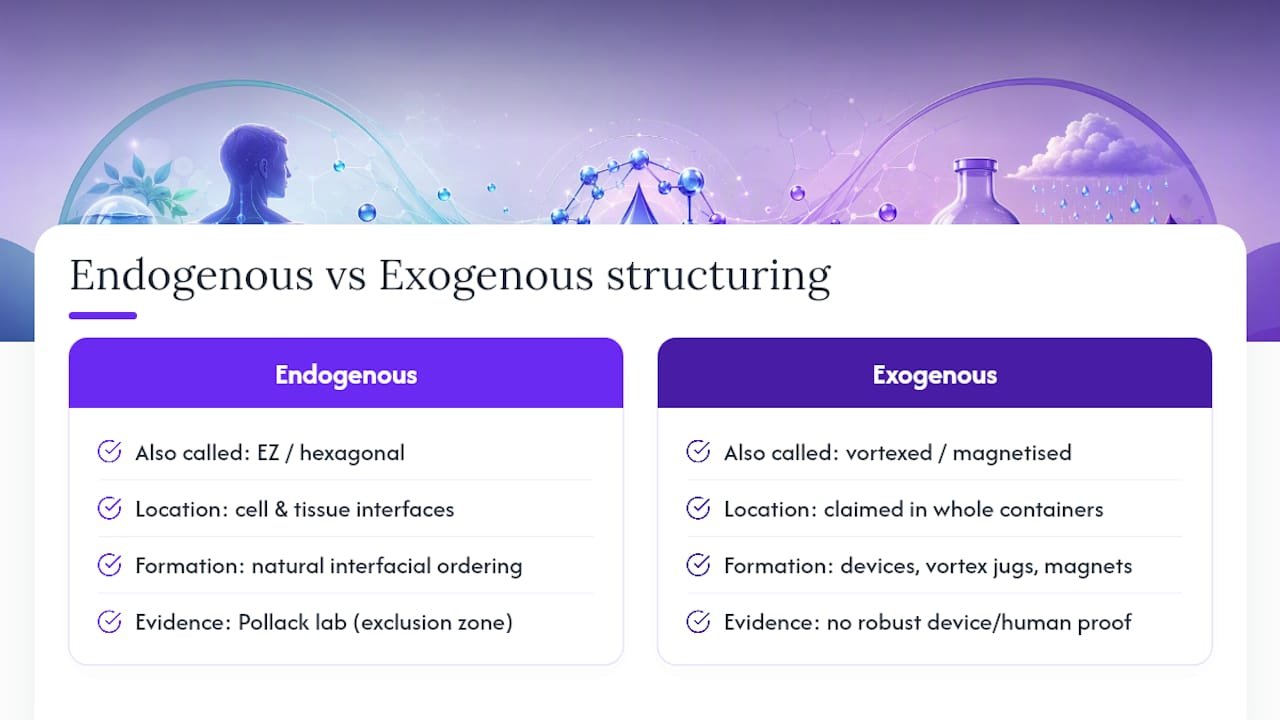
That distinction between endogenous structuring (which happens naturally inside your cells and tissues) and exogenous structuring (what a device or bottle claims to do to water before you drink it) is the crux of nearly every disagreement on this topic. Your body may well structure water at biological interfaces as part of normal cell function. Whether a vortex jug can do the same thing to a litre of tap water, and whether that would survive digestion even if it could, is a separate and far shakier claim.
What benefits do people claim for structured water?
Wellness marketing around structured water tends to promise a wide spread of outcomes, some testable, most vague. The most common claims include:
- Better hydration than regular water, sometimes described as “more bioavailable” or easier for cells to absorb.
- Increased energy and reduced fatigue.
- Support for detoxification, often paired with claims about flushing toxins more efficiently.
- Improved skin appearance, including hydration and elasticity.
- Metabolic benefits, such as better blood sugar or lipid markers.
- Sleep and cognitive improvements, usually described anecdotally rather than measured.
A handful of these claims are at least testable in principle. Hydration status can be measured through urine osmolality or blood markers, and blood lipid or glycaemic profiles are standard clinical tests. Claims about “energy,” detoxification, or general wellbeing are harder to pin down and rarely defined in a way that a study could actually measure.
Marketing for structured water products frequently leans on origin stories rather than data: glacial melt, mountain springs, vortexing chambers, or “energised” crystals sit alongside the health claims as if the source itself proves the benefit. It’s a compelling narrative. It is also, on its own, no substitute for a controlled study.
Does structured water work? What the evidence shows
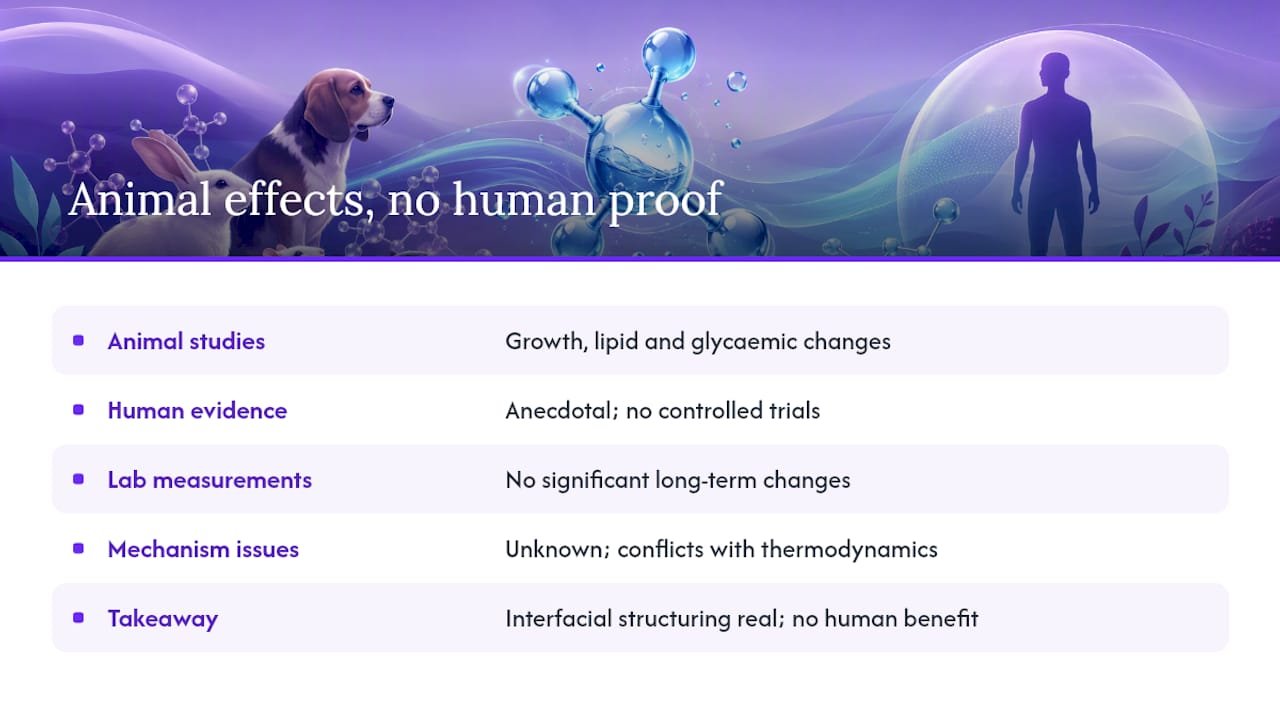
The honest answer is that the evidence is thin, uneven, and mostly comes from the wrong species. A 2021 review published in PMC looked at animal studies where subjects consumed structured or magnetized water for durations of several weeks or more. It found consistent responses across several studies, including increased growth rate and improved lipid or glycaemic markers. That sounds promising until you read the review’s own conclusion: the mechanisms behind these effects remain unknown, and nothing confirms the results translate to humans.
Repeated positive responses in animal studies do not, on their own, establish either a plausible mechanism or a demonstrated benefit in humans. The gap between “this happened in rats” and “this will happen in you” is exactly where structured water claims tend to fall apart.
That gap matters because most of what exists on humans is not a clinical trial at all. A PubMed record covering structured water animal studies notes that animal research spans roughly twenty years, while human data remains largely anecdotal or limited to small, uncontrolled field observations. No sample sizes worth citing. No blinding. No control groups drinking regular water side by side. That’s not a minor gap in the literature, it’s the entire category of evidence that would actually tell you whether structured water changes anything in a human body.
Lab measurements of magnetised or vortexed water add another layer of doubt. Studies measuring pH, conductivity, and hardness after magnetisation commonly find no significant long-term changes. Small transient effects can appear right after treatment, but they don’t confirm a stable, novel form of water has been created.
Scientific critics go further, and their objections are worth taking seriously rather than dismissing as reflexive scepticism. A detailed critical analysis of structured water and H3O2 claims points out that claims of permanent molecular reorganisation from vortexing or magnets carry the hallmarks of pseudoscience: small uncontrolled samples, poor reproducibility, and a direct contradiction of basic thermodynamic principles. Water at room temperature has enormous entropy. Getting billions of molecules to hold a stable, ordered structure without a continuous surface or energy source to maintain it isn’t just unproven, it runs against how liquids behave physically.
Put together, the credible takeaway is narrow: interfacial water structuring is real and observable in a lab, animal studies show some repeatable effects that nobody can yet explain, and human clinical evidence supporting health benefits from drinking “structured” water does not currently exist at any meaningful scale.
How is structured water made? Vortexing, magnets, and other methods
If you’ve shopped for a structuring device, you’ve likely seen some combination of these methods, each with its own claimed mechanism:
- Vortexing: swirling water in a cone or spiral chamber, said to mimic the movement of water in natural streams.
- Magnetising: passing water through or past magnets, often built into an in-line tap attachment.
- Light or UV exposure: claimed to “energise” water molecules.
- Crystals: placing quartz or other crystals in or near water containers.
- Electrolysis devices: splitting water electrochemically, sometimes marketed alongside hydrogen-water claims.
What these processes measurably change tends to be modest and short-lived: minor temperature shifts, changes in dissolved gas content, brief molecular orientation near surfaces, or small pH and conductivity fluctuations that fade quickly. None of that is the same as permanent, bulk molecular restructuring, and the lab data above doesn’t support that a device can achieve it.
There’s a more practical concern too. Unregulated devices, particularly cheaper vortex jugs, magnetic attachments, or electrolysis units bought online, aren’t held to the same safety standards as certified filtration systems. Some can introduce unwanted minerals or fail to filter contaminants a proper purification system would catch.
Pro Tip: Before buying any water-treatment device, check whether it has undergone independent water-quality testing, not just marketing claims about “energised” or “structured” output. A device that improves filtration is worth paying for. One that only claims to rearrange molecules, with no safety testing behind it, is a different proposition entirely.
How long does structured water last, and where do proponents say it occurs naturally?
Claims about how long “structure” persists vary wildly, and that inconsistency is itself a red flag. Some proponents suggest the claims about effect duration vary widely, from fading quickly after pouring to lasting for extended periods. There’s no agreed standard for measuring or verifying either claim.
Natural sources frequently cited as inherently “structured” include:
- Mountain spring water
- Glacial meltwater
- Water from fast moving streams or waterfalls
- Water inside living plant tissue and cells
The problem is thermodynamic, not just a matter of missing studies. Bulk water left standing in a bottle or jug has no ongoing energy source or surface to maintain an ordered arrangement. Entropy pulls disordered systems toward randomness, not away from it, so any structure created by a spring, a vortex, or a magnet has no obvious reason to persist once the water sits still. Endogenous structuring inside plant cells or biological tissue is a different matter, since it’s continuously maintained by living interfaces, not a one-off treatment applied to a jug.
Hydration and safety: what actually matters more
Water safety and total intake do far more for your health than any structuring claim. Before worrying about vortexes or magnets, get these basics right:
- Start with water quality, not water structure. Use municipal water testing results or a certified filter if you’re concerned about contaminants, rather than a device promising molecular reorganisation.
- Check your hydration status simply. Pale straw coloured urine, minimal thirst, and steady energy through the day are reasonable everyday indicators that intake is adequate.
- Adjust for activity and climate. Exercise, heat, and illness all raise fluid needs well above a generic daily target.
- Talk to a clinician before changing your fluid routine if you have kidney disease, heart failure, or another condition affecting fluid balance. Adding mineral-rich specialty waters or significantly increasing intake can be genuinely risky for these conditions, and that caution applies whether the change comes from a “structured” product or simply drinking more water than usual.
If switching to a specialty water product makes you feel better, the most plausible explanation is behavioural: you’re simply drinking more water than before, not experiencing a molecular effect. That’s still a genuine win. It’s just not the mechanism the marketing describes.
Live5dhealth’s perspective on structured and living water
Live5dhealth sells various water-related products and wellness therapies. We think it’s worth being straightforward about where the evidence actually stands: current clinical research does not show structured water outperforms ordinary, safe drinking water for hydration or disease prevention.
What we do focus on is quality and transparency. Our role is education and provision, not clinical claims: we don’t position any water product as a cure or a replacement for medical care. If you’re curious about the topic, our living water resources and structured water product range are built around helping you make an informed choice, backed by proper filtration and quality control, rather than promises we can’t back with data. If a therapy or product doesn’t meet that bar, it doesn’t belong on our shelves.
The gap between the marketing and the microscope
Here’s what conventional coverage of structured water tends to get wrong: it either dismisses the entire concept as nonsense or treats vendor claims as settled science. Neither position holds up. Pollack’s exclusion-zone research is genuinely interesting physics, and the animal-study signal in the PMC review is real enough that it shouldn’t be waved away. What’s missing is the bridge between those observations and a human drinking a bottle of “structured” water expecting a measurable health outcome.
My honest read is that most people chasing structured water are actually solving a hydration problem, not a molecular one. If a fancy jug gets someone to drink two more glasses of water a day, that’s a genuine benefit, just not the one printed on the label. Prioritise water quality and consistent intake first. Treat structuring claims as an open scientific question worth watching, not a settled benefit worth paying a premium for today.
— Mark
Curious about water quality? Here’s where to start
If this has left you more interested in water quality than in structuring claims, that’s the right instinct, and it’s exactly where Live5dhealth can help without overselling you on anything. We sell purification devices designed to remove contaminants using established filtration standards, not just marketing language about “energised” molecules.
Our hydrogen-rich reverse osmosis purifier is a practical starting point if you want cleaner water with transparent specifications rather than unverifiable claims. Ask us about filtration standards, mineral content, and testing data before you buy, whether from us or anyone else selling water devices. If you’d rather explore the wider picture of holistic hydration and wellness in person, our luxury retreats combine expert guidance with therapies designed around genuine physiological support. Browse the full shop to compare options and book a consultation to talk through what actually fits your health goals.
Sources
This article is general information, not a substitute for advice from a qualified doctor. Consult a qualified healthcare professional about your own circumstances before acting on anything here.