
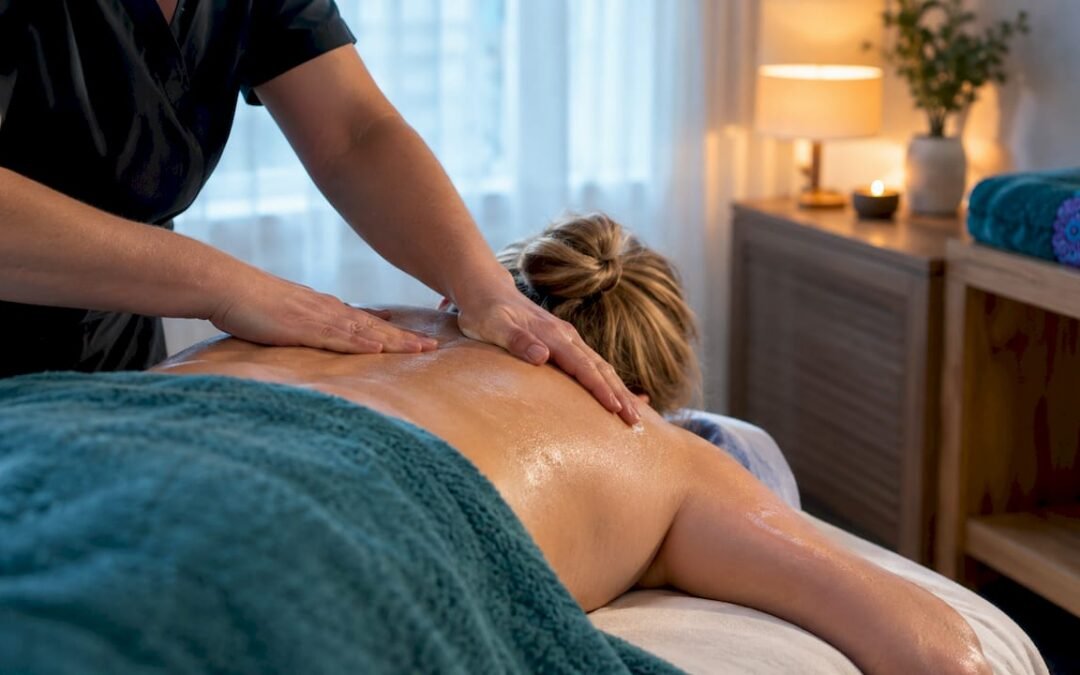
Holistic massage benefits your body, mind and emotions in ways that go well beyond a good stretch. The main caveat is context: certain medical conditions, particularly during active cancer treatment, call for adapted pressure and clinician input before booking a session.
TL;DR:
- Regular holistic massage can provide cumulative benefits, with weekly sessions for four to six weeks greatly reducing pain and stress markers.
- Those with active cancer or recent surgery should seek clinician input before booking, as deep pressure over tumor sites or open wounds is contraindicated.
- The primary measurable effects include lowered blood pressure, cortisol levels, and heart rate, with emotional releases often occurring during treatment.
- Consistent practice enhances sleep quality, reduces tension, and improves overall mood, but long-term disease prevention claims lack strong scientific backing.
- Personalized sessions adapt techniques based on real-time feedback, emphasizing the importance of full disclosure about health conditions for safe and effective treatment.
Table of Contents
- What are the physical benefits of holistic massage?
- Mental and emotional benefits worth taking seriously
- The mechanisms behind the benefits
- Safety and contraindications you should know before booking
- What happens during a holistic massage session
- How often should you get a holistic massage?
- Holistic massage vs standard massage: what’s actually different
- Do the benefits build up over time?
- How holistic massage compares to acupuncture and reflexology
- What the evidence gets right, and where the hype outpaces it
- Book holistic massage and recovery support at Live5dhealth
- Sources
- FAQ
What are the physical benefits of holistic massage?
The physical case for holistic massage is no longer just anecdotal. The Frontiers in Psychology meta-analysis found average reductions in systolic blood pressure, heart rate, and pain scale scores compared with control groups. Those are averages across dozens of trials and many massage styles, so individual results vary, but the direction of the evidence is consistent.
Beyond the numbers, manual pressure and rhythmic strokes encourage blood flow to tight or injured tissue, which helps flush out metabolic waste and deliver oxygen where it’s needed. Lymphatic flow also benefits from gentle, directional strokes, something that matters even more for anyone managing swelling after surgery or cancer treatment.
Conditions that typically respond well include:
- Chronic lower back pain and stiffness from prolonged sitting or standing
- Tension headaches linked to shoulder and neck tightness
- Post-exercise soreness and slow recovery
- Reduced joint mobility from inactivity or ageing
- Poor sleep quality tied to physical tension
Track your own response over a few sessions. Watch for easier movement getting out of bed, fewer tension headaches, and whether you’re sleeping through the night without shifting to find a comfortable position.
Mental and emotional benefits worth taking seriously
Stress relief from massage isn’t just a feeling. It shows up in measurable autonomic changes. The same Frontiers in Psychology meta-analysis that documented blood pressure improvements also recorded cortisol reductions of up to 31%, a hormonal shift that correlates with reduced anxiety and better sleep quality.
Touch itself carries a therapeutic signal that has nothing to do with muscle mechanics. Specialised nerve fibres called C-tactile afferents respond to slow, gentle stroking by triggering the release of oxytocin, sometimes called the body’s calming hormone. This mechanism, described in reviews of rhythmical massage techniques, helps explain why a session can leave you feeling emotionally lighter, not just physically looser.
Pro Tip: If you notice unexpected emotional release during a session, a lump in the throat, tears, or a wave of relief, that’s a normal response to sustained physical touch and parasympathetic activation. It usually passes within minutes and often leaves people feeling clearer afterwards.
Common emotional benefits include:
- Lower day-to-day anxiety and a calmer baseline mood
- Better quality sleep, particularly falling asleep faster
- A sense of mental clarity or emotional “unloading” post-session
- Improved mood that can last several days after treatment
The mechanisms behind the benefits
Holistic massage works through several overlapping biological pathways, not a single mechanism. Sustained, moderate pressure activates the parasympathetic nervous system, the body’s “rest and digest” mode, which is why heart rate and blood pressure tend to drop during and after a session.
On the endocrine side, cortisol reduction is the most consistently documented change. Lower cortisol reduces the physiological stress response that keeps muscles tense and sleep disrupted. Touch also modulates neurotransmitter activity linked to mood regulation, working alongside oxytocin release from stimulated C-tactile afferents, as outlined in the mechanistic review from Human Kinetics.
Circulatory and lymphatic effects are more straightforward: manual pressure physically encourages blood and lymph movement through tissue. Immune findings are murkier. Some research has looked at natural killer (NK) cell activity following massage, but the evidence here remains preliminary and inconsistent.
A fair reading of the research acknowledges its limits. A systematic mapping of massage therapy evidence found that high or moderate-certainty evidence exists for only a few specific outcomes, while most benefits carry low or very low certainty ratings. That doesn’t mean the effects aren’t real. It means researchers haven’t yet standardised protocols enough to measure them with total precision.
Safety and contraindications you should know before booking
Holistic massage is broadly safe, but a few situations call for caution or a different approach entirely. Deep pressure isn’t appropriate for everyone, and disclosure at intake matters more than most people realise.
Defer or modify treatment if you have:
- A fever, active infection, or contagious skin condition
- Deep vein thrombosis or unexplained swelling in one limb
- Recent surgery, fractures, or open wounds near the treatment area
- Severe osteoporosis, where deep pressure risks injury
- Active cancer treatment, without prior clinician clearance
Cancer care needs particular attention. A PLOS One systematic review found that light-to-moderate intensity massage in people with cancer generally carries no increased risk of harm, although deep massage directly over tumour sites is discouraged due to uncertainty around its effects. Therapists trained in oncology massage typically favour gentler pressure and avoid working directly over known tumour locations. If you’re managing swelling from treatment, it’s worth understanding lymphoedema and how manual lymphatic drainage helps before your first session. Always disclose medications, recent procedures and diagnoses at intake so your therapist can adapt.
What happens during a holistic massage session
A holistic session is built around adapting to you in real time, not running through a fixed routine.
- Intake conversation. Your therapist asks about physical complaints, stress levels, sleep, and any medical conditions or medications before you get on the table.
- Technique selection. Expect a blend of long effleurage strokes, kneading, gentle joint mobilisation and slower holding techniques, chosen based on what your body and stated goals need that day.
- Real-time adaptation. Pressure and pacing shift depending on how your muscles respond, tension you’re holding, and verbal or physical feedback during the session.
- Aftercare. Sessions typically run 60 to 90 minutes. Mild soreness, light-headedness, or emotional lightness afterwards are all normal. Drink water and move gently for the rest of the day.
How often should you get a holistic massage?
Frequency depends on what you’re trying to achieve. For acute pain or high stress, weekly sessions for four to six weeks tend to produce the clearest results. Once symptoms ease, fortnightly sessions usually maintain progress without the intensity of weekly bookings.
For general wellbeing and stress management, monthly sessions are often enough to sustain benefits, particularly when paired with good sleep habits and regular movement. Signs it’s working include better sleep, fewer tension flare-ups, and feeling calmer between sessions. If nothing shifts after three or four visits, it’s worth changing technique, pressure, or frequency rather than assuming massage isn’t for you.
Holistic massage vs standard massage: what’s actually different
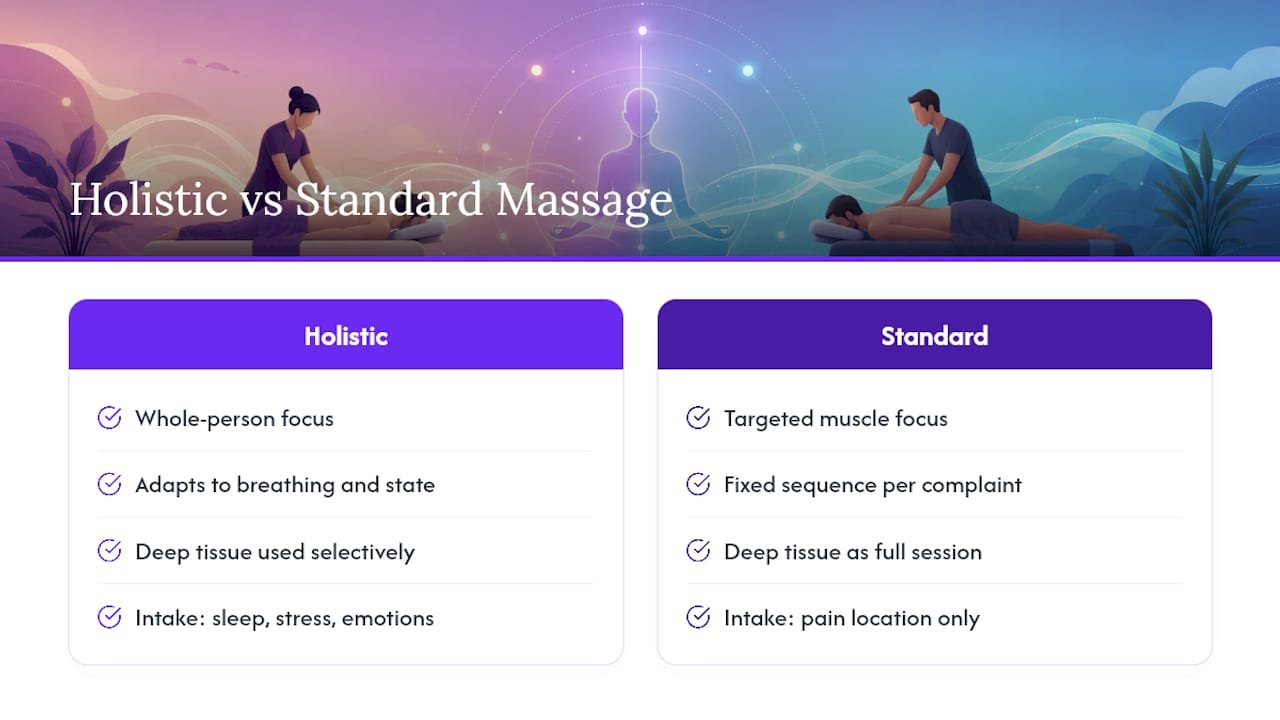
The difference comes down to intent, not just technique. Standard massage, including many deep tissue sessions, targets a specific muscle group or complaint with a fairly fixed sequence. Holistic massage treats the whole person, adjusting pressure, pace and technique based on emotional state, breathing and how your body responds moment to moment.
Integrative bodywork specialists frame this as whole-person regulation rather than purely mechanical release, and that distinction shapes everything about the session, according to an overview from Memorial Sloan Kettering’s integrative medicine programme. A deep tissue session might spend forty minutes working through one stubborn shoulder. A holistic session might start there, then shift to slower, calming strokes across the back if your breathing signals you need to settle rather than be worked harder.
This also explains why holistic massage vs deep tissue isn’t really a competition between two techniques. Deep tissue is often one tool within a broader holistic session, used selectively rather than as the entire treatment plan. The intake conversation matters more in a holistic setting too. Therapists ask about sleep, stress and emotional state, not just where it hurts, and tailor oils, pacing and pressure to match. That’s a meaningfully different experience from booking “an hour of deep tissue” and getting exactly that, regardless of how you’re feeling that day.
Do the benefits build up over time?
A single session can lower your heart rate and ease tension for a few days. Regular sessions do more than that: they compound. Consistent bodywork over months tends to produce cumulative improvements in baseline stress levels, sleep quality and pain tolerance that a one-off treatment simply can’t match.
This mirrors what’s seen in supportive cancer care, where trials report sustained reductions in fatigue, pain and mood disturbance across a course of treatment rather than after a single session, according to reporting from The ASCO Post. The body seems to respond to a pattern of care, not an isolated intervention.
That said, evidence for long-term outcomes is thinner than for immediate, session-by-session effects. Most trials measure changes over days or weeks, not years, so claims about massage preventing chronic disease or permanently resetting stress physiology go beyond what the research currently supports. What’s better supported is a practical pattern: people who receive massage regularly, alongside decent sleep and movement, tend to report better stress resilience and fewer flare-ups of chronic pain than those who treat it as a one-off indulgence. Think of it less like a single dose of medicine and more like exercise. One session helps. A consistent pattern changes your baseline.
How holistic massage compares to acupuncture and reflexology
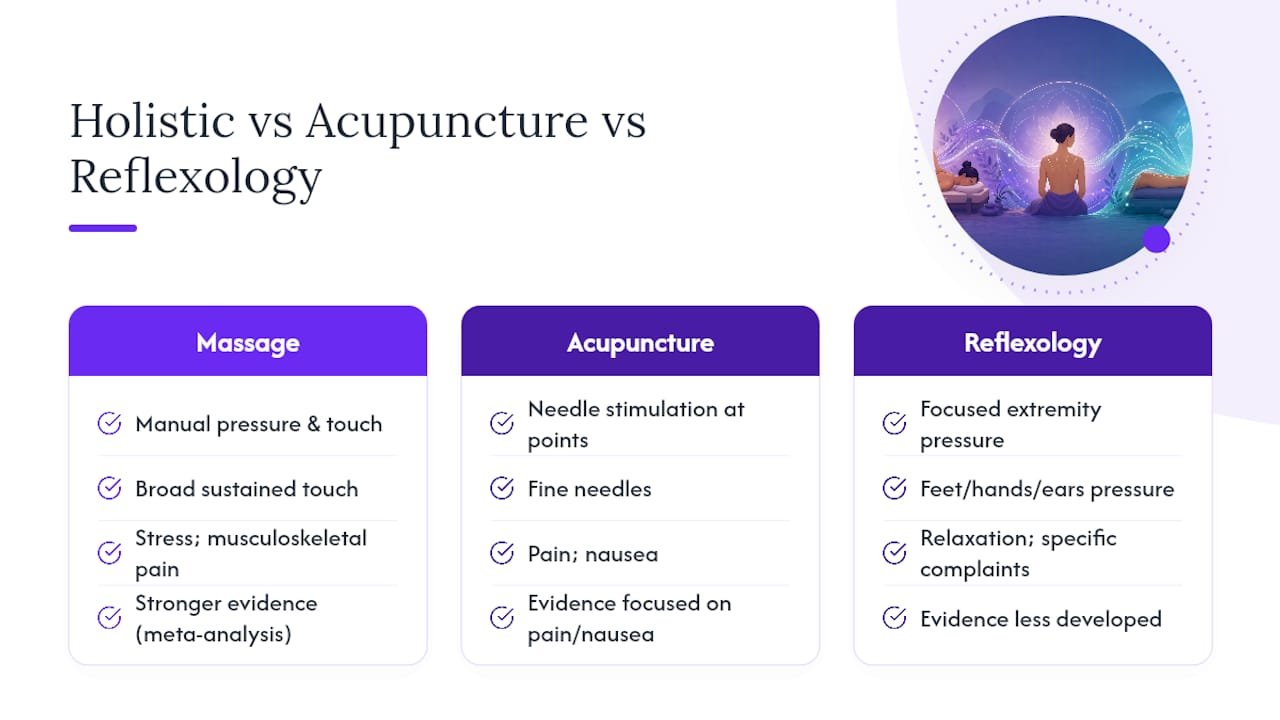
All three sit under the complementary therapy umbrella, but they work through different mechanisms and suit slightly different needs. Holistic massage relies on direct manual pressure and touch, activating the parasympathetic nervous system and modulating cortisol through sustained physical contact.
Acupuncture uses fine needles at specific points to influence pain signalling and nervous system regulation, with a different evidence base built largely around pain conditions and nausea. Reflexology applies focused pressure to points on the feet, hands or ears believed to correspond to other body systems, though its evidence base is generally less developed than that for massage or acupuncture.
For general stress reduction and musculoskeletal complaints, holistic massage currently has the stronger body of clinical evidence behind it, including the large-scale meta-analysis covering thousands of participants. That doesn’t make it universally superior. Someone managing chronic migraine might find acupuncture more targeted; someone who dislikes being touched extensively might prefer reflexology’s more contained approach. Many people combine therapies rather than choosing one exclusively, using massage for broad relaxation and acupuncture or reflexology for specific complaints.
What the evidence gets right, and where the hype outpaces it
The honest reading of this research is that holistic massage earns its reputation for stress relief and short-term pain reduction, but the industry oversells its certainty on longer-term and disease-specific claims. The systematic mapping is blunt about this: solid evidence exists for a narrow set of outcomes, while most other claimed benefits sit in low-certainty territory. That’s not a reason to dismiss massage. It’s a reason to be precise about what it does well.
Where conventional wellness advice falls short is treating all massage as interchangeable. A weekly deep tissue session booked purely to “work out knots” and a holistic session built around emotional intake and adaptive pressure are different interventions with different likely outcomes. Readers dealing with chronic conditions, cancer recovery, or persistent anxiety get more value from finding a therapist who screens properly and adapts technique than from chasing the deepest pressure available.
If you prioritise one thing, prioritise disclosure. Tell your therapist everything, medications, diagnoses, emotional state, even if it feels irrelevant. The mechanisms behind these benefits, oxytocin release, cortisol reduction, parasympathetic activation, depend on your nervous system feeling safe enough to actually respond.
— Mark
Book holistic massage and recovery support at Live5dhealth
Holistic massage combined with sauna, steam and cold plunge facilities can help address muscle tension, circulation and nervous system regulation in the same session rather than across separate appointments.

This suits readers managing chronic pain, perimenopause symptoms, or recovery after cancer treatment who want a therapist who screens properly and adapts pressure rather than running a fixed routine. If you’re navigating swelling or lymphatic concerns, it’s worth reading about lymphatic drainage massage and when it helps before booking. For a deeper reset, the luxury health retreats combine massage with wider recovery support over several days. Ready to feel the difference for yourself? Explore spa and holistic massage bookings at Live5dhealth and check current availability.
This article is general information, not a substitute for advice from a qualified doctor. Consult a qualified healthcare professional about your own circumstances before acting on anything here.
Sources
- Frontiers in Psychology systematic review and meta-analysis (2026)
- PLOS One systematic review — harms of massage in persons with cancer (2022)
FAQ
What happens during a holistic massage?
A therapist begins with an intake conversation covering your physical and emotional state, then blends techniques like effleurage, kneading and gentle joint mobilisation, adapting pressure and pace based on how your body responds throughout the session.
Are there parts of the body a therapist won’t massage?
Therapists generally avoid direct pressure over open wounds, recent surgical sites, active infections, varicose veins, and areas with suspected blood clots; in cancer care, they also avoid deep work directly over known tumour sites.
How often should you get a holistic massage?
Weekly sessions for four to six weeks work well for acute pain or high stress, while fortnightly or monthly sessions typically maintain benefits once symptoms ease.
What is the difference between a typical massage and a holistic massage?
Standard massage usually targets a specific complaint with a fixed technique, while holistic massage adapts pressure, pacing and technique in real time based on your whole physical and emotional state.
Is massage safe during or after cancer treatment?
Light-to-moderate pressure massage is generally considered safe for people with cancer, though deep pressure over tumour sites is discouraged and clinician clearance is recommended before starting treatment.