
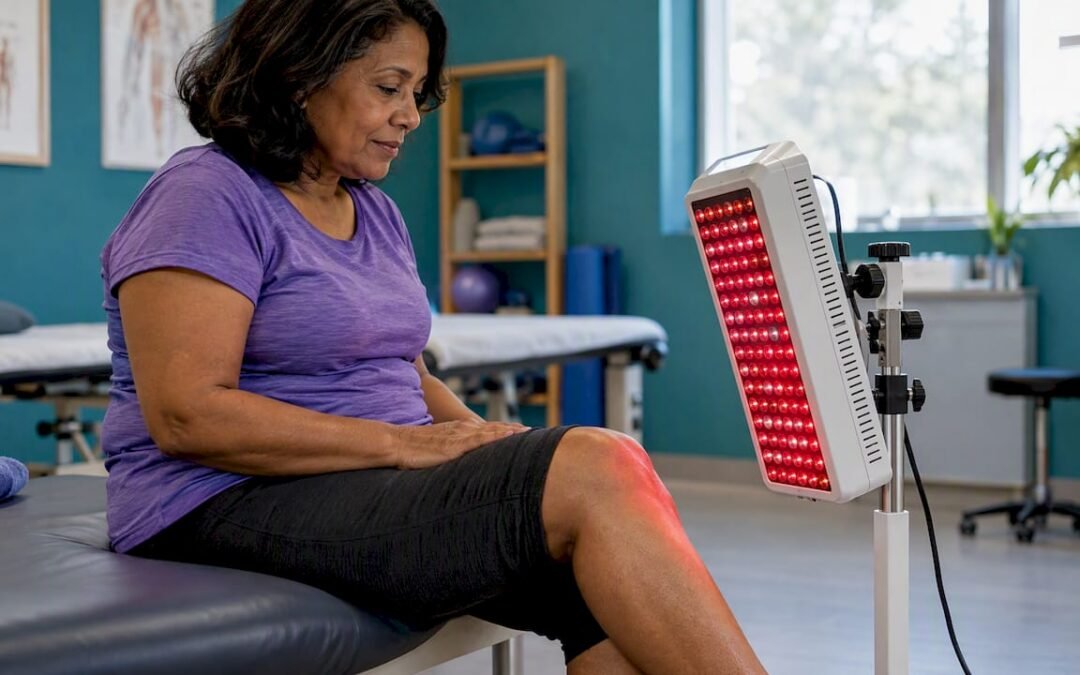
Red light therapy may help ease arthritis pain, and the best evidence so far is for knee osteoarthritis. It is not a cure, it does not replace your prescribed treatment, and the certainty of the research is still low. Used as a gentle extra alongside exercise and the care your doctor or rheumatology team recommends, it can be a sensible option to explore. Here is what the studies say, where they fall short, and how to approach a course of sessions safely.
TL;DR
- Red light therapy (also called photobiomodulation) reduced knee osteoarthritis pain in a 2024 review, but the certainty of that evidence was rated very low.
- For rheumatoid arthritis the evidence is weaker and more uncertain, so treat light as a comfort measure only, never a replacement for your medication.
- Wavelength, dose and session length all matter. Results vary with treatment parameters.
- If you have or have had cancer, or take medicines that affect how your skin reacts to light, speak to your oncologist or specialist before booking.
- At Live5DHealth in Boyle, Co. Roscommon, red light sessions cost €20 to €40.
Table of Contents
- What red light therapy actually does in a joint
- What the research says for osteoarthritis
- Rheumatoid arthritis: a more cautious picture
- Knees, hands and feet: does the joint matter?
- Dose, wavelength and frequency: why the details matter
- Who should check first
- Using light alongside your current treatment
- Home devices or a supervised session?
- Red light sessions at Live5DHealth
- Our perspective: light is a helper, not a headline
- If light therapy is not right for you
- FAQ
- Sources
What red light therapy actually does in a joint
Red light therapy uses low-level red and near-infrared light, delivered by LED panels or low-level lasers, to reach the skin and the tissue beneath it. The scientific name is photobiomodulation, often shortened to PBM. It is not heat therapy, and it is a different thing from UV light.
A 2023 review of the mechanisms and efficacy of photobiomodulation in arthritis explains that PBM may increase ATP production, regulate inflammatory cytokines and improve blood flow, which could in turn reduce inflammation and pain. ATP is the cell’s energy currency, produced in the mitochondria, the “powerhouse of the cell”. If you want the cell-level detail, our piece on red light and mitochondria goes deeper.
That mechanism is a hypothesis supported by lab and clinical work, not a guarantee. A joint affected by arthritis is a complicated environment: cartilage, the joint lining, bone, muscle and nerves all contribute to what you feel. Light may influence some of these, and that is why researchers keep studying it.
What the research says for osteoarthritis
Osteoarthritis, the wear-related form that most often affects knees, hips, hands and the base of the thumb, has the most research behind it.
A 2024 systematic review and meta-analysis in the journal Physical Therapy looked at photobiomodulation for knee osteoarthritis. It found that PBM reduced pain intensity and may improve disability, but the certainty of evidence was very low. It also found that PBM did not significantly improve performance on the Timed “Up & Go” test compared with placebo. That test measures how quickly you can stand, walk a short distance and sit back down.
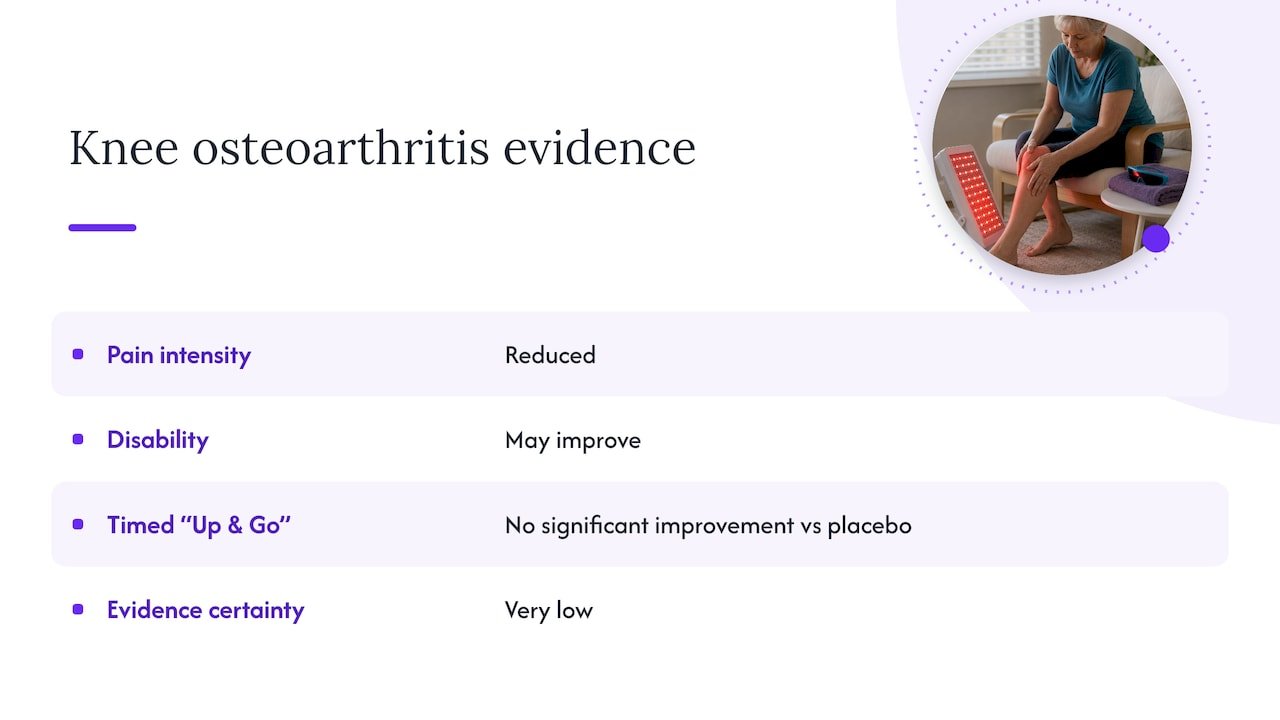
In plain words: people tended to report less pain, but there was no clear proof of faster walking or standing in that particular test. Pain relief is real to the person feeling it, and it can make exercise easier. Still, it is honest to say the studies are small or varied and the quality is limited.
The same review noted something useful about wavelengths. Wavelengths of 904 to 905 nm and 785 to 850 nm significantly reduced knee pain compared with sham low-level laser therapy. Those are near-infrared wavelengths, which is why a good provider talks about both red and near-infrared light rather than red alone. We explain this further in our guide to red light wavelengths.
A separate narrative review of low-level laser therapy in osteoarthritic pain, with Irish authors Dr SN Hennessy and GD Corcoran, makes a balanced point. Because pain is multifaceted, it is difficult to quantify treatment results, yet LLLT is a useful non-pharmacological adjunct in a broader osteoarthritis rehabilitation plan. The review also reports that LLLT has an excellent side-effect profile and very few contraindications.
The key word there is adjunct: something added to the core of care, not a substitute for it.
Rheumatoid arthritis: a more cautious picture
Rheumatoid arthritis (RA) is an autoimmune condition, and the evidence for light therapy is weaker than for osteoarthritis. A Cochrane-style review of low-level laser therapy in adults with RA found low-quality or very uncertain evidence: infrared laser may not be superior to sham, and evidence for red laser is insufficient.
There was an earlier suggestion that LLLT could relieve pain and stiffness in RA in the short term. The newer, more careful review did not confirm a clear benefit. If you have RA, that means:
- Do not stop or reduce disease-modifying medicines (DMARDs) or biologics because you are trying light therapy.
- Think of red light as a possible comfort measure for sore, stiff joints, not a way to change the course of the disease.
- Tell your rheumatology team what you are trying, so that any change in symptoms can be read in context.
Knees, hands and feet: does the joint matter?
Readers often ask whether light works better on small joints than large ones. One of the pages ranking for this topic suggests lower-powered red light may suit arthritis in the hands and feet but may not be optimal for knees. We could not find a controlled trial that settles this, so treat it as an open question rather than a rule.
What we can say from the evidence above:
- Knees: the strongest data, with near-infrared wavelengths showing the clearest pain reduction.
- Hands and feet: the skin is thin and the joints sit close to the surface, so light reaches them easily. Research is thinner, though, and results for these joints should be seen as promising rather than proven.
- Hips and spine: these joints lie deeper, so how much light actually reaches them is less certain. A longer session or a different device may be discussed, but expectations should stay modest.
A quick summary of how the evidence looks, joint by joint and type by type:
| Condition | Strength of evidence | What it suggests |
|---|---|---|
| Knee osteoarthritis | Very low certainty, but pain reduction reported | May reduce pain; no clear gain in the Timed “Up & Go” test |
| Other osteoarthritis (hands, hips) | Limited | Possible adjunct; discuss with your clinician |
| Rheumatoid arthritis | Low quality or very uncertain | Comfort measure at most; never replaces DMARDs |
Dose, wavelength and frequency: why the details matter
With light therapy, how it is delivered changes the result. The osteoarthritis review stresses that LLLT results vary with treatment parameters, including dose, wavelength, frequency and duration, and that recognised dosing guidelines, such as those from the World Association for Photobiomodulation Therapy (WALT), are important.
In practice, this gives you four questions to ask any provider:
- Which wavelengths does the device use? Both red and near-infrared are relevant for joints.
- How is dose measured? Look for a provider who can talk about irradiance and energy per square centimetre, not just “minutes under the light”. Our guide to red light therapy dosage explains how to think about this.
- How many sessions should I plan? One session rarely tells you anything. We suggest committing to a short course before judging, as set out in trying 6 to 8 sessions first for pain.
- How will we track progress? Note your pain level, morning stiffness and how far you can walk before and after the course.
What we would avoid: a device that gives no wavelength information, claims to treat every joint in two minutes, or promises a cure.
Who should check first
Low-level light therapy has a good safety record, but a few situations call for a conversation before you start. Our guide to red light therapy side effects covers the full list. The ones most relevant to people with arthritis are below.
Cancer or a history of cancer
If you have, or have ever had, cancer, ask your oncologist before using red light or laser therapy. A known or suspected tumour area should not be treated with low-level laser therapy, and the decision for anyone with a cancer history is best left to the oncologist who knows your case. This applies whether the joint is near the original site or not, because your team can weigh your treatment stage and risks. If your pain is new, persistent or in a bone, tell your team: it needs assessing, not just soothing.
If you want to understand how to approach complementary options sensibly during or after cancer care, our article on alternative cancer therapies is a good place to begin.
Medicines that change how skin reacts to light
Some arthritis medicines make skin more sensitive to ultraviolet light. The HSE patient leaflet from Cork University Hospital says that people taking azathioprine should avoid direct sunlight and sunbeds, because UV light interacts with azathioprine in skin cells and may theoretically cause skin cancer. Red and near-infrared light are not ultraviolet, but if you take azathioprine or any other immunosuppressant, check with your rheumatology team or pharmacist before any light-based treatment, and never use a sunbed in its place.
Eyes, skin and infection
Light aimed at the eyes is a genuine hazard with stronger devices, so protective eyewear matters. We cover this properly in red light eye safety. Do not treat skin that is infected, broken or inflamed, and tell the practitioner about any skin conditions, photosensitising medicines or implants.
Using light alongside your current treatment
The osteoarthritis review says that LLLT may be integrated into osteoarthritis management and rehabilitation, particularly with exercise. That is the best way to see it. A realistic plan might look like this:
- Keep taking prescribed medicines and attend your usual appointments.
- Keep up strengthening and mobility exercises. Many people find that a session before exercise makes movement feel easier, though that is experience rather than proven fact.
- Add a short course of red light sessions and keep a simple symptom diary.
- Review after six to eight sessions. If there is no change, stop and put your money elsewhere.
We also hear from clients who want to combine therapies. Hyperbaric oxygen therapy is a different treatment from red light, and the research reviewed here does not discuss it in arthritis, so we would not promise any joint benefit from it. If you are curious about it for general wellbeing, you can read about hyperbaric oxygen therapy at Live5DHealth and discuss suitability with your doctor first.
Home devices or a supervised session?
Home panels are popular, and they can make sense if you are sure the treatment helps you. Before you buy, though, a supervised course lets you test the idea at a lower cost. A practitioner can position the light on the right joint, keep the dose consistent and make sure your eyes are protected. You also avoid spending several hundred euro on a panel that does not suit you.
For an overview of how red light for arthritis is used in practice and how it may affect osteoarthritis symptoms, this guide to red light therapy for arthritis is a useful companion to the research above.
Red light sessions at Live5DHealth
At our wellness centre in Boyle, Co. Roscommon, red light therapy sessions are priced from €20 to €40. You can read the full details on our red light therapy page. Many of our clients are women over 40 who want a calm, supported way to look after stiff and tender joints, and some are managing long-term conditions. We welcome your questions beforehand, and we always suggest you speak to your own doctor first if you have any health concern.
If you would like to make a day of it, our sauna, steam room and cold plunge spa is €30, and the warmth can feel soothing for stiff joints before or after a session. You can find that on our spa day page. To plan your visit, start from our booking page or the Live5DHealth home page.
Our perspective: light is a helper, not a headline
We run a centre built around advanced wellness technologies, so you might expect us to say red light is the answer to joint pain. We do not think it is, and we would rather be straight with you. The research on arthritis is encouraging for knee osteoarthritis and much less settled for rheumatoid arthritis. The certainty is low, and good care still starts with your GP or specialist.
What we have seen is that people do best when they treat light as one part of a broader routine. That means movement, good sleep, nourishing food, plenty of clean water and, where it helps, restful time in the sauna or steam room. A short course of sessions gives you a fair test. If your pain eases and moving feels easier, wonderful. If not, you have lost little and learned something about your body.
We also believe in matching the therapy to the person. A woman in her fifties with sore hands and knees will have different needs from someone recovering from cancer treatment, and the second person should always have her oncologist’s view first. Our job is to give you a welcoming space, honest information and a well-run session. Your best self awaits, and it begins with informed choices.
— Mark
If light therapy is not right for you
Not everyone should use it, and not everyone will respond. Standard management of osteoarthritis has used physical rehabilitation programmes where feasible, while non-surgical treatment has primarily been pharmacological. That points to some solid foundations:
- Exercise and physiotherapy: strengthening the muscles around a joint is one of the most reliable ways to ease load and pain. Ask your GP about a physiotherapy referral.
- Medication reviews: your GP or pharmacist can talk through pain relief options and any interactions with your other medicines.
- Weight and pacing: small changes in activity and daily pacing can reduce flare-ups.
- Other drug-free options: heat, gentle massage and relaxation can help some people. Our overview of pain therapy options compares several.
If pain is severe, wakes you at night, comes with swelling, redness or fever, or a joint suddenly loses movement, see your doctor promptly rather than trying a new therapy.
FAQ
Can red light therapy cure arthritis?
No. Research suggests it may reduce pain in some people, particularly with knee osteoarthritis, but the certainty of the evidence is very low and there is no proof it reverses joint damage. It is best seen as a supportive extra alongside medical care and exercise.
How many sessions does it take to feel a difference?
Results vary with dose, wavelength, frequency and duration, so there is no single answer. We suggest trying a course of around six to eight sessions and tracking your pain and stiffness before deciding whether to continue.
Is red light therapy safe if I have rheumatoid arthritis?
The light itself has a good safety profile, but the evidence that it helps rheumatoid arthritis is low quality or very uncertain. Keep taking your prescribed medicines, and tell your rheumatology team before you start, especially if you take medicines that affect how your skin responds to light.
Can I use red light therapy if I have had cancer?
Ask your oncologist first. A known or suspected tumour area should not be treated with low-level laser therapy, and people with a cancer history are best advised to let their oncologist decide. Bring the details of the device and wavelengths to that conversation.
How much does a session cost in Ireland?
At Live5DHealth, red light therapy is €20 to €40 per session. Prices elsewhere differ, so ask any provider what a session includes and how the dose is measured.
Sources
- Effectiveness of photobiomodulation in reducing pain and disability in knee osteoarthritis (Physical Therapy, 2024)
- Low-level laser therapy in osteoarthritic pain: a narrative review
- Effects of low-level laser therapy in adults with rheumatoid arthritis (2023)
- The mechanisms and efficacy of photobiomodulation therapy in arthritis (2023)
- Azathioprine (Imuran) patient information leaflet, Cork University Hospital, HSE (2023)
- Red light therapy for arthritis and bone health