

Low-frequency PEMF has genuine randomised-trial support for reducing insomnia severity in some adults, with benefits typically showing after two to four weeks of consistent use. It won’t work for everyone, and it isn’t a substitute for treating serious underlying conditions. If you have a pacemaker, are pregnant, or live with epilepsy, PEMF is off the table without medical clearance. For most other adults with mild to moderate insomnia, a supervised trial at a centre such as Live5dhealth is a reasonable, low-risk starting point.
TL;DR:
- PEMF benefits are most evident after two to four weeks of consistent nightly use, with about 70% of participants showing significant improvement in sleep onset.
- The effectiveness depends heavily on device settings, such as frequency, intensity, application site, and session duration, which vary widely across protocols.
- People with pacemakers, ICDs, cochlear implants, or who are pregnant should avoid PEMF without medical clearance, and those with epilepsy or metal implants should consult a doctor first.
- Clinical trials indicate that PEMF can reduce insomnia severity and improve sleep quality, especially in cases focused on sleep onset and short-term efficiency, but long-term data is limited.
- A supervised, two-to-four-week trial with proper screening maximizes safety and evidence-based results, rather than relying on unsupervised devices or untested protocols.
Table of Contents
- How PEMF for sleep might work on your brain and nervous system
- What do clinical trials say about PEMF and sleep?
- Who should avoid PEMF? Contraindications and side effects
- What does a real PEMF session for sleep look like?
- Should you try PEMF? A practical decision checklist
- Trying PEMF for sleep at Live5dhealth
- The evidence is real, but so are its limits
- Try a supervised PEMF session at Live5dhealth
- Sources
- FAQ
How PEMF for sleep might work on your brain and nervous system
Pulsed electromagnetic field therapy, often shortened to PEMF, delivers low-level magnetic pulses through the body using a mat, pad, or wearable coil. The theory behind using PEMF for sleep rests on three connected ideas: calming an overactive brain, settling the nervous system, and nudging the chemistry that governs your sleep cycle.
Insomnia is frequently described by sleep researchers as a state of cortical hyperarousal. Your brain simply won’t power down at night, even when your body is exhausted. Low-frequency pulses, generally at or below 1 Hz, appear capable of producing an inhibitory effect on cortical activity, which is the opposite of the racing, wired feeling that keeps so many people staring at the ceiling at 2am. A review of PEMF signal characteristics notes that frequency, amplitude, and pulse duration together determine what a given protocol does in the body, and that low frequencies near 1 to 2 Hz are the ones most often associated with sleep-related effects, while other frequencies are used for pain relief or bone healing entirely.
The second mechanism involves your autonomic nervous system, specifically the balance between the sympathetic (“fight or flight”) and parasympathetic (“rest and digest”) branches. A placebo-controlled trial applying PEMF to the neck in 485 volunteers found frequency-dependent improvements in both sleep and anxiety, with the strongest response recorded around 16 Hz. That finding points towards vagal nerve modulation, meaning PEMF may help shift your body out of stress mode and into the physiological state sleep actually requires.
There’s also a plausible biochemical layer. Researchers have proposed that PEMF exposure could influence neurotransmitters like GABA, your brain’s primary calming signal, and neurotrophic factors such as BDNF, which support healthy neural regulation over time. This part of the picture is the least settled. Much of the mechanistic work here is suggestive rather than confirmed, and human sleep-specific data on neurotransmitter change is still thin.
What ties all of this together, and what makes PEMF frustrating to research cleanly, is that outcomes depend heavily on device settings:
- Frequency shapes the biological target. Sub 1 Hz pulses lean towards cortical calming; higher frequencies like 16 Hz appear more linked to autonomic and anxiety effects.
- Intensity (measured in gauss or millitesla) determines how deeply the field penetrates tissue, and stronger isn’t automatically better.
- Timing and duration matter because the nervous system needs repeated exposure to shift patterns, not a single burst.
- Application site changes the outcome. A neck-based device targeting the vagus nerve behaves very differently to a full-body mat or a forehead-worn stimulator.
That variability is exactly why two PEMF studies can report different results. They may not be testing the same thing at all.
What do clinical trials say about PEMF and sleep?
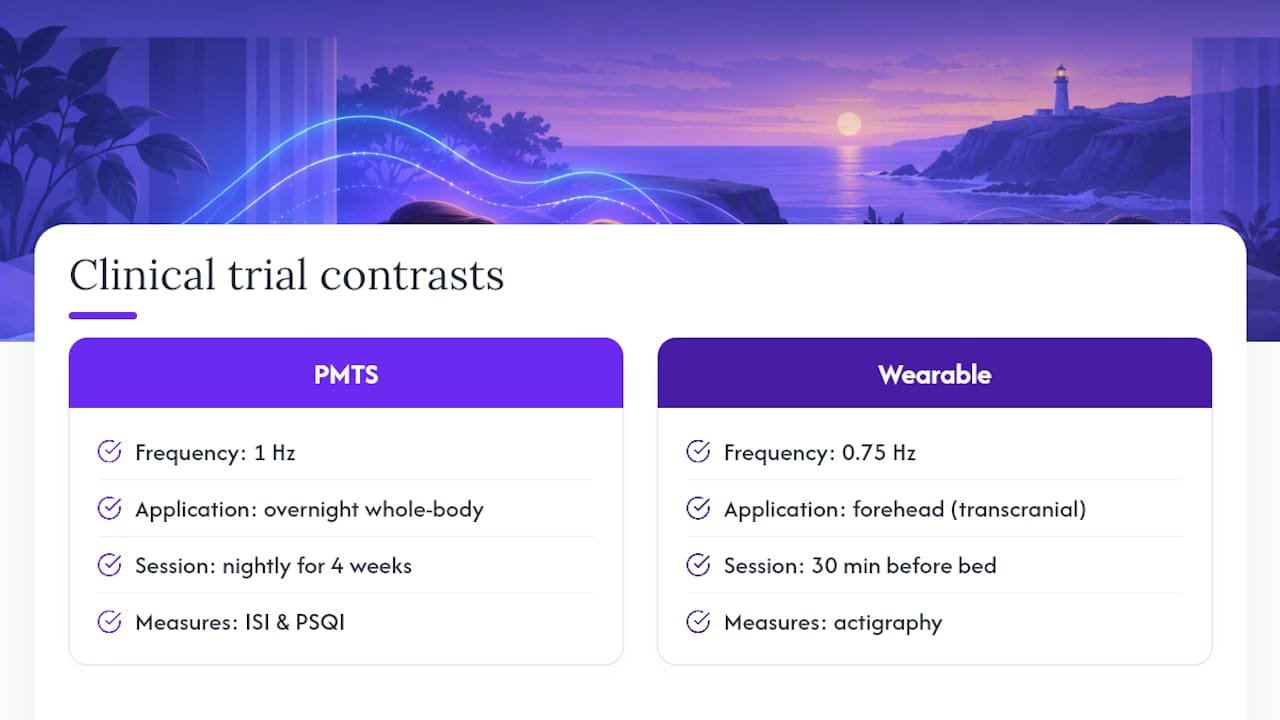
The strongest evidence for using PEMF for sleep comes from a multicentre, randomised, double-blind, placebo-controlled trial of a portable Pulse Magnetic Therapy System, or PMTS, run in adults diagnosed with insomnia disorder. Participants used the device at home overnight for four weeks, and researchers tracked outcomes using the Insomnia Severity Index (ISI) and the Pittsburgh Sleep Quality Index (PSQI), the two most widely used clinical scales for measuring insomnia.
That response rate held up reasonably well, with 75% classified as responders at the one-week follow-up after treatment ended. This matters for two reasons. First, a nearly 70% response rate is a meaningful signal in insomnia research, where placebo response is notoriously high. Second, the fact that benefits persisted a week after stopping treatment suggests PEMF may do more than simply distract or relax someone in the moment. It hints at a lasting physiological shift, though one week is still a short follow-up window by clinical standards.
A separate line of evidence comes from wearable transcranial stimulation rather than whole-body PEMF mats. A randomised crossover study tested a forehead-worn device delivering 0.75 Hz stimulation for 30 minutes before bed. Improvements were detectable after a single night and grew stronger with repeated use, tracked using actigraphy rather than self-report alone.
It’s worth being precise about what these two trials actually tested. The PMTS study used a low-frequency (1 Hz), overnight, whole-body protocol aimed at general insomnia severity. The wearable study used a different frequency, a different application site, a much shorter session, and focused specifically on sleep onset rather than overall sleep quality. These are not interchangeable devices, and a result from one shouldn’t be assumed to apply to the other.
Both studies also share limitations common to PEMF research generally. Sham-controlled trials in insomnia tend to see a strong placebo response purely from participants expecting to sleep better, and one clinical insight worth flagging is that in PMTS-style trials, the true treatment effect often only separates clearly from placebo after the second week, meaning short trials risk underestimating or missing the real benefit entirely. Follow-up periods in both trials were also relatively brief, and participants were largely drawn from mild-to-moderate insomnia populations rather than severe, treatment-resistant cases.
The honest takeaway: the current evidence base is strongest for sleep onset and short-term sleep efficiency, particularly over a four-week trial window. Long-term maintenance data, and evidence in people with more complex or chronic insomnia, remains limited. That doesn’t make the results meaningless, it just means PEMF should be approached as a promising, evidence-supported option rather than a guaranteed fix.
Who should avoid PEMF? Contraindications and side effects
Before trying PEMF for sleep or relaxation, run through a proper safety check. This isn’t optional caution, it’s the first thing any reputable provider should ask you about before you lie down on a mat or strap on a device.
Absolute contraindications, meaning PEMF should not be used at all without direct medical clearance:
- Pacemakers, implantable cardioverter-defibrillators (ICDs), or cochlear implants, since magnetic fields can interfere with electronic medical devices.
- Pregnancy, where supplier and manufacturer contraindication lists consistently advise avoidance due to insufficient safety data.
Situations that require a conversation with your doctor first rather than an automatic no:
- Epilepsy or a history of seizure disorders.
- Recent surgery, particularly with implanted hardware or healing incisions.
- Active infection at the intended application site.
- Significant metal implants, which can behave unpredictably in a magnetic field.
Reassuringly, clinical guidance from Cleveland Clinic describes PEMF as generally well tolerated outside of these groups. Reported side effects in safety summaries are mild and infrequent: transient fatigue, mild headache, and occasional lightheadedness during or after a session. None of these are dangerous on their own, but they’re worth noting to a practitioner if they persist beyond your first couple of sessions.
Pro Tip: Book your first PEMF session somewhere it can be supervised, rather than starting with an unsupervised at-home device straight away. A trained practitioner can screen you properly, start you on a shorter or lower-intensity setting, and check how your body responds before you commit to nightly use at home.

Practically, that means: get screened properly before your first session, start with a shorter duration and lower intensity rather than jumping straight to a long overnight protocol, never place a device directly over an implant or pacemaker site, and stop immediately if you notice anything beyond mild, brief tiredness. Full contraindication screening should always come before treatment, not after you’ve already started.
What does a real PEMF session for sleep look like?
Two broad delivery formats exist, and they suit different lifestyles. Clinic-supervised sessions, typically on a full-body mat or pad, let a practitioner control intensity and duration and check in on how you’re responding. At-home devices, ranging from under-pillow generators to wearable frontal stimulators, offer convenience and daily consistency but put screening and pacing entirely in your own hands.
Trial protocols give a useful, non-prescriptive sense of what’s realistic:
- Overnight, low-frequency protocols. The PMTS trial used 1 Hz stimulation applied continuously overnight for four weeks, reflecting a cumulative approach where nightly consistency mattered more than any single session.
- Short, targeted pre-bed sessions. The wearable tES study used just 30 minutes of 0.75 Hz stimulation before sleep, showing that shorter, more frequent applications can still meaningfully shift sleep onset latency.
- Multi-hour therapeutic use. Some device manufacturer guidance for other PEMF indications recommends six to eight hours of daily use, sometimes split across the day, illustrating how much protocols vary depending on what the device is designed to treat.
However you start, cumulative use appears to matter more than any single heroic session. A single night of stimulation might nudge sleep onset slightly, but the clearer, more durable improvements in the trial data showed up after two to four weeks of consistent nightly or near-nightly use.
Track your own response properly rather than guessing. A simple sleep diary, noting time to fall asleep, night wakings, and how rested you feel, gives you real data. If you want something closer to what researchers use, the Insomnia Severity Index is a short, validated questionnaire you can score yourself. Reassess after two to four weeks, in line with how the strongest trial evidence was measured, rather than judging PEMF after two or three nights.
Should you try PEMF? A practical decision checklist
Not every case of poor sleep is the same, and PEMF’s evidence base is strongest for specific patterns rather than sleep problems generally. Run through this before booking anything:
- Is your main issue trouble falling asleep (sleep onset) rather than staying asleep or waking too early? The strongest trial data centres on onset and overall severity, not fragmented sleep specifically.
- Do you have none of the absolute contraindications covered earlier, and has your doctor cleared you if you fall into a cautionary category?
- Have you already tried, or are you also willing to combine PEMF with, other non-drug approaches like CBT-I techniques, consistent sleep and wake times, and reduced evening screen exposure?
- Are you prepared to commit to a genuine two-to-four-week trial rather than judging results after a handful of sessions?
If you’re evaluating a provider or device, ask direct questions before paying anything: what evidence supports this specific device and protocol, not PEMF in general? What does their screening process actually check for? Is there a trial period or return policy if it doesn’t suit you? And what follow-up or reassessment do they offer once you’ve started?
Pro Tip: Treat your first PEMF session like a baseline test, not a cure-all. Have a supervised session if one is available, start conservatively, and use a sleep diary from night one so you have real evidence to review at the two-to-four-week mark, rather than relying on how you feel that particular week.
PEMF works best as one part of a broader approach, not a replacement for good sleep hygiene or, where needed, structured therapy such as CBT-I. Combine it with the fundamentals covered in Live5dhealth’s guide to sleep problems and treatments rather than expecting a magnetic mat to undo months of irregular bedtimes on its own.
Trying PEMF for sleep at Live5dhealth
A wellness centre operates supervised PEMF sessions alongside a wider range of recovery-focused therapies, with screening for contraindications done before treatment, in line with the safety checks outlined above.
A typical supervised pathway follows a straightforward sequence:
- Initial assessment, where a practitioner talks through your sleep pattern, medical history, and checks for contraindications like pacemakers or pregnancy.
- First session, generally starting conservatively so you and the practitioner can gauge your response.
- Short review, checking in on side effects and early impressions before committing to a longer course.
- Follow-up sessions, adjusted based on how you’re responding, with progress tracked over the two-to-four-week window the clinical evidence points to.
For readers wanting more detail on who should steer clear of PEMF, Live5dhealth’s contraindications page covers the screening criteria practitioners work through before treatment. PEMF’s evidence base extends beyond sleep too. Live5dhealth’s page on PEMF for bone healing covers a separate, well-documented application of the same underlying technology. If you’re specifically weighing up access and options in an Irish context, the centre’s overview of PEMF therapy in Ireland is a useful starting point before booking anything.
The evidence is real, but so are its limits
The trial data on PEMF for sleep is more convincing than most people expect, and more limited than most marketing suggests. Both things are true at once.
Where I think conventional advice gets it wrong is treating PEMF as either a miracle device or dismissing it outright as pseudoscience. Neither position survives contact with the actual research. The honest position is narrower and more useful: PEMF has genuine, mechanism-backed potential for sleep onset problems specifically, works best over a proper two-to-four-week trial rather than a few nights, and depends heavily on parameters that most consumers never think to ask about.
If you take one thing from this, prioritise proper screening and a real trial period over device shopping. The frequency and application site matter more than the marketing claims on the box.
— Mark
Try a supervised PEMF session at Live5dhealth
If the research here has you curious rather than convinced, the sensible next step isn’t buying an unsupervised device online. It’s trying PEMF properly, with screening, guidance, and someone who can adjust the session based on how you actually respond. That’s the gap Live5dhealth fills for people in Ireland who want to trial PEMF without guessing at settings or skipping contraindication checks entirely.

A wellness centre in Boyle, County Roscommon, combines PEMF with a wider range of recovery therapies, including hyperbaric oxygen and red light therapy, so a single visit can address sleep, recovery, and general wellbeing together rather than in isolation. Sessions are screened for contraindications before you start, following the same safety principles covered throughout this guide. If you’re ready to see how PEMF fits into your own sleep routine, book a session at Live5dhealth and start with a supervised first visit rather than an unsupervised guess.
This article is general information, not a substitute for advice from a qualified doctor. Consult a qualified healthcare professional about your own circumstances before acting on anything here.
Sources
For readers who want to go beyond this summary, the PMTS randomised controlled trial is the most rigorous piece of evidence currently available on PEMF and insomnia. The wearable low-frequency stimulation study offers a useful contrast in device type and protocol. Cleveland Clinic’s patient guidance is a reliable, plain-language overview, and the CDC’s sleep resources give broader context on why sleep quality matters. Speak with a doctor before starting PEMF, particularly if you have any of the contraindications covered above.
- Pulsed electromagnetic field (PEMF) therapy — Cleveland Clinic patient information
- PEMF therapy contraindications — Biomag
FAQ
Does PEMF help you sleep?
Low-frequency PEMF has shown measurable improvements in insomnia severity and sleep quality in randomised, placebo-controlled trials, particularly over a four-week period. In the largest such trial, roughly 69.7% of participants using PMTS no longer met the threshold for clinically significant insomnia by week four, compared with the sham group.
When should you not use PEMF?
Avoid PEMF if you have a pacemaker, ICD, cochlear implant, or are pregnant, since contraindication guidance consistently flags these as reasons to avoid treatment. Speak to a doctor first if you have epilepsy, recent surgery, an active infection at the treatment site, or significant metal implants.
Does PEMF therapy make you sleepy?
Some users report mild, transient tiredness or lightheadedness after a session, which clinical guidance describes as a generally mild and infrequent side effect rather than a guaranteed drowsy reaction. The intended effect is calmer, more efficient sleep at night rather than immediate sedation during the day.
What does PEMF do to the brain?
Low-frequency pulses appear to have an inhibitory effect on overactive cortical activity, which is thought to ease the hyperarousal common in insomnia. PEMF may also influence autonomic nervous system balance, with one study noting frequency-specific effects on relaxation and anxiety around 16 Hz, though the underlying biochemical mechanisms are still being studied.
How much does PEMF therapy cost at Live5dhealth?
Live5dhealth does not publish a set price for PEMF therapy online, so current pricing is available directly through the centre. You can check availability and costs when booking a session.