
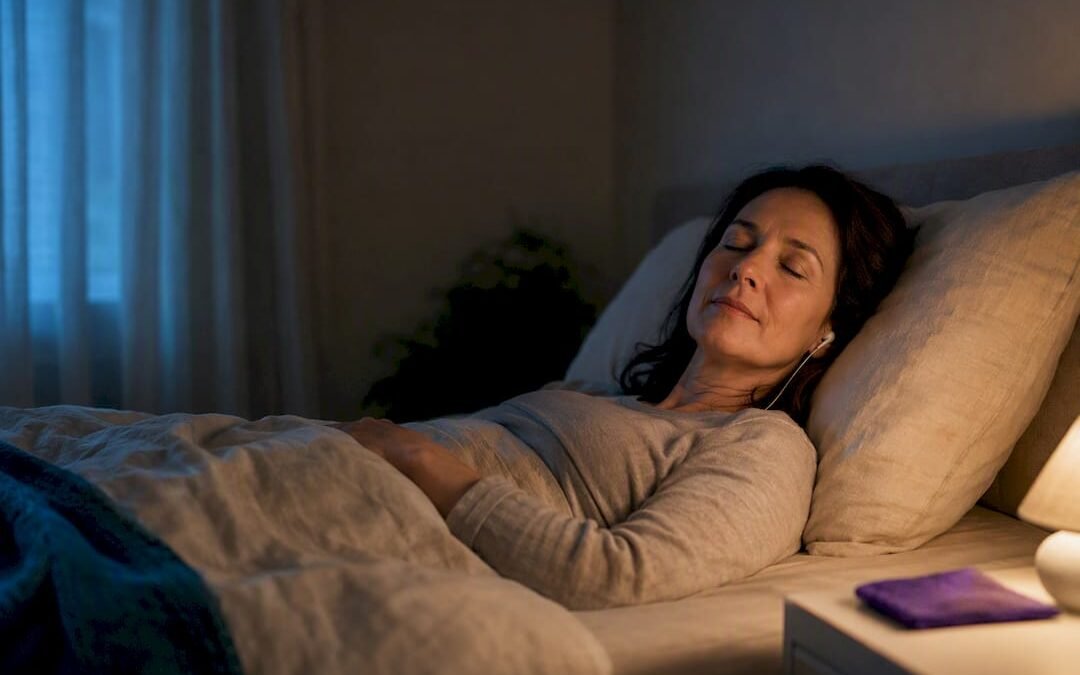
The strongest evidence for sound therapy sleep support points to three approaches: binaural beats paired with calm instrumental music, timed pink-noise bursts, and multiaudio mixes that combine noise with music or guided relaxation. Objective results such as deeper slow-wave sleep are still inconsistent between studies, but subjective sleep quality improves reliably enough to be worth testing. Start with a short binaural-beats-plus-instrumental session at bedtime, continuing for a couple of weeks, and track how you feel each morning before deciding whether to adjust.
TL;DR:
- Timed pink-noise bursts synchronized with slow brainwaves may improve deep sleep and cerebrospinal fluid flow, but they require sleep-stage detection devices.
- Binaural beats are most effective for reducing sleep onset time in people with racing minds when used with stereo headphones for 20 to 30 minutes at bedtime.
- Continuous white noise or sound machines are primarily suited for masking disruptive sounds, especially in shared bedrooms or noisy environments.
- Combining noise with music or guided relaxation (multiaudio) shows stronger subjective improvements in stress and sleep quality, especially for anxiety-related insomnia.
- Supervised sound and light therapy sessions offer a personalized, calibrated alternative to DIY methods, particularly for chronic sleep issues or unsuccessful app trials.
Table of Contents
- What is sound therapy for sleep?
- How sound affects the brain and body during sleep
- Types of sound therapies and when to use each
- What do the studies actually show?
- How to try sound therapy tonight and over four weeks
- Choosing a device or app for sound therapy
- When should you avoid sound therapy or see a doctor?
- Supervised sound and light therapy versus DIY protocols
- A measured view on sound therapy for sleep
- Try guided sound and light therapy at Live5dhealth
- Sources
- FAQ
What is sound therapy for sleep?
Sound therapy for sleep covers any deliberate use of audio, from a single tone to a layered soundscape, to help you fall asleep faster, stay asleep longer, or wake feeling more rested. It sits under the broader umbrella of sound healing for sleep, though that term leans towards ceremonial or meditative practice, while sound therapy sleep protocols are usually more structured and closer to a clinical intervention than a spiritual one.
The vocabulary matters because it shapes what you buy or download. Here’s a working glossary:
- Binaural beats — two slightly different tones played separately into each ear, which the brain perceives as a single pulsing beat. This is the basis of most soothing frequencies for sleep apps.
- Pink noise — a steady sound weighted towards lower frequencies, softer and warmer than static, often described as rainfall or wind through leaves.
- White noise — an even sound across all frequencies, closer to a fan or television static, mainly used for masking.
- Multiaudio — a blended track combining noise with instrumental music, nature recordings, or a guided meditation voice track.
- Sound baths — in-person or recorded sessions using singing bowls, gongs, or chimes, typically for relaxation before sleep rather than during it.
- Vibroacoustic therapy — low-frequency vibration delivered through a mat or table alongside sound, felt in the body as much as heard.
Delivery method matters as much as sound choice. Over-ear headphones or earbuds work best for binaural beats, since the effect depends on each ear receiving a distinct tone. In-room speakers or dedicated sound machines suit pink noise and white noise, which don’t require stereo separation to work. Bone-conduction headbands sit somewhere between the two, useful for side-sleepers who find standard headphones uncomfortable.
The key distinction to hold onto is passive masking versus active stimulation. Masking simply covers disruptive noise, a snoring partner, traffic, a creaky radiator, so your brain has less reason to wake. Active stimulation, like binaural beats or timed pink-noise bursts, aims to nudge your brainwave activity towards patterns associated with deeper sleep. Both have a place, but they solve different problems.
How sound affects the brain and body during sleep
Binaural beats work through a mechanism called brainwave entrainment: your brain’s electrical activity tends to synchronise with a rhythmic external stimulus. Slower binaural frequencies, in the delta and theta range, are associated with the transition into deeper sleep stages, and small trials have reported shorter sleep-onset latency and longer N3 (deep) sleep when binaural beats are delivered at suitable frequencies and timings.
Slow-tempo, lyric-free music does something different. It appears to encourage parasympathetic activation, the “rest and digest” side of your nervous system, which lowers heart rate and eases the kind of mental chatter that keeps you staring at the ceiling. This is largely why multiaudio tracks that blend music with noise tend to outperform noise alone for perceived stress.
Then there’s masking, the most straightforward mechanism of the three: a continuous background sound reduces the contrast between silence and sudden noise, so a door closing or a car passing is less likely to jolt you awake.
The 50-millisecond finding: MIT researchers found that short bursts of pink noise, timed precisely to the peaks of your slow brainwaves during non‑REM sleep, increased both the amplitude of those slow waves and the flow of cerebrospinal fluid in the brain. The effect appeared in a study of 14 volunteers using EEG and fMRI measures, and it’s a meaningfully different mechanism from simply playing pink noise all night.
That timing detail is easy to miss, but it’s arguably the most important nuance in current sound therapy sleep research. A continuous pink-noise track playing from 11pm to 7am is not doing the same thing as a burst delivered at the precise millisecond your brain produces a slow wave. The second approach requires sleep-stage detection, which is why device-driven, timed delivery is where the field is heading next.
Types of sound therapies and when to use each
Not every sound approach solves the same sleep problem. Matching the method to your specific issue, difficulty falling asleep, waking at 3am, or a noisy household, saves weeks of trial and error.
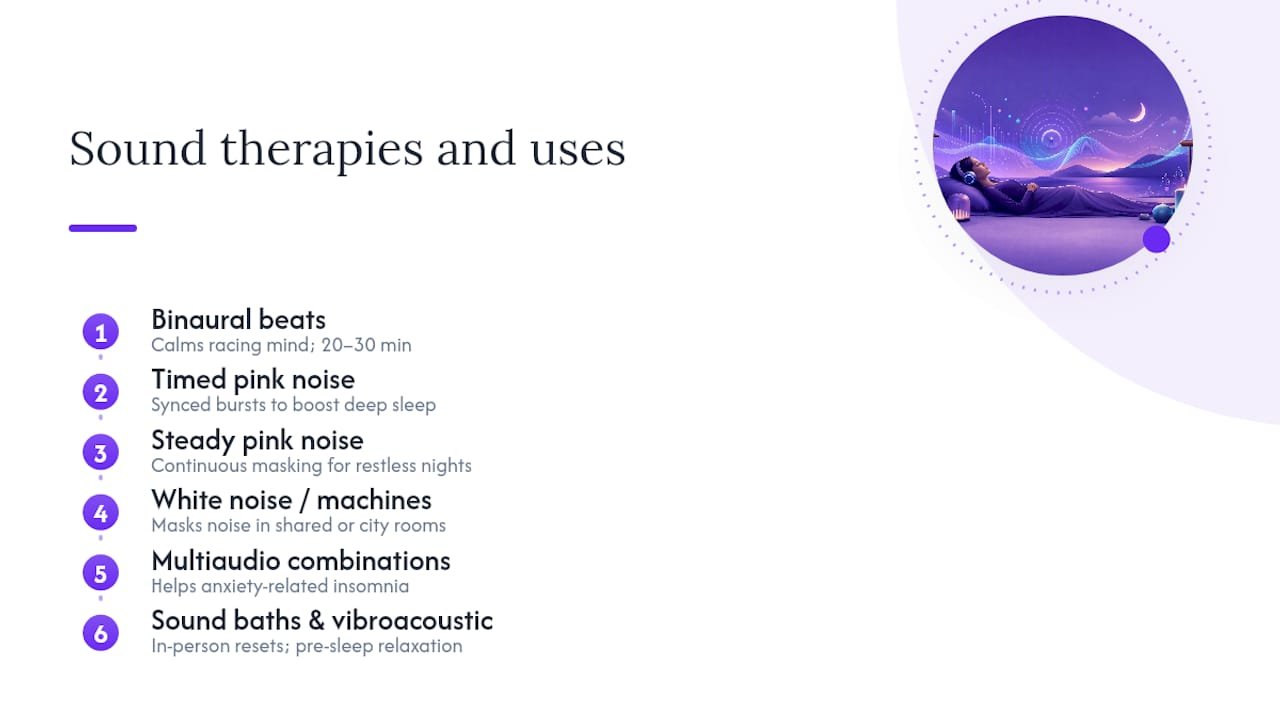
Binaural beats suit people who lie awake with a racing mind. The hyperarousal that keeps you replaying tomorrow’s meeting responds well to a steady, low-frequency pulse. Sessions of 20 to 30 minutes at bedtime are typical, and you’ll need proper stereo headphones or earbuds, since the beat effect collapses if both ears hear identical audio. A structured binaural beats protocol can help you calibrate frequency and session length rather than guessing.
Pink noise has two distinct uses depending on delivery. Timed bursts, synced to slow-wave peaks, appear to enhance deep sleep quality, though this currently requires specialist equipment. Steady, continuous pink noise is simpler and mainly useful for smoothing out a restless night by softening abrupt sounds, and it’s a reasonable default if you don’t have access to timed delivery.
White noise and sound machines are the pragmatic choice for shared bedrooms, city-facing windows, or a partner’s snoring. It’s a blunt instrument compared with binaural beats, but its job is masking, not stimulation, and it does that job reliably for a lot of people.
Multiaudio combinations (noise layered with instrumental music or a guided voice track) consistently show some of the more encouraging results in the research, particularly for stress-related insomnia. If your sleep problem is tangled up with anxiety rather than pure noise sensitivity, this is often the better starting point.
Sound baths and vibroacoustic sessions are less about nightly self-administration and more about deep, in-person relaxation, useful before a stressful week or as a reset rather than a nightly habit. Sound bath sessions can lower pre-sleep tension noticeably, though they’re not something most people need to do at home every night to get value from sound therapy.
Pro Tip: If you’re not sure which category fits, start with a multiaudio track rather than a pure tone. Blended audio tends to be more forgiving of individual taste, and you’re less likely to abandon it after three nights because the tone alone feels grating.
What do the studies actually show?
A systematic review covering 34 studies and 1,103 participants found that pink noise produced positive sleep outcomes in 81.9% of studies, compared with only 33% for white noise.
A 2026 randomised controlled trial gives a more granular picture. College students who listened to 30 minutes of bedtime audio, five nights a week for four weeks, saw improved sleep quality scores regardless of whether they used binaural beats with music or pink noise with music. Interestingly, the binaural-beats-plus-music group reported lower perceived stress than the pink-noise group, even though cortisol levels didn’t differ between them, a reminder that subjective and physiological measures don’t always move together.
“Short pink-noise bursts timed to slow-wave peaks increased both slow-wave amplitude and cerebrospinal fluid flow, a mechanism plausibly linked to the brain’s restorative processes during sleep.” This is the core insight from the MIT research, and it’s the reason continuous playback and precisely timed delivery shouldn’t be treated as interchangeable.
Smaller pilot studies add a further layer: customised binaural-beat protocols, tailored to an individual rather than played from a generic track, produced clinically meaningful reductions in Insomnia Severity Index scores in people with chronic insomnia. The sample sizes were small, and none of this rises to the level of definitive proof. Every review in this space calls for larger, longer, better-controlled trials, and objective measures like polysomnography remain thin on the ground compared with self-reported questionnaires. Treat sound therapy as a genuinely promising, well-supported tool, not a guaranteed fix.
How to try sound therapy tonight and over four weeks
You don’t need special equipment to run a fair test of whether sound therapy sleep methods work for you. A simple, staged protocol beats randomly switching tracks every few nights.
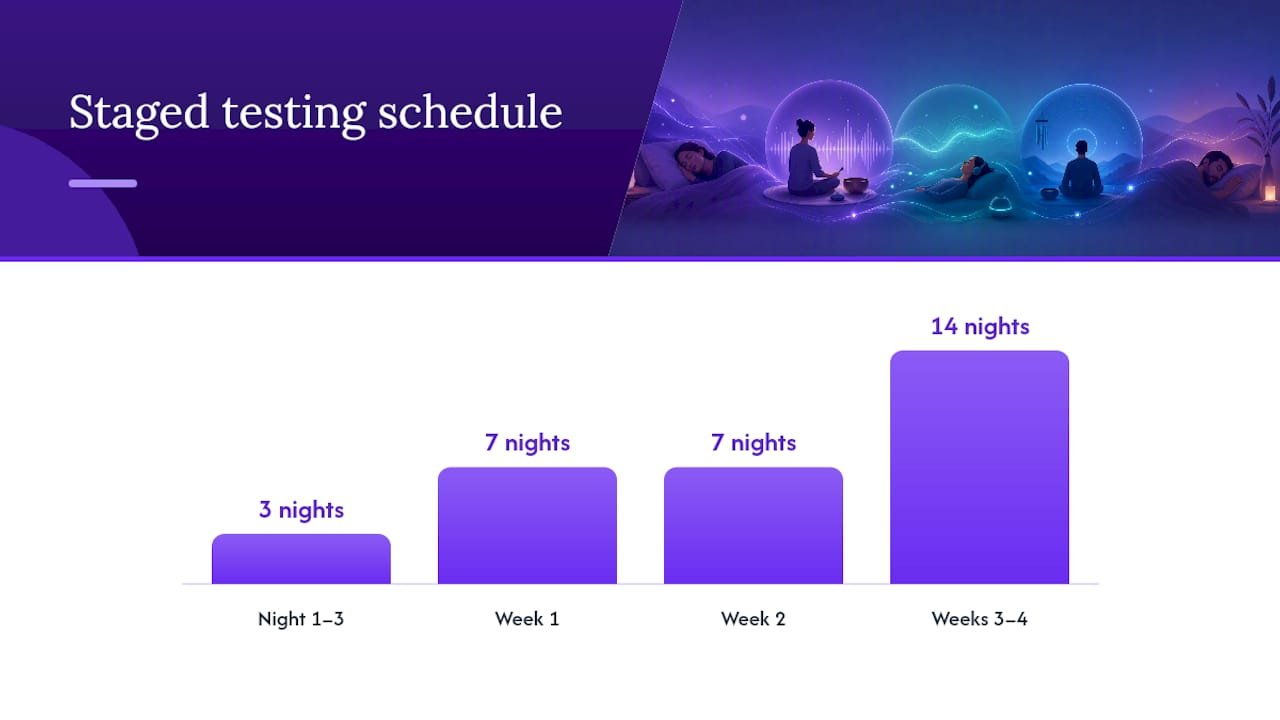
- Night one to night three: play a binaural-beats-plus-instrumental track through headphones or earbuds for 20 to 30 minutes as you settle into bed, at a volume comfortable enough to talk over. Let the track stop automatically rather than removing headphones mid-sleep.
- Week one: keep the same track and timing every night. Changing variables too early makes it impossible to tell what’s actually helping.
- Week two: if binaural beats aren’t landing, switch to a multiaudio track that layers pink noise with soft instrumental music, and reassess.
- Week three to four: if you have access to an app or device that detects sleep stages and can time pink-noise bursts, this is where it’s worth experimenting, since the timing effect appears to matter more than volume or duration alone. If not, continuous pink noise remains a reasonable substitute for gentle masking.
- Throughout: keep a short sleep diary, time to bed, rough time asleep, number of wake-ups, and a one-to-ten rating of how rested you feel. You don’t need a formal PSQI questionnaire, but mimicking its structure (sleep quality, latency, disturbances, daytime function) gives you a consistent baseline to compare week to week.
Two to six weeks is a realistic testing window. Four weeks match the duration used in the Frontiers 2026 trial, and it’s long enough to separate a genuine effect from a placebo-driven good week.
Watch for three common snags. Habituation is the most frequent: a track that felt calming on night one can become background noise you barely register by night ten, which isn’t necessarily a failure, just a sign to rotate tracks periodically. Increased awareness is the opposite problem, some people find that focusing on a soundtrack makes them more alert to their own wakefulness rather than less. And morning grogginess, if it appears, is worth checking against volume and headphone comfort before assuming the method doesn’t work for you.
Pro Tip: Set a fixed nightly reminder to fill in your sleep diary before you forget the details of how the previous night actually went. Morning memory of sleep quality fades fast, and a diary filled in three days late is not much use.
Choosing a device or app for sound therapy
Your bedroom setup and hearing profile should decide the delivery method before app reviews do. Over-ear headphones and earbuds are essential for genuine binaural beats, since the effect relies on each ear receiving a distinct tone, but they’re impractical for side-sleepers or anyone sharing a bed who dislikes the sensation overnight.
- Bone-conduction headbands sit more comfortably for side-sleeping and still allow stereo separation, making them a workable middle ground for binaural protocols.
- In-room speakers suit pink noise and white noise well, and they’re the only sensible option for shared bedrooms, since headphones exclude a partner entirely.
- Speaker-based masking is generally more accessible than binaural headphone approaches for people with tinnitus or partial hearing loss, since it doesn’t depend on precise stereo perception.
- Sleep-stage-synchronised devices, which time pink-noise bursts to your slow-wave activity, remain experimental and are worth trying only if cost and convenience aren’t a barrier, since research such as the MIT pink-noise study is still early-stage.
If you’re using a smart app that tracks sleep stages via your phone or a wearable, check what data it collects and where it’s stored before granting microphone or biometric access overnight, particularly with cheaper apps that monetise through advertising rather than subscriptions.
When should you avoid sound therapy or see a doctor?
Sound therapy is low-risk for most healthy adults over the short term, but a few groups should check with a clinician first.
- People with epilepsy, since rhythmic stimulation has, in some individuals, been linked to seizure sensitivity.
- Anyone with a severe psychiatric condition where altered states of relaxation or focus could be destabilising.
- People with implanted electronic devices, such as cochlear implants or certain hearing aids, where audio delivery methods need clinical guidance.
- Children, who should only use structured sound therapy under a clinician’s direction rather than through consumer apps designed for adults.
On volume, keep playback low enough that you could comfortably hold a conversation over it, and avoid sustained high volume directly against the skull through tight-fitting headphones overnight, since prolonged pressure and sound exposure together can cause discomfort you won’t notice until morning. Long-term safety data on nightly sound therapy use is still limited, so if you notice increasing daytime sleepiness, worsening mood, or symptoms that seem to intensify rather than settle after a few weeks, stop and reassess rather than pushing through. If insomnia persists beyond a few weeks despite consistent sound therapy and reasonable sleep hygiene, that’s the point to consider cognitive behavioural therapy for insomnia (CBT‑I) or a referral to a sleep specialist, since sound therapy works best as one part of a plan rather than a standalone fix.
Supervised sound and light therapy versus DIY protocols
At-home binaural beats and pink-noise apps are a reasonable starting point, but they’re not the only option, and for some people they’re not the most effective one. Practitioner-led approaches remove the guesswork around calibration, timing, and frequency selection that DIY users are largely doing by trial and error.
Roxiva light-and-sound brain entrainment therapy combines synchronised audio with light pulses delivered through a headset, under practitioner supervision, rather than relying on a generic app track. It’s a fundamentally different experience from listening to a pre-recorded binaural track alone at home, since the parameters are adjusted for the individual session rather than fixed in advance. Supervised sessions typically run for a set period with a practitioner present throughout, which suits people who’ve tried DIY audio without success or who prefer guided rather than self-administered therapy.
In-person sound bath sessions work on a similar principle for pre-sleep relaxation rather than nightly use, offering a deeper reset than most people can replicate with headphones at home. Anyone who has struggled to get consistent results from apps and generic tracks, or who simply prefers expert guidance over self-experimentation, tends to benefit more from a supervised session than from another month of solo trial and error.
A measured view on sound therapy for sleep
Sound therapy deserves more credit than sceptics give it and less faith than marketing copy suggests. The honest position, based on the research, is that it works often enough to be worth trying, not that it works for everyone or replaces good sleep habits.
My advice is to treat it as one lever among several. Test methodically, track results for a few weeks rather than a few nights, and don’t be afraid to combine it with basic sleep hygiene or CBT‑I if underlying insomnia persists. Sound therapy sleep methods reward patience and measured expectations far more than they reward chasing the newest app.
— Mark
Try guided sound and light therapy at Live5dhealth
If a few weeks of headphone experiments haven’t shifted your sleep, a supervised session removes the guesswork DIY apps can’t solve. An alternative to app-based trial and error for sound therapy sleep support in Ireland are practitioner-calibrated Roxiva light-and-sound sessions and guided sound baths, delivered in person rather than through a generic pre-recorded track.
Roxiva sessions use synchronised light and sound entrainment adjusted to you during the session, a different proposition from a fixed frequency played through earbuds at home. For anyone who prefers a deeper reset before committing to nightly self-administered protocols, a sound bath session offers guided relaxation without needing to own or calibrate any equipment. If your sleep issues sit alongside broader stress or fatigue, the multi-day wellness retreats build supervised therapies into a longer reset. You can also pair a session with complementary approaches such as structured relaxation techniques for the nights in between visits. Book a Roxiva session directly here to see whether guided therapy gets you further than the apps did.
This article is general information, not a substitute for advice from a qualified doctor. Consult a qualified healthcare professional about your own circumstances before acting on anything here.
Sources
- Auditory stimulation and sleep: systematic review — PMC
- The impact of sound intervention on sleep quality and stress levels in college students: a randomized controlled trial — Frontiers in Psychology
- A burst of “pink noise” may lead to more restorative sleep — MIT News
- Use of customized binaural beats for the treatment of chronic insomnia — e‑JSM (2025)
FAQ
Who should not do sound therapy for sleep?
People with epilepsy, severe psychiatric conditions, or implanted electronic devices such as cochlear implants should check with a clinician before starting. Children should only use structured sound therapy under professional guidance rather than consumer apps aimed at adults.
Can I do sound therapy on myself at home?
Yes, most binaural beats, pink noise, and multiaudio protocols are designed for self-administration with headphones or a speaker. For calibrated, practitioner-guided sessions rather than a generic track, Roxiva light-and-sound therapy offers a supervised alternative.
Can sound therapy help with insomnia?
Small trials suggest customised binaural-beat protocols can produce clinically meaningful reductions in insomnia severity in some people, though sample sizes remain limited. If insomnia persists for weeks despite consistent use, combining sound therapy with CBT‑I or seeing a sleep specialist is the next sensible step.
What is the healthiest noise to sleep to?
Pink noise has the strongest track record among the options studied, with 81.9% of pink-noise studies reporting positive sleep outcomes compared with 33% for white noise. Multiaudio combinations, blending noise with music or guided relaxation, carried the lowest risk of bias among the three categories reviewed.