
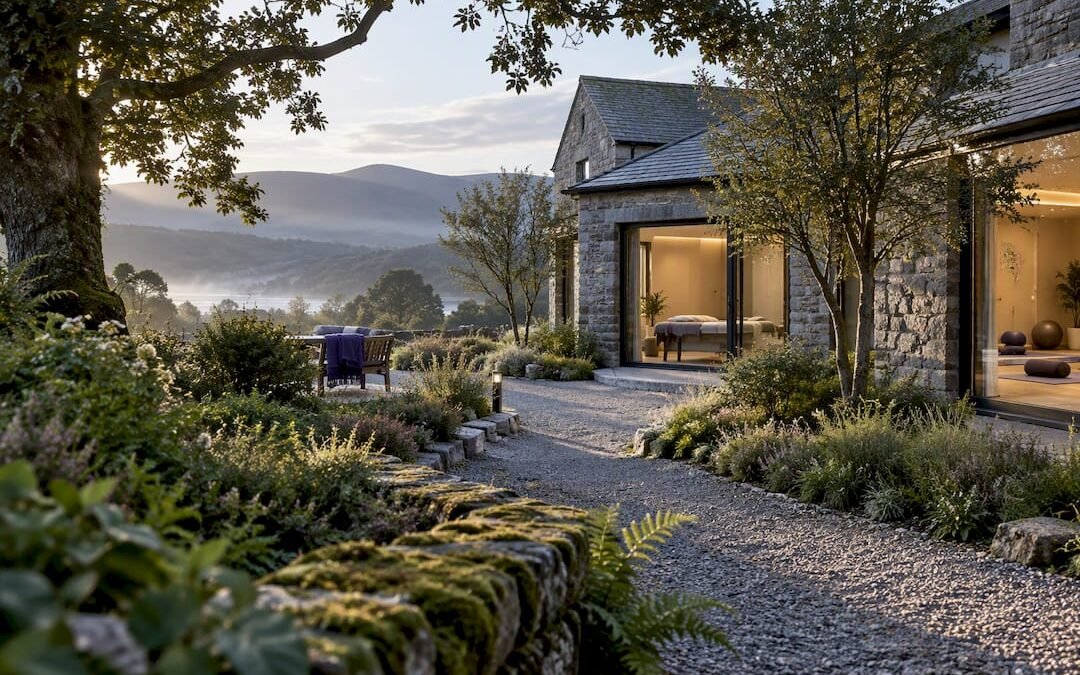
Start by naming the single wellness outcome you most want. Every other choice flows from that: retreat style, location, programme intensity, food philosophy, and safety protocols all need to serve that one goal. Compare options across six axes, type, setting, programme, nutrition, safety, and cost, and check the booking’s consumer protections before you pay a deposit.
TL;DR:
- Most retreats focus on a single wellness outcome, so match your goal with the retreat’s primary purpose, whether stress recovery, fitness, or detox.
- Verify that the retreat’s programme, length, and intensity align with your specific condition and desired changes, avoiding over- or under-stimulation.
- Ensure the location’s accessibility, medical facilities nearby, and outdoor options suit your health profile and travel comfort, especially if managing chronic conditions.
- Confirm that accommodations, facilities, and daily schedules support your needs for rest, privacy, personalization, and safety before booking.
- Always review detailed costs, cancellation policies, and the retreat’s therapy protocols, ensuring transparency, proper screening, and legal protections before making a deposit.
Table of Contents
- Understand and prioritise your wellness goals
- Retreat styles and approaches explained
- Location and setting: what really matters
- Accommodation and facilities: what to inspect or ask about
- Programme structure and activities: reading schedules and learning what’s actually offered
- Food and nutrition: menus, dietary support and evidence-based approaches
- Privacy, accessibility and safety: medical screening and contraindications
- Practical booking considerations: cost, length, cancellation and insurance
- Live 5D Health perspective: choosing a retreat with integrated therapies
- A final word on trusting your own judgement
- How Live 5D Health can help you choose the right retreat
- Sources
- FAQ
Understand and prioritise your wellness goals
Before you browse a single brochure, write down the one outcome that matters most to you right now. Is it stress recovery, physical fitness, detoxification, spiritual growth, or support alongside a clinical treatment plan? Pick one primary goal and, at most, two secondary ones. Trying to solve five problems in five days usually solves none of them well, because programme intensity and duration are built around a specific outcome, not a wish list.
This matters because a retreat designed for deep rest looks nothing like one built for athletic performance. Someone recovering from burnout needs slow mornings, gentle movement, and unstructured time. Someone training for a fitness goal needs supervised exertion, recovery protocols, and measurable progress markers. Booking the wrong intensity for your actual need is the single most common regret retreat guests report.
The WHO’s framework for wellbeing treats health as an integrated state across physical, mental, emotional, spiritual, and social domains, rather than a single metric to optimise. That framing is useful here: a retreat that only promises weight loss or only promises relaxation is solving one variable in a much larger equation. Look for programmes that connect movement, nutrition, therapy, and community rather than isolating one lever.
Use these questions to sharpen your primary goal:
- What specific change do you want to feel or measure by the time you go home?
- Are you recovering from something (illness, stress, burnout) or building toward something (fitness, a life change)?
- Do you have a medical condition that needs to shape the programme’s intensity?
Pro Tip: Write your goal as a single sentence before you start comparing retreats. If a retreat’s own description doesn’t clearly serve that sentence, move on.
Retreat styles and approaches explained
Retreat marketing uses overlapping language, so it helps to know the broad categories before you start filtering by price or location.
- Detox retreats focus on fasting protocols, juice cleanses, or elimination diets, usually paired with saunas and massage; these suit guests without complex medical conditions who want a structured reset.
- Fitness retreats build daily schedules around supervised exercise, from hiking to strength training, and suit guests who want measurable physical progress rather than pure rest.
- Yoga and mindfulness retreats centre on meditation, breathwork, and movement practice, and suit guests managing stress, anxiety, or seeking a mental reset without high physical demands.
- Luxury spa retreats prioritise comfort and pampering, with treatments like massage and hydrotherapy, and suit guests who want restoration without a strict programme.
- Clinical or rehabilitation retreats combine medical oversight with therapeutic treatment, and suit guests managing chronic illness or recovering from treatment who need practitioner-led care.
- Nature immersion retreats use remote or wild settings as the core therapy, and suit guests whose primary goal is disconnecting from digital life and daily routine.
Whichever style you’re drawn to, check group size, facilitator credentials, and how the daily schedule is paced before booking. A four-day fitness retreat with a dozen guests and one instructor delivers a very different experience from a boutique retreat with a ratio closer to one to three.
Location and setting: what really matters
Setting affects outcomes more than most people expect, but not always in the direction marketing suggests. A remote, off-grid location can deepen disconnection and rest, yet it can also mean long transfers, patchy connectivity, and real difficulty if a medical issue arises. Weigh remoteness against your actual health profile and travel tolerance, not just the photos.
- Check total travel time door to door, including transfers, not just flight duration.
- Confirm the nearest hospital or medical facility and its distance from the retreat.
- Ask about mobile signal and internet access if you need to stay reachable for work or family.
- Consider the season and climate: a hot-weather detox programme in peak summer suits some guests and overwhelms others.
- Check what outdoor options exist on wet or cold days, since many programmes depend on being outside.
If you manage a chronic condition or take regular medication, remoteness that sounds appealing on a website can become a genuine risk if something goes wrong far from care.
Accommodation and facilities: what to inspect or ask about
Accommodation shapes how well you rest between sessions, so treat it as a decision axis in its own right rather than an afterthought.
- Room type and privacy: single rooms suit guests processing something personal or needing uninterrupted sleep; shared rooms suit guests who value community and lower cost.
- Booking flexibility: check whether you can upgrade, extend, or shorten your stay once there, and what that costs.
- Onsite therapy and movement spaces: ask what’s actually available beyond the marketing photos, saunas, cold plunge pools, dedicated therapy rooms, and any specialist equipment relevant to your goal.
- Accessibility: confirm step-free access, lift availability, and adapted bathrooms if you have mobility needs.
- Staff-to-guest ratio: a low ratio usually means more personalised attention during therapy sessions and less waiting around.
- Cleanliness and maintenance standards: recent reviews or a direct question to the retreat about housekeeping frequency will tell you more than any brochure.
Ask specifically what happens if a facility is out of service during your stay, some retreats close saunas or pools for maintenance without much notice, and it’s worth knowing the policy before you arrive.
Programme structure and activities: reading schedules and learning what’s actually offered
A retreat’s real value sits in its daily schedule, not its homepage. Request a sample itinerary before booking and check the balance between active sessions (movement, exercise, workshops) and restorative ones (rest periods, therapy, unstructured time). A programme packed with back-to-back activities from 7am to 9pm often produces exhaustion rather than recovery, whatever the goal.
Personalisation is the next thing to check. Does the retreat run an initial health screening or consultation, or does everyone follow an identical schedule regardless of fitness level, health history, or goal? One-to-one sessions, even brief ones, usually indicate a programme built around individual need rather than a fixed template.
Qualifications matter more here than almost anywhere else in the decision. Ask what certifications instructors and therapists hold, how long they’ve practised, and whether any clinical therapies are supervised by a qualified practitioner. A retreat offering therapeutic massage, for instance, should be able to describe the training behind it, and separate evidence exists showing measurable benefits from holistic massage when delivered by trained practitioners.
Length and intensity should map to your goal. A weekend won’t shift a chronic stress pattern much, but it can reset sleep and introduce new habits. A five to ten day programme allows time for the body to adjust to new routines, which is usually where guests report the most noticeable change.
- Ask for a full sample daily schedule, not a summary of themes.
- Confirm whether sessions are group-based, one-to-one, or a mix.
- Check what health information the retreat collects before you arrive and how it’s used to adjust your programme.
Pro Tip: Ask what a “typical day” looked like for a guest with your specific goal last month, not what the programme promises in general.
Food and nutrition: menus, dietary support and evidence-based approaches

Food is not a side detail at a wellness retreat; it’s often the mechanism through which the programme’s stated goal is delivered. A plant-forward menu suits general reset goals, a structured detox plan suits guests targeting elimination or cleansing, and clinical nutrition support suits guests managing a medical condition alongside their stay. Indulgent, comfort-focused menus suit relaxation-first retreats where nutrition isn’t the main lever.
Before booking, ask directly about dietary accommodations: how allergies are handled, where ingredients are sourced, and how hydration is supported throughout the day. If a retreat makes specific nutritional claims, weight loss guarantees, detox promises, immune boosts, ask what those claims are based on rather than accepting the wording at face value. General public health guidance on nutrition and immune health can help you sanity-check bold claims against established behaviour rather than marketing language.
- Ask how allergies and intolerances are flagged and managed in the kitchen.
- Request a sample menu, not just a description of the “philosophy”.
- Check whether hydration support, water quality or electrolyte options, is built into the daily schedule.
Privacy, accessibility and safety: medical screening and contraindications
If you manage an active medical condition, particularly one involving ongoing treatment such as cancer therapy, seek written clearance from your treating clinician before booking anything with clinical therapies, HBOT, intensive detox protocols, or high-intensity exercise. A reputable retreat will ask about your medical history, not just wave you through, and a pre-booking screening checklist for HBOT is a useful model for the kind of questions worth asking any clinical therapy provider.
- Ask what the retreat’s emergency procedure is and how far the nearest A&E department is.
- Confirm the qualifications of any therapist delivering clinical treatments, not just wellness staff.
- Check what happens to your health information: who sees it, how it’s stored, and whether it’s shared beyond the treating practitioner.
- Ask whether single rooms are guaranteed or subject to availability if privacy matters to you.
For guests with specific conditions, detailed screening guidance exists for particular therapies, for example safety screening before hyperbaric oxygen therapy, and it’s worth asking any retreat you’re considering for an equivalent written protocol.
Practical booking considerations: cost, length, cancellation and insurance
Compare total cost, not headline price. Ask what’s included (accommodation, meals, therapies) versus what’s billed as an optional extra once you arrive, since add-on therapies can meaningfully change the final bill.
- Request an itemised breakdown before paying any deposit: accommodation, meals, therapies, and transfers should each be listed separately.
- Match length to your goal: a short break can reset sleep and introduce habits, while five to ten days gives the body more time to adjust to sustained change.
- Check whether the booking is sold as a package holiday or a linked travel arrangement, because the protections differ.
- Confirm cancellation terms in writing before you commit to a non-refundable deposit.
Under Irish consumer protection rules for package holidays, if an organiser cancels or makes a major change, you’re entitled to a replacement, a lower-grade alternative with a partial refund, or a full refund within a reasonable period. Price increases above a set threshold also let you cancel without a fee.
Package holidays carry insolvency protection and defined refund rights under Irish consumer law, while linked travel arrangements often don’t offer the same cover. Ask the organiser directly which category your booking falls under before you pay anything.
Travel organisers must also disclose essential pre-booking information, including insolvency protection, itinerary details, and cancellation procedures, so ask to see this in writing rather than relying on a verbal assurance. If flights or transport are bundled in, check the ATOL registry to confirm the organiser is financially protected.
Live 5D Health perspective: choosing a retreat with integrated therapies
At Live 5D Health, our retreats are built around therapy breadth rather than a single wellness gimmick. A guest arriving for stress recovery might move through sauna and cold plunge, red light therapy, and a hyperbaric oxygen session across their stay, each chosen to support the same underlying goal rather than compete for attention. This is the model worth testing against any retreat you’re evaluating: does each element serve one coherent outcome, or is it a list of add-ons?
- Ask any retreat how its therapies connect to a single wellbeing goal, not just how many it offers.
- Request written protocols for any clinical therapy, hyperbaric oxygen, PEMF, or similar.
- Confirm practitioner qualifications for each therapy on the schedule, not just the headline instructor.
Our 3, 5 and 10-Day Total Wellness Retreats page sets out how these therapies are sequenced across a stay.
A final word on trusting your own judgement
The retreats that deliver the most aren’t the ones with the longest therapy list, they’re the ones that match your actual condition and goal, screen you properly beforehand, and are honest about what a few days can and can’t change. Trust your own read of a retreat’s transparency over its marketing polish.
— Mark
How Live 5D Health can help you choose the right retreat
If you’ve worked through your goal, your preferred setting, and your safety checklist and want a retreat built around integrated therapy rather than a single treatment, our 3, 5 and 10-Day Total Wellness Retreats are designed around exactly that principle.
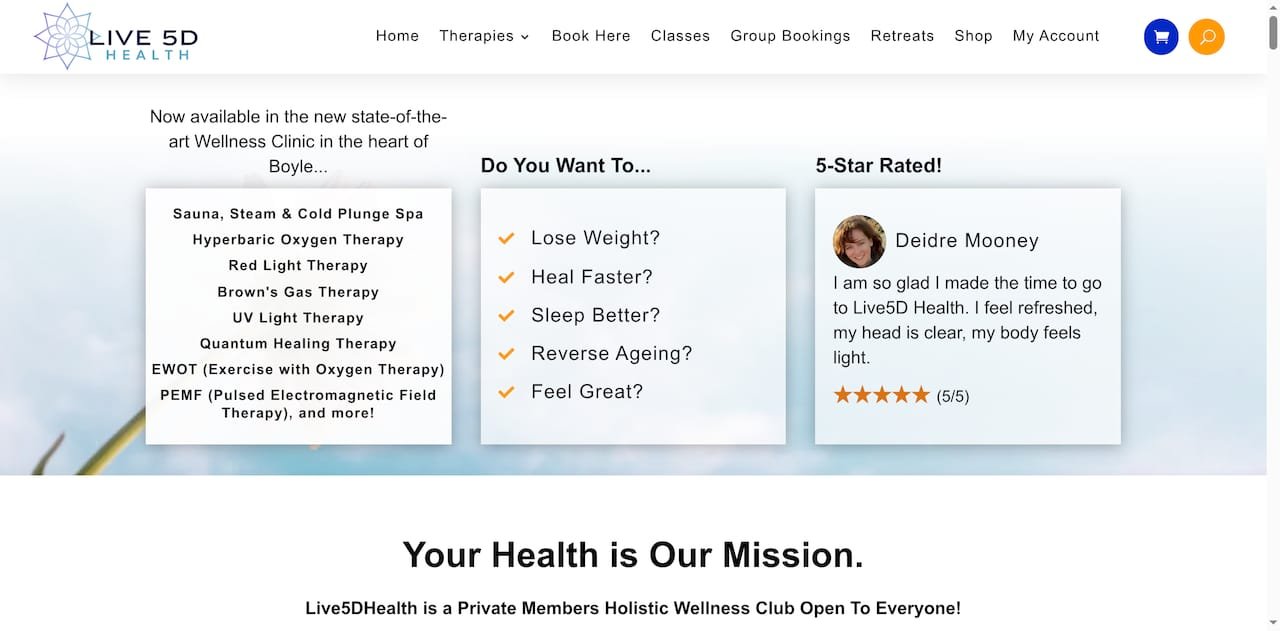
Guests choose from stays built around sauna, steam and cold plunge, hyperbaric oxygen therapy, red light therapy, and a hydrogen bar, each therapy sequenced to support the goal you arrive with rather than sold as a standalone extra. Group bookings are also available for guests who want to attend with family or friends.
- Check availability and programme details on the retreats page.
- Arrange a group booking if you’re planning to attend with others.
- Test individual therapies first with a spa day before committing to a full retreat.
If you want to see how a full stay is packed and prepared for, our retreat packing list covers what to bring and what to leave behind.
Sources
- Package holidays and linked travel arrangements — Citizens Information
- Achieving well-being: a global framework for integrating well-being into public health — WHO
- Package holiday buyer information — Citizens Information (API copy)
FAQ
What are the 7 areas of wellness?
Definitions vary slightly between organisations, but a common version includes physical, mental, emotional, social, spiritual, occupational, and environmental wellness. The WHO’s framework treats wellbeing as an integrated state rather than isolated categories, which is why the strongest retreats connect several of these areas rather than targeting just one.
What are the signs you need a retreat?
Persistent stress, disrupted sleep, low energy, or a sense of running on empty despite normal routines are common reasons people seek a retreat. If you’re managing a chronic condition or recovering from treatment, a retreat with clinical oversight and proper medical screening is more appropriate than a purely leisure-focused break.
What are the rules of a retreat?
Rules vary by retreat but typically cover schedule attendance, dietary restrictions during the stay, quiet hours, and sometimes digital device limits. Always ask for the specific house rules and cancellation terms in writing before booking, particularly around deposits and refund conditions under package holiday protections.
How do I know if a retreat suits my health needs?
Start by confirming your primary goal, then ask the retreat directly about health screening, practitioner qualifications, and emergency procedures before booking. If you have an active medical condition, seek written clearance from your treating clinician first, and request any clinical therapy protocols in advance.
What should I check before paying a deposit?
Confirm whether the booking is a package holiday or a linked travel arrangement, since the refund and insolvency protections differ between the two. Ask for an itemised cost breakdown and written cancellation terms before you pay anything non-refundable.