
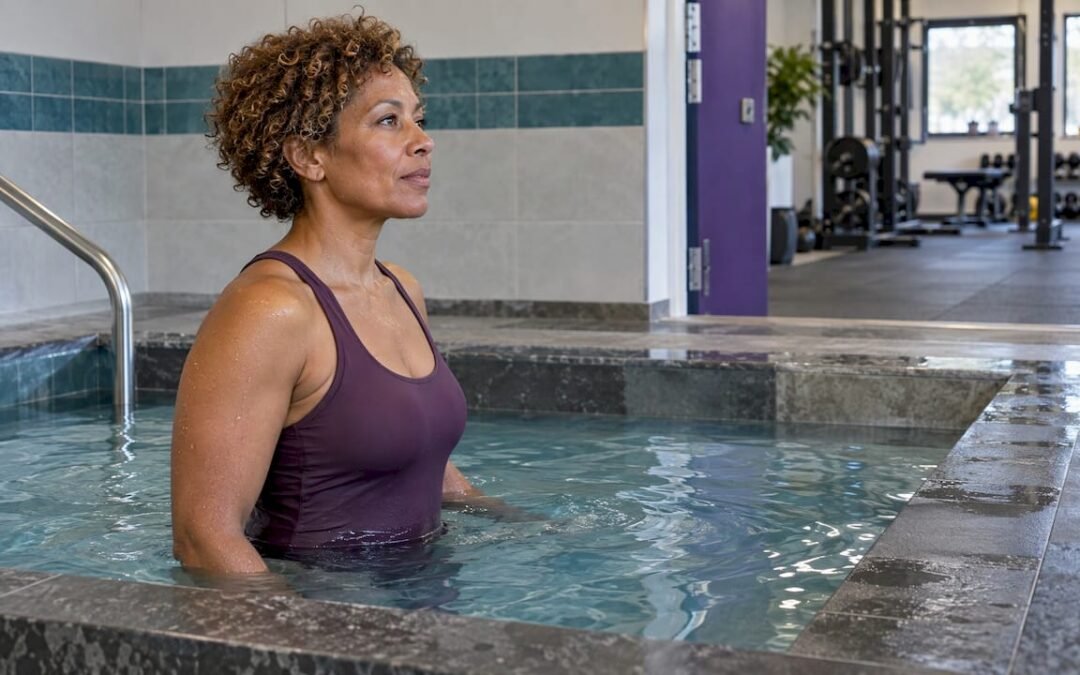
A cold plunge before a workout suits some sessions and works against others. It can sharpen alertness and help endurance work in hot conditions. It is a poor lead-in to heavy lifting or sprinting, because cold muscle produces less force. If your goal is strength, plunge after training, or several hours later. If you are over 40, or living with a health condition such as cancer, speak to your doctor or oncologist before you start. At our spa in Boyle, County Roscommon, the cold plunge is part of a sauna, steam and cold plunge session, so you can plan the order of your day around your training.
TL;DR
- Cold exposure lowers muscle temperature, and colder muscle produces less power. Avoid plunging right before heavy strength, power or sprint work.
- A plunge before endurance exercise in the heat can improve performance. A plunge early in the morning, hours before training, suits strength goals.
- For strength and muscle gain, the American College of Sports Medicine (ACSM) suggests delaying cold water for four to six hours after exercise.
- A cold plunge or cold shower in the evening may help sleep for some people, but the evidence is mixed.
- Cold water is not suitable for everyone. Check with your GP or oncologist first if you have a heart condition, high blood pressure, Raynaud’s disease, an underactive thyroid or are in cancer treatment.
Table of Contents
- What a cold plunge does to your muscles before training
- When a plunge before exercise can help
- Strength, power and muscle gain: plunge after, not before
- A simple way to time your plunge
- Cold plunge before bed, and cold showers for sleep
- If you are a woman over 40
- Safety: who should be careful with cold water
- Our perspective
- Try it at our spa in Boyle
- FAQ
- Sources
What a cold plunge does to your muscles before training
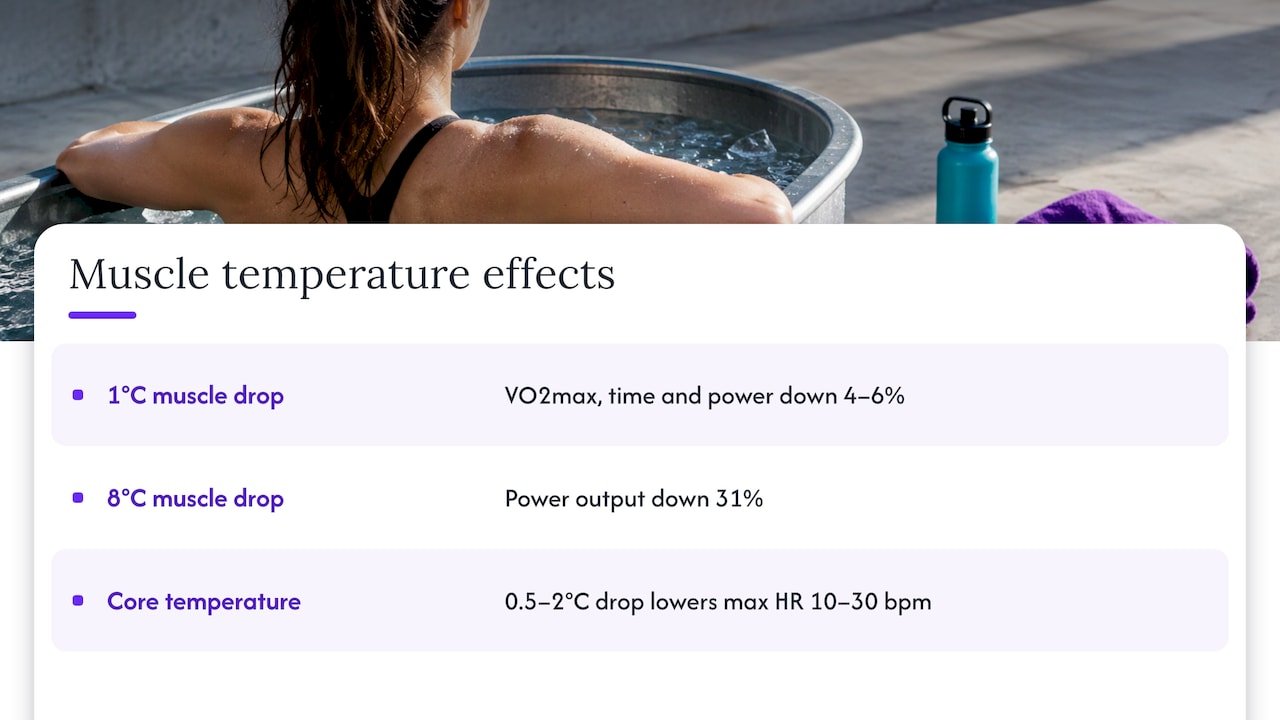
Cold water pulls heat out of your skin and muscles within minutes. That matters because muscles work best when warm. The ACSM expert consensus statement reports that for every 1°C fall in muscle temperature, VO2max, exercise time and power or sprint ability decline by 4% to 6%. It also reports that an 8°C drop in muscle temperature reduces power output by 31% and maximal voluntary contraction by 19%.
The same statement notes that cold water reduces leg muscle blood flow during exercise. It also notes that maximal heart rate is 10 to 30 beats per minute lower when deep body temperature has fallen by 0.5°C to 2.0°C.
In plain terms: if you step out of a cold plunge and go straight to squats, your muscles are cooler, your nerves fire less crisply and your heart may not climb as it normally would. You can still train, but you are starting from a disadvantage. That is why most guides tell you to warm up first and plunge later.
When a plunge before exercise can help
Cold before exercise is not always a mistake. There are two situations where it earns its place.
Endurance work in the heat
Pre-cooling means lowering your body temperature before exercise so you can work for longer before overheating. A systematic review published in 2012 found moderate evidence that cold water immersion improved endurance performance in hot conditions. A 2020 systematic review of highly trained athletes in temperatures of 30°C or above found that pre-cooling increased distance covered by 1.5% to 13.1% and time to exhaustion by 19% to 31.9%. Strategies that ended with cold water immersion were the most effective.
Irish weather rarely reaches 30°C, so this applies mainly if you train in a hot room, a heated studio or abroad on holiday. For a normal damp morning run, there is little pre-cooling benefit to chase.
A morning plunge for alertness
Cold water triggers a surge of alertness hormones. The ACSM’s article Cold Water Immersion: Friend or Froze? says that cold water immersion early in the morning, before exercise, would be ideal to trigger dopamine, norepinephrine and epinephrine release while minimising the impact on strength training later in the day. The key phrase is later in the day. A plunge at 7 am followed by lifting at lunchtime or in the evening is a very different thing from plunging at the gym door and loading the bar five minutes later.
Strength, power and muscle gain: plunge after, not before
If you lift weights, do sprint intervals, play field sports or want to hold on to muscle, timing is the whole game. Cold before the session lowers the temperature of the very tissue you want to load. Cold straight after the session may blunt some of the adaptation signals that drive muscle growth.
The ACSM’s guidance for off-season training aimed at greater strength and muscle size is to delay cold water exposure for four to six hours after exercise. That keeps the benefits people want, such as less pain, less soreness and quicker recovery, while limiting the downsides for adaptation.
What does the recovery evidence look like? Results are not uniform:
- A 2022 study of simulated soccer matches found that cold water immersion afterwards reduced fatigue. The fall in maximal voluntary contraction was 9.9% against 23.7% with thermoneutral immersion, and sprint performance was less impaired.
- A 2021 study by Irish researchers found that a 5 to 10 minute immersion at 8°C after exercise did not improve a later 4 km cycling time trial compared with passive or active recovery in normal temperatures.
The sensible reading is that cold water can help you feel and perform better after a hard, fatiguing session, particularly when you have another match or session soon. For building strength over weeks, space it away from your lifting.
A simple way to time your plunge
There is no single correct answer, because it depends on what you are training for. Use this as a starting framework, and adjust with your doctor’s advice.
- Decide your main goal. Strength and muscle: keep cold away from the hours around your lifting. Endurance in warm conditions: pre-cooling can help. General wellbeing and energy: timing matters less.
- If you want an energy lift, plunge in the morning. Leave a gap of some hours before a strength session, in line with the ACSM’s morning suggestion.
- If you must plunge shortly before training, keep it brief and give your body time to rewarm. Then do a longer, gradual warm-up: light cardio, joint mobility, and lighter sets before your working weight. There is no checked figure for exactly how long to wait after a plunge, so let your body tell you: you should feel warm, loose and not shivery before you load anything heavy.
- After a hard session, if you are not chasing muscle size, a plunge can ease soreness. If you are, wait four to six hours.
- Build up gradually. Start with short, comfortable exposures. Our guide to cold plunge temperature ranges and protocols explains how people usually progress.
A warm-up after cold exposure should never be rushed. Cold muscles and stiff joints are less forgiving, and the point of training is to feel stronger, not to risk a strain.
Cold plunge before bed, and cold showers for sleep
Many people also ask about cold exposure in the evening. The research is promising but not conclusive, and most of it involves athletes.
- A 2021 French study of 12 well-trained runners found that 10 minutes of cold water immersion at 13.3°C after high-intensity exercise increased the share of deep, slow-wave sleep in the first 180 minutes of the night, and reduced sleep arousals and limb movements.
- A 2013 Australian study of trained cyclists found no change in total sleep time, sleep efficiency or sleep stages after evening exercise with or without cold immersion.
- A 2025 meta-analysis of 11 randomised controlled trials with 3,177 participants found improvements in sleep-related outcomes and reduced stress after cold water immersion. It also reported a 29% reduction in sickness absence among people who took cold showers, although the authors say better quality research is still needed.
So a cold shower or plunge in the evening may suit you, particularly after exercise, but it is worth trying carefully and noticing how you sleep. Some people find the alertness boost makes them wide awake, so keep it earlier in the evening if that happens to you. For a fuller look, read our page on cold plunge for sleep.
If you are a woman over 40
Training after 40 is about consistency and recovery as much as intensity. Muscle and bone become more important, so protecting your strength work matters. That is a good reason to keep cold exposure away from the hours right around your lifting sessions. Our recovery workouts after 40 plan covers how to space hard days and rest.
Also consider how you feel in cold water. Hot flushes, changes in circulation and blood pressure are common in midlife, and cold water makes the body’s stress response work harder. Start gently and get your GP’s view if you are unsure.
If you are living with cancer or in treatment
Treatment can change your circulation, nerve sensation, blood counts, energy and temperature tolerance. Please do not begin cold plunging, or change a routine, without asking your oncologist or treating team first. Tell them what you are planning, including how cold the water is and how long you would stay in. The same applies to heat: see our page on sauna safety during chemotherapy. If your team gives the go-ahead, keep sessions short and gentle, and bring someone with you.
Safety: who should be careful with cold water
The ACSM lists several contraindications for cold water immersion: previous cold injury, claustrophobia, Raynaud’s disease, hypothyroidism, cryoglobulinemia, certain cardiovascular diseases, uncontrolled hypertension, and disorders of the sympathetic or sensory nervous system. It advises consulting a health care professional, especially if you have a pre-existing condition. Our page on who should avoid cold plunges goes through this in more detail.
Cold shock is the other thing to respect. The Water Safety Institute in Ireland explains that the first moments in cold water can cause incapacitation and drowning in the first two to three minutes, and that people unused to water below 15°C are at particular risk. Michael Tipton of the University of Portsmouth, in his guidance on minimising risks, says cold shock peaks between 10 and 15°C and is strongest in the first 30 seconds. He advises letting the response subside before immersing your face and avoiding prolonged breath holds.
Practical rules that follow:
- Enter slowly and keep your breathing steady.
- Keep your head out of the water at first.
- Never plunge alone, and never after alcohol.
- Get out if you feel dizzy, chest discomfort, numbness or uncontrolled shivering.
- Do not combine a plunge with a heavy session if you feel unwell or dehydrated.
A supervised, controlled setting makes these rules easier to follow than open water, where temperature, currents and rescue access vary.
Our perspective
Most people ask whether cold comes before or after training, but the better question is what you want from the day. If you want to feel awake and clear-headed, a morning plunge does that. If you want strength, we would protect your lifting and leave the cold for later.
We built our spa around contrast: heat and cold used deliberately, in a calm, clean setting with energised water throughout the facility. A sauna, steam room and cold plunge in one visit lets you plan the order that suits your body, rather than guessing. For our members, that means choosing the right moment for the cold instead of using it every time.
Our approach is holistic, combining modern technology with traditional wisdom. We encourage everyone, and especially women over 40 and anyone in cancer treatment, to speak to their doctor first and then begin gently. You can read more about how we think about contrast therapy and recovery on our site.
Mark
Try it at our spa in Boyle
Our Sauna, Steam & Cold Plunge Spa session costs €30 and gives you the full contrast circuit in one visit, so you can warm up, cool down and finish with how you feel. Many of our guests pair it with their gym session or a day of other therapies at the centre. You can book a spa day in Ireland through our site.

If you are exploring hyperbaric oxygen therapy for recovery or wellbeing, our hyperbaric oxygen therapy sessions are priced at €80 to €120. Our team can help you plan how the different therapies fit together across a week or a retreat stay.
FAQ
Is it okay to do a cold plunge before a workout?
Yes, for some workouts. A plunge suits endurance sessions in hot conditions or a morning energy boost. It is not ideal right before heavy lifting, sprints or power work, because colder muscle produces less force. If you do plunge first, rewarm and warm up thoroughly.
How long after a cold plunge can you work out?
There is no single checked figure. Wait until you feel properly warm and loose, then do a progressive warm-up before intense effort. For strength training, the ACSM’s morning suggestion is to plunge hours before your session rather than minutes.
Is an ice bath before a workout the same as a cold plunge?
The effect on muscle temperature is similar, so the same timing advice applies. The colder the water and the longer you stay in, the more your muscle temperature drops, and the more you should rewarm before training. Keep sessions brief while you are new to it.
Can I do a cold plunge or cold shower before bed?
Some studies suggest better sleep after cold exposure, including more deep sleep after post-exercise immersion, while others found no change. Try it earlier in the evening and see how you feel. If it leaves you wide awake, move it to the morning.
Who should check with a doctor first?
Anyone with a heart condition, high blood pressure, Raynaud’s disease, an underactive thyroid, nerve problems or a history of cold injury, and anyone in cancer treatment. Ask your GP or oncologist before beginning.
Sources
- ACSM, Cold Water Immersion: Friend or Froze?
- ACSM Expert Consensus Statement, Current Sports Medicine Reports, 2021
- Jones et al., pre-cooling for endurance exercise in the heat, 2012
- Rodríguez et al., systematic review of pre-cooling, 2020
- Bouchiba et al., Frontiers in Physiology, 2022
- Egaña et al., Frontiers in Sports and Active Living, 2021
- Chauvineau et al., cold water immersion and sleep, 2021
- Robey et al., evening post-exercise cold water immersion, 2013
- Cain et al., cold-water immersion meta-analysis, 2025
- Water Safety Institute (Ireland), Hypothermia leaflet
- Tipton, Cold water therapies: minimising risks