
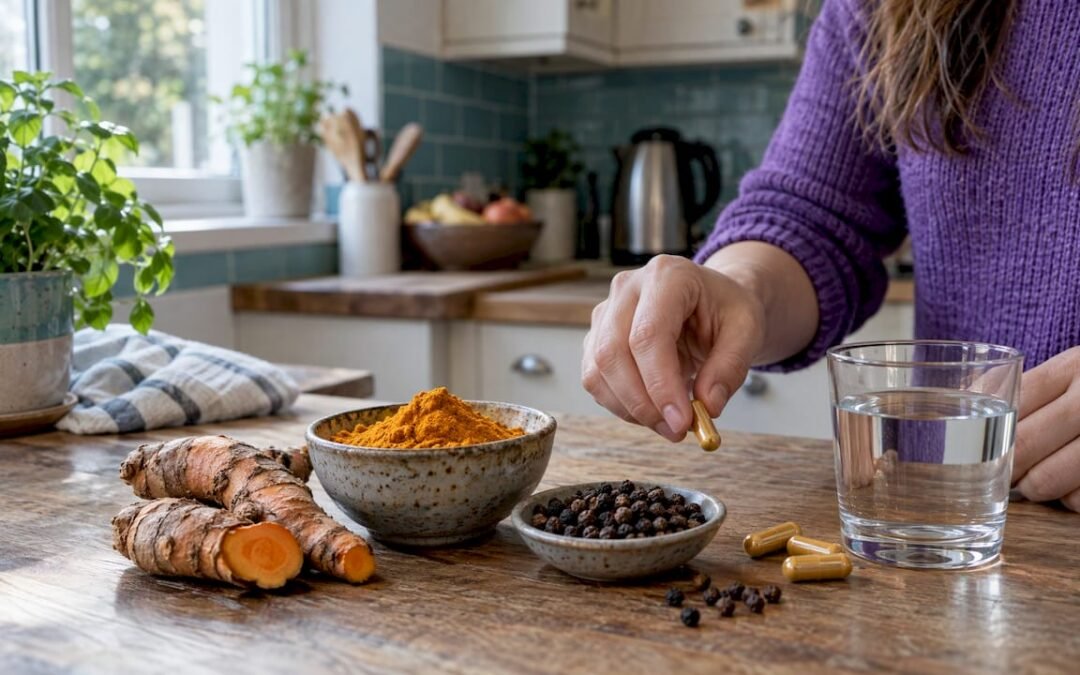
Curcumin, the main active compound in turmeric, is poorly absorbed when swallowed. Only a small fraction reaches your bloodstream in its active form, because it dissolves badly in water and your gut and liver break it down quickly. Black pepper’s piperine and specially made formulations can raise the amount absorbed, in some studies by many times. If you are over 40, managing a health condition or having cancer treatment, the key point is that anything that boosts absorption can also change how your medicines behave, so your oncologist or GP should know before you start.
This guide explains the science in plain terms, shows what the studies found, and tells you what to check before you buy. Our online shop stocks health supplements, and we have written a separate guide to curcumin supplements for over-40s if you want to go further.
TL;DR
- Bioavailability means how much of a substance actually reaches your bloodstream. For plain curcumin it is very low: less than 1% reaches circulation in active form, and it is cleared within an hour or two.
- Piperine from black pepper slows curcumin’s breakdown. In a 1998 human study, 20 mg of piperine with 2 g of curcumin raised curcumin levels by 2000%.
- Modern formulations, such as submicron particles, have raised absorption by 7 to 30 times or more in human trials, but products are hard to compare with one another.
- Curcumin with piperine can interact with medicines. A breast cancer study found it lowered the active form of tamoxifen. Speak to your oncology team or GP first.
Table of Contents
- What bioavailability means, and why curcumin has so little
- Piperine: what it does and what the evidence says
- Formulations compared
- Simple ways to get more from curcumin
- If you have cancer or take regular medicines
- Choosing well if you are over 40
- Wellness support alongside your supplements
- Our perspective
- FAQ
- Sources
What bioavailability means, and why curcumin has so little
When you swallow a capsule, the active compound has to cross several hurdles. It must dissolve, pass through the gut wall, survive the liver, and then circulate in a form your cells can use. Bioavailability is the share that makes it through.
Curcumin struggles at almost every step. A 2025 review lists the reasons:
- It barely dissolves in water, so little of it is taken up in the gut.
- The gut wall and liver quickly convert it into inactive forms called curcumin glucuronide and curcumin sulfate.
- Your body eliminates it fast. Its half-life is around one to two hours.
A 2023 review adds that curcumin is unstable in alkaline conditions and crosses the intestinal wall poorly. Its authors conclude that these weaknesses limit its potential as an oral medicine.
High doses do not simply fix the problem. A 2019 review notes that poor absorption persists even at 12 g a day. The Linus Pauling Institute at Oregon State University reports that in one UK trial, a 3.6 g dose produced plasma curcumin of only about 0.01 µM one hour later. Below that daily dose, neither curcumin nor its metabolites were detectable.
This is why a sprinkle of turmeric in a curry is unlikely to do what a trial dose does. Turmeric spice contains only a small percentage of curcumin by weight, and what you eat is poorly absorbed.
Piperine: what it does and what the evidence says
Piperine is the alkaloid that gives black pepper its bite. It slows the liver and gut enzymes that convert curcumin into inactive forms, so more curcumin stays in its original form for longer.
The best-known result comes from a 1998 study in healthy volunteers. After 2 g of curcumin alone, blood levels were undetectable or very low. With 20 mg of piperine added, curcumin levels rose by 2000% between 15 minutes and one hour after the dose, with no adverse effects observed.
A few points help you read that figure sensibly:
- It was a single dose in a small group of healthy people, not a long-term trial.
- A 2000% rise from a very low starting point is still a modest absolute amount.
- Higher blood levels do not automatically mean a better health outcome. That has to be shown separately.
Some trials have tested the combination over weeks. In 117 people with metabolic syndrome, 1 g a day of a curcumin complex with 10 mg a day of piperine for eight weeks was reported safe, and was linked with improvements in LDL cholesterol, glucose, HbA1c, CRP (a marker of inflammation) and blood pressure.
Formulations compared
Besides piperine, manufacturers use finer particles, fat-based carriers and other techniques to help curcumin dissolve. The table shows what published human research reports.
| Approach | What the research reports | Source |
|---|---|---|
| Plain curcumin powder | Very low absorption, around 1% or less in active form | 2025 review |
| Curcumin with piperine | Curcumin levels up 2000% after a 2 g dose | 1998 study |
| Submicron curcumin (Theracurmin) | Total exposure 35.9 to 42.6 times that of powder in 24 healthy adults; peak reached at 1.5 to 3 hours rather than 8 | 2021 crossover study |
| Several curcuminoid formulations | Total curcuminoid absorption raised 7 to 30 times in humans | 2024 review |
| Curcuminoids in buttermilk | About 15 times the bioaccessibility of neat curcuminoids, though still only about 6% | 2019 review |
Two cautions make this table less simple than it looks. First, these trials use different doses, different measuring methods and different people, so a “30-fold” product is not automatically better than a “20-fold” one. Researchers writing in a 2023 scoping review point out that the mix of enhanced products used in trials makes it hard to compare curcuminoid doses across studies, because each product’s effect on absorption is rarely measured within the trial itself.
Second, some researchers argue that curcumin’s metabolites may contribute to its effects, and these are often left unmeasured. The authors of a 2019 review suggest future trials should look at both curcumin and its metabolites reaching target organs, rather than treating the level of free curcumin as the only measure that matters.
Simple ways to get more from curcumin
You do not need a laboratory to make sensible choices. These points follow from how curcumin behaves:
- Take it with a meal that contains fat. Curcumin is fat-soluble, meaning it dissolves in oils rather than water. Taking it with food that contains healthy fats, such as olive oil, avocado or oily fish, suits its chemistry.
- Look for a stated absorption approach. A label that names piperine, a submicron form or another delivery method tells you the maker has thought about absorption. Check the amount of curcuminoids per capsule, not just the weight of turmeric.
- Check the piperine amount. The trials above used 10 mg to 20 mg of piperine. A professional monograph notes that piperine affects several liver enzymes at doses as low as 20 mg.
- Keep it consistent. Curcumin leaves your body within hours, so trials generally use daily dosing rather than occasional large amounts.
- Buy a notified product. In Ireland, the Food Safety Authority of Ireland (FSAI) is the competent authority for food supplements, and supplements placed on the market must be notified to it.
If you have cancer or take regular medicines
This is the part that matters most for many of our readers. Anything that changes how much curcumin your body absorbs can also change how it handles other substances, because both curcumin and piperine act on the same liver enzymes that process many medicines.
The clearest evidence comes from a 2019 Dutch study in women with breast cancer. Adding curcumin 1200 mg three times daily with piperine 10 mg three times daily to tamoxifen lowered levels of endoxifen, tamoxifen’s active form, by 12.4% compared with tamoxifen alone. The effect was stronger in people who process the drug quickly (extensive CYP2D6 metabolisers). The authors noted this could push endoxifen below its effective level in 20 to 40% of patients. The study also recorded more hot flushes and fatigue, and grade 2 to 3 diarrhoea in three patients taking curcumin with piperine.
The piperine monograph also lists drugs whose levels can rise when taken with piperine, including phenytoin, propranolol, rifampicin and theophylline. It describes black pepper as generally regarded as safe at food-like amounts, but says long-term high-dose data are lacking.
What to do in practice:
- Tell your oncology team, pharmacist or GP before you start, and show them the label, including the curcuminoid and piperine amounts. This applies to tamoxifen and every other treatment, whether chemotherapy, hormone therapy or something else.
- Do not stop or change any prescribed medicine yourself.
- Report new symptoms promptly. The most common side effects across trials were digestive symptoms, headache and dizziness, according to the 2023 scoping review of 389 citations.
- Ask about timing, for example around surgery or treatment cycles. Your care team knows your plan.
The same principle applies to other supportive therapies. If you are exploring them during treatment, our guides on sauna safety during chemotherapy and oncology massage both begin with checking with your oncologist.
Choosing well if you are over 40
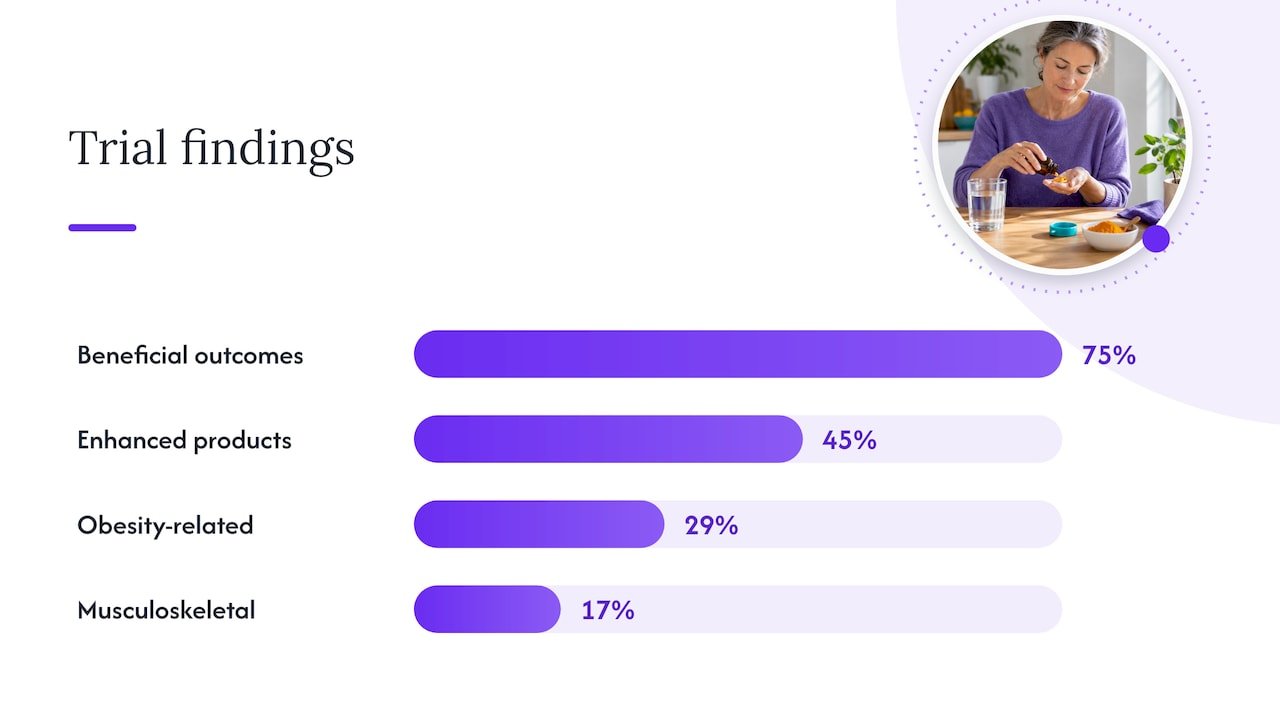
Women in midlife often come to curcumin for joint comfort, general inflammation support or healthy ageing. The research is varied. The 2023 scoping review found beneficial effects on clinical outcomes or biomarkers in 75% of the trials it covered, with obesity-related metabolic disorders (29%) and musculoskeletal disorders (17%) the most studied categories. Enhanced-absorption products were used in 45% of the trials.
A sensible shortlist of questions:
- What is the curcuminoid content per serving, and what delivery method is used?
- Does it contain piperine, and how much?
- Do you take any prescribed medicine, hormone therapy or blood-thinning treatment? Check with your GP or pharmacist.
- Are you pregnant, planning surgery or managing a liver or gallbladder condition? Ask your doctor first.
- Is the product from a notified, reputable supplier with a clear label?
Supplements work best as one part of a wider routine of food, movement, sleep and recovery. If you are looking at what else supports your body, our pages on red light and mitochondria and PEMF for inflammation set out what the evidence says.
Wellness support alongside your supplements
At Live5DHealth in Boyle, County Roscommon, we bring together a wellness centre, spa, gym and retreat centre with an online shop selling health supplements and wellness products. Our therapies include hyperbaric oxygen therapy, listed at €80 to €120, red light therapy at €20 to €40, and our sauna, steam and cold plunge spa at €30. We also offer PEMF, EWOT, holistic massage and Ireland’s first Hydrogen Bar, and clean energised water is available throughout the facility.
If you are curious about hyperbaric oxygen, start with Hyperbaric Oxygen Therapy at Live5DHealth. For multi-day stays, see our 3, 5 and 10-day wellness retreats.
If you have cancer or are in treatment, speak to your oncologist before booking any therapy.
Our perspective
Absorption is only one piece of the picture, and we like to see it that way. A capsule that your body takes up well is useful, but how you feel day to day depends on sleep, movement, stress, recovery and the food on your plate.
That is why we built Live5DHealth around a holistic approach that combines modern technology with ancient wisdom. Our therapies, from red light and PEMF to hyperbaric oxygen, massage and the sauna, steam and cold plunge spa, are designed to support the body in different ways, and our clean energised water runs throughout the facility.
For women over 40, and for anyone rebuilding their strength, we believe in building a routine you can enjoy and keep up. Our online shop offers health supplements and wellness products, and our team is happy to talk you through your options in Boyle. Always share your plans with your doctor or oncology team first, so everything you do works together.
Mark
FAQ
What is the most bioavailable form of curcumin?
No single form is proven best for everyone. Piperine combinations, submicron particles and other delivery systems have each raised absorption in human studies, from about 7-fold to more than 40-fold depending on the product and the measure. Because trials differ in dose and design, compare the curcuminoid amount and the stated method rather than the biggest headline number.
What are the benefits of taking curcumin with piperine?
Piperine slows curcumin’s breakdown, so more of it stays in your blood. In the 1998 study, 20 mg of piperine raised curcumin levels by 2000% after a 2 g dose, with no adverse effects observed. Piperine can also change how some medicines are processed, so check with your GP, pharmacist or oncology team first.
Can I take curcumin if I am having cancer treatment?
Speak to your oncology team before you begin. A 2019 study found curcumin with piperine lowered the active form of tamoxifen, and other treatments may interact too. Take the product label to your appointment.
Does turmeric in food give me enough curcumin?
Cooking with turmeric is a pleasant part of a varied diet. However, curcumin is poorly absorbed from food, and trial doses are much higher than a spice can supply. Pairing turmeric with fat and black pepper in cooking suits its chemistry.
Should I take curcumin with food?
Yes, with a meal containing some fat is a sensible habit, since curcumin dissolves in fat rather than water. Follow the dose on your product label and your doctor’s advice.
Sources
- Curcumin: biochemistry, pharmacology, advanced drug delivery (2025 review)
- Dietary Curcumin: Correlation between Bioavailability and Health Potential (2019)
- The Holy Grail of Curcumin and its Efficacy in Various Diseases
- Curcumin Formulations for Better Bioavailability: What We Learned from Clinical Trials (2023)
- Curcumin, Linus Pauling Institute, Oregon State University
- Influence of piperine on the pharmacokinetics of curcumin (1998)
- Comparative pharmacokinetics of Theracurmin (2021)
- Enhancing the Bioavailability and Bioactivity of Curcumin (2024)
- Curcumin Supplementation and Human Disease: A Scoping Review (2023)
- Impact of Curcumin (with or without Piperine) on the Pharmacokinetics of Tamoxifen (2019)
- Piperine, Black Pepper monograph
- FSAI: food supplements legislative requirements