
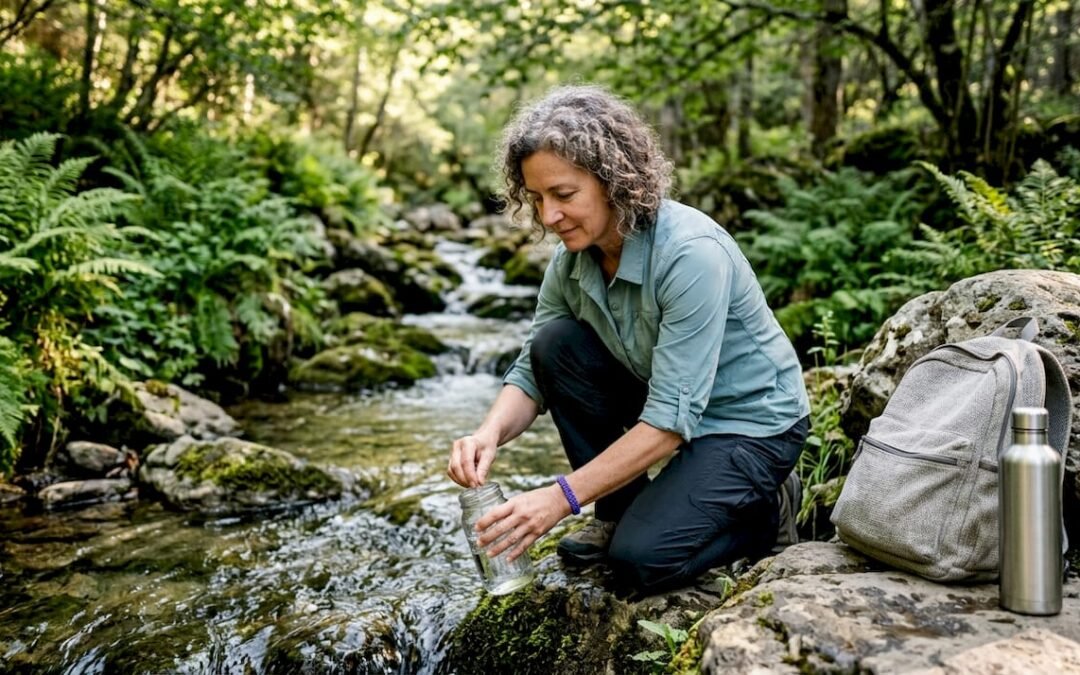
Living water is defined as naturally flowing or energetically revitalised water that carries unique physical properties and profound spiritual significance. The term spans two worlds: the scientific, where hexagonal molecular structure and negative Oxidation Reduction Potential (ORP) values distinguish it from processed water, and the theological, where it appears in John 4:10–14 as a metaphor for eternal life and divine renewal. Both definitions share one core idea: water that is alive, moving, and life-giving. Whether you are drawn to the science of cellular hydration or the symbolism of the Holy Spirit, understanding this concept opens a genuinely rich path into holistic wellness.
What is living water, and what makes it different?
Living water, known in scientific wellness circles as structured water, refers to water in its most natural, energetically coherent state. Natural springs, mountain streams, and waterfalls all produce it. The movement, mineral contact, and oxygenation these sources provide create a hexagonal molecular arrangement that differs measurably from the water that comes out of most taps.
The key measurable marker is ORP, or Oxidation Reduction Potential. Negative ORP values between -150 and -400 mV confirm antioxidant capacity, meaning the water donates electrons rather than stripping them. That is the opposite of oxidative stress, which accelerates cellular ageing. Tap water and many bottled waters carry a positive ORP, offering no antioxidant benefit at all.
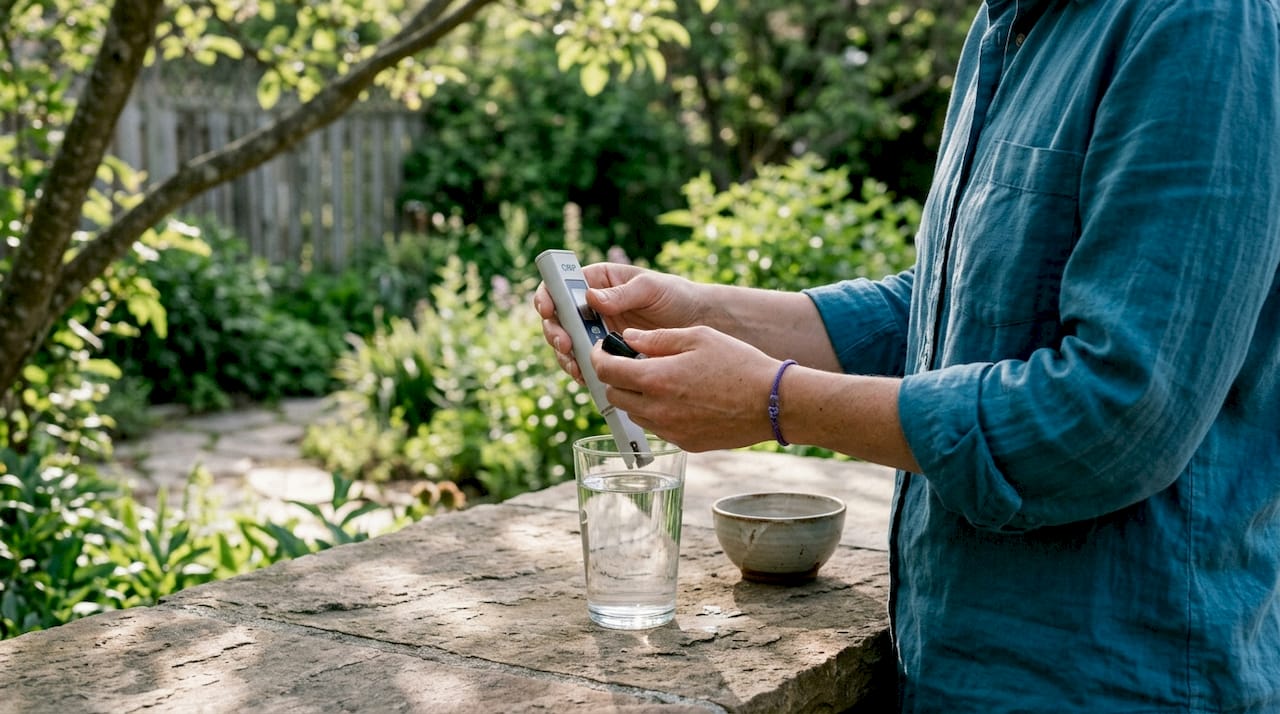
Processed water presents a particular contrast. Reverse Osmosis filtration strips water of its minerals and produces an acidic, demineralised output that wellness practitioners classify as “dead water.” It lacks the mineral content and molecular structure that give natural water its vitality. Restoring those properties requires re-mineralisation, which most standard filtration systems do not perform.
The concept of micro-clustering sits at the heart of the structured water debate. Proponents argue that smaller water molecule clusters penetrate cell membranes more efficiently, improving nutrient delivery and waste removal. Mainstream science continues to debate these mechanisms, but the wellness community and a growing body of clinical observation treat micro-clustering as a working model worth taking seriously.
- Natural springs and waterfalls produce living water through continuous movement and mineral absorption.
- Negative ORP signals antioxidant capacity, a property absent in most processed water.
- Micro-clustered molecules are proposed to enter cells more readily than standard water clusters.
- Reverse Osmosis output lacks minerals and structure, placing it at the opposite end of the spectrum.
Pro Tip: To partially restore structure to tap water at home, try the freeze-thaw method: freeze a bottle of filtered water, then allow it to thaw naturally. Storing water in a clay or ceramic jug for several hours also encourages re-structuring through mineral contact.
What are the health benefits of drinking living water?
The living water benefits most frequently cited in clinical and wellness contexts centre on hydration efficiency, blood health, and acid-base balance. These are not abstract claims. A clinical study of 100 people showed significant blood viscosity improvement in those consuming alkaline ionised water after intense physical activity. Thicker blood impairs oxygen transport and slows recovery. Reducing viscosity after exercise is a measurable, meaningful outcome.
Dehydration is far more common than most people realise. Between 17% and 28% of adults suffer from undiagnosed medical dehydration. Among those affected, 83.9% report constant thirst and 45.9% report unexplained fatigue. These figures suggest that standard water intake, even when adequate in volume, may not be resolving cellular dehydration for a significant portion of the population. Structured water’s micro-clustering is proposed as one reason it may address symptoms that ordinary water does not.
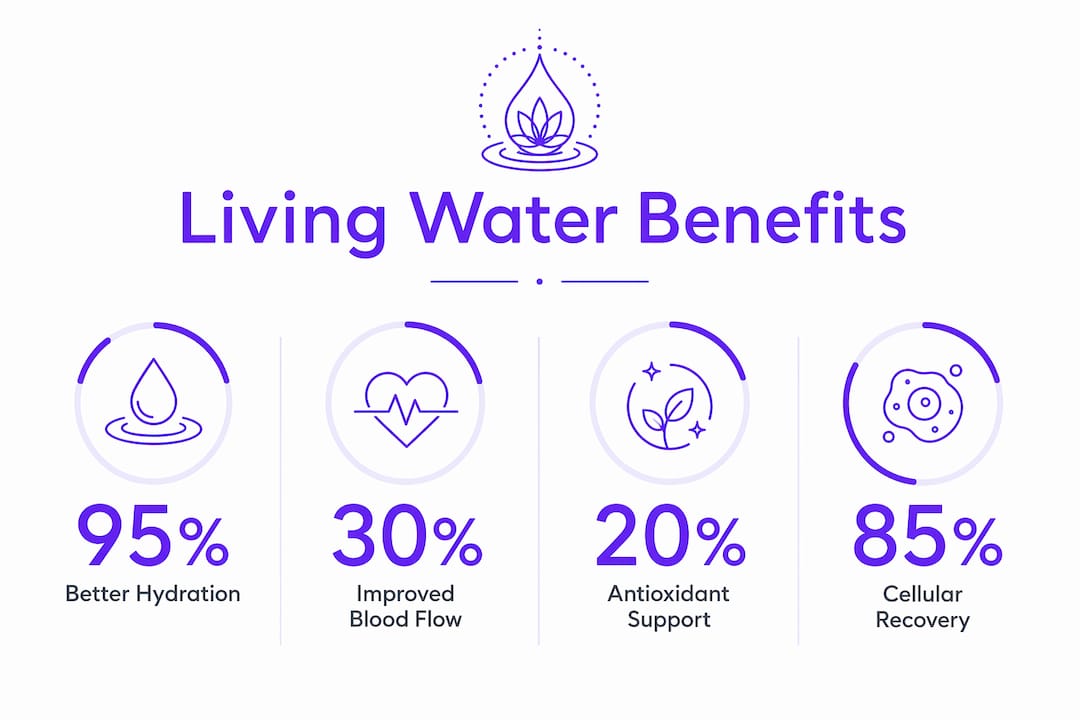
Health authorities confirm that consistent water intake is fundamental to metabolic function, irrespective of water type. The quality and structure of that water may, however, influence how efficiently the body uses it. That distinction matters when you are trying to move beyond basic hydration into genuine cellular wellness.
The key health benefits associated with structured water consumption include:
- Improved cellular hydration through micro-clustered molecules that penetrate cell membranes more readily.
- Reduced blood viscosity after exercise, supporting faster oxygen delivery and recovery.
- Antioxidant support via negative ORP values that neutralise free radicals.
- Better acid-base balance through natural mineral content, particularly calcium and magnesium.
- Symptom relief for chronic dehydration, including fatigue and persistent thirst, where standard water has failed.
- Enhanced nutrient transport into cells, supporting energy production and detoxification.
Scientific consensus on structured water mechanisms remains active and evolving. The wellness industry, however, treats these benefits as a working framework supported by clinical observation and a growing number of peer-reviewed studies.
How is living water understood in biblical and cultural traditions?
Living water carries one of the most layered symbolic meanings in religious history. The Hebrew phrase mayim chayyim literally means “living waters” and refers to flowing water, specifically springs and rivers, as opposed to stagnant cistern water. This was not merely poetic. In ancient practice, flowing water was considered safer and more vital than stored water, which made its symbolic power entirely grounded in lived experience.
The most cited passage is Jesus’ conversation with the Samaritan woman at the well in John 4:10–14. Jesus offers her “living water” and explains that anyone who drinks it will never thirst again. The meaning shifts from physical water to an internal, self-generating spring of spiritual life. This was a deliberate redirection: from the external well to an internal source of renewal. For those exploring biblical healing and spiritual wellness, this passage remains one of the most theologically rich in the New Testament.
John 7:37–39 extends the metaphor further. Jesus declares that rivers of living water will flow from within those who believe, and the text identifies this directly with the Holy Spirit. The spiritual living water is therefore tied to baptism, indwelling, and continual internal renewal rather than any single external act.
| Biblical reference | Key phrase | Spiritual meaning |
|---|---|---|
| John 4:10–14 | “Living water I shall give” | Eternal life as an internal, self-renewing source |
| John 7:37–39 | “Rivers of living water” | The indwelling of the Holy Spirit in believers |
| Ezekiel 47:9 | “Everything will live where the river goes” | Restoration and life flowing from God’s presence |
| Zechariah 14:8 | “Living waters shall flow from Jerusalem” | Eschatological renewal and divine abundance |
Living water also appears in Mandaeism, one of the world’s oldest surviving Gnostic religions. Mandaean baptismal practice, known as masbuta, requires flowing water called yardna for ritual purity. Still water is considered insufficient. This cross-cultural insistence on flowing water as spiritually superior reinforces how deeply the concept is embedded across traditions, not just Christianity.
The spiritual and physical definitions are not in conflict. Both treat flowing, vital water as a source of renewal. One operates at the cellular level; the other at the level of the soul.
How can living water guide your daily wellness practice?
Integrating the principles of living water into daily life does not require a complete overhaul of your routine. It begins with intentionality: choosing water quality with the same care you give to food quality, and approaching hydration as a practice rather than a habit.
On the physical side, the priorities are clear:
- Choose spring water or filtered water with re-mineralisation over standard tap or Reverse Osmosis output wherever possible.
- Use clay or glass containers rather than plastic, which can leach compounds that disrupt water’s natural structure.
- Hydrate before meals to support digestive enzyme activity and nutrient absorption.
- Explore structured water products designed to restore molecular coherence to filtered water.
- Pair hydration with movement, since physical activity supports lymphatic flow and cellular detoxification.
On the spiritual side, living water symbolism offers a genuinely useful framework for mindfulness. The image of an internal spring, one that does not run dry regardless of external circumstances, is a powerful anchor for meditation and reflection. Jesus used this metaphor to redirect attention from external provision to internal renewal. That shift in orientation is as relevant to modern wellness as it was two thousand years ago.
Pro Tip: Try beginning your morning with a glass of spring water before any food or caffeine, then spend two to three minutes in quiet reflection or breath work. This pairs the physical act of hydration with a moment of intentional stillness, reinforcing both the cellular and spiritual dimensions of living water practice.
Nutrition and detoxification also benefit from this framework. Natural mineral content in spring water supports the acid-alkaline balance that underpins metabolic health. Calcium, magnesium, and bicarbonate ions all contribute to this balance in ways that demineralised water cannot replicate.
Key takeaways
Living water is both a scientifically distinct form of naturally structured water and a spiritual symbol of renewal, and understanding both dimensions is the most complete approach to holistic wellness.
| Point | Details |
|---|---|
| Physical definition | Living water features a hexagonal molecular structure and negative ORP values that standard tap water lacks. |
| Health impact | Clinical evidence shows structured water reduces blood viscosity post-exercise and may address chronic dehydration symptoms. |
| Spiritual significance | Biblical texts from John 4 and John 7 define living water as the Holy Spirit and a source of eternal internal renewal. |
| Cross-cultural reach | From Hebrew mayim chayyim to Mandaean baptismal rites, flowing water holds sacred status across multiple traditions. |
| Daily practice | Choosing quality spring water and pairing hydration with mindfulness integrates both physical and spiritual benefits. |
Why I think living water deserves more serious attention
Most wellness conversations treat water as a background variable: drink enough of it and move on. What strikes me about the living water concept is that it refuses to let water be ordinary. Whether you approach it from the scientific angle, looking at ORP values and micro-clustering, or from the theological angle, sitting with John 4 and what it means to have a spring within you, the conclusion is the same. Water quality and water intentionality matter far more than most people give them credit for.
The uncomfortable truth is that the majority of people in the developed world drink water that has been stripped, pressurised, chlorinated, and delivered through ageing pipes. That water keeps you alive. It does not necessarily keep you well. The gap between survival hydration and genuine cellular nourishment is where living water sits, and it is a gap worth closing.
What I find most compelling is the convergence. Ancient traditions across cultures, from Hebrew scripture to Mandaean ritual to Christian theology, independently arrived at the same conclusion: flowing, vital water is categorically different from stagnant water. Modern wellness science is now building a molecular vocabulary for exactly that distinction. That kind of convergence across millennia and disciplines is not something to dismiss lightly.
The challenge for most people is access and habit. Spring water is not always convenient. Structured water devices vary in quality. And the spiritual dimension of hydration feels unfamiliar to those who have never considered it. My suggestion is to start small: one glass of quality spring water each morning, taken with a moment of quiet. The physical and the contemplative reinforce each other more than you might expect.
— Mark
Living water and wellness at Live5dhealth
Live5dhealth, based in Boyle, County Roscommon, brings together the physical and spiritual dimensions of wellness in one place. The centre’s approach to hydration, detoxification, and cellular health aligns directly with the principles explored here.

Whether you are looking for luxury spa experiences that support deep relaxation and cellular recovery, or you want to explore wellness retreats in Ireland designed around natural healing principles, Live5dhealth offers a setting where these ideas become lived experience. The online shop also carries a curated range of health supplements chosen to complement quality hydration and support the body’s natural detoxification processes. Your next step toward feeling genuinely well is closer than you think.
FAQ
What is living water in simple terms?
Living water is naturally flowing water, from springs or streams, that retains its mineral content and a hexagonal molecular structure. In spiritual contexts, it refers to the Holy Spirit and eternal life as described in John 4:10–14.
Is living water the same as structured water?
The terms are closely related. Structured water is the scientific label for water with micro-clustered molecules and negative ORP values. Living water encompasses both this physical definition and its broader spiritual and cultural meanings.
What are the main living water benefits for health?
Clinical evidence points to improved blood viscosity after exercise, better cellular hydration, antioxidant support through negative ORP, and relief from chronic dehydration symptoms such as fatigue and persistent thirst.
What does living water symbolise in the Bible?
Living water in the Bible symbolises the Holy Spirit, eternal life, and divine renewal. Jesus uses it in John 4 and John 7 to describe an internal, self-generating source of spiritual life that never runs dry.
Can you make living water at home?
You can partially restore water’s natural structure at home by using the freeze-thaw method, storing water in clay or ceramic jugs, or using a re-mineralising filter. Full spring-quality structured water is best sourced directly from a natural spring.