

Anxiety is a state of persistent worry, physical tension, and heightened alertness that goes beyond ordinary stress. Unlike passing nervousness before a presentation, an anxiety disorder disrupts daily life through symptoms that are disproportionate to the situation and difficult to control. Clinical diagnosis of Generalised Anxiety Disorder requires excessive, uncontrollable worry lasting over six months, alongside symptoms such as restlessness, fatigue, and disturbed sleep. The good news is that anxiety responds well to treatment. Whether you are looking for therapeutic approaches, lifestyle changes, or natural remedies, effective options exist and they work.
What are the common symptoms of anxiety?
Anxiety symptoms fall into two broad categories: psychological and physical. Recognising both is the first step toward managing them effectively.
Psychological symptoms include:
- Persistent, hard-to-control worry about everyday situations
- Irritability and a low threshold for frustration
- Difficulty concentrating or a sense that your mind goes blank
- Feeling on edge or restless, as though something bad is about to happen
- Avoidance of situations that trigger worry
Physical symptoms include:
- Racing or pounding heart (palpitations)
- Muscle tension, particularly in the neck, shoulders, and jaw
- Nausea, stomach cramps, or diarrhoea
- Dizziness or lightheadedness
- Shortness of breath or chest tightness
- Sweating and trembling
These physical signs are not imaginary. Sympathetic nervous system activation triggers the “fight-or-flight” response, flooding the body with adrenaline and cortisol. Hyperventilation follows in many cases, causing lightheadedness and tingling in the hands and feet.
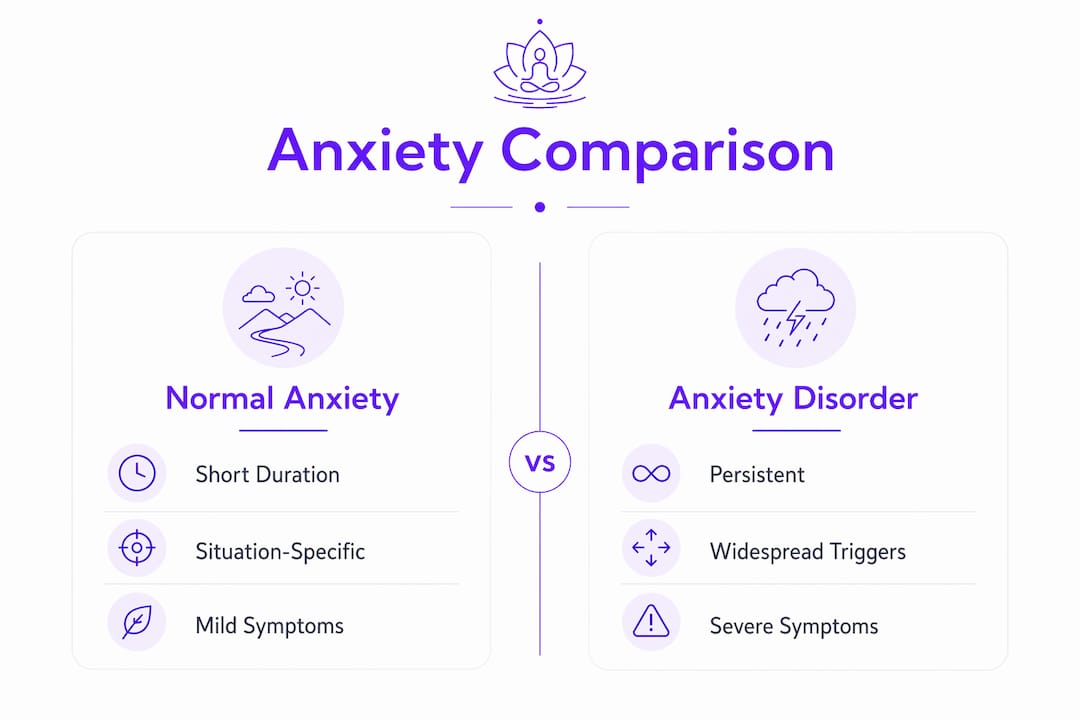
The table below shows how normal anxiety differs from an anxiety disorder.
| Feature | Normal anxiety | Anxiety disorder |
|---|---|---|
| Duration | Short-lived, situation-specific | Persistent, six months or more |
| Intensity | Proportionate to the trigger | Disproportionate and hard to control |
| Impact on daily life | Minimal | Significant disruption to work and relationships |
| Physical symptoms | Mild and temporary | Frequent and distressing |
| Resolution | Resolves once the trigger passes | Persists without the trigger |
Anxiety is often underdiagnosed and frequently occurs alongside other psychiatric and medical conditions. Early, effective treatment prevents outcomes from worsening over time.
What causes anxiety, and which factors contribute to it?
Anxiety develops from a combination of biological, psychological, and social factors. No single cause explains every case, and the interaction between these factors is what matters most.
Biological factors:
- Genetic predisposition: a family history of anxiety disorders raises your personal risk
- Neurochemical imbalances involving serotonin, dopamine, and gamma-aminobutyric acid (GABA)
- Hormonal fluctuations, particularly during perimenopause or thyroid dysfunction
Psychological factors:
- Catastrophic thinking fuels anxiety intensity by amplifying perceived threats beyond their realistic scale
- Low self-compassion and harsh self-talk worsen emotional distress
- Past trauma, including childhood adversity, shapes how the nervous system responds to stress
Social and environmental factors:
- Chronic work pressure, financial stress, or relationship conflict
- Social isolation, which removes the buffering effect of community support
- Substance use, including caffeine, alcohol, and stimulants, which can trigger or worsen symptoms
Medical conditions also play a role. Cardiovascular disease, asthma, and comorbid substance use disorders frequently co-occur with anxiety. This is why a professional assessment matters. Ruling out physical causes before assuming a purely psychological origin is not optional; it is necessary.
How can therapeutic approaches help manage anxiety effectively?
Therapy is the most evidence-based treatment for anxiety disorders, and the results are measurable. 79% of people improved in anxiety symptom severity during professional therapy treatment. That figure reflects what is achievable when the right approach is matched to the right person.
Cognitive-behavioural therapy (CBT)
CBT is the most widely studied psychological treatment for anxiety. It works by identifying distorted thought patterns, such as catastrophising or all-or-nothing thinking, and replacing them with more accurate, balanced perspectives. A typical course runs for 12–16 sessions, and gains tend to be durable beyond the end of treatment. The quality of the relationship between therapist and client predicts outcomes as much as the technique itself.
Other recommended therapies
Acceptance and Commitment Therapy (ACT) takes a different approach. Rather than challenging anxious thoughts, ACT teaches you to observe them without reacting. Exposure therapy is particularly effective for phobias and social anxiety, gradually reducing fear responses through controlled, repeated contact with the feared situation. Integrating “bottom-up” body calming techniques like controlled breathing with “top-down” cognitive therapies like CBT produces the most lasting benefit. The body and mind need to be addressed together.
When medication is appropriate
Medication is not a first-line treatment for mild to moderate anxiety, but it has a clear role in moderate to severe cases. Selective serotonin reuptake inhibitors (SSRIs) and serotonin-norepinephrine reuptake inhibitors (SNRIs) are the most commonly prescribed classes. Short-term use of benzodiazepines may be considered during acute episodes, though dependence risk limits their long-term use. A GP or psychiatrist should guide any pharmacological decision, particularly where anxiety co-occurs with other medical conditions.
Pro Tip: Before your first therapy appointment, keep a one-week symptom diary noting the time, trigger, physical sensations, and intensity of each anxious episode. This gives your therapist a concrete starting point and shortens the assessment phase significantly.
You can also explore HBOT and mental health as a complementary approach that some people find supportive alongside conventional therapy.
Which lifestyle changes and natural remedies support anxiety management?
Self-help strategies do not replace therapy, but they are powerful tools that work between sessions and over the long term. The key is consistency. At least two weeks of consistent practice is necessary before you can fairly assess whether a technique is working for you.
Here are the most effective approaches, ranked by evidence strength:
-
Daily aerobic exercise. Exercise reduces cortisol, promotes neuroplasticity in the hippocampus, and produces anxiolytic effects lasting several hours. Even a single moderate session lowers perceived anxiety. Aim for 30 minutes of brisk walking, cycling, or swimming at least five days per week.
-
Controlled breathing. Breathing at 5–6 cycles per minute activates the parasympathetic nervous system and calms the stress response. Box breathing is a reliable technique: inhale for four counts, hold for four, exhale for four, hold for four. Practise it daily, not only during anxious moments.
-
Progressive muscle relaxation (PMR). PMR involves systematically tensing and releasing muscle groups from feet to face. It teaches the body to recognise and release tension before it accumulates. Ten minutes before bed reduces both sleep-onset anxiety and overnight cortisol disruption.
-
The worry window. Setting a daily worry window confines anxious thoughts to a specific 15-minute slot each day. When worries arise outside that window, you note them and defer them. The brain learns that worry has a time and place, which prevents it from spreading throughout the day. Suppressing anxious thoughts paradoxically increases anxiety; containment, not suppression, is the goal.
-
Sleep hygiene. Chronic anxiety alters sleep cortisol rhythms, creating a cycle where poor sleep worsens anxiety and anxiety worsens sleep. Consistent sleep and wake times, limiting screens for 60 minutes before bed, and reducing caffeine after 2:00PM all support better sleep architecture.
-
Mindfulness and grounding. The 5-4-3-2-1 grounding technique (name five things you can see, four you can touch, three you can hear, two you can smell, one you can taste) interrupts the cognitive loop of anxious rumination and returns attention to the present moment.
-
Nutrition and natural supplements. Magnesium deficiency is associated with heightened stress reactivity. A diet rich in leafy greens, nuts, and whole grains supports nervous system function. For targeted support, magnesium supplements may offer additional benefit, particularly for people with disrupted sleep and muscle tension.
Pro Tip: Pair your worry window with a brief relaxation practice immediately after. Closing the window with a calming ritual signals to the nervous system that the worry period is genuinely over.
Key takeaways
Anxiety is most effectively managed through a combination of evidence-based therapy, consistent physical self-care, and targeted lifestyle adjustments applied together over time.
| Point | Details |
|---|---|
| Know the clinical threshold | Generalised Anxiety Disorder requires six months of uncontrollable worry plus at least three physical or cognitive symptoms. |
| Therapy produces measurable results | 79% of people show improvement in symptom severity during professional treatment. |
| Exercise is a direct anxiolytic | A single moderate aerobic session lowers perceived anxiety through cortisol reduction and hippocampal neuroplasticity. |
| Containment beats suppression | A daily worry window reduces anxiety spread; suppressing anxious thoughts makes them stronger. |
| Consistency is non-negotiable | Techniques like breathing exercises and mindfulness require at least two weeks of daily practice before their effect becomes clear. |
What I have learned from watching anxiety express itself in the body first
Most people arrive at an anxiety diagnosis through their GP, not a therapist. They come in with chest tightness, persistent nausea, or a racing heart. They suspect a cardiac problem. The physical symptoms of anxiety are real, and they often appear before the person consciously registers that they are worried about anything. Anxiety frequently expresses physically before conscious awareness, which is why tracking physical symptoms is as important as tracking thoughts.
What I find most underappreciated is how much patience the management process requires. People try box breathing for three days, feel no different, and conclude it does not work. Two weeks is the minimum. The nervous system does not reorganise itself overnight.
The other thing I would push back on is the idea that anxiety is purely a thinking problem. CBT is excellent, but it works best when the body is also being regulated. Exercise, sleep, and breathing are not “nice to haves.” They are the physiological foundation that makes cognitive work possible. Without them, therapy is harder and slower.
Seeking help is not a sign that your anxiety is severe. It is a sign that you are taking it seriously before it becomes severe. That distinction matters enormously for long-term outcomes.
— Mark
How Live5dhealth supports your path to calmer living
Managing anxiety well often requires more than one tool. Live5dhealth, based in Boyle, County Roscommon, offers a wellness centre, luxury spa, gym, and retreat facilities designed to support both body and mind.

Whether you are looking for structured relaxation through spa therapies, physical movement in a supportive gym environment, or a restorative retreat in the west of Ireland, Live5dhealth brings these resources together in one place. The online shop also stocks a carefully selected range of natural supplements to complement your daily self-care routine, including options relevant to stress and sleep support. If you are ready to take a practical step toward feeling better, Live5dhealth is a good place to start.
FAQ
What is the difference between anxiety and an anxiety disorder?
Anxiety is a normal response to stress that resolves once the trigger passes. An anxiety disorder is diagnosed when worry is excessive, lasts six months or more, and significantly disrupts daily functioning.
What are the first signs of anxiety to watch for?
The earliest signs are often physical: muscle tension, a racing heart, and disturbed sleep. Psychological signs such as persistent worry and difficulty concentrating typically follow.
How long does it take for anxiety treatment to work?
CBT typically produces measurable improvement within 12–16 sessions. Self-help techniques such as breathing exercises and mindfulness require consistent daily practice for at least two weeks before their effect becomes clear.
Can lifestyle changes alone manage anxiety effectively?
Lifestyle changes including exercise, sleep hygiene, and controlled breathing significantly reduce anxiety symptoms. For moderate to severe anxiety disorders, they work best alongside professional therapy rather than as a standalone approach.
Is anxiety linked to depression?
Anxiety and depression frequently co-occur. Both conditions share overlapping neurochemical pathways, and treating one without addressing the other often produces incomplete results. A professional assessment should screen for both.