
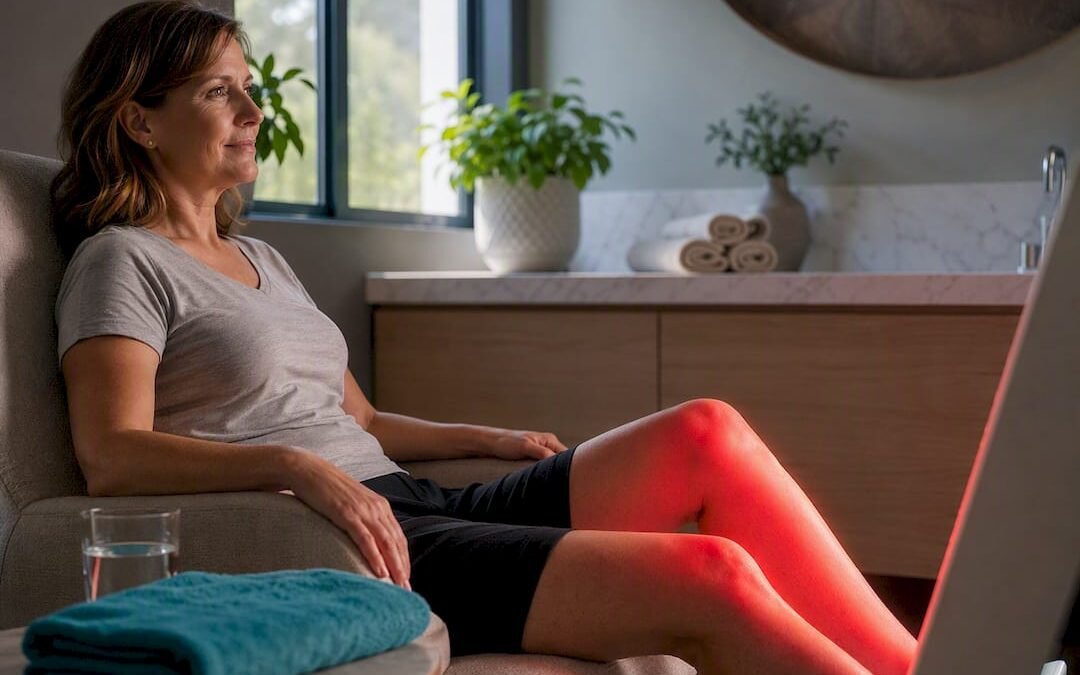
Red light therapy, or photobiomodulation, can meaningfully reduce pain from fibromyalgia, knee osteoarthritis, non-specific low back pain and tendinopathy, according to randomised trials and systematic reviews. The size and duration of that relief varies by condition and protocol, and most people see results as part of a treatment course rather than after one session. It’s generally well tolerated, though it isn’t right for everyone.
TL;DR:
- Most studies suggest red or near-infrared light therapy offers meaningful pain relief when used consistently over several weeks, especially for fibromyalgia and osteoarthritis.
- Proper dosing, involving at least 4 joules per treatment point and wavelengths between 780 and 905 nanometres, is vital for achieving benefits.
- Effects tend to build gradually, with noticeable improvements usually appearing between the third and sixth week of treatment.
- Safety profiles are strong, but caution is advised for those on photosensitizing medication, with active cancer, or during pregnancy.
- Combining therapy with other treatments like physiotherapy and tracking pain scores enhances outcomes and guides treatment adjustments.
Table of Contents
- What red light therapy for pain actually is
- What the clinical evidence says for different pain conditions
- Typical treatment parameters and what to expect
- Safety, side effects and who should be cautious
- Clinic treatment versus home devices: how to choose
- How Live5dhealth approaches red light therapy for pain
- What people actually report after a course of treatment
- Staying comfortable after your treatment course ends
- How red light therapy compares with other pain treatments
- Combining red light therapy with other pain treatments
- Using red light therapy safely as part of your pain plan
- Book a red light therapy session with Live5dhealth
- Key research and guidance to read next
- Sources
What red light therapy for pain actually is
Photobiomodulation, commonly shortened to PBM, is the clinical term for what most people call red light therapy. It uses specific wavelengths of red and near-infrared light to trigger biological changes inside your cells, rather than heating tissue the way a hot water bottle or infrared sauna does. You’ll see the terms “red light therapy,” “LED therapy,” and “low-level laser therapy” used almost interchangeably online, but they aren’t identical: LED devices spread light across a wider area at lower intensity, while lasers deliver a more concentrated beam to a smaller spot. Both fall under the PBM umbrella, and both appear across the clinical trials referenced throughout this guide.
The mechanism comes down to your mitochondria, the energy-producing structures inside almost every cell in your body. Red and near-infrared light is absorbed by an enzyme called cytochrome c oxidase, sitting inside the mitochondrial membrane. That absorption boosts the cell’s production of ATP, the molecule your body runs on. More available energy means your cells can get on with the job of repairing tissue, calming inflammatory signalling, and improving local blood flow, three things that matter enormously when you’re dealing with joint pain, a stubborn tendon injury, or the diffuse aching of fibromyalgia.
Wavelength determines how deep that light travels. Shorter red wavelengths, around 630 to 660 nanometres, tend to act more superficially, which suits skin conditions and shallow tissue. Near-infrared wavelengths, stretching from roughly 800 to 905 nanometres, penetrate further into muscle, joint capsules, and deeper connective tissue. That’s precisely why most musculoskeletal pain protocols in the trial literature use near-infrared or a combination of both bands rather than red light alone.
A few terms worth knowing before you look at a device or book a session:
- Irradiance: how much light power lands on a given area of skin, usually measured in milliwatts per square centimetre.
- Fluence (dose): total energy delivered per treatment point, measured in joules per square centimetre or joules per point.
- LLLT: low-level laser therapy, an older term still used for laser-based PBM devices.
- Class 3B/4 laser: professional-grade lasers capable of higher output than most consumer LED panels.
- Panel vs. pod: LED panels treat a flat area from a distance; pods or wraps deliver light directly against curved joints like knees or shoulders.
Understanding these terms matters because dosing accuracy is one of the biggest differences between a well-calibrated clinic device and a bargain home unit, a point that resurfaces throughout the evidence below.
What the clinical evidence says for different pain conditions
The strength of the evidence for photobiomodulation for pain depends heavily on which condition you’re asking about. Some conditions have a reasonably consistent signal across multiple trials. Others have promising but patchier data. None of it amounts to a guaranteed fix, and that distinction matters when you’re deciding whether to try it.
Fibromyalgia
Fibromyalgia is where some of the more encouraging photobiomodulation data sits. Reviews summarising multiple randomised controlled trials report clinically meaningful reductions in widespread pain intensity and tender point sensitivity following courses of red or near-infrared light therapy, with PBM is described as a promising, non-invasive, drug-free option for chronic pain conditions including fibromyalgia. Because fibromyalgia involves central nervous system sensitisation rather than a single damaged joint or tendon, researchers suspect PBM’s anti-inflammatory and circulation effects work alongside broader central pain-processing changes, though the exact interplay isn’t fully mapped.
Knee osteoarthritis
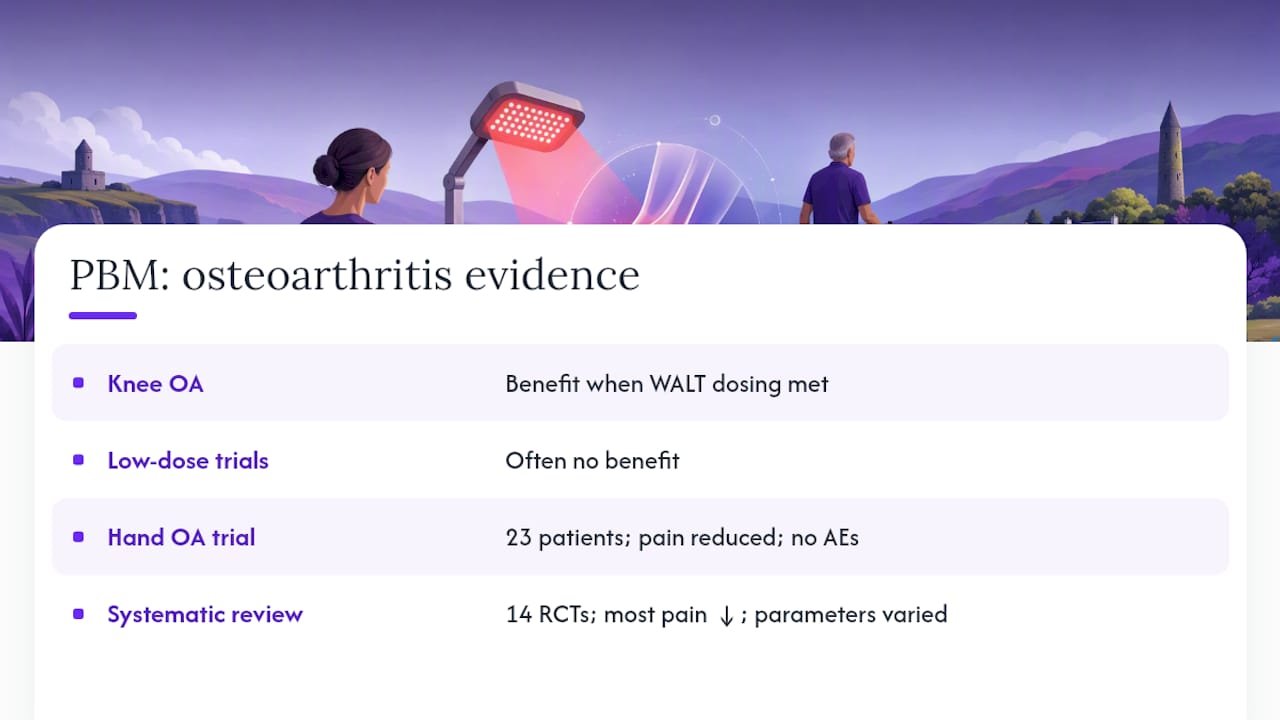
Knee osteoarthritis has attracted the largest volume of trials, and the picture here is genuinely mixed rather than uniformly positive. Several meta-analyses report meaningful improvements in pain scores and WOMAC function scores when treatment parameters align with dosing guidance from the World Association for Laser Therapy (WALT), which recommends minimum energy thresholds such as at least 4 joules per treatment point at wavelengths between 780 and 860 nanometres for knee joints. Older or smaller trials using lower doses or shorter wavelengths often failed to show the same benefit, which strongly suggests that dose, not just the presence of red light, drives the outcome. A separate narrative review covering knee pain, hip replacement recovery, and fibromyalgia reached a similar conclusion: PBM reduces pain intensity across these conditions when applied correctly, and does so with a favourable safety record.
A smaller trial specifically on hand osteoarthritis adds a useful data point. Twenty-three patients treated with high-density LED irradiation twice weekly for four weeks showed statistically significant reductions in pain scores at both four and six weeks, with no adverse events recorded during the trial. It’s a small sample, so treat it as a coherent signal rather than definitive proof, but it does show the effect holding up at a second joint site beyond the knee.
Fast fact: A 2026 systematic review covering 14 randomised controlled trials found that most trials reported significant pain reductions from PBM, but the treatment parameters used varied so widely between studies that the reviewers stopped short of recommending a single standardised protocol.
Low back pain and tendinopathy
Non-specific low back pain, meaning pain without a clear structural cause like a fracture or disc herniation, shows short to medium-term pain reduction across multiple trials. Tendinopathy, particularly at sites like the Achilles or shoulder rotator cuff, follows a similar pattern: several trials report reduced pain and improved function within weeks of starting treatment. The consistent caveat across both conditions is follow-up length. Most trials track patients for weeks rather than months, so how well the benefit holds up a year later remains an open question.
Neuropathic and acute pain
Neuropathic pain, the burning or shooting pain associated with nerve damage, has more mixed evidence than the musculoskeletal conditions above. Some trials show promise; others show no meaningful difference from placebo, and sample sizes tend to be smaller across this subset of research. Acute and post-surgical pain data leans similarly mixed, though single-session device trials occasionally report rapid pain reduction, in some cases within 30 minutes of treatment. Rapid onset is an interesting finding, but a single session measured over a few hours tells you nothing about whether that relief lasts, so it shouldn’t be read as proof of durable benefit.
Why heterogeneity keeps coming up
Every review cited above eventually lands on the same limitation: trials use different wavelengths, different doses, different session counts, and different follow-up windows, which makes pooling results into one clean average genuinely difficult. That’s not a reason to dismiss the evidence. It’s a reason to treat “does red light therapy work” as a question that depends heavily on which condition, which protocol, and which outcome measure you’re asking about.
Typical treatment parameters and what to expect
Trial protocols vary, but patterns repeat often enough to give you a realistic sense of what a course of treatment usually looks like.
- Wavelength: Most musculoskeletal pain trials use red light around 660 nanometres, near-infrared around 800 to 905 nanometres, or a combination of both. Deeper joints like the knee or hip generally call for the longer near-infrared wavelengths.
- Dose per session: WALT-referenced guidance suggests figures such as a minimum of 4 joules per point at 780 to 860 nanometres for knee treatment, though actual trial doses range considerably above and below that depending on the device and target tissue.
- Session frequency: Two to three sessions per week is the most common schedule across trials, though some hand and knee studies used twice-weekly dosing successfully.
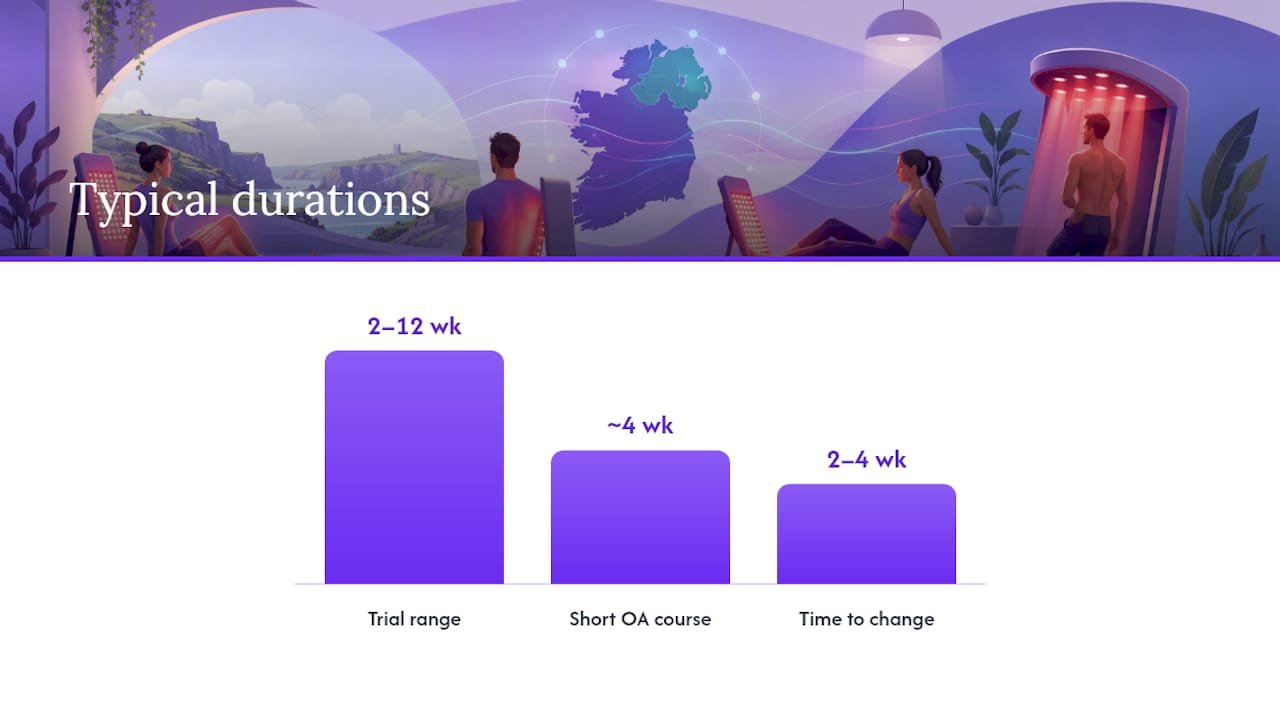
- Course length: Trial durations range from two to twelve weeks. Shorter courses of around four weeks appear frequently in osteoarthritis research; fibromyalgia trials sometimes run longer given the more diffuse nature of the condition.
- Time to noticeable change: Some studies report measurable pain reduction within two to four weeks, though this is far from universal, and a proportion of patients need the full course before noticing a difference.
Because PBM works by stimulating cellular repair processes rather than acting systemically like a painkiller, the effect tends to build cumulatively across a course of sessions rather than arriving all at once. That’s worth holding onto if your first session doesn’t feel dramatic. It usually isn’t meant to.
Pro Tip: Start with a short, measurable trial of six to eight sessions rather than committing to months of treatment upfront. Score your pain on a simple 0 to 10 scale before and after each session, note any change in the medication you’re taking, and track a functional marker too, like how far you can walk or how long you can stand. If you see no meaningful shift by session eight, that’s useful information, not a failure, and it tells you whether to continue, adjust the protocol, or explore a different approach entirely.
Safety, side effects and who should be cautious
Red light therapy has one of the more reassuring safety profiles among pain treatments studied in randomised trials. Reviews of the clinical literature consistently report a low incidence of adverse events, with the hand osteoarthritis trial mentioned earlier recording none at all across its full six-week follow-up. When side effects do occur, they’re typically minor: mild warmth, temporary redness, or occasional headache.
That said, “generally safe” isn’t the same as “safe for everyone,” and a few situations call for extra caution:
- Photosensitising medication: Certain antibiotics, acne treatments, and some heart medications increase skin sensitivity to light; check with your prescriber first.
- Active cancer at the treatment site: Stimulating cellular activity near an active tumour is not something current evidence supports, so this area should be avoided unless a treating oncologist advises otherwise.
- Pregnancy: Data on PBM use during pregnancy is limited, so treatment over the abdomen isn’t advisable without medical guidance.
- Eye exposure: Never look directly into an LED panel or laser device; use the protective eyewear supplied with professional equipment.
- Unregulated devices: Cheap imported panels sometimes overstate their wavelength accuracy and power output, so buying from a reputable source matters more than it might seem.
If you’re managing a complex or high-risk condition, reading through a detailed contraindications guide before starting is a sensible first step, and a broader overview of possible side effects is worth a look too. When in doubt, a quick conversation with your GP or physiotherapist costs you little and removes the guesswork.
Clinic treatment versus home devices: how to choose
The decision between booking clinic sessions and buying a home panel usually comes down to how deep your pain sits and how precisely you need the dose controlled.
Professional-grade devices typically deliver substantially higher irradiance and more accurately calibrated wavelengths than most consumer units, which matters when you’re trying to reach a knee joint capsule or a lumbar disc rather than skin-level tissue. Clinic settings also bring a trained practitioner who can assess your condition first, adjust the protocol as you progress, and track outcomes using proper measures like the WOMAC function score or a simple visual pain scale, rather than guessing whether a home unit is doing anything at all.
Clinic care tends to make more sense when:
- Your pain is deep (hip, knee, lumbar spine) rather than surface-level.
- You haven’t had a clear diagnosis yet and need an assessment alongside treatment.
- You’re managing a complex or chronic condition where PBM needs to sit within a wider, multimodal pain plan.
A home device is a reasonable option when:
- Pain is mild and relatively superficial, such as a minor tendon niggle.
- You’ve already had a supervised course and want to maintain gains between clinic visits.
- You’re consistent enough to actually stick to a regular schedule, which home units often struggle to guarantee.
Before booking anywhere, ask whether they conduct a proper assessment before treatment, whether they track your pain and function scores across the course, and whether they can explain the wavelength and dose they’re using and why. If you’re buying a device instead, be wary of listings with no stated wavelength, no irradiance figures, or claims that sound suspiciously close to a cure.
Pro Tip: Ask any clinic directly how they measure whether the treatment is working. A confident, specific answer, referencing a pain scale, a functional test, or session-by-session notes, tells you far more about the quality of care than any marketing claim on their website.
How Live5dhealth approaches red light therapy for pain
Red light therapy often sits alongside other evidence-aware modalities, including hyperbaric oxygen therapy, PEMF, and EWOT, rather than standing alone as a single-fix solution. Every course starts with an assessment of your pain history and goals, because the research above makes one thing clear: PBM tends to perform best as part of a wider, multimodal pain plan rather than in isolation.
Sessions are structured around consistent, trackable outcomes, checking in on your pain levels and function across a defined course rather than treating it as a one-off. Where it makes sense, red light therapy is combined with other therapies available at the centre to support recovery from multiple angles at once. If you’re weighing up treatment options and want more detail on suitability, the contraindications guide and the clinic’s overview of red light therapy benefits are worth reading before you book.
What people actually report after a course of treatment
Individual results vary, and no reputable clinic should promise a guaranteed outcome, but the pattern that shows up across trial data and clinical experience is fairly consistent. People with knee or hand osteoarthritis often describe the change as gradual: less morning stiffness first, then an easier time with stairs or longer walks by the third or fourth week. That mirrors the hand osteoarthritis trial’s timeline, where significant improvement showed up at the four and six-week marks rather than immediately.
Fibromyalgia patients frequently describe the benefit differently, less a sharp drop in a specific pain point and more a general easing of the constant background ache, alongside occasionally better sleep. Low back pain and tendinopathy cases tend to sit somewhere in between, with function often improving before pain scores drop dramatically, being able to sit through a full meeting or finish a training run before the discomfort itself fully settles.
What’s notable across almost every account, whether from published trial data or clinical observation, is that people who track their pain with a simple daily score and note any change in medication use are far better placed to judge whether the therapy is actually helping them, rather than relying on a vague overall impression weeks later.
Staying comfortable after your treatment course ends
Finishing a course of red light therapy doesn’t mean the work is done. Because PBM’s effects build through stimulating cellular repair rather than masking pain the way medication does, many people benefit from periodic maintenance sessions to sustain the gains, particularly for chronic conditions like osteoarthritis or fibromyalgia that don’t simply resolve and stay resolved.
A sensible approach is to space out maintenance sessions gradually, moving from twice weekly during the active course to once every few weeks once your pain and function scores have stabilised. Keep using the same tracking habit you started with: a quick pain score, a functional check, and a note of any flare-ups. If your scores start drifting upward again, that’s your signal to book another short course rather than waiting until the pain becomes disruptive again. Combining maintenance PBM with ongoing movement, whether that’s gentle strength work, swimming, or a regular walking routine, tends to support the gains for longer than passive treatment alone.
How red light therapy compares with other pain treatments
Red light therapy doesn’t replace medication, physiotherapy, or acupuncture, but it does offer something most of them don’t: a genuinely low side-effect profile with no drug interactions to worry about. Pain medication, particularly anti-inflammatories and opioids, works faster for acute flare-ups but carries risks around long-term use, from gastrointestinal issues to dependency concerns that simply don’t apply to light-based treatment.
Physiotherapy addresses the mechanical side of pain, building strength and correcting movement patterns that light therapy alone can’t touch. The evidence suggests these two work well together rather than as competitors, since PBM’s anti-inflammatory effects can make it easier to tolerate the loading and movement physiotherapy requires. Acupuncture and PBM share a similar niche, both non-invasive, both used as adjuncts rather than standalone cures, though acupuncture’s evidence base rests on a different mechanism entirely and the two haven’t been extensively compared head-to-head in trials.
The honest summary: red light therapy is best understood as one tool in a broader kit, not a replacement for any of the others.
Combining red light therapy with other pain treatments
Most of the strongest results in the trial literature come from PBM used alongside other care, not instead of it. If you’re on medication for pain, red light therapy doesn’t typically interfere with it, though it’s still worth mentioning to your prescriber, particularly if you’re on any photosensitising drugs covered earlier.
Pairing PBM with physiotherapy or a structured exercise programme tends to work well because reduced inflammation and improved local blood flow can make movement-based rehab more tolerable in the early stages. A detailed look at multimodal pain management options is a useful next read if you’re building out a fuller plan. Some clinical partners in pain recovery also highlight the importance of managing pain properly during return to normal activity after any treatment course, a principle that applies just as well here: don’t rush back into full activity levels the moment pain eases, ease into it and keep monitoring.
The general guideline worth remembering is sequencing: use PBM to bring inflammation and pain down first, then layer in strengthening or mobility work once things feel more manageable, rather than trying to push through intense rehab while pain is still peaking.
Using red light therapy safely as part of your pain plan
Start with a defined short trial, six to eight sessions, and track your pain score, function, and medication use throughout rather than relying on how you “feel” it’s going. Bring physiotherapy, gentle exercise, or rehab into the plan alongside PBM rather than after it. If you see no meaningful shift by the end of that trial, that’s a clear signal to book a proper reassessment with a clinician rather than pushing on regardless.
— Mark
Book a red light therapy session with Live5dhealth
If you’ve read this far, you already know red light therapy works best as part of a considered plan, not a one-off fix bought off a shelf. Live5dhealth is set up to give you exactly that: a proper assessment before treatment, professionally calibrated equipment delivering accurate wavelengths and dose, and the option to combine PBM with other evidence-aware therapies under one roof, including hyperbaric oxygen and PEMF, rather than piecing treatments together yourself across different providers.
Sessions take place at the luxury spa and wellness centre in Boyle, where outcomes are tracked properly across your course rather than left to guesswork. If you’re also managing inflammation more broadly, the team can talk you through supplement options, including curcumin, that some clients use alongside their treatment plan. Get in touch to book an assessment and find out whether a red light therapy course fits your situation.
Key research and guidance to read next
- PubMed’s photobiomodulation review summarises efficacy across fibromyalgia, osteoarthritis, and back pain.
- The musculoskeletal pain control review covers knee pain, hip replacement recovery, and fibromyalgia in detail.
- The hand osteoarthritis trial offers a real-world protocol and outcome timeline.
- The 2026 systematic review explains why protocol standardisation remains a work in progress.
- The knee osteoarthritis PBM review sets out WALT dosing references in full.
This article is general information, not a substitute for advice from a qualified doctor. Consult a qualified healthcare professional about your own circumstances before acting on anything here.
Sources
- PubMed citation — photobiomodulation reviews (2026)
- Low‑intensity LASER and LED (photobiomodulation therapy) for pain control of the most common musculoskeletal conditions
- High‑density LED irradiation therapy for hand osteoarthritis (clinical trial)
- Photobiomodulation in chronic pain: systematic review of randomized clinical trials