
Most red light therapy benefits happen between 4 and 30 J/cm² per session, with 3 to 5 sessions a week outperforming daily marathon exposure or occasional high-dose blasts. You calculate your dose using one formula: irradiance (mW/cm²) × time (seconds) ÷ 1000 = fluence (J/cm²). Get your device’s irradiance at your actual treatment distance, and the rest is simple arithmetic.
TL;DR:
- Most effective red light therapy sessions use 4 to 30 J/cm² delivered three to five times weekly, with doses above 60 J/cm² risking reduced benefits.
- Accurate dosing depends on measuring irradiance at your treatment distance, as manufacturer specs often overstate actual light exposure.
- Wavelength selection should match your target tissue depth, using red light (630-660nm) for superficial skin and near-infrared (810-850nm) for deeper joints or muscles.
- Home devices can be effective if you properly measure irradiance and adjust session times accordingly; clinical sessions ensure proper setup and dosing.
- Consistent, moderate sessions spread across the week are preferred over infrequent, intense treatments for optimal results and safety.
Table of Contents
- Red light therapy dosage quick-reference table
- How the dose calculation actually works
- Why your device might be delivering less than advertised
- Matching fluence and wavelength to what you’re treating
- How often to use red light therapy for best results
- Red light therapy safety: contraindications and warning signs
- Three worked dosing examples you can copy
- Inside a Live5D Health red light therapy session
- Home dosing works, but only if you measure properly
- Book a measured red light therapy session in Ireland
- Sources
- FAQ
Red light therapy dosage quick-reference table
Once you know your device’s irradiance at the distance you actually sit or stand from it, working out session time becomes a lookup exercise rather than guesswork. The table below maps four common irradiance levels to the time needed for three popular fluence targets: 10 J/cm² (light maintenance), 20 J/cm² (general therapeutic middle ground), and 30 J/cm² (upper end for deeper tissue work).
| Irradiance (mW/cm²) | Time for 10 J/cm² | Time for 20 J/cm² | Time for 30 J/cm² |
|---|---|---|---|
| 30 | 5 min 33 sec | 8 min 20 sec | 10 min |
| 50 | 3 min 20 sec | 6 min 40 sec | 10 min |
| 60 | 3 min 20 sec | 5 min 8 sec | 6 min 40 sec |
| 100 | 1 min 40 sec | 3 min 20 sec | 5 min |
These figures assume your irradiance reading was taken at the actual distance you’ll sit or stand during treatment, not the manufacturer’s surface-contact spec sheet. Move your face or body 10cm further from the panel and irradiance drops sharply, which throws every number in that row out of date.
Remember that J/cm² measures energy delivered to each square centimetre of tissue, not the whole treatment area. A large panel covering your entire back at 20 J/cm² delivers the same density of energy as a small handheld device held over one shoulder for the same fluence target. Coverage area changes how much of your body benefits, not how “strong” the dose is per spot. This distinction trips up more first-time users than any other part of red light therapy dosing.
How the dose calculation actually works
The formula behind every red light therapy protocol looks intimidating until you run it once with real numbers. Fluence, expressed in joules per square centimetre (J/cm²), is simply irradiance multiplied by exposure time, divided by 1000 to convert milliwatts into watts.
Here’s the calculation broken down step by step:
- Measure or find your irradiance. This is the power density hitting your skin, in mW/cm², measured at your treatment distance, not at the device surface.
- Decide your target fluence. Most therapeutic goals sit between 4 and 30 J/cm² per session, depending on what you’re treating.
- Apply the formula: J/cm² = (mW/cm² × seconds) ÷ 1000.
- Rearrange to solve for time when you know your target dose: seconds = (target J/cm² × 1000) ÷ mW/cm².
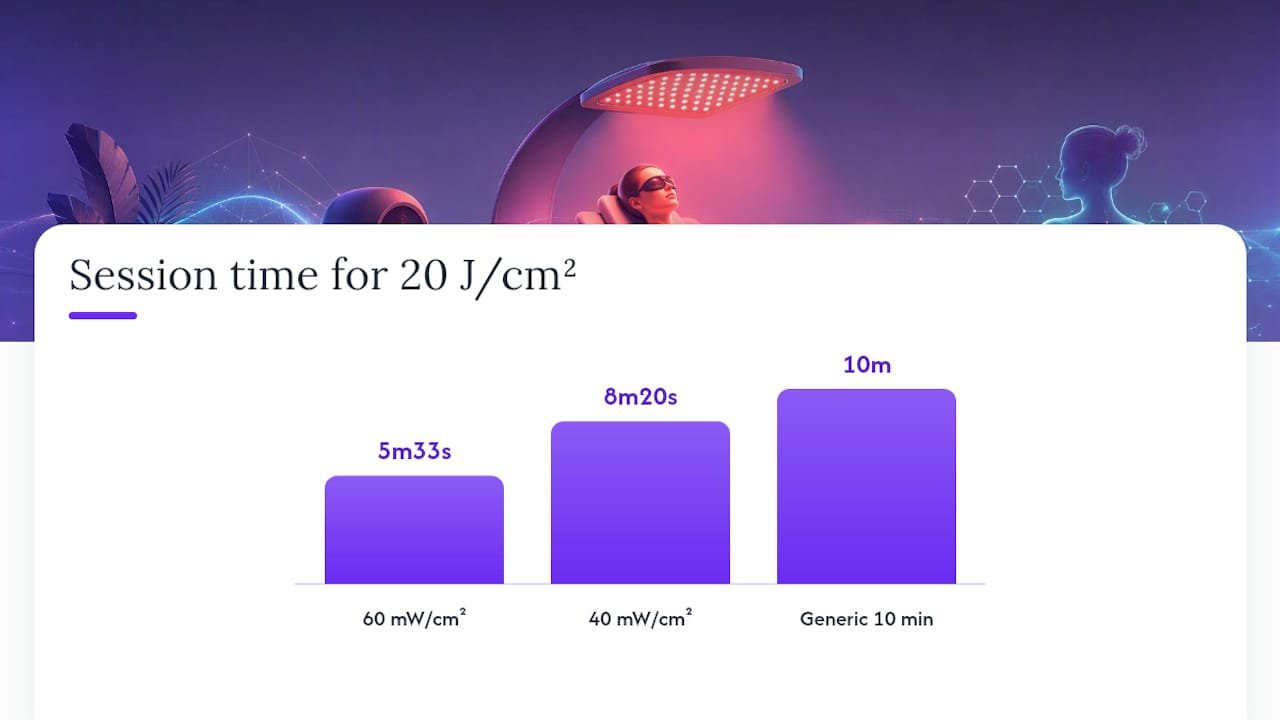
Worked example: your panel delivers 60 mW/cm² at your usual sitting distance, and you want 20 J/cm² for general skin support. Solve for time: seconds = (20 × 1000) ÷ 60 = 333 seconds, or roughly 5 minutes and 33 seconds. That’s your session length for that target, on that device, at that distance.
Change any one variable and the answer changes. Sit further back and irradiance might drop to 40 mW/cm², pushing your required time to exactly 8 minutes and 20 seconds for the same 20 J/cm² target. This is why generic “use for 10 minutes” advice printed on device boxes is often wrong for your specific setup.
Why your device might be delivering less than advertised
Manufacturer spec sheets nearly always report irradiance measured at the panel surface, sometimes only at the single brightest centre point. Real-world treatment distance is rarely zero centimetres, and light intensity falls off fast once you step back. Practical testing suggests actual irradiance at typical treatment distances of 15 to 30cm can fall to somewhere between a quarter and just over half of the surface-rated figure, according to Youlumi’s technical dosing guide.
A handful of practical checks help you avoid underdosing without buying lab equipment:
- Take readings at the centre of the panel and at all four corners, plus the midpoints between them, for a nine-point average rather than trusting one peak number.
- Use that averaged figure, not the marketing spec, whenever you run the dose formula.
- If you have no meter, treat the manufacturer’s surface-rated irradiance as roughly two to four times higher than what you’re actually receiving at normal sitting distance, and adjust your session time upward accordingly.
- Recheck your irradiance if you change devices, panels, or your usual sitting position.
Pro Tip: If your skin never shows the mild, temporary warmth or slight pinkness typical of a properly dosed session, you’re very likely sitting too far back or underestimating your device’s real output. Move closer, extend the session modestly, and reassess before assuming the therapy simply isn’t working for you.
The nine-point averaging method comes from broader guidance on irradiance and dosing physics, which stresses that a single centre-point reading almost always overstates what your body actually receives across a treatment area.
Matching fluence and wavelength to what you’re treating
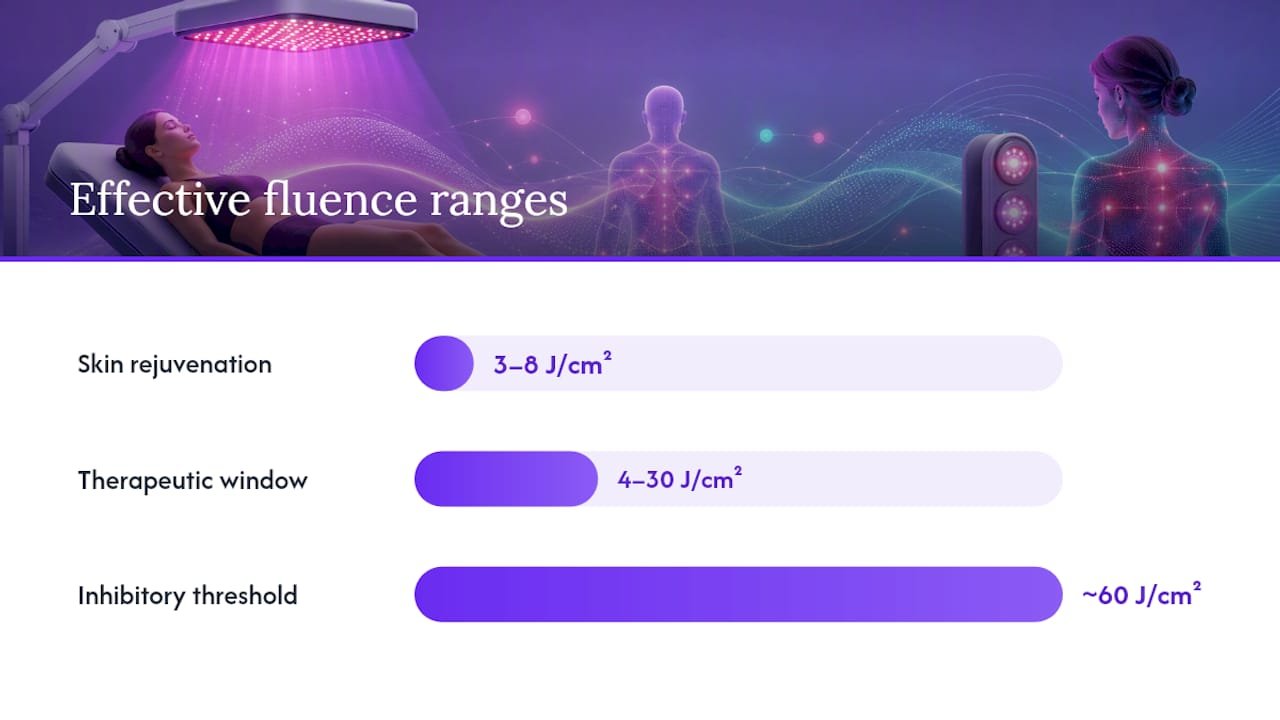
The dose-response curve for photobiomodulation isn’t a straight line where more is always better. It follows a biphasic pattern, often called the Arndt-Schulz law, where benefits climb through a moderate dose window, then plateau, then can reverse into inhibitory or even mildly counterproductive territory at very high doses. Canonical PBM research clusters most clinical benefit inside a 4 to 30 J/cm² window, with effects tapering or working against you above roughly 60 J/cm².
Wavelength matters as much as dose. Red light in the 630 to 660nm range penetrates shallowly and is well suited to skin, superficial wound care, and hair follicles near the scalp surface. Near-infrared light at 810 to 850nm travels deeper into tissue, reaching muscle, tendon, and joint structures that red light alone struggles to influence. Live5dhealth’s guide to red light wavelengths breaks down which band suits which target in more depth.
Here’s how that plays out for common goals:
- Skin rejuvenation and complexion support: lower fluence, typically 3 to 8 J/cm², using red light around 630 to 660nm, applied several times weekly.
- Hair growth support: similar low-to-moderate fluence at the scalp, red wavelengths, sustained over an 8 to 12 week course before judging results.
- Wound healing: conservative doses at the lower end of the therapeutic window, since damaged tissue can respond to less than intact skin needs.
- Knee osteoarthritis and joint pain: near-infrared wavelengths, with clinical trials supporting roughly 4 to 8 joules per treated spot around the joint line.
- Muscle recovery after exercise: higher total energy delivered across the muscle group, often cluster protocols totalling 20 to 60 joules per muscle, using near-infrared for depth.
- Neuropathic or deep tissue pain: near-infrared at moderate-to-higher fluence, generally requiring professional guidance to target the correct depth and nerve pathway accurately.
Mismatching wavelength to target depth is one of the most common reasons people conclude red light therapy “doesn’t work” for them, when the real issue is applying a superficial red wavelength to a problem sitting several centimetres beneath the skin.
How often to use red light therapy for best results
Three to five sessions a week is the sweet spot most protocols converge on, whether you’re treating skin, joints, or general recovery. Daily use is acceptable for most people and most targets, provided each session stays within the appropriate fluence window rather than creeping upward because “more must be better.”
A sensible starter course looks different depending on what you’re addressing:
- For pain or joint issues, try an initial block of 6 to 8 sessions before judging whether the approach suits you.
- For skin or hair goals, commit to 8 to 12 weeks of consistent sessions, since visible tissue remodelling takes longer than pain relief typically does.
- If you’re using red light therapy twice in one day, leave at least 6 hours between sessions to avoid stacking doses into the inhibitory range.
- Track your weekly cumulative exposure, not just each individual session, particularly if you’re treating multiple body areas with overlapping schedules.
Frequency consistently matters more than chasing one large, infrequent dose. Multiple moderate sessions spread across the week tend to outperform a single intense session, according to practical dosing guidance from RedLightTherapy.expert, which is a pattern seen across most photobiomodulation protocols rather than a quirk of any single device brand.
Red light therapy safety: contraindications and warning signs
Red light therapy carries a favourable safety profile for most healthy adults, but a handful of situations call for caution or a conversation with a clinician first.
- Photosensitising medications (certain antibiotics, acne treatments, and some herbal supplements) can heighten skin sensitivity to light exposure.
- Pregnancy isn’t an absolute stop, but treating the abdominal area specifically warrants a chat with your doctor beforehand.
- Active malignancy near the treatment site should be discussed with an oncologist before starting any light-based therapy.
- Eye protection matters, especially with near-infrared wavelengths you can’t see, and near-eye devices or facial masks should always include proper goggles.
- Watch for excessive redness, unusual heat, or skin irritation lasting beyond the session; these signal you should reduce fluence or step back from the panel, not push through.
Live5dhealth’s detailed breakdown of who should avoid red light therapy and its guide to potential side effects cover screening questions worth running through before your first session, particularly if you’re managing a chronic health condition.
Three worked dosing examples you can copy
Numbers stick better with real scenarios attached. Here are three calculations covering the most common home and clinic setups.
- Facial panel at 50 mW/cm². For a 10 J/cm² maintenance dose: 200 seconds, or 3 minutes 20 seconds. For a fuller 20 J/cm² session: 400 seconds, or 6 minutes 40 seconds.
- Handheld diode over a tendon at 100 mW/cm². Targeting the 4 to 8 J per-point range used in musculoskeletal protocols: at 100 mW/cm², 8 joules takes 80 seconds per point, so a wrist or elbow tendon needing coverage across three points runs roughly 4 minutes total.
- Whole-body bed with variable output. If your torso zone reads 40 mW/cm² and your leg zone reads 65 mW/cm² (uneven output is common on bed-style panels), you’d need roughly 8 minutes 20 seconds on the torso and 5 minutes 8 seconds on the legs to each reach 20 J/cm², treating zones separately rather than running one blanket timer for the whole body.
Pulsed-mode devices add one more variable: effective irradiance equals peak irradiance multiplied by duty cycle, so a device pulsing at 50% duty cycle needs roughly double the exposure time to hit the same fluence as continuous output at the same peak rating.
Inside a Live5D Health red light therapy session
Mark here, writing from a clinic in Boyle, County Roscommon. The red light therapy service runs on the same 630 to 660nm and 830 to 850nm wavelength bands referenced throughout this guide, with prices varying depending on the protocol booked. We typically recommend clients try 6 to 8 starter sessions before assessing results, particularly for pain and joint complaints.
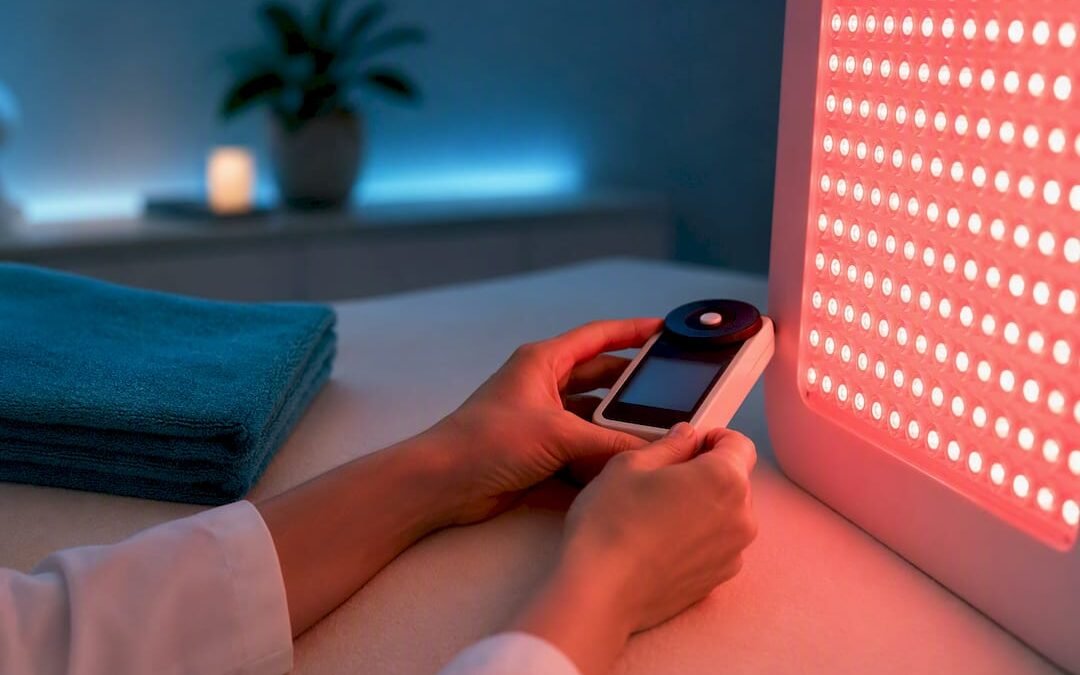
Before any client sits under a panel, actual delivered irradiance is measured at their treatment position rather than relying on manufacturer specs, then session length is set using the same formula outlined above.
Home dosing works, but only if you measure properly
Home red light devices genuinely deliver therapeutic value, provided you treat the dose formula as non-negotiable rather than optional. The most common failure isn’t a bad device; it’s sitting too far away, running too short a session, and assuming the manufacturer’s surface irradiance figure describes what actually reaches your skin.
Where I’d draw the line on self-treatment: deep joint or muscle targets, or any case where weeks of consistent home dosing produce no change, deserve a clinical measurement session rather than more guesswork. Expect gradual, not dramatic, results. Skin and hair protocols need months, not days, and pain relief tends to build across a starter course rather than announce itself in session one.
— Mark
Book a measured red light therapy session in Ireland
Getting the maths right at home takes a meter, patience, and a willingness to recheck your numbers every time you change position. Booking a session at Live5dhealth skips that step entirely: our team measures your actual delivered irradiance, selects the wavelength suited to your target tissue, and sets your session time using the same formula covered throughout this guide, so you’re never guessing whether you underdosed.
A typical visit includes an irradiance check at your treatment position, a protocol matched to your goal (skin, joint, muscle recovery, or general wellness), and a progress review to adjust dose across your course. Sessions run between €20 and €40, with the Red Light Therapy page covering current options and what to expect on your first visit. If you’d rather combine it with other recovery therapies during your visit, our booking hub lists everything available on the day. Check availability and book your first measured session directly through the red light therapy page above.
Sources
- Photobiomodulation and the Arndt–Schulz biphasic dose response (PMC2790317)
- Stausholm et al. (2019) — meta-analysis on LLLT for musculoskeletal pain (PubMed)
- Redlighttherapy
This article is general information, not a substitute for advice from a qualified doctor. Consult a qualified healthcare professional about your own circumstances before acting on anything here.
FAQ
What is a good red light therapy dosage to start with?
Most people do well starting at 10 to 20 J/cm² per session, three to five times a week, and adjusting from there based on how their skin or symptoms respond. This sits comfortably inside the 4 to 30 J/cm² therapeutic window that most clinical research supports.
How long should a red light therapy session last?
Session length depends entirely on your device’s irradiance at your treatment distance, not a fixed number of minutes. Use the formula seconds = (target J/cm² × 1000) ÷ mW/cm² to calculate your own time rather than following generic instructions.
Can you overdose on red light therapy?
Yes, doses above roughly 60 J/cm² per session can reduce or even reverse the benefits you’re aiming for, a pattern known as the biphasic dose response. Sticking within the 4 to 30 J/cm² range and avoiding back-to-back sessions without adequate spacing keeps you well clear of that threshold.
How much does red light therapy cost at a clinic in Ireland?
At Live5dhealth, individual red light therapy sessions run between €20 and €40, depending on the protocol booked. Clinic sessions include measured irradiance and a tailored dose calculation, which home devices often skip.
Is daily red light therapy safe?
Daily use is generally acceptable for most healthy adults, provided each session stays within the appropriate fluence range for the target tissue. If you’re treating twice in one day, leave at least six hours between sessions to avoid stacking doses too close together.