
Structured water is a real topic in research, but it is not a proven, separate kind of drinking water. Scientists do study how water molecules organise near surfaces and under magnetic fields or light. What they have not shown is that drinking “structured” water improves human health. Below, we separate what is measured from what is claimed, so you can choose your water with a clear head.
TL;DR
- Water’s molecular arrangement is a genuine research field, but the term “structured water” is used loosely, and the mechanisms remain poorly understood.
- Chemists say ordinary liquid water rearranges its hydrogen bonds in picoseconds, so a lasting bulk “structure” is hard to defend.
- Existing health findings come mostly from animal studies. No high-quality human trials support the headline claims.
- Claims about curing or treating illness, cancer included, are not supported. Never delay medical treatment because of a water or therapy claim.
- What you can act on: clean, well-filtered water, steady hydration and a straight answer from anyone selling you a device.
Table of Contents
- What “structured water” actually means
- What the laboratory studies found
- How long could any structure last?
- Is structured water real as a drinking water?
- Does structured water work for health?
- Common myths, and the safe way to read them
- What the Irish rules say about water claims
- What to look for in better drinking water
- Our perspective
- Enjoy a hydrating, restorative day with us
- FAQ
- Sources
What “structured water” actually means
The phrase has two meanings, and most confusion comes from mixing them.
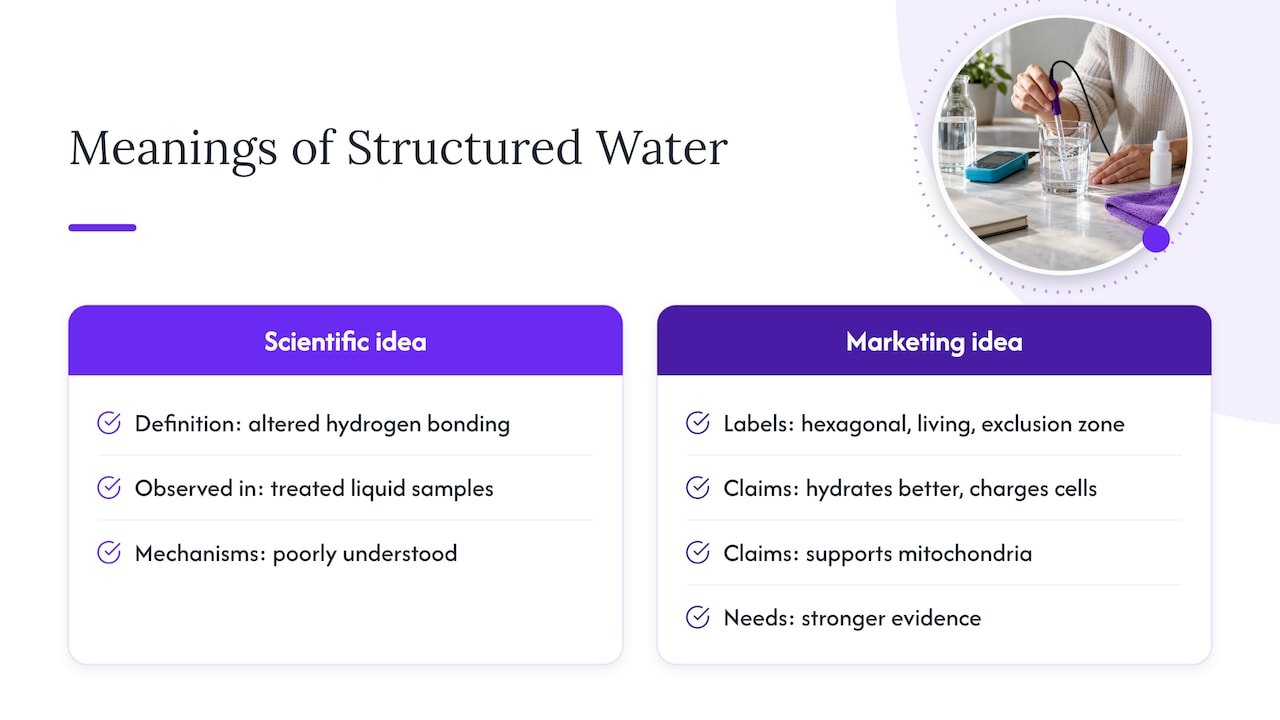
The first is a scientific idea. A 2021 review in the journal literature defines structured water operationally: liquid water whose hydrogen-bonding arrangement has been altered by energy treatments such as magnetic fields and light. The same review states that the mechanisms are poorly understood.
The second is a marketing idea. Online, you will see “hexagonal water”, “living water” or “exclusion zone water” described as a special form that hydrates better, charges your cells or supports your mitochondria. Those are claims about drinking water, and they need far stronger evidence than a laboratory observation about water next to a surface.
Keeping the two apart is the key to reading everything else on this page. A measured effect in a lab sample is one thing. A proven benefit in a person who drinks a glass of water is another.
What the laboratory studies found
There is real published work behind the vocabulary, and it deserves a fair summary.
Exclusion zones near surfaces
A 2006 study from a US laboratory reported zones next to water-loving surfaces that excluded dissolved particles. The authors described them as a physically distinct, less-mobile phase of water. This is the origin of the term “exclusion zone” or EZ water.
A 2022 PLOS ONE paper reported similar particle-free zones in water suspensions next to magnetic poles. A 2024 study of plant xylem reported EZ formation in cut plant vessels. Its authors were careful to note that the samples were cut-out xylem and that more research was needed to establish physiological significance.
So the honest reading is this: researchers have observed unusual behaviour at interfaces in controlled settings. Whether it matters for the water in your glass is still an open question.
Water is more complex than a simple liquid
A 2024 review in Frontiers in Chemistry describes water as a heterogeneous system containing molecular and supramolecular structures. The authors argue that fast molecular exchange does not automatically rule out larger, transient structures. They also stress that only some reported lifetimes have been confirmed by modelling, and that no reliable general conclusion can yet be drawn about how long particular structures last.
That is a balanced position. Water chemistry is richer than a textbook diagram, and the details are still being resolved.
How long could any structure last?
This is where the strongest scepticism comes from, and it is worth understanding.
In ordinary liquid water, hydrogen bonds constantly break and reform. In The Conversation, chemist Timothy Schmidt wrote in 2022 that water forgets its neighbouring molecules within picoseconds and swaps hydrogen atoms on millisecond timescales. His conclusion was that any bulk structure different from tap water lasts only a few millionths of a millionth of a second.
The experimental literature on treated samples points to a different timescale, but still a short one. The 2021 review reported that magnetically or light-treated water showed structuring lasting hours and no more than about three days, decaying roughly exponentially. That is an experimental claim about treated samples. It is not proof of a stable consumer water phase.
The table sets the positions side by side.
| Question | What the sources report |
|---|---|
| Does water have local structure? | Yes, at very short scales and near surfaces |
| How long does bulk structure last? | Picoseconds to milliseconds in ordinary water, per chemists |
| Treated-sample claims | Hours up to about three days, with mechanisms unknown |
| Months-long stable “structured” water | Described as a claim, with mechanisms unknown |
| Proven human health benefit | Not established |
Is structured water real as a drinking water?
As a distinct, stable product with its own health properties, the evidence does not support it. The Conversation article says it is not possible to buy a type of water other than regular water. AAP FactCheck in Australia reported chemists calling the claim that H3O2 structured water is healthier than regular water false, with one noting that pure water has one dynamic structure.
A 2026 Skeptical Inquirer analysis adds that the usual evidence offered, small samples, anecdotes, poorly designed experiments and results that are hard to reproduce, shows familiar warning signs. It also says that claims that swirling, vibration, light or magnets reorder water into predictable rings defy physics, and that it found no actual evidence for vortexing.
We publish our own plain-language summary of this on our structured water science page, because we think readers deserve to see where the evidence stands.
Does structured water work for health?
The short answer is that nobody has shown it does in people.
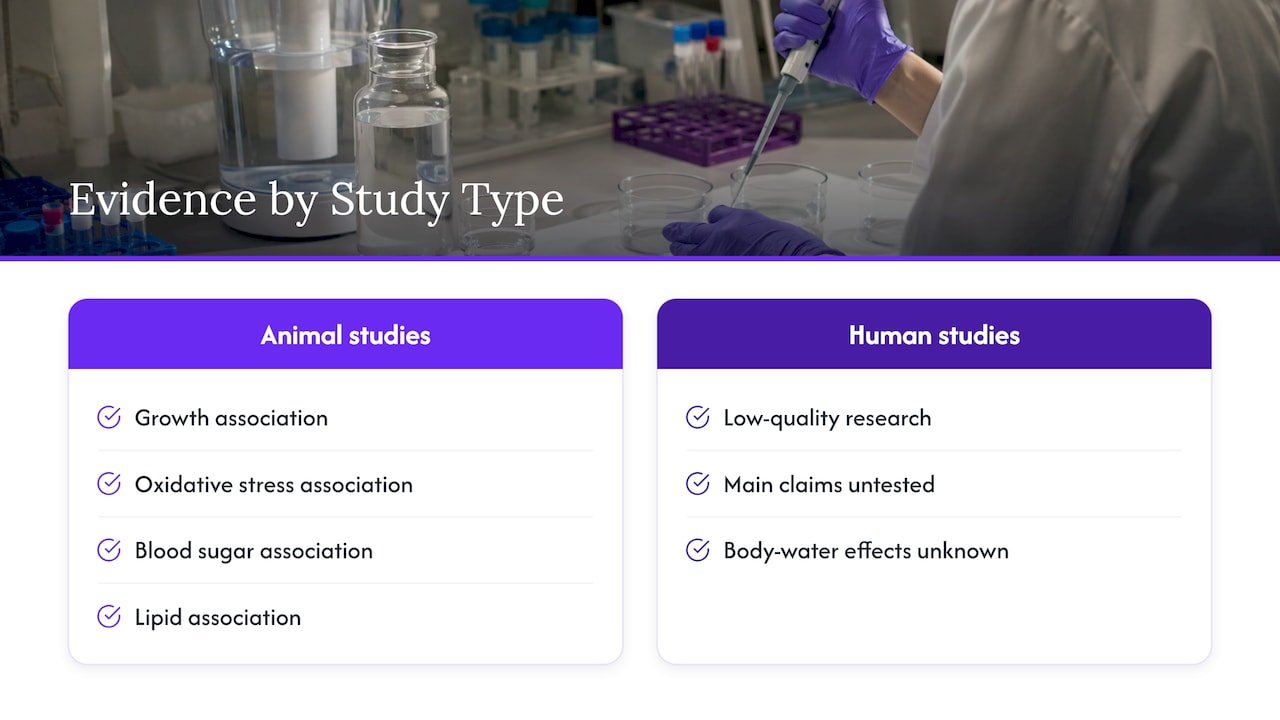
Healthline reports that no high-quality human studies support the health claims, and that the human research available is low quality and does not test the main claims made by proponents.
What exists is mostly animal work. The 2021 review reported associations in animal studies with growth, oxidative stress, blood sugar, lipids and reproductive measures. It also states plainly that it remains unknown whether drinking structured water changes the way water is structured inside the body. Healthline also notes a 2013 study in which magnetised water seemed to reduce blood glucose and DNA damage in diabetic rats after eight weeks.
Animal findings are useful signals. They are not the same as established effects in people. If you want to see how researchers keep that distinction clear in another field, this animal-study research comparison is a good example of reading reported findings carefully.
A related note on alkaline water, which is often sold alongside structured water. A 2026 review in Frontiers in Medicine found limited, context-specific effects and inconsistent evidence for metabolic, antioxidant and immune benefits, and said claims about preventing disease lack robust clinical evidence.
Common myths, and the safe way to read them
“Structured water cures or treats serious illness”
This is the claim to treat with the most care. No water, structured or otherwise, has been shown to cure or treat cancer. If you or someone close to you is living with cancer, keep your oncology team at the centre of every decision, and tell them about any supplement, water or therapy you are considering.
The same caution applies to the wider wellness world. The US FDA’s consumer warning states that hyperbaric oxygen therapy has not been clinically proven to cure or treat cancer, autism or diabetes, and that unproven claims may lead patients to delay effective treatment. Health Canada says hyperbaric chambers are licensed for 14 specific conditions and that there is no scientific proof for private-clinic claims about cancer and several other conditions. That is Canadian guidance rather than Irish regulation, but it addresses the same myth.
“Vortexing, sunlight or sound structures your water”
DIY guides describe swirling, sunlight, sound and added minerals as ways to build structured water. The sources above found no good evidence that these methods create a lasting, health-relevant change. If you enjoy a vortex as part of a mindful drinking ritual, that is your choice, but it is not a proven health intervention.
“Hydration is better with hexagonal water”
No reliable human data show better hydration from “hexagonal” water. Your hydration depends on how much you drink, your diet, your activity and your health, not on a molecular pattern.
What the Irish rules say about water claims
Ireland and the EU regulate health claims on food and drink, and water is included. The Food Safety Authority of Ireland says the nutrition and health claims rules cover natural mineral waters and water intended for human consumption. Claims must be based on generally accepted scientific principles and must not attribute disease prevention, treatment or cure to a food.
For bottled water, S.I. No. 282/2016 prohibits indications on natural mineral water that attribute properties for preventing, treating or curing human illness, apart from permitted indications that meet the criteria. It also requires other bottled waters to be wholesome and clean and to meet microbiological, chemical and radiological parameters. A “structured” label does not replace those safety requirements.
In practice, this gives you a simple test. If a seller promises that water will treat a disease, treat that promise as a red flag.
What to look for in better drinking water
The good news is that the things that matter most are practical and within reach.
- Start with clean water. Filtration or distillation can improve the taste and reduce what you do not want in your glass. Choose a system that suits your supply and keep up with filter changes.
- Drink consistently. Regular small drinks across the day beat catching up at night.
- Add minerals through food and, if you wish, electrolytes. This is especially useful when you sweat in a sauna or after exercise.
- Match the claim to the evidence. A product described as a way to enjoy your water is different from one promising to heal you.
- Ask your GP or pharmacist if you have a kidney, heart or other condition that affects how much fluid or which minerals are right for you.
If you want to browse options, our water category brings together water-related products, and our structured water tag and hydrogen water tag group the related items. For a separate topic that people often confuse with structured water, see our guide to hydrogen inhalation therapy and its safety window.
Our perspective
We run a wellness centre in Boyle, County Roscommon, so we hear this question often: is structured water real?
Our honest view is that the laboratory work on how water behaves at surfaces is fascinating, and that the human evidence is not there yet. We would rather tell you that plainly than promise you something science has not shown. That is why we published a page on the state of the evidence.
What we do care about is the experience of water as part of a wider healthy routine. Clean, energised water is available throughout our facility, and our membership includes free energised water. We pair that with the sauna, steam room and cold plunge, because hydration matters when you are looking after your body.
Water is a supportive part of wellbeing, not a treatment. If you are living with a serious illness, we welcome you as a complement to your medical care, never a replacement for it. Our holistic approach brings together modern technology and ancient wisdom, and we want you to feel informed and confident in every choice you make.
Mark
Enjoy a hydrating, restorative day with us
If you would like to experience a well-rounded wellness routine in Boyle, we offer a sauna, steam and cold plunge spa for €30. It is a relaxed way to unwind, with clean water on hand throughout.
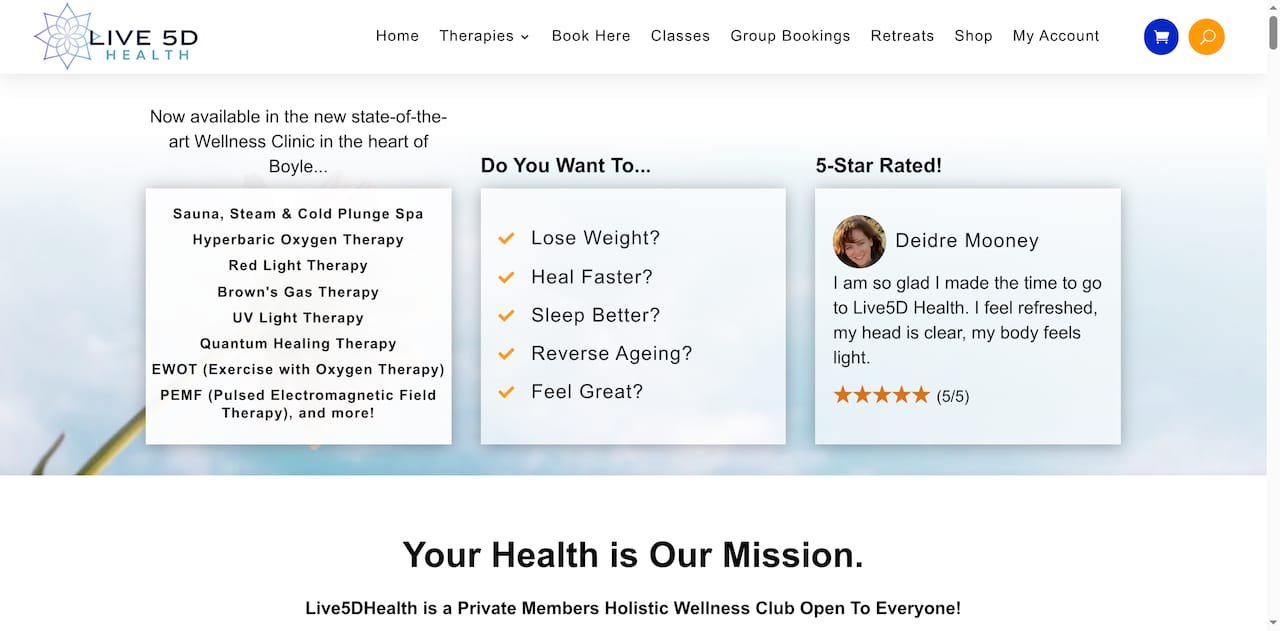
We also offer hyperbaric oxygen therapy at €80 to €120 and red light therapy at €20 to €40. For longer stays, our 3, 5 and 10-day wellness retreats let you step away and focus on yourself. You can see everything we offer on our main page.
FAQ
Does structured water work?
There is no reliable human evidence that it does. Reviews describe animal-study signals, but they state that the mechanisms and relevance to people remain unknown. Healthline reports that available human research is low quality. Good hydration and clean water remain the dependable basics.
Is structured water real?
Water does show local organisation at very short scales and near some surfaces, and researchers study this. A separate, stable, health-giving drinking water is not supported. Chemists say any bulk structure in ordinary water disappears in a tiny fraction of a second.
Can I make structured water at home with a vortex or sunlight?
You can swirl or sun-warm water, but the sources reviewed here found no evidence these steps create a lasting, beneficial change. Treat them as a ritual rather than a health measure. Filtering or distilling your water is a more practical step for quality.
Can structured water or hyperbaric therapy treat cancer?
No. The FDA warns that hyperbaric oxygen therapy has not been clinically proven to treat cancer, and Health Canada says there is no scientific proof for such private-clinic claims. If you have cancer, speak to your oncology team before adding any therapy, and do not delay your treatment.
Sources
- Structured water: effects on animals, PMC (2021)
- Zheng et al., exclusion zone study (2006)
- Magnetic fields induce exclusion zones in water, PLOS ONE (2022)
- Exclusion-zone water inside and outside of plant xylem (2024)
- The heterogeneity of aqueous solutions, Frontiers in Chemistry (2024)
- Don’t fall for the snake oil claims of structured water, The Conversation (2022)
- Claims of structured water health benefits, AAP FactCheck (2024)
- Structured Water: Definition, Benefits, Research, Healthline (2024)
- Structured Water: Distilling the Science, Skeptical Inquirer (2026)
- The health benefits of alkaline water, Frontiers in Medicine (2026)
- Hyperbaric Oxygen Therapy: Don’t Be Misled, FDA (2013 archive)
- Hyperbaric Oxygen Therapy, Health Canada
- Information on Nutrition and Health Claims, FSAI (2021)
- S.I. No. 282/2016, European Union (Natural Mineral Waters) Regulations
- DSIP, Selank and Semax research comparison