

Morning light exposure genuinely advances your circadian clock, and doing it right can sharpen your sleep timing, mood and alertness within days. The practical target is simple: get outside within 30 to 60 minutes of waking for at least 10 to 30 minutes, ideally without sunglasses. If you have bipolar disorder, a retinal condition, or take photosensitising medication, speak to a clinician before starting a bright-light routine, as systematic review evidence and clinical guidance both flag real exceptions.
TL;DR:
- Getting outside within 30 to 60 minutes of waking for 10 to 30 minutes significantly advances sleep timing and enhances alertness, especially on bright days above 1,000 lux.
- Bright light exposure in the morning produces the strongest phase advance, but timing is crucial, as light before wake time can delay sleep, undermining routine benefits.
- For most adults, outdoor daylight—particularly on overcast days—is sufficient, while indoor lighting rarely reaches the effective level, making outdoor sessions more effective than window light.
- People with bipolar disorder, eye conditions, photosensitivity, or on certain medications should consult a clinician before trying bright-light routines due to potential risks.
- To build a sustainable habit, prioritize consistent outdoor exposure shortly after waking, avoid sunglasses if safe, and consider a light box only during low-light seasons or for specific clinical needs.
Table of Contents
- How morning light exposure improves sleep, mood and alertness
- Timing and dose: when to get light and how bright it needs to be
- How to build a morning light routine into everyday life
- Who should be cautious about morning light exposure
- The mechanism: how your eyes and brain translate morning light into a body clock reset
- Why this matters more than most wellness advice you’ll read this year
- Sources
- FAQ
How morning light exposure improves sleep, mood and alertness
The clearest, best-supported effect of morning light is a phase advance. Bright light in the morning nudges your internal clock earlier, which means you feel sleepy earlier at night and wake more naturally the next day. A systematic review of light exposure and sleep outcomes in community-dwelling adults found that brighter morning light, generally above 1,000 lux, correlated with earlier sleep timing and better self-reported sleep quality across the studies it examined.
That review is honest about its limits. Many of the included studies were observational, used different measurement tools, and tracked people over varying timeframes. That heterogeneity matters: it means the phase-advance effect is real and repeatedly observed, but the exact dose-response curve (how many lux for how many minutes produces how much shift) isn’t nailed down to a single formula. Treat the lux figures as a genuinely useful benchmark rather than a precise dial.
Alertness responds fastest. The alerting effect of morning light shows up in a short-term, roughly reliable way. Get proper light shortly after waking, and you tend to feel more alert within that same morning, likely because light suppresses melatonin and activates arousal pathways in the brain. This is the effect most readers notice first, often before any sleep-timing changes accumulate over subsequent nights.
Mood improvement is a promising but softer signal. Multiple studies suggest morning light lifts mood, and clinical light therapy for seasonal affective disorder is one of the more established uses of bright light in psychiatry. Outside SAD, though, the mood evidence in ordinary healthy adults is less consistent than the alertness or phase-advance findings. It’s a real effect for many people, but not one you should expect to work with the same reliability as the circadian shift itself.
Sleep architecture is where it gets messier. Not every study finds cleaner, longer sleep after morning light. Some report fragmented sleep or shorter total duration, particularly when timing is off or when exposure happens too close to a person’s usual wake window rather than right at it. This isn’t a contradiction of the phase-advance finding; it’s a reminder that when you get the light matters as much as whether you get it.
A pilot open-label trial using blue-enriched light for 25 minutes before 9am found improvements in daytime sleepiness and some sleep indices over two weeks. It was small, so treat it as supportive rather than definitive, but it aligns with the broader pattern: morning, blue-enriched, reasonably bright light tends to help.
The takeaway for readers who want the sharpest return: prioritise consistent timing over chasing a perfect lux number. The clock cares more about when than exactly how bright, within a reasonable range.
Timing and dose: when to get light and how bright it needs to be
Get outside within the first 30 to 60 minutes after you wake. This window matters because your circadian pacemaker is at its most sensitive to light right around your habitual wake time, when a dose of bright light produces the strongest, most predictable phase advance. NIOSH’s circadian rhythm training module lays out the underlying phase response curve: light near your wake time shifts your clock earlier, while light in the two to four hours before you’d normally wake produces less predictable, sometimes negligible effects. Miss the window and you’re not just getting a smaller dose, you may be hitting a part of the curve where the clock barely responds.
Evening light does the opposite. It delays your clock, pushing sleep onset later. This is why a bright-lit commute home or hours of screen use after dark can quietly undo a disciplined morning routine, an insight the same NIOSH guidance makes explicit.
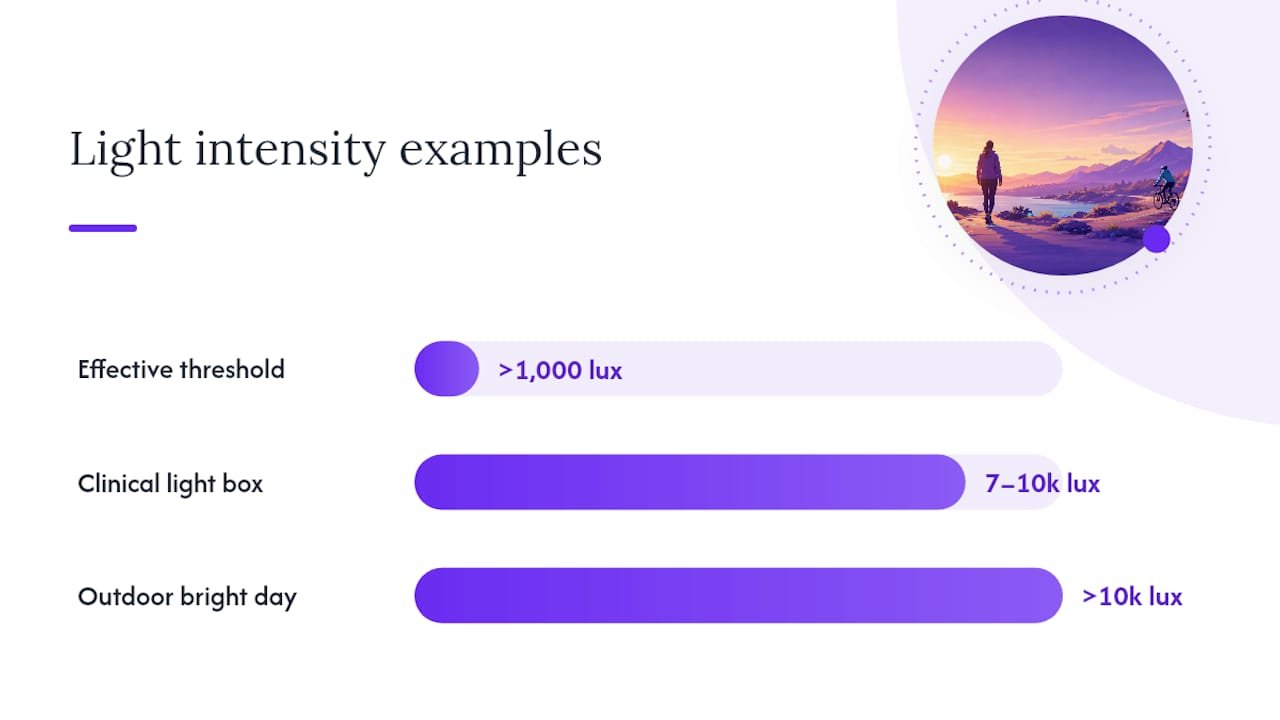
How bright does it need to be? The commonly cited effective threshold from the systematic review is above 1,000 lux, a level that ordinary outdoor daylight clears easily, even under cloud cover. For comparison, clinical light boxes used in seasonal affective disorder protocols deliver 7,000 to 10,000 lux at a specified distance, typically 16 to 24 inches, for around 20 to 30 minutes. Those clinical doses are calibrated for treating a diagnosed mood disorder, not for the everyday circadian tune-up most healthy adults are after.
Practical proxies matter more than a lux meter. Most readers don’t own a light meter, and you don’t need one. Ten to 30 minutes outdoors on an ordinary day, even overcast, typically delivers a circadian-effective dose far beyond what any indoor room provides. This is backed by a useful comparison: outdoor and daylight-optimised exposure produced a 22-minute earlier sleep onset in a crossover trial when compared with standard window conditions, a meaningful shift for a simple behaviour change.
- Outdoor light on a bright day: often well above 10,000 lux, far exceeding the effective threshold with room to spare.
- Outdoor light on an overcast day: still commonly several thousand lux, generally sufficient for a phase advance.
- Light through an ordinary window: substantially weaker, both dimmer and depleted of the short-wavelength content that drives circadian signalling.
- Indoor room lighting without windows: rarely close to the effective range, regardless of how bright the room feels to your eyes.
Why windows underperform. Ordinary glass filters out a meaningful share of the light spectrum your eyes need for circadian signalling, and indoor rooms are simply dimmer than the outdoors, often by a factor of ten or more, even when they feel adequately lit to your eyes. If you can step outside, do it, even for a shortened session; if you genuinely cannot, sit as close to an unobstructed, unshaded window as possible and extend the duration to compensate for the weaker dose.
When a device makes sense. Light boxes and dawn simulators earn their place for people in low-daylight seasons, night-shift workers adjusting their schedule, or anyone with a diagnosed circadian or mood disorder where a clinician has recommended a specific protocol. If you use one, the manufacturer’s specified distance is not a suggestion. Light intensity falls sharply with distance, and sitting even a little further back than recommended can quietly undertreat you without any obvious sign that something’s off.
How to build a morning light routine into everyday life
You don’t need a special gadget or a dramatic lifestyle overhaul to get this right. You need a repeatable habit that survives a busy Tuesday, bad weather, and a commute. Here’s how to build one that actually sticks.
- Step outside within 30 to 60 minutes of waking. This is the single highest-leverage change you can make. Even a short walk to the end of the street, a coffee on the doorstep, or five minutes in the garden counts, and doing it consistently beats an occasional long session.
- Skip the sunglasses where it’s safe to do so. Light reaches your circadian system through your eyes, specifically through non-visual photoreceptors that don’t need you to stare at anything. You don’t need to look directly at the sun, but sunglasses cut the dose considerably, so leave them off for this brief window if brightness allows.
- If you can’t get outside, sit by the brightest unshaded window in the house. Open the curtains fully, clear anything blocking the glass, and stay there for longer than you would outdoors, since window light is weaker and needs more time to deliver a comparable dose.
- Move your morning routine physically closer to natural light. Eat breakfast at the table nearest the window rather than in a dim kitchen corner. Do your emails or your first coffee on a balcony or porch if you have one.
- Use your commute deliberately. If you walk or cycle any part of your journey, that’s morning light exposure working in the background. If you drive or take public transport, build in a five to ten minute outdoor buffer, parking further away or leaving early enough to walk the last stretch.
- At work, take an early outdoor break instead of a mid-afternoon one. A ten-minute walk shortly after arriving, rather than waiting until lunch, keeps you inside the sensitive part of your circadian window. Walking meetings held outdoors in the first hour or two of the working day double up nicely here.
- In winter or in low-daylight regions, consider a light box or dawn simulator. A dawn simulator, which gradually brightens before your alarm, can ease the transition on dark mornings. A light box used for 20 to 30 minutes shortly after waking is the more established option, particularly if mood dips noticeably in darker months.
- Keep a simple log for the first two weeks. Note roughly what time you got light, for how long, and how you slept and felt the next day. Patterns tend to show up fast, often within a week, and the log helps you see whether timing or duration is the bigger lever for you personally.
Pro Tip: If mornings are genuinely chaotic, anchor the habit to something you already do without thinking, like brushing your teeth or making the first coffee. Step outside while the kettle boils rather than treating light exposure as a separate task competing for time.
A few situational notes worth flagging. If you work night shifts, morning light for you means light shortly after your personal “wake time,” which may fall in the afternoon or evening by the clock, and the same phase-advance logic still applies relative to your own schedule. If you’re travelling across time zones, morning light at your destination is one of the more effective, low-cost tools for resetting jet lag, again timed to your new local wake window rather than your home time zone.
Device users should watch for a few practical pitfalls. Don’t stare directly into a light box or dawn simulator, since these devices are designed to be used at an angle in your peripheral vision while you read, eat, or work, not looked at head-on. Stick to the manufacturer’s stated distance rather than assuming a bit closer or further makes no difference; it does. And if you notice new headaches, eye strain, or unusually disrupted sleep after starting a device, that’s a signal to scale back and reassess rather than push through.
Who should be cautious about morning light exposure
Morning light is safe for the overwhelming majority of healthy adults, but a handful of groups genuinely need medical input before starting a deliberate bright-light routine, and skipping that step isn’t a minor oversight.
Bipolar disorder is the clearest contraindication. Bright-light therapy can trigger hypomanic or manic episodes in people with bipolar disorder, a risk serious enough that the International Society for Bipolar Disorders’ clinical recommendations call for clinician supervision and monitoring before use, not just casual caution. If you have a bipolar diagnosis, this is a conversation with your psychiatrist first, not a routine to self-start.
Eye disease and photosensitivity need a specialist check. Conditions like retinal disease, certain forms of macular degeneration, or a history of photosensitivity reactions warrant an ophthalmologist’s input before ramping up light exposure, particularly with a device. The same caution applies if you take photosensitising medication, a category that includes some antibiotics, certain acne treatments, and a handful of psychiatric medications, so check with a GP or pharmacist if you’re uncertain whether your prescription qualifies.
Bright light therapy is a genuinely powerful intervention, which is precisely why it carries real contraindications. The same mechanism that lifts mood and resets sleep timing in most people can destabilise mood in a smaller group with underlying vulnerabilities. Respecting that isn’t caution for caution’s sake; it’s what makes the intervention trustworthy in the first place.
Common short-term effects are usually mild and manageable. Some people notice eye irritation, mild headaches, or temporarily disrupted sleep, particularly in the first week or if the timing is slightly off (too close to your usual wake time or accidentally caught in the less predictable window a few hours before). These effects typically settle as your body adjusts, but they’re worth tracking.
- Start with shorter sessions (10 minutes) and build up gradually rather than jumping straight to 30.
- Keep a brief sleep and mood log for the first fortnight to catch patterns early.
- If you use a device, follow the manufacturer’s positioning and distance guidance exactly.
- Stop and reassess if you notice new headaches, eye discomfort, or a mood shift that feels out of character.
- If you have any of the conditions above, get clinical input before you start, not after something goes wrong.
For readers already managing photosensitivity linked to other light-based treatments, it’s worth reading how red light therapy side effects are assessed and managed, since the underlying caution around light-sensitive skin and eyes carries across different modalities. Similarly, anyone weighing morning sunlight against UV light therapy risks should note that ordinary morning daylight and a UV sunbed session are not comparable exposures, and the safety profile differs substantially.
The mechanism: how your eyes and brain translate morning light into a body clock reset
Morning light doesn’t work through the part of your eye that lets you read this sentence. It works through a separate population of cells in your retina called intrinsically photosensitive retinal ganglion cells, or ipRGCs, which contain a photopigment called melanopsin. These cells are most sensitive to short-wavelength light, the blue end of the visible spectrum that’s abundant in daylight and comparatively scarce in most indoor lighting.
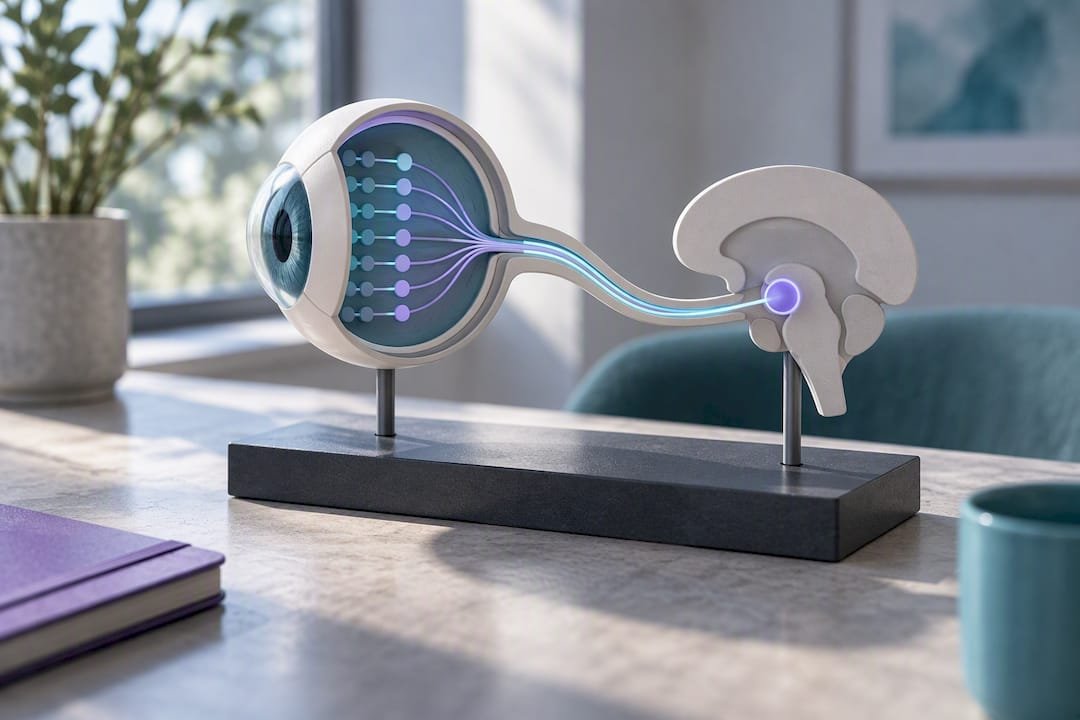
ipRGCs don’t feed into your visual cortex the way rods and cones do. Instead, they send signals along a non-visual pathway directly to the suprachiasmatic nucleus, the small cluster of neurons in your hypothalamus that functions as your master body clock. This is why the effect doesn’t require you to consciously look at anything bright; the system responds to the presence of the light itself, integrated over your exposure. Research on circadian mechanisms confirms that even brief or intermittent bright-light exposures can produce measurable phase shifts, because the system accumulates signal across a session rather than requiring one continuous, uninterrupted stare.
The phase response curve explains the timing rules. Picture a curve plotting how much your clock shifts depending on when during your body’s internal night or morning you receive light. Light delivered around your usual wake time produces a phase advance, the clock effectively moves earlier. Light delivered in the evening, before your usual bedtime, produces the opposite: a phase delay, pushing your clock later. This single curve explains almost every practical rule in this article, from why 30 to 60 minutes after waking works best, to why the same bright light at 9pm undoes what you achieved that morning.
Spectral composition adds another layer of nuance. Two scenes can look equally bright to your eyes while differing substantially in their melanopic content, meaning one activates ipRGCs far more effectively than the other. This is part of why daylight-optimised window conditions outperformed standard windows in the crossover trial mentioned earlier, even when raw brightness wasn’t wildly different; the daylight condition preserved more of the short-wavelength signal.
| Light condition | Approximate lux range | Circadian effectiveness |
|---|---|---|
| Outdoor daylight, clear sky | 10,000 lux | High, well above the effective threshold |
| Outdoor daylight, overcast | 1,000 to 10,000 lux | Generally sufficient for phase advance |
| Daylight-optimised window | Variable, closer to outdoor levels | Moderate to high, measurably better than standard glass |
| Standard indoor window | Typically under 1,000 lux | Low to moderate, weaker circadian signal |
| Indoor room lighting | Often under 1,000 lux | Low, rarely reaches the effective threshold |
| Clinical light box (specified distance) | 7,000 to 10,000 lux | High, calibrated for SAD treatment protocols |
The systematic review underlying much of this table is worth remembering for one caveat: study heterogeneity means these lux figures are useful practical benchmarks, not laboratory-precise cutoffs. Your own sensitivity, age, and even eye colour can shift where your personal threshold sits. The pattern across studies, though, is consistent enough to act on: brighter, bluer, earlier light produces a stronger, more reliable circadian signal than dim, warm, or poorly timed light.
Why this matters more than most wellness advice you’ll read this year
Morning light exposure gets filed under “obvious lifestyle tip” far too often, sitting next to advice like drinking more water or going to bed earlier. That’s a mistake. Unlike a lot of general wellness guidance, this one has a specific, mechanistic explanation, a measurable dose response, and a genuinely narrow window in which it works best. Get the timing wrong by a few hours and you can blunt or even reverse the benefit. That precision is what separates this from vague lifestyle advice, and it’s why I think it deserves more attention than it gets.
What strikes me most in the evidence is how modest the effective intervention actually is. A 22-minute sleep-onset shift from optimising daylight access, or meaningful alertness gains from ten minutes outdoors, doesn’t require a subscription, a device, or a treatment plan for most healthy adults. It requires knowing the rule and building the habit. That’s rarer in wellness content than it should be, where complexity is often mistaken for credibility.
Where it gets more interesting, and more relevant to what Live5dhealth does, is at the edges: people managing genuine circadian disruption, low-daylight winters, shift work, or a mood disorder that makes bright light a double-edged tool rather than a simple daily habit. That’s where the clinical literature and clinic-based therapies earn their place alongside the basic morning walk, whether that’s a properly calibrated light box, structured retreat time away from disrupted routines, or red light therapy approaches that work on different, complementary pathways to daylight exposure. None of it replaces the free habit of stepping outside each morning. It supports it, for the people whose circadian systems need more than a walk can give.
If you’re dealing with a mood disorder, a diagnosed sleep condition, or you’re simply not seeing results from a sensible morning light routine after a few weeks, that’s worth raising with a GP or a specialist rather than pushing harder on your own. Live5dhealth’s wellness services exist for the cases where structured, professional support genuinely adds something a morning walk can’t, but the clinical judgement always comes first.
— Mark
This article is general information, not a substitute for advice from a qualified doctor. Consult a qualified healthcare professional about your own circumstances before acting on anything here.
Sources
- A systematic review of the amount and timing of light in association with objective and subjective sleep outcomes in community-dwelling adults – PMC
- Access to daylight at home improves circadian alignment, sleep, and mental health in healthy adults: a crossover study
- Module 2. Effects of Light on Circadian Rhythms | NIOSH
- Bright-light therapy for bipolar depression: ISBD clinical recommendations
FAQ
How much light exposure do you need in the morning?
Aim for 10 to 30 minutes outdoors within 30 to 60 minutes of waking, which typically exceeds the 1,000 lux threshold linked to earlier sleep timing and better subjective sleep quality. Overcast days still usually clear this threshold; indoor rooms rarely do.
Is 7am sunlight healthy?
Yes, for most adults, 7am sunlight falls within the effective window for a circadian phase advance, provided it’s roughly within the first hour after you wake. The exact clock time matters less than its position relative to your personal wake time.
How do you get bright light exposure in the morning?
Step outside without sunglasses for 10 to 30 minutes shortly after waking, or sit by an unshaded window and extend the duration if you can’t get outdoors. On dark winter mornings, a light box or dawn simulator used for 20 to 30 minutes can substitute, though outdoor exposure remains the simpler default for most healthy adults.
Does morning sunlight count if it’s through a window?
It counts, but weaker. Ordinary window glass filters part of the light spectrum and reduces overall brightness, so a crossover trial found daylight-optimised windows produced a 22-minute earlier sleep onset compared with standard windows, meaning the type of window and the decision to step outside both genuinely matter.