
Cold plunges are safe for most healthy adults when entered gradually and kept short, but the immediate dangers are real: cold shock, a spike in blood pressure and heart rate, and, for people with existing heart conditions, a genuine risk of dangerous arrhythmia, particularly during the initial immersion period. The highest-risk groups are people with cardiovascular disease, uncontrolled hypertension, epilepsy, and those who are pregnant or intoxicated. Supervision, gradual entry, and strict time limits cut that risk substantially, which is exactly why those safeguards are important to include in every supervised cold plunge session.
TL;DR:
- Cold shock is the immediate danger during immersion, causing rapid gasp reflex, blood pressure and heart rate spikes, which can be fatal if unprepared.
- People with heart disease, uncontrolled hypertension, epilepsy, pregnancy, or cold-triggered allergies should avoid or seek medical advice before cold plunging due to high risks.
- Proper preparation, slow entry, brief sessions under 10 minutes, supervision, and post-immersion rewarming are essential to minimize cold water therapy hazards.
- The strongest evidence supports cold plunges being safe only when supervised and screened, as most fatalities occur immediately after immersion begins.
- Long-term benefits remain unproven, and the main dangers involve acute responses like cold shock and arrhythmia, not the cold exposure itself.
Table of Contents
- What are the physiological risks of a cold plunge?
- Who should avoid cold plunges? Medical contraindications explained
- How can you lower cold plunge risk before, during and after?
- What does the evidence actually say about cold plunge safety?
- What warning signs should you watch for after a cold plunge?
- Live5dhealth’s take: caution first, benefits second
- Book a supervised cold plunge session with Live5dhealth
- Sources
- FAQ
What are the physiological risks of a cold plunge?
The first danger you meet in cold water isn’t hypothermia. It’s the involuntary gasp reflex, known clinically as cold shock, and it hits within seconds of immersion below roughly 15°C. Your body inhales sharply, breathing rate rockets, and blood pressure and heart rate surge as your cardiovascular system reacts to the temperature change. Swimcoach notes that most cold-water deaths happen in the opening minutes of immersion, almost always tied to this gasp reflex combined with panic or facial submersion.
That gasp is also where drowning risk enters the picture. Involuntary hyperventilation makes it far harder to control breathing near or underwater, and a sudden inhalation at the wrong moment can be fatal even for strong swimmers.
There’s a second, less visible danger: autonomic conflict. Cold triggers a “dive response” that slows the heart while the cold shock response simultaneously tries to speed it up. In someone with an underlying rhythm disorder, that tug-of-war can spark a dangerous arrhythmia, particularly if the face is submerged and breath is held.
- Cold shock: gasp reflex, hyperventilation, BP and HR spike, all within seconds.
- Cardiac strain: competing nervous-system signals can trigger arrhythmia in susceptible people.
- Hypothermia: core temperature drops progressively the longer immersion continues.
- After-drop: core temperature keeps falling even after you’ve left the water.
A systematic review of voluntary cold-water exposure documents all of these as recognised physiological risks, alongside genuinely mixed evidence for the wellness benefits people chase. Most cold-water fatalities cluster in the opening minutes of immersion, not the later stages, which tells you where the real danger sits: entry, not endurance.
Who should avoid cold plunges? Medical contraindications explained
Some people face materially higher stakes from the same three minutes in cold water that a healthy adult tolerates easily. Harvard Health’s review of cold plunges and heart risk is blunt on this point: evidence for cardiovascular benefit is limited, while the risk for people with existing heart conditions is well documented.
You should avoid cold plunges, or get clinical sign-off first, if any of the following apply:
- Heart disease, arrhythmia, or a recent heart attack.
- Uncontrolled high blood pressure.
- Epilepsy or a history of seizures.
- Pregnancy.
- Raynaud’s phenomenon or cold urticaria (a cold-triggered allergic reaction).
- Sickle cell disease.
- Acute illness, fever, or intoxication from alcohol or drugs.
Children and older adults need extra caution too. Industry guidance from BISHTA and SPATA generally treats unsupervised cold plunges as unsuitable for under-16s, and older adults often carry undiagnosed cardiovascular risk that only surfaces under cold stress. If you’re on medication that affects blood pressure, heart rhythm, or thermoregulation, ask your GP before you plunge, not after.
How can you lower cold plunge risk before, during and after?
Most of the danger in cold water therapy sits in poor preparation, not the cold itself. A structured approach closes most of that gap.
- Screen yourself first. Review medications, skip alcohol beforehand, and flag any personal or family history of arrhythmia.
- Wet your face and neck before full immersion. This blunts the gasp reflex rather than letting it hit you unprepared, a technique Swimcoach recommends specifically for open-water and plunge settings.
- Enter slowly and control your breathing. Rushing in amplifies the cardiovascular spike; slow entry gives your system a chance to adjust.
- Keep sessions short, especially at the start. Bgi recommends beginner immersions well under 10 minutes, building up gradually rather than testing your limits on day one. Live5dhealth’s own cold plunge temperature protocols follow the same staged logic.
- Never plunge alone. Supervision, rescue readiness, and trained staff matter far more than they get credit for, particularly in a commercial setting where sanitation and water testing (photometers rather than test strips, given how cold water skews strip accuracy) are part of the standard.
- Rewarm properly afterwards. Dry off, layer warm clothing, and drink something warm. Skip the hot bath.
Pro Tip: A wet face and neck before you step in does more to blunt the gasp reflex than any amount of mental bravado. It’s the single easiest thing most first-timers skip.
What does the evidence actually say about cold plunge safety?
The honest answer is: benefits are plausible but unproven, risks are documented and real. The PMC systematic review covering voluntary cold-water exposure finds genuinely mixed evidence for the wellness claims made around cold plunging, while the acute physiological risks, cold shock, hypothermia, arrhythmia, are consistently observed and well characterised.
Harvard Health’s caution echoes that split: cold exposure may offer some recovery benefit, but the heart-risk evidence is strong enough that anyone with cardiovascular disease should treat plunging as a genuine medical consideration, not a lifestyle choice.
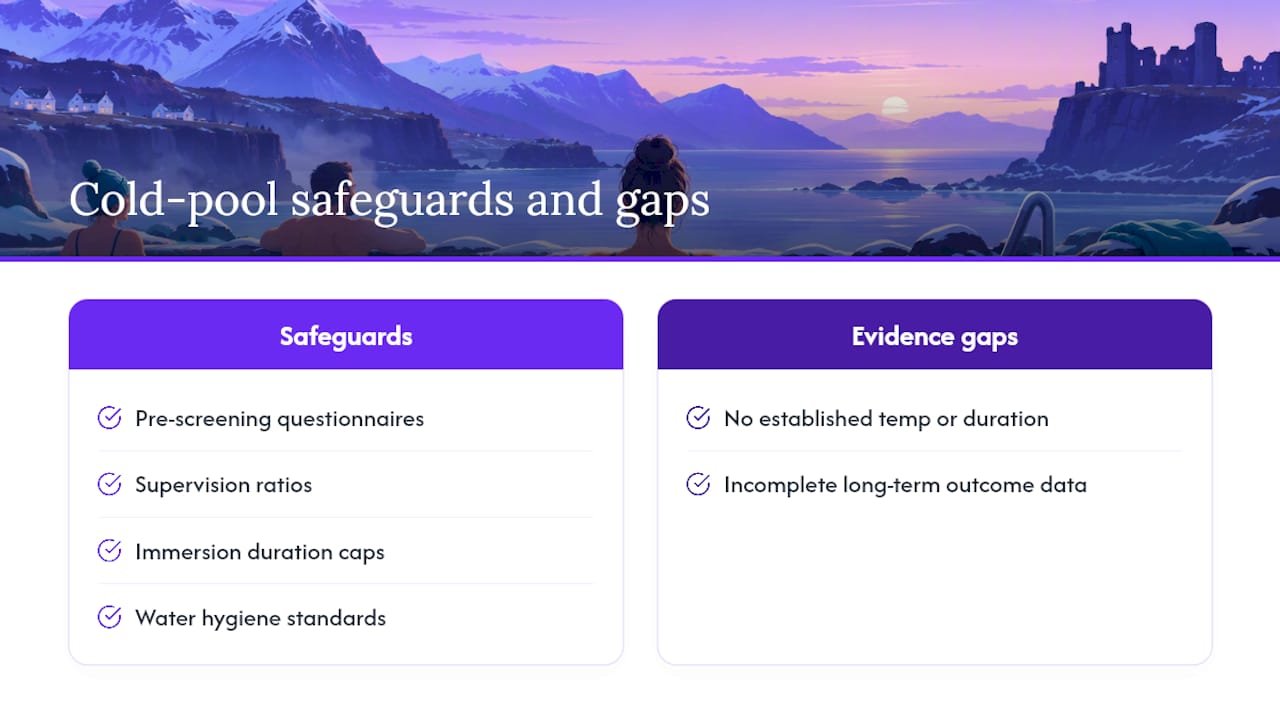
On the practical side, Bgi fills the gap between research and real-world operation: pre-screening questionnaires, supervision ratios, immersion duration caps, and water hygiene standards specific to cold pools. What’s still missing from the wider evidence base is long-term outcome data. Nobody has firmly established the “optimal” temperature or duration for cold plunging as a repeated practice, and acclimatisation reduces but doesn’t eliminate the cold shock response, even experienced winter swimmers get caught out by unexpected immersion.
What warning signs should you watch for after a cold plunge?
After-drop is the part most people don’t expect: your core temperature can keep falling for up to 30 minutes after you’ve left the water, even as you start to feel warmer on the surface. The right sequence is to remove wet clothing, layer up with dry warm clothes, and sip a warm drink, never jump straight into a hot bath, which can trigger sudden vasodilation and destabilise blood pressure at exactly the wrong moment.
Treat the following as reasons to seek medical attention immediately, not to “wait and see”:
- Chest pain or tightness.
- Fainting or near-fainting.
- Persistent breathlessness once you’re dry and warm.
- Severe confusion or disorientation.
- Shivering that won’t stop or gets worse rather than better.
If you plunge regularly, keep a simple log of time, water temperature, who you were with, and how you felt afterwards. It’s a small habit that gives a clinician something concrete to work from if a pattern of symptoms ever emerges.
Live5dhealth’s take: caution first, benefits second
The wellness industry sells cold plunging as an instant fix. The evidence doesn’t support that framing, and pretending otherwise does readers a disservice. What actually reduces risk isn’t grit or tolerance, it’s screening, supervision, and a rewarming plan before you ever get in. Live5dhealth’s own 4 Hour Rule protocol and pre-session screening questions exist for exactly this reason: a trained team catches the contraindications a solo home plunge never will. Done properly, under supervision, with sensible limits, cold water therapy can be a genuinely useful tool. Done alone, unscreened, and pushed too far, it’s a preventable risk.
— Mark
Book a supervised cold plunge session with Live5dhealth
Home cold plunges leave you screening yourself, timing yourself, and rewarming yourself, with nobody checking any of it. Live5dhealth’s Sauna, Steam & Cold Plunge Spa session gives you trained staff, pre-session screening, and infrastructure built for proper rewarming, the exact safeguards this article has spent the last several sections explaining.
One-off spa day costs vary and may include access to sauna, steam, and cold plunge facilities, sometimes guided by staff who monitor for cold shock and discuss contraindications. If you’re managing a heart condition, high blood pressure, or simply want a second opinion before you try cold water therapy for the first time, book a spa day session or check the booking hub for availability and speak to a member of staff about screening before you go anywhere near the water.
This article is general information, not a substitute for advice from a qualified doctor. Consult a qualified healthcare professional about your own circumstances before acting on anything here.
Sources
- Health effects of voluntary exposure to cold water – PMC – NIH
- Swimcoach
- Bgi
- Cold plunges: Healthy or harmful for your heart? | Harvard Health Publishing
FAQ
What are the negative effects of a cold plunge?
The main negative effects are cold shock (gasp reflex, hyperventilation, BP and HR spikes), risk of arrhythmia in people with heart conditions, hypothermia, and after-drop, where core temperature keeps falling after you exit. The PMC review documents all of these as consistently observed physiological responses.
Is a 3 minute cold plunge safe?
For most healthy adults following gradual entry and proper screening, a short plunge of a few minutes is generally well tolerated. It’s a different question entirely for anyone with cardiovascular disease, uncontrolled hypertension, or epilepsy, for whom even brief immersion carries real risk, per Harvard Health’s cardiac guidance.
What are the downsides of taking cold water baths?
Beyond the acute cold shock response, downsides include disrupted sleep if done too late in the day, the possibility of after-drop continuing to lower core temperature post-exit, and, for regular users chasing muscle growth, some evidence that routine cold exposure after resistance training can blunt hypertrophy gains.
What happens after 30 days of cold plunge?
Regular exposure tends to build some habituation to the initial shock, though acclimatisation reduces the cold shock response without eliminating it entirely. Long-term outcome data on repeated cold plunging is still limited, so claims of dramatic 30-day transformations outpace what the current evidence actually supports.