
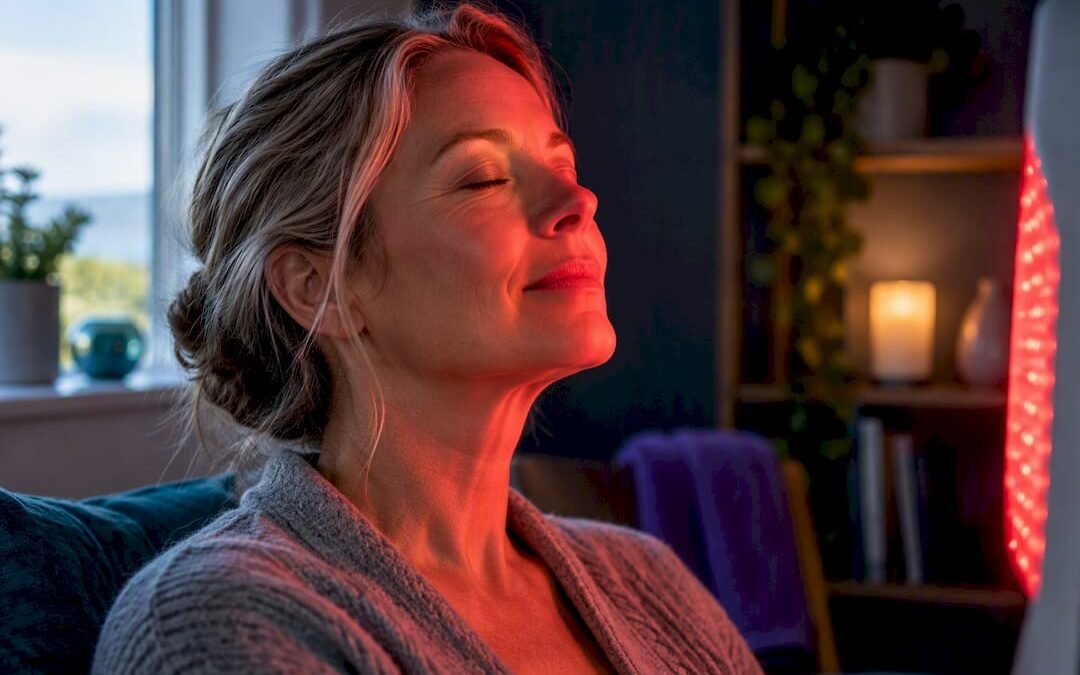
Standard consumer red and near-infrared devices are generally considered safe for healthy eyes when used as directed, with no confirmed structural damage in unmedicated adults. The caveats matter, though: high-intensity laser protocols, close-contact face masks, children, and anyone on photosensitising medication need extra care. For close-range sessions, keep your eyes closed or wear certified goggles, and speak to an eye professional first if you have existing eye disease.
TL;DR:
- Using diffuse LED devices at a distance of over two feet and with eyes closed generally poses minimal risk of eye damage for healthy adults.
- Close-contact masks and laser-based devices require certified eye protection and careful distance management to prevent increased retinal irradiance.
- People on photosensitising medications or with existing eye conditions should consult an eye professional before any red light therapy session.
- Typical side effects are mild and temporary, such as eye strain or afterimages, with no confirmed lasting retinal damage reported in healthy users.
- Supervised sessions by practitioners include screening for contraindications and proper device positioning, reducing risks compared to unsupervised home use.
Table of Contents
- What does red light eye safety actually depend on?
- What symptoms have people actually reported?
- How do you protect your eyes during a session?
- Why do face masks and close-contact devices need extra caution?
- What separates clinical protocols from consumer wellness devices?
- How does Live5dhealth approach eye safety in clinic?
- What I’d want you to take from this
- Book a supervised red light session with practitioner oversight
- Sources
- FAQ
What does red light eye safety actually depend on?
Your eye absorbs light differently depending on wavelength. The cornea and lens let red and near-infrared wavelengths pass through to the retina, where mitochondria in retinal cells absorb the energy and use it for cellular processes. This is the same absorption pathway that makes red light therapy useful for skin and tissue, applied to a much more delicate structure.
Red and near-infrared light are non-ionising, meaning they don’t carry enough energy to damage DNA the way ultraviolet light can. That’s a fundamentally different risk profile from UV or high-energy blue light, which is why sun exposure and tanning carry cumulative ocular risks that red light devices simply don’t share in the same way, as Live5dhealth’s guide to UV light therapy risks explains.
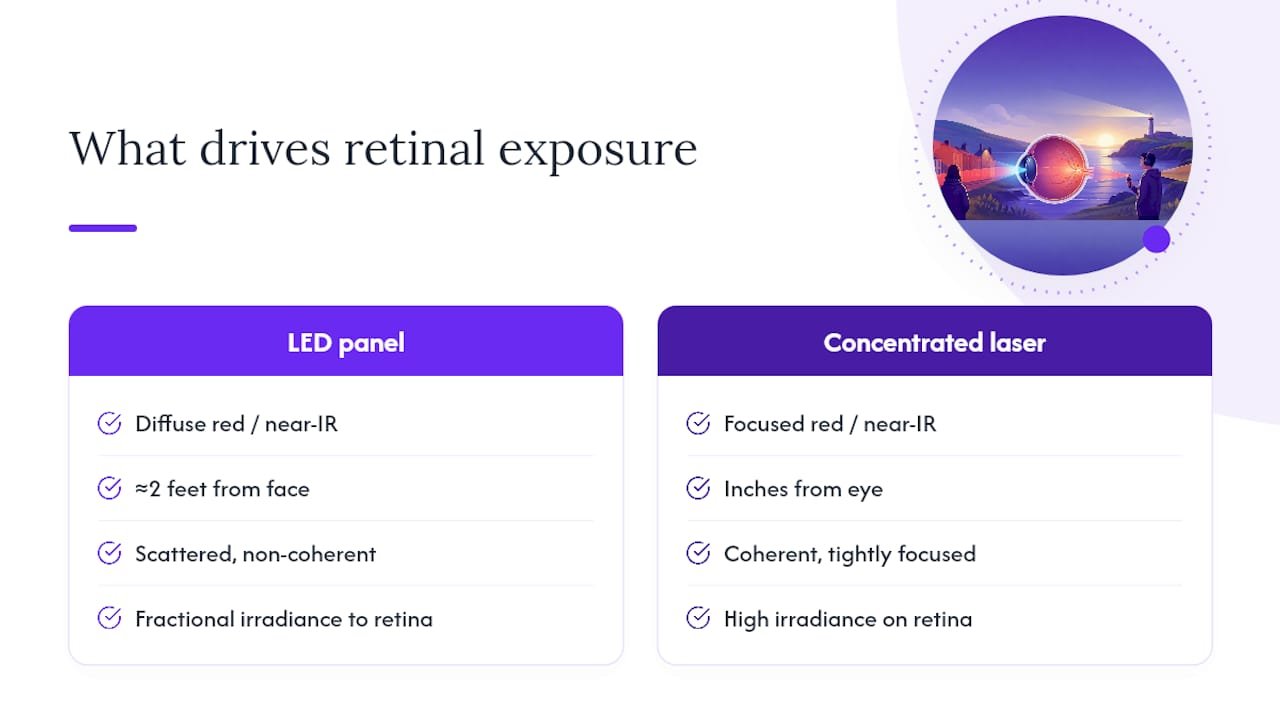
What does change the risk is intensity, distance, and duration. A diffuse LED panel two feet from your face delivers a fraction of the irradiance of a concentrated laser held inches from your eye. Coherent laser light also focuses energy far more tightly on the retina than the scattered light from an LED array, which is why the two categories are regulated so differently.
What symptoms have people actually reported?
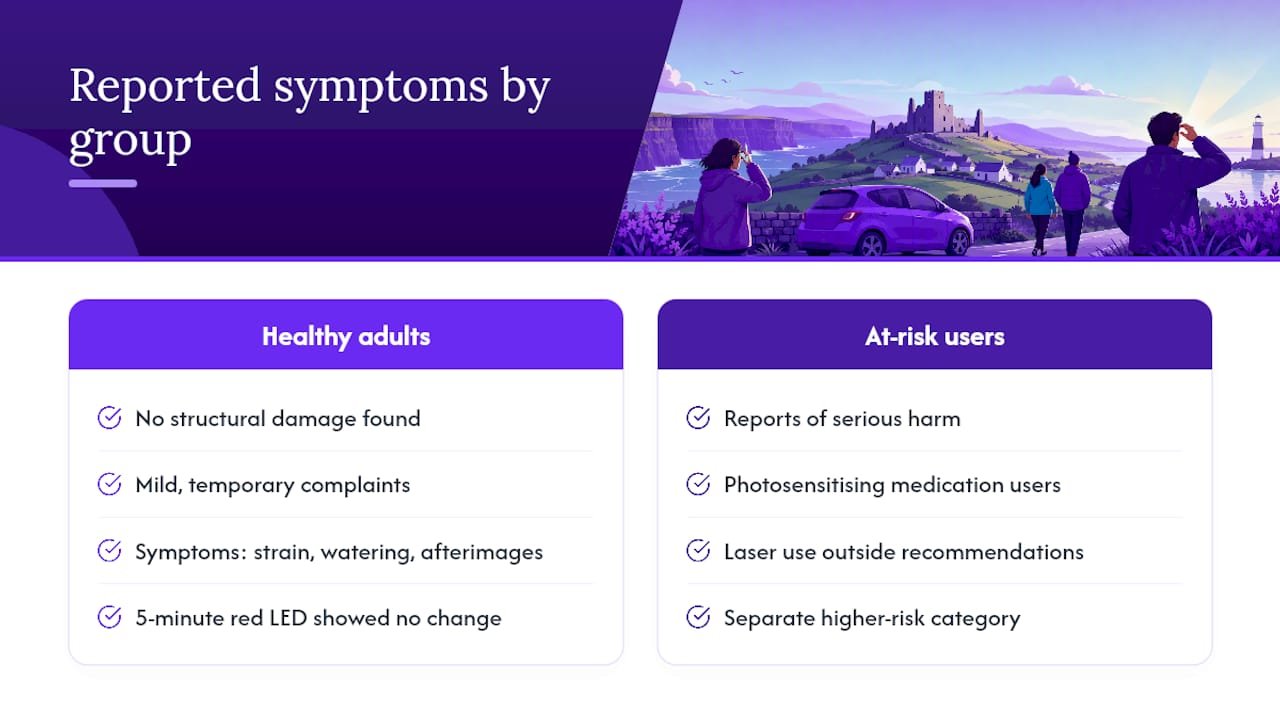
The honest picture is mixed but reassuring for most healthy adults. A 2017 systematic review found no evidence of ocular structural damage in physically healthy, unmedicated participants using light therapy devices.
In numbers: Ocular complaints were reported by varying percentages of participants across the studies reviewed, ranging from no issues at all to noticeable discomfort in some trials.
Most complaints were mild and temporary: eye strain, fatigue, watering, or brief afterimages after staring too close to a bright source. None of this reflects lasting retinal harm in the populations studied. A 2026 Journal of Optometry study reinforced this, finding that five minutes of diffuse red LED exposure caused no immediate changes to retinal thickness or blood flow in healthy adults.
The more serious reports in the wider literature involve people on photosensitising medication, or laser-based devices used outside recommended settings. Those cases are a different category entirely from wellness-grade LED sessions, and the distinction matters when you’re weighing your own risk.
How do you protect your eyes during a session?
Whether you need goggles depends entirely on the device and the distance. A full-body red light panel used from several feet away, with your eyes closed, carries a very different exposure profile from a close-contact facial mask positioned inches from your eyelids.
Follow these steps for any home or clinic session:
- Check the device specs first. Look for the manufacturer’s stated safe distance and session duration, and never exceed either.
- Close your eyes or wear certified protective eyewear for any panel positioned close to your face or at eye level.
- Screen yourself for photosensitising medication before starting, including certain antibiotics, antidepressants, and acne treatments.
- Keep to recommended distances. Standing further back reduces irradiance significantly, even from the same device.
- Avoid staring directly into any LED array, diffuse or not, for the same reason you wouldn’t stare at a bright bulb.
- Stop and reassess if you notice persistent discomfort, glare sensitivity, or blurred vision after a session.
Pro Tip: Set a timer rather than trusting your sense of time in a relaxing session. Most red light exposure guidance is based on specific minute counts, and it’s easy to lose track when you’re comfortable.
If you’re researching contraindications more broadly, Live5dhealth’s page on who should avoid red light therapy covers the medication and health-condition screening questions worth asking before your first session.
Why do face masks and close-contact devices need extra caution?
Proximity changes everything. Move a light source twice as close to your eye, and the irradiance hitting your retina increases sharply, following the same physics that makes a torch blinding up close but comfortable from across a room. Face masks sit closer to the eyes than any panel, which is precisely why manufacturers build in specific safety features.
Look for these when choosing a close-contact device:
- Opaque, well-fitted eye covers rather than thin fabric that lets light through.
- LEDs recessed away from direct eye-level positioning within the mask.
- Devices tested and certified for facial or near-eye use, not adapted panels.
Children and myopia-control laser devices sit in an entirely separate safety category. Low-level laser instruments used for myopia management have, in some radiometric assessments, been found to approach or exceed maximum permissible exposure limits depending on pupil size and session length. That’s a strong argument for clinician oversight rather than unsupervised home use in children.
What separates clinical protocols from consumer wellness devices?
Clinical ocular photobiomodulation trials, the kind exploring treatment for conditions like dry age-related macular degeneration, typically use wavelengths between roughly 630 and 800 nanometres under direct professional supervision. A review of ocular photobiomodulation notes that higher-intensity exposures in these settings carry retinal risks if safety parameters aren’t carefully managed.
That’s where Maximum Permissible Exposure, or MPE, comes in. It’s the exposure ceiling set by ophthalmic instrument standards such as those from ANSI, and clinicians test devices against it before pointing anything at the eye. Clinical trials using multiwavelength PBM protocols have reported improvements in some eye conditions with no observed phototoxicity, but only because dosing and device parameters were tightly controlled throughout. That’s a strong argument for choosing regulated, tested devices whenever treatment targets the eye directly, rather than assuming any red light source is interchangeable.
How does Live5dhealth approach eye safety in clinic?
Live5dhealth works with wavelengths in the 630 to 660 nanometre and 830 to 850 nanometre ranges, the bands most consistently associated with beneficial cellular effects in published research. Sessions are designed with practitioner oversight rather than left to guesswork, which matters given how much distance and duration influence outcomes.
In practice, that means:
- Screening clients for photosensitising medication and existing eye conditions before any session.
- Positioning devices at distances appropriate to the treatment area, not eye-level exposure by default.
- Guiding clients on eyewear or eye closure where a session brings light closer to the face.
If you want the fuller picture on side effects and who should hold off, Live5dhealth’s guide to red light therapy side effects is worth reading before you book.
What I’d want you to take from this
The evidence here is genuinely reassuring for most people, and I think that gets lost in a lot of anxious online chatter about red light therapy. Healthy adults using diffuse, moderate-intensity devices at sensible distances are not the population where serious ocular harm shows up in the research.
Where I’d push back on casual advice is the assumption that all red light devices are equally low-risk. They aren’t. A wellness panel and a close-contact laser mask are different tools with different exposure profiles, and treating them as interchangeable is where people get complacent. If you have any retinal condition or take photosensitising medication, that’s not a moment for a home experiment. It’s a moment to ask an optometrist first, then consider supervised sessions if you want the benefits without the guesswork.
— Mark
Book a supervised red light session with practitioner oversight
Live5dhealth is the alternative to guessing at device settings alone at home. Every red light therapy session in Boyle is positioned and timed by a practitioner who screens for contraindications first, so you get the benefits of near-infrared light without wondering whether your device settings are right.
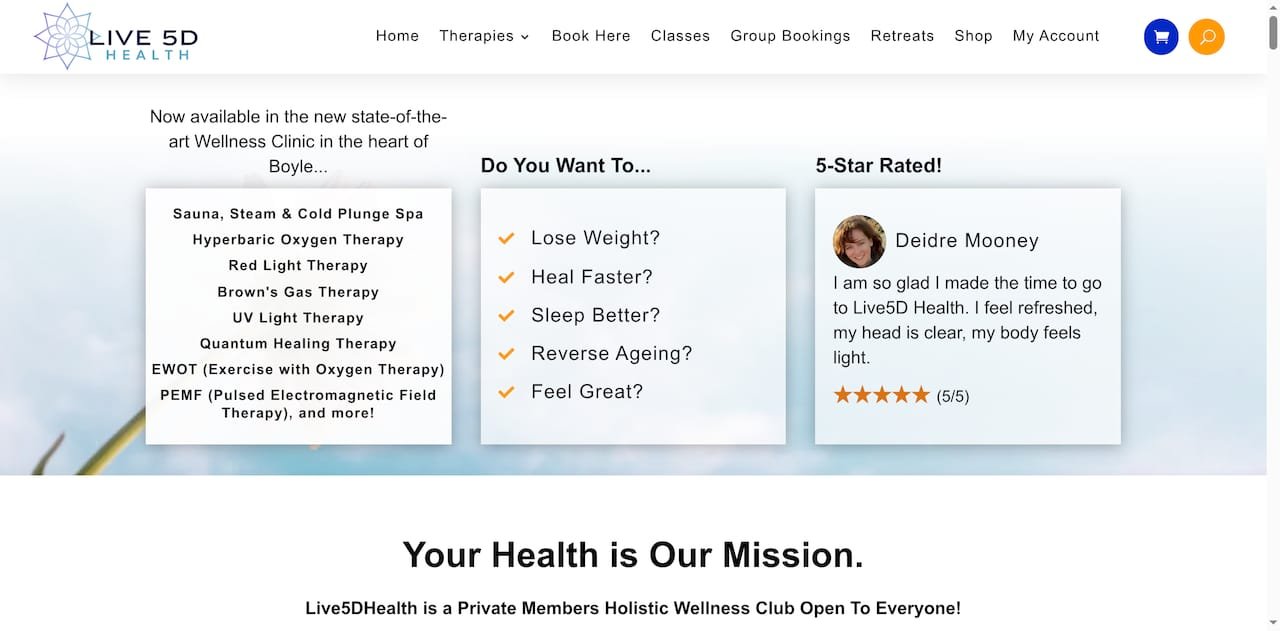
This matters most if you’re managing a chronic condition, taking photosensitising medication, or simply prefer clinician-led treatment over trial and error at home. Sessions run from €20 to €40, and you can view full details on the red light therapy page. If you’d rather combine it with sauna, steam, and cold plunge access in one visit, the spa day option covers that too. Ready to book? Reserve your slot through the online booking page and bring your questions about eye protection straight to your practitioner on arrival.
Sources
Key references include the 2017 systematic review on ocular safety, the 2026 Journal of Optometry study, and peer-reviewed archives via PubMed Central.
This article is general information, not a substitute for advice from a qualified doctor. Consult a qualified healthcare professional about your own circumstances before acting on anything here.
- Light therapy: is it safe for the eyes? — systematic review (2017)
- Photobiomodulation in ocular disease — review (PMC article)
- Transient ocular effects of red light exposure — Journal of Optometry (2026)
FAQ
Do I need eye protection when using red light therapy?
For panels used at a sensible distance with eyes closed, dedicated goggles usually aren’t necessary, though many people prefer them for comfort. Close-contact masks and high-intensity clinic devices are a different matter, and certified protective eyewear or manufacturer-provided eye covers are recommended there.
What are the downsides of red light therapy?
The main downsides reported are mild and temporary: eye strain, fatigue, watering, or brief afterimages if you stare too close to a bright source. A systematic review found ocular complaints in roughly 0% to 45% of studies’ participants, with no confirmed structural eye damage in healthy, unmedicated adults.
Can I just close my eyes during red light therapy?
Yes, closing your eyes is a practical and widely used approach for standard panels, since eyelids block most direct light exposure. For close-contact facial masks or high-intensity devices, certified goggles or built-in opaque eye covers offer more reliable protection.
Where should you not put red light therapy?
Avoid pointing any high-intensity or laser-based red light device directly at your open eyes, and be cautious with masks that sit very close to the eyelids without proper covers. Live5dhealth’s guide on who should avoid red light therapy covers other areas and conditions worth screening for first.
How much does supervised red light therapy cost?
Live5dhealth’s red light therapy sessions cost between €20 and €40 per session, with practitioner oversight included as part of the visit. Full details are available on the red light therapy page.