

Current evidence on hyperbaric oxygen therapy (HBOT) for traumatic brain injury is genuinely mixed, and anyone telling you otherwise is oversimplifying. A 2025 systematic review and meta-analysis found meaningful gains in memory, attention and general cognition. Yet pooled evidence reviewed by the VA and DOD shows no consistent short-term benefit over sham treatment for chronic post-concussion symptoms. The honest answer depends heavily on which injury, which protocol, and which outcome you’re measuring.
TL;DR:
- The effectiveness of hyperbaric oxygen therapy for traumatic brain injury depends on the injury type, protocol, and outcome measures, with evidence showing mixed results.
- Larger, standardized trials with proper sham controls are needed to confirm the benefits seen in some neurocognitive improvements and symptom scores.
- Differences in treatment pressure, session length, and total sessions significantly impact outcomes, making protocol details critical when comparing studies.
- HBOT is not FDA-approved for TBI, and safety screening is essential to avoid risks like untreated pneumothorax or severe side effects.
- Most treatments are paid out of pocket, and clear expectations should be set with a qualified provider before starting therapy.
Table of Contents
- HBOT and traumatic brain injury: what the systematic reviews actually show
- What the key randomised trials actually tested
- HBOT protocols: pressure, timing, and why the dose matters
- Safety, screening, and who shouldn’t have HBOT
- What this means if you’re considering HBOT for a brain injury
- Where the research still needs to catch up
- Why Live5dhealth takes a screening-first approach to HBOT
- Ready to explore HBOT with proper medical screening?
- Sources
- FAQ
HBOT and traumatic brain injury: what the systematic reviews actually show
The strongest recent synthesis on HBOT and traumatic brain injury recovery comes from a 2025 systematic review and meta-analysis pooling multiple studies with several hundred patients. It reported statistically significant improvements across several neurocognitive domains, including memory, attention, general cognition, executive function, information processing speed, and motor skills.
Those numbers look compelling in isolation, and they’re worth taking seriously. But the same review flagged a real problem: the four included studies varied in design, some non-randomised, and the authors themselves called for larger, standardised trials before treating these findings as settled.
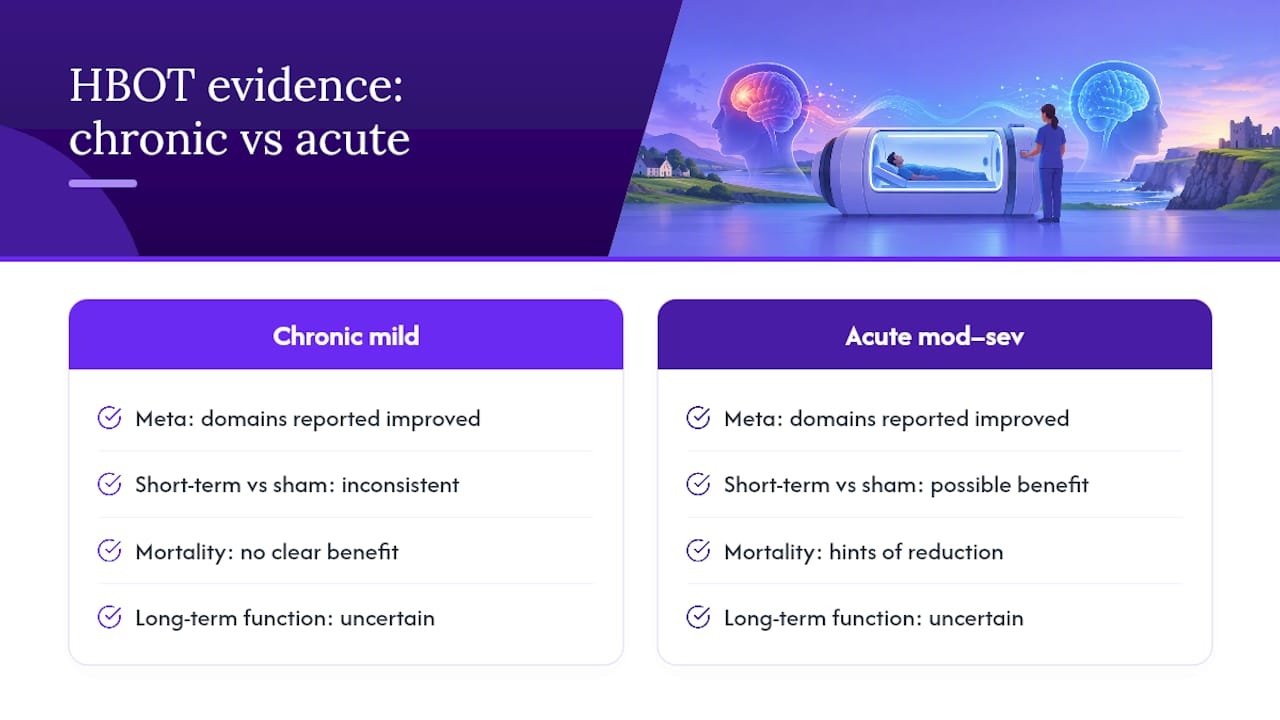
That caution gets reinforced by policy-level analysis. The VA’s Evidence Synthesis Program, reviewing hbot for concussion and post-traumatic stress together, concluded that pooled data for chronic mild TBI does not show consistent short-term benefit over sham treatment. Acute, moderate to severe TBI trials tell a different story, hinting at reduced mortality and less severe coma outcomes, though long-term functional benefit remains uncertain.
Regulatory status reflects that split. Hyperbaric oxygen therapy is not FDA-cleared as a standard treatment for traumatic brain injury or hbot post concussion syndrome. The Undersea and Hyperbaric Medical Society (UHMS) does approve HBOT for a defined list of other indications, such as carbon monoxide poisoning and decompression sickness, but TBI sits outside that approved list. This gap between promising research data and formal clinical endorsement is exactly why the picture reads as “mixed but evolving” rather than settled either way.
What the key randomised trials actually tested
Headline statistics only mean something once you understand how they were generated, so the trial designs behind hbot treatment effectiveness claims deserve a closer look.
The most rigorous recent study is a double-blind, randomised, sham-controlled trial published in Scientific Reports. Participants with persistent symptoms after brain injury received 40 sessions of hyperbaric oxygen therapy, compared against a matched sham protocol designed to feel identical to participants. The primary outcome was change on the Neurobehavioral Symptom Inventory (NSI) at 13 weeks.
Results favoured the active treatment group. The HBO2 group’s NSI scores improved notably compared to sham, with a statistically significant difference favoring HBOT. Notably, researchers later offered a second, unblinded 40-session course, which complicates interpretation of any longer-term follow-up data from that cohort.
That single trial sits inside a wider literature with recurring weaknesses:
- Blinding is genuinely hard. Ear pressure changes and chamber sounds can tip participants off to which arm they’re in.
- Sham validity varies. Some “sham” protocols use slightly compressed air rather than a true inert comparator, muddying the contrast.
- Sample sizes stay small. Many trials run fewer than 50 participants per arm, limiting statistical power.
- Study types mix freely. Meta-analyses often blend randomised trials with non-randomised case series, which can inflate apparent effect sizes.
None of this means the positive findings are false. It means they’re fragile, and fragile results need replication before anyone builds firm treatment guidelines around them.
HBOT protocols: pressure, timing, and why the dose matters
Two trials using “HBOT” can mean two very different interventions, and that variance plausibly explains why results conflict.
Neurological trials for brain injury recovery have typically used lower pressures than HBOT protocols for other conditions like non-healing wounds. A common regimen runs around 1.5 ATA (atmospheres absolute), with sessions lasting roughly 50 to 60 minutes, delivered via facemask to maintain a high-oxygen chamber environment. Full courses in the trials reviewed ranged from around 40 to 80 sessions. Other indications, and some earlier TBI studies, used pressures above 2.0 ATA. That’s not a minor technical detail. Research on protocol sensitivity suggests pressure and oxygen fraction both independently affect outcomes, so a trial using 1.5 ATA and one using 2.4 ATA aren’t really testing the same treatment.
The proposed mechanisms behind hbot for brain injuries centre on a few plausible pathways:
- Increased tissue oxygenation in areas with compromised blood flow
- Anti-inflammatory signalling effects at the cellular level
- Changes in cerebral blood flow patterns
- Shifts in molecular markers linked to neural repair processes
Pro Tip: If you’re comparing two studies’ results, check the pressure (ATA), session length, and total session count before assuming they tested “the same therapy.” Small protocol differences can produce very different outcomes.
Safety, screening, and who shouldn’t have HBOT
HBOT carries a strong safety record when delivered in certified medical chambers, but it isn’t risk-free, and screening matters.
There is one absolute contraindication: an untreated pneumothorax (a collapsed lung). Pressure changes inside the chamber can turn a stable pneumothorax into a life-threatening emergency, which is why clinical hyperbaric guidance insists on lung imaging before anyone begins treatment.
Common, generally mild side effects reported across trials include:
- Ear or sinus barotrauma from pressure changes
- Transient vision changes, usually resolving after the treatment course
- Claustrophobia or anxiety in enclosed chambers
Rarer but more serious events, including pulmonary complications and seizures, have appeared in some acute-care studies, particularly at higher pressures or oxygen concentrations. Relative contraindications, such as recent thoracic surgery or uncontrolled seizure disorders, require a physician’s screening before proceeding. Our detailed hyperbaric therapy contraindications list breaks down exactly what a proper pre-treatment assessment should cover, and a good safety checklist is worth reviewing before any first session, wherever you book it.
What this means if you’re considering HBOT for a brain injury
Translating the research into a real decision means asking the right questions and understanding where the evidence is strongest.
Signals of benefit appear most consistently in two places: certain neurocognitive measures following moderate to severe acute TBI, and specific symptom scores like the NSI in well-controlled chronic trials. That’s encouraging, but it doesn’t mean HBOT works equally well for everyone with a brain injury history, or that results from one trial’s protocol will transfer to a different chamber, pressure, or session count.
Before booking any course of treatment, bring these questions to a clinician or provider:
- What type of chamber is used, and is it certified to medical standards (ASME PVHO-1)?
- What pressure (ATA) and session length does the protocol use, and how many sessions total?
- What objective outcome measures will track progress, not just subjective symptom reports?
- What timeline should I expect before seeing any measurable change?
- What are the specific risks for my medical history, and has a physician screened me first?
- What does the full course cost, and is any of it covered by insurance?
On that last point: expect to pay out of pocket in most cases. Because HBOT for traumatic brain injury remains investigational rather than an approved standard of care in many jurisdictions, insurance coverage is inconsistent at best. Our overview of hyperbaric therapy for neurological conditions covers other areas where the therapy is used, which can help frame realistic expectations.
Where the research still needs to catch up
The literature’s biggest weakness isn’t a lack of interest. It’s inconsistency. Future trials need standardised regimens (fixed ATA, fixed session counts), genuinely validated sham controls that participants can’t detect, and larger multicentre samples that go beyond the 250-patient pool seen in the current meta-analysis.
A shared set of outcome measures across trials would also help enormously, since NSI scores and cognitive test batteries aren’t always directly comparable. Biomarker research, looking at who actually responds to treatment and why, could eventually let clinicians identify likely responders before starting a costly course. Some reviews caution that context and expectation effects may inflate results in uncontrolled case series, a problem only larger blinded trials can fully resolve. Ongoing DOD-sponsored research continues to test these questions, though clear practice-changing answers are still some years away.
Why Live5dhealth takes a screening-first approach to HBOT
Live5dhealth offers medically supervised hyperbaric oxygen therapy because we believe the evidence, while still developing, is promising enough to offer responsibly, not to oversell. Every client goes through informed consent and a proper screening process before any session, with realistic expectations set from the first conversation rather than after payment.
— Mark
Ready to explore HBOT with proper medical screening?
If you’ve read this far, you already know HBOT isn’t a guaranteed fix for traumatic brain injury symptoms, and you deserve a provider who says so honestly rather than promising outcomes the research can’t back. Live5dhealth’s hyperbaric oxygen therapy service starts every client with proper screening, including a review of your medical history and any prior scans or clinical reports you can bring along.

Session prices and consultation details are available through the provider’s official site, where you can also learn about contraindication checks and treatment expectations. If ongoing recovery support matters to you alongside HBOT, our centre also offers red light therapy and a full sauna, steam and cold plunge spa as complementary options. Book your initial evaluation through our appointments page to get a clear, honest answer about whether HBOT fits your situation.
This article is general information, not a substitute for advice from a qualified doctor. Consult a qualified healthcare professional about your own circumstances before acting on anything here.
Sources
- Hyperbaric oxygen therapy (HBOT) for neurocognitive deficits following traumatic brain injury: a systematic review and meta-analysis
- A double-blind randomized trial of hyperbaric oxygen for persistent symptoms after brain injury
- Evidence Synthesis Program: Hyperbaric Oxygen Therapy for Traumatic Brain Injury and/or PTSD (evidence brief)
FAQ
Is hyperbaric oxygen therapy effective for traumatic brain injury?
The evidence is mixed rather than conclusive. A 2025 meta-analysis found significant improvements in memory, attention and cognition, while pooled VA/DOD data found no consistent benefit over sham for chronic post-concussion symptoms.
What are the absolute contraindications for hyperbaric oxygen therapy?
The single absolute contraindication is an untreated pneumothorax, because pressure changes inside the chamber can turn a stable collapsed lung into an emergency. Lung imaging before treatment is standard practice for this reason.
Can the brain heal from traumatic brain injury?
Brain recovery varies enormously by injury severity, location, and individual factors, and no single therapy guarantees full recovery. Interventions like HBOT show measurable improvement on specific cognitive measures in some trials, but outcomes depend heavily on the original injury and treatment protocol.
What are the potential dangers of hyperbaric oxygen therapy?
Common side effects include ear or sinus barotrauma and transient vision changes, both usually mild and temporary. Rarer but serious risks, including pulmonary complications and seizures, have appeared in some acute-care studies, which is why screening at a certified facility like Live5dhealth matters before starting any course.