
A day of wellness treatments in Ireland generally ranges from a low-cost entry point to higher daily rates; weekend retreats and longer residential stays vary with accommodation and included therapies, with luxury weeks potentially costing significantly more. The best starting move is to decide your goal first, then match the format to your budget. Live5DHealth, based in Boyle, County Roscommon, is one Ireland-based example worth checking for current package pricing.
TL;DR:
- Day wellness treatments in Ireland generally start at around €30 for basic access to facilities and one or two treatments.
- Longer retreats of four days or more can cost from a few hundred to several thousand euros, depending on accommodation, therapies, and length.
- Prices are heavily influenced by room type, facility location, included therapies, and whether the booking is during peak season or off-peak.
- Specialist programs with technology-led therapies or clinical oversight are significantly more expensive and require qualified staff.
- Transparent pricing and clear communication about inclusions, practitioner qualifications, and cancellation policies are essential for accurate budgeting.
Table of Contents
- Typical price bands and what each band usually includes
- What actually drives the price up or down
- What a week actually costs, by format
- How to budget, compare quotes and save money
- What the evidence says about retreats and where the limits are
- How to pick the right retreat for your goals
- Our take on value and transparency in Irish retreats
- Check Live5DHealth retreat packages and pricing
- Sources
- FAQ
Typical price bands and what each band usually includes
Once you know roughly what you want to spend, it becomes much easier to filter out retreats that don’t match your goals. Irish wellness retreats tend to cluster into four recognisable price bands, and each one buys you a noticeably different experience.
A single day of treatments, sometimes called a spa day or wellness day, sits at the entry level. You’re usually paying for access to facilities such as a sauna, steam room or cold plunge, plus one or two treatments, often with a light lunch included. Live5DHealth’s sauna, steam and cold plunge spa is priced at €30 as a one-off, which gives a useful anchor for what a no-frills day experience costs in the Irish market.
A mini weekend, typically one or two nights, moves you into proper retreat territory. Expect a shared or private room, two to three meals a day, a handful of guided sessions such as yoga or breathwork, and perhaps one bodywork treatment. Accommodation at this level is comfortable rather than lavish: think a countryside guesthouse or a modest wellness centre rather than a five-star estate.
The four to seven day standard residential is where most people picture when they think “wellness retreat”. At this length, the daily rhythm usually includes:
- Structured morning and evening sessions (yoga, meditation, movement classes)
- Full board with meals planned around the retreat’s dietary philosophy
- A set number of therapies or treatments included in the package
- Daily access to facilities such as saunas, pools or nature trails
- Some free time for rest or optional add-on treatments
Luxury and residential retreats of eight days or more sit at the top of the market. These typically combine premium accommodation, a higher ratio of practitioners to guests, and access to specialist technology-led therapies rather than only traditional spa treatments. Live5DHealth’s 3, 5 and 10-day total wellness retreats fall into this category, pairing holistic practices with therapies such as hyperbaric oxygen and red light treatment, which is a different proposition from a standard countryside retreat built around yoga and clean eating alone.
The accommodation grade is the clearest signal of where a retreat sits in the market. Budget and mid-range retreats often use shared bathrooms or simple ensuite rooms, while luxury retreats tend to offer private suites, premium bedding and estate-style grounds. Meal plans follow a similar pattern: budget retreats usually serve set menus, mid-range retreats offer some choice, and luxury retreats often build the entire programme around a nutritionist-designed plan with multiple courses.
What actually drives the price up or down
Two retreats of identical length can differ in price by hundreds of euros, and the gap almost always comes down to a specific set of variables rather than vague “quality” differences.
- Duration and room type: Price scales with nights booked, and a single room typically costs more per person than a shared twin, sometimes by a meaningful margin.
- Accommodation grade and location: A remote coastal estate or a premium countryside property costs more to run than a town-centre wellness centre, and that overhead shows up in the nightly rate.
- Included therapies and practitioner oversight: A retreat built around specialist technology, such as hyperbaric oxygen therapy or supervised fasting, costs more to deliver than one built around group yoga, because it needs trained staff and equipment.
- Meals, transfers and excursions: Full board with premium or specialist menus adds cost, and so does any included airport transfer or off-site excursion.
- Seasonality and booking window: Peak season (generally spring and summer) and popular long weekends command higher prices and earlier deposits, while shoulder-season dates often come with lower rates and more flexible terms.
VAT and service charges are worth watching too. Some Irish wellness providers build tax and gratuities into the headline price, while others list them separately, so a quote that looks cheaper on paper can end up costing the same once everything is added.
Pro Tip: Ask every provider for the all-in total, including VAT, service charge and any mandatory add-ons, before comparing two quotes side by side.
What a week actually costs, by format
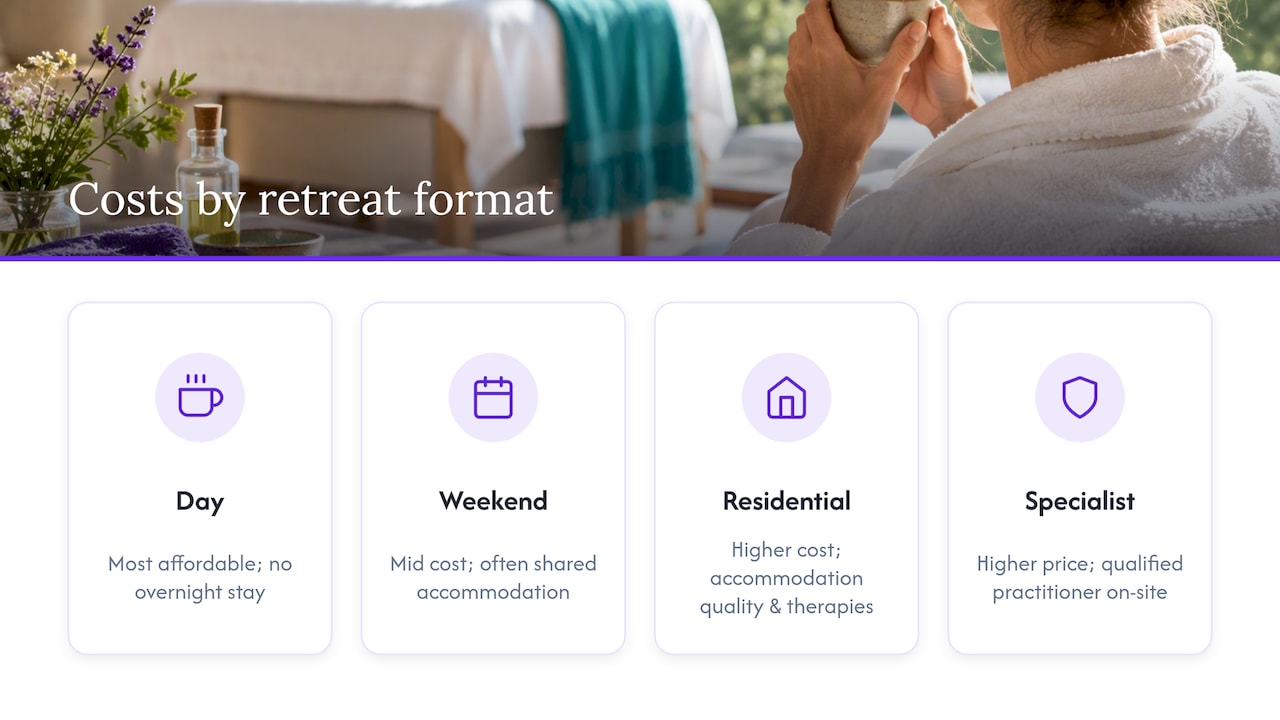
While price ranges vary, day workshops or wellness days tend to be the most affordable, weekend retreats cost more generally with some shared accommodation, and longer residential retreats and luxury or specialist programs typically involve higher costs, influenced by accommodation quality and therapies included.
Specialist programmes, such as those built around medically supervised weight management or clinical oversight, sit at a different price point again, often because they require a qualified practitioner on site rather than a general wellness coach. These programmes also carry a different suitability profile: they’re designed for people with a specific health goal under guidance, not simply a general reset, and the HSE’s clinical guidance on obesity is clear that effective care in this area is multidisciplinary, combining nutrition therapy, physical activity and psychological support rather than a single retreat stay.
Add-on therapies are where quotes can quietly climb. Red light therapy sessions in Ireland, for example, are commonly priced in the €14 to €40 per session range, and similar per-session pricing applies to other technology-led treatments when they’re not already bundled into your package. It’s worth asking exactly how many sessions of each therapy are included before you book, rather than assuming “access” means unlimited use.
A longitudinal study of attendees at a one-week residential retreat recorded measurable wellbeing improvements immediately after the stay and again at six weeks follow-up, which is one of the clearer pieces of evidence that short residential formats can deliver a real, if short-term, benefit (Europe PMC). That six-week marker matters: it suggests the benefit of a single retreat is real but not necessarily permanent, which should factor into how you weigh the cost against the outcome.
How to budget, compare quotes and save money
Before you commit a deposit, run every quote through the same checklist so you’re comparing like with like.
- Confirm the full list of included meals, treatments and sessions rather than assuming “all-inclusive” covers everything.
- Ask about practitioner qualifications for any specialist or technology-led therapy, particularly anything involving oxygen, heat extremes or supervised fasting.
- Read the cancellation and deposit terms in full, including what happens if you need to change dates.
- Price your own travel and transfers separately, since these are rarely included in the headline rate.
- Check whether travel insurance is recommended or required, especially for retreats involving physically demanding activities.
Several practical tactics can bring the total down without sacrificing the core experience. Booking during shoulder season, choosing a shared room instead of a single, opting for a shorter stay, and watching for early-bird pricing can each shave a meaningful amount off the final bill. For readers on a tighter budget, a single day of local nature-based activity, a coastal walk, a lake swim or a forest trail, delivers genuine wellbeing value at little or no cost, and can work well as a lower-cost complement to an occasional multi-day retreat rather than a replacement for one.
| Item to check | Why it matters |
|---|---|
| Full inclusions list | Reveals whether meals, transfers and therapies are bundled or extra |
| Practitioner credentials | Confirms qualified oversight for specialist or medical-leaning therapies |
| Cancellation and deposit terms | Protects you if your dates or circumstances change |
| Room type (single vs shared) | Often the single biggest swing factor in per-person price |
| Season and booking window | Peak dates cost more and book out further in advance |
Confirming the true total price before you pay a deposit, including VAT, service charges and any optional excursions, is the single habit that prevents the most common budgeting surprise: a retreat that looked affordable on the website but cost considerably more once every line item was added.
What the evidence says about retreats and where the limits are
Retreats can genuinely support how you feel in the short term, but the research base behind them is thinner than the marketing around them suggests, and it’s worth knowing where the evidence stops.
A systematic review of residential retreats, published in BMC Complementary Medicine and Therapies, found that while short-term wellbeing improvements are reported, there is limited data on economic return and long-term clinical efficacy; understanding what to check before attending is important, as explained in this wellness screening kit guide. The same review noted a lack of published data on adverse events, which is a practical reason to check a provider’s safety protocols and practitioner qualifications before booking anything involving intense physical or medical-adjacent therapies.
Retreats can show positive wellbeing effects, but the evidence for specific clinical outcomes, and for their economic value compared with other interventions, remains weak.
That gap matters most for anyone considering a retreat as a weight-loss or clinical solution rather than a wellbeing boost. The HSE’s model of care for obesity in Ireland frames effective treatment as multidisciplinary, combining medical nutrition therapy, physical activity and psychological support, with pharmacotherapy considered only at defined clinical thresholds. A retreat, however well run, is not presented as a primary treatment model in that guidance, which is worth keeping in mind if a retreat’s marketing leans heavily on weight-loss promises.
On the other end of the cost spectrum, Ireland’s own environmental and public health guidance points to something encouragingly simple: regular time in green and blue spaces, parks, woodland, lakes, the coast, delivers real wellbeing benefits at little or no cost. The Environmental Protection Agency highlights this as a genuinely low-cost complement to, or even substitute for, a remote residential retreat, particularly for readers who want ongoing benefit rather than a single intense week.
How to pick the right retreat for your goals
Matching the retreat to the goal is the step most people skip, and it’s the one that prevents the most disappointment.
- If your goal is rest and a break from routine, a weekend or four to five day retreat with a gentle schedule and good food usually delivers more value than a high-intensity programme.
- If your goal is stress reduction or a mental reset, look for retreats with daily breathwork, meditation or nature time built into the structure rather than a packed activity list.
- If your goal is a longer-term lifestyle shift, an eight to ten day retreat with follow-up guidance tends to offer more durable change than a single weekend.
- If you’re considering a retreat for a specific medical or clinical goal, speak to your GP first and treat the retreat as a complement to, not a replacement for, professional care.
A few red flags are worth watching for regardless of budget: unverified medical claims about curing or reversing specific conditions, pricing that’s only revealed after a sales call, aggressive upselling once you arrive, and vague or missing cancellation terms. Any of these should prompt more questions before you hand over a deposit.
Before booking, it helps to run through a short script with the provider: What exactly is included in the quoted price? Who delivers the specialist therapies, and what are their qualifications? What happens if I need to cancel or change dates? Are there any health conditions that would make this retreat unsuitable for me? What’s the realistic daily schedule, not just the brochure version? And is there a deposit, and is it refundable?
Pro Tip: Ask for the daily schedule in writing before you book: a vague itinerary is often a sign that pricing details are vague too.
Our take on value and transparency in Irish retreats
A lot of Irish wellness marketing leans on the word “luxury” as if it explains the price on its own. It doesn’t. What actually justifies a premium figure is specific: qualified practitioners overseeing specialist therapies, transparent all-in pricing with no surprise extras, and a programme built around a defined outcome rather than a loosely themed week of treatments.
Live5DHealth’s retreats in Boyle, County Roscommon, run across 3, 5 and 10-day formats and combine holistic practices with specialist technology-led therapies such as Exercise With Oxygen Therapy and Brown’s Gas therapy. That combination of modality and format is a useful illustration of how price and substance should line up: a longer stay with more specialist sessions should cost more, and a reader comparing quotes should be able to see exactly why.
The clearest advantage of transparent pricing is that it lets you compare retreats properly. When a provider lists what’s included, who delivers it and what qualifications they hold, you can judge whether the premium is paying for genuine expertise or simply for branding. If you’re considering any retreat with a clinical or medical framing, whether weight management, chronic condition support or intensive detox claims, speak to your GP beforehand. A retreat can sit alongside good medical care, but it shouldn’t be mistaken for it.
— Mark
Check Live5DHealth retreat packages and pricing

A few sensible next steps if you’re weighing this up:
- Check the inclusions list carefully against the budgeting checklist above before you commit.
- If you’re planning a trip with family or colleagues, Live5DHealth’s group booking option is worth asking about directly.
- For bespoke questions about specialist therapies or pricing, contact the team directly rather than relying on general estimates.
This article is general information, not a substitute for advice from a qualified doctor. Consult a qualified healthcare professional about your own circumstances before acting on anything here.
Sources
- The health impact of residential retreats: a systematic review — BMC Complementary Medicine and Therapies
- Environmental Protection Agency (Ireland) — resources on environment and health
- Longitudinal observational study of a residential retreat — Europe PMC
FAQ
What are some of the best wellness retreats in Ireland?
Ireland offers a range of retreats, from countryside yoga weekends to technology-led facilities such as Live5DHealth in Boyle, County Roscommon, which combines holistic practices with specialist therapies across its 3, 5 and 10-day retreat formats. The right choice depends on whether you want a gentle reset, a structured lifestyle programme or a specialist therapy focus.
How much do retreats cost?
Day experiences in Ireland typically start around €30, weekend retreats vary with accommodation and therapies, four to seven day residentials cost more generally, and luxury or specialist retreats of eight days or more involve higher costs. The exact figure depends on room type, included therapies and the season you book.
What is the cheapest country for a wellness retreat?
Costs vary enormously by country and this article focuses on Ireland, where prices range from around €30 for a single day of treatments to several thousand euros for a longer luxury stay. Within Ireland itself, booking off-season, choosing shared accommodation and opting for a shorter stay are the most reliable ways to lower the cost.
What is the best weight loss retreat in Ireland?
The HSE does not present weight-loss retreats as a primary treatment model for obesity, instead recommending multidisciplinary care involving nutrition therapy, physical activity and psychological support. Anyone considering a retreat for weight management should treat it as a complement to medical guidance and speak to their GP before booking.