
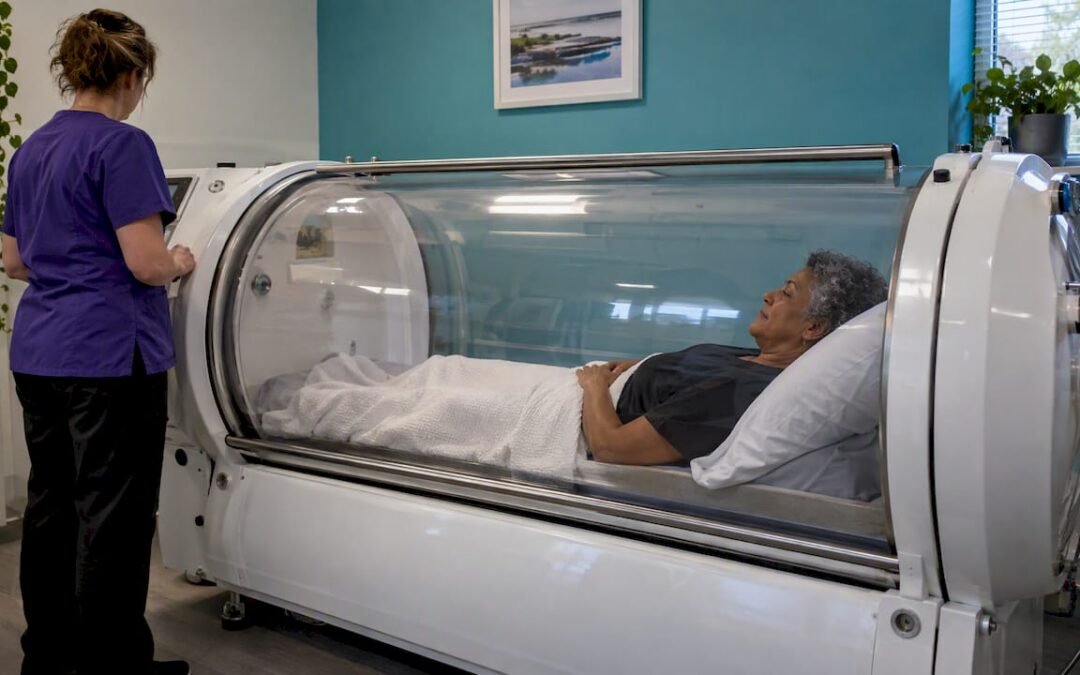
Hyperbaric oxygen therapy (HBOT) is one of the more promising non-drug options being studied for fibromyalgia. Several small trials and reviews report less pain, less fatigue and better quality of life. The evidence is still early, though, and not every analysis agrees. This guide sets out what the studies found, how PEMF compares, who should speak to a doctor first, and what a realistic course looks like.
TL;DR
- A 2023 meta-analysis in BMJ Open found HBOT relieved fibromyalgia pain compared with control treatments, but another 2023 meta-analysis found no clear effect on overall pain perception.
- Trials typically used 100% oxygen at 2.0 atmospheres, five days a week for eight weeks, so this is a course of treatment, not a one-off session.
- PEMF has much weaker evidence for fibromyalgia, and the largest trial found no difference from sham treatment.
- If you have cancer, are on chemotherapy, or have lung, ear or sinus problems, speak to your specialist before booking any hyperbaric session.
- Treat HBOT as a possible addition to your care plan, not a replacement for it.
Table of Contents
- What fibromyalgia patients are hoping HBOT will do
- What the studies actually found
- Does HBOT reduce inflammation?
- What a realistic HBOT course looks like
- Side effects and who should check first
- What about PEMF for fibromyalgia?
- Fitting HBOT into a wider plan
- Our perspective
- Try HBOT at our Boyle centre
- A sensible way to start
- FAQ
- Sources
What fibromyalgia patients are hoping HBOT will do
Fibromyalgia brings widespread pain, deep fatigue, poor sleep and a fog that makes everyday life harder. Many women over 40 live with it for years, trying medication, pacing and gentle exercise, and still want something more. That is why HBOT keeps appearing in search results.
HBOT means breathing 100% oxygen in a chamber pressurised above normal air pressure. According to Chen and colleagues’ 2023 systematic review, the pressure increases the oxygen dissolved in blood plasma and the oxygen delivered to tissues. Researchers study it in fibromyalgia because it may calm inflammatory activity and influence how the brain handles pain signals. For a plain-English walkthrough of the body-level effects, see our guide to what pressurised oxygen does to your body.
What the studies actually found
The results are encouraging, but they come with honest caveats. Here is the picture trial by trial.
Reviews and meta-analyses
- Chen et al., 2023 (BMJ Open). HBOT relieved pain in fibromyalgia compared with control interventions (standardised mean difference of -1.56). Most included studies also reported improvements in tender points, fatigue, function, patient global rating and sleep, although findings varied. The review is clear that guidelines have not recommended HBOT because the evidence is insufficient.
- Cao et al., 2023. Pooling four randomised trials with 163 participants, this meta-analysis found HBOT could benefit the Fibromyalgia Impact Questionnaire score and tender point count. It found no significant effect on overall pain perception.
- Leys et al., 2026. A systematic review of HBOT for chronic pain found consistent within-group improvements in pain, functioning and quality of life across several fibromyalgia trials. Between 29% and 53.3% of treated participants no longer met the diagnostic criteria for fibromyalgia after treatment. “Within-group” matters here: it describes change in the treated people, which is weaker evidence than a clean win over a sham group.
Individual trials
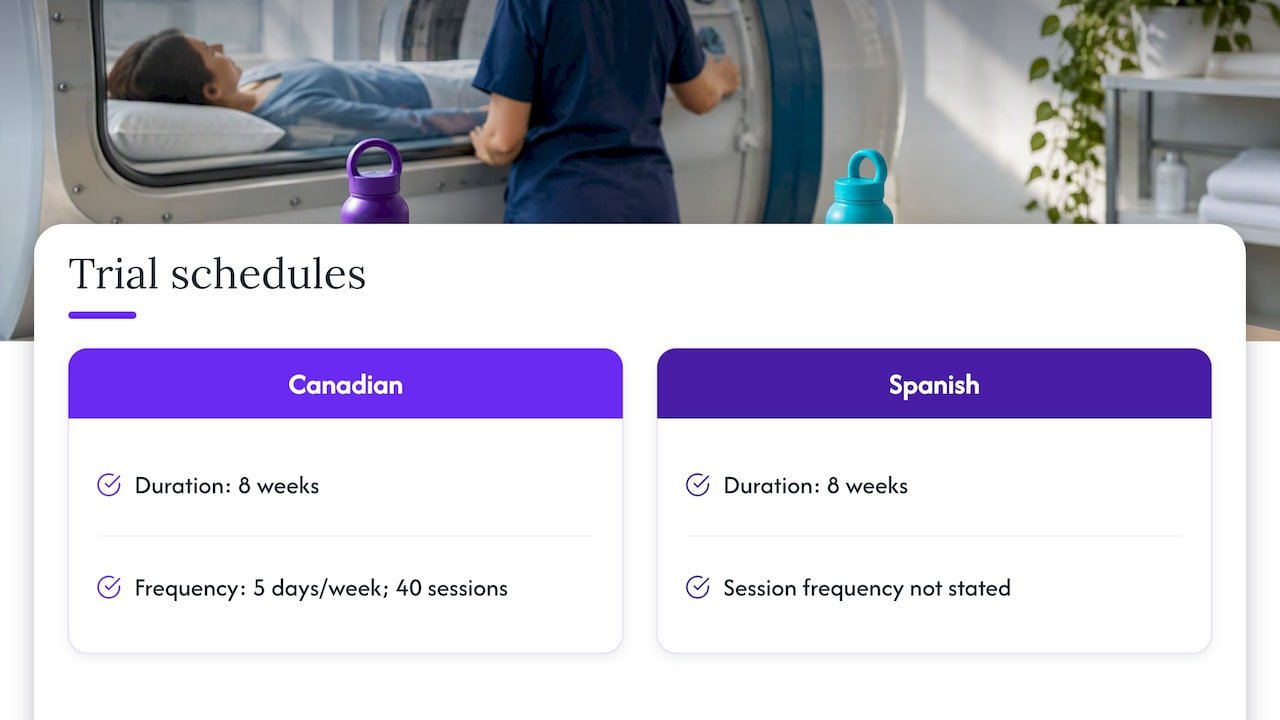
- Canada, 2021. In a feasibility study by Curtis and colleagues, 18 people were randomised to HBOT straight away or after a 12-week wait. HBOT used 100% oxygen at 2.0 atmospheres, five days a week for eight weeks. Improvements were still present at a three-month follow-up.
- Spain, 2024. An eight-week randomised trial of low-pressure HBOT in women with fibromyalgia improved pain-related psychological factors such as pain catastrophising and mental defeat, as well as quality of life.
- Israel, 2024. A Scientific Reports study in fibromyalgia patients with a history of childhood sexual abuse found HBOT outperformed pregabalin and duloxetine on FIQ scores and functional measures. This is a specific subgroup, so do not read it as proof for everyone.
Reading the evidence fairly
The pattern is hopeful: quality of life, fatigue, function and tender points often improve. Researchers link these gains to neural plasticity and greater activity in brain regions that process pain, according to the 2026 review. But trials are small, protocols differ, and pain scores do not always move in every analysis. An Irish physician, Dr Kate McCann, writes for Emdoc that studies have not yet validated HBOT for fibromyalgia, and advises discussing suitability with a specialist and choosing a facility with trained staff. We agree with that advice.
Does HBOT reduce inflammation?
This is a common question, and the careful answer is: possibly. The 2023 BMJ Open review describes anti-inflammatory potential through reduced glial activation and inflammatory mediators. It also says the exact mechanism in fibromyalgia needs more investigation. So inflammation is a plausible route, not a settled one.
What a realistic HBOT course looks like
The trials above did not test a single visit. The Canadian protocol ran five days a week for eight weeks, which is 40 sessions. The Spanish trial also ran for eight weeks. A single session will not tell you whether HBOT suits you, and the trial protocols are far more intensive than most people can fit into a normal week.
If you are planning around work and family, our guide to the HBOT sessions per week protocol explains how frequency and total number of sessions are usually thought about. It also helps to read how to maximise results from hyperbaric oxygen therapy, covering sleep, hydration and pacing around sessions.
Fatigue is part of fibromyalgia, so many people also ask about overlap with chronic fatigue. We cover that in the role of HBOT in chronic fatigue.
Side effects and who should check first
HBOT is generally well tolerated in supervised settings, but it is not risk-free. In the Canadian feasibility study, HBOT-related events included mild middle-ear barotrauma in 3 participants and new-onset myopia (short-sightedness) in 4. Ear pressure problems are the most familiar issue, which is why a cold, sinus infection or recent ear surgery matters.
If you have cancer or are having cancer treatment
Speak to your oncology team before booking. OncoLink advises telling your care team about all medicines and conditions first. It says HBOT should not be used, or should be used with caution, alongside bleomycin, cisplatin, disulfiram, mafenide acetate or doxorubicin. It also lists pneumothorax, lung disease, recent ear injury or surgery, sinus infection, seizure disorder, fever or a cold as things to mention. Your consultant or oncology pharmacist is the right person to ask, because they know your exact drugs and schedule.
Our hyperbaric therapy contraindications list goes through these checks in more detail.
Other things to raise with your GP
- Any lung condition or history of collapsed lung.
- A recent cold, sinus problem or ear surgery.
- Seizure disorders.
- Eye conditions, since myopia changes were reported in one trial.
- Pregnancy.
Bring your medication list. A good facility will ask these questions before your first session, not after.
What about PEMF for fibromyalgia?
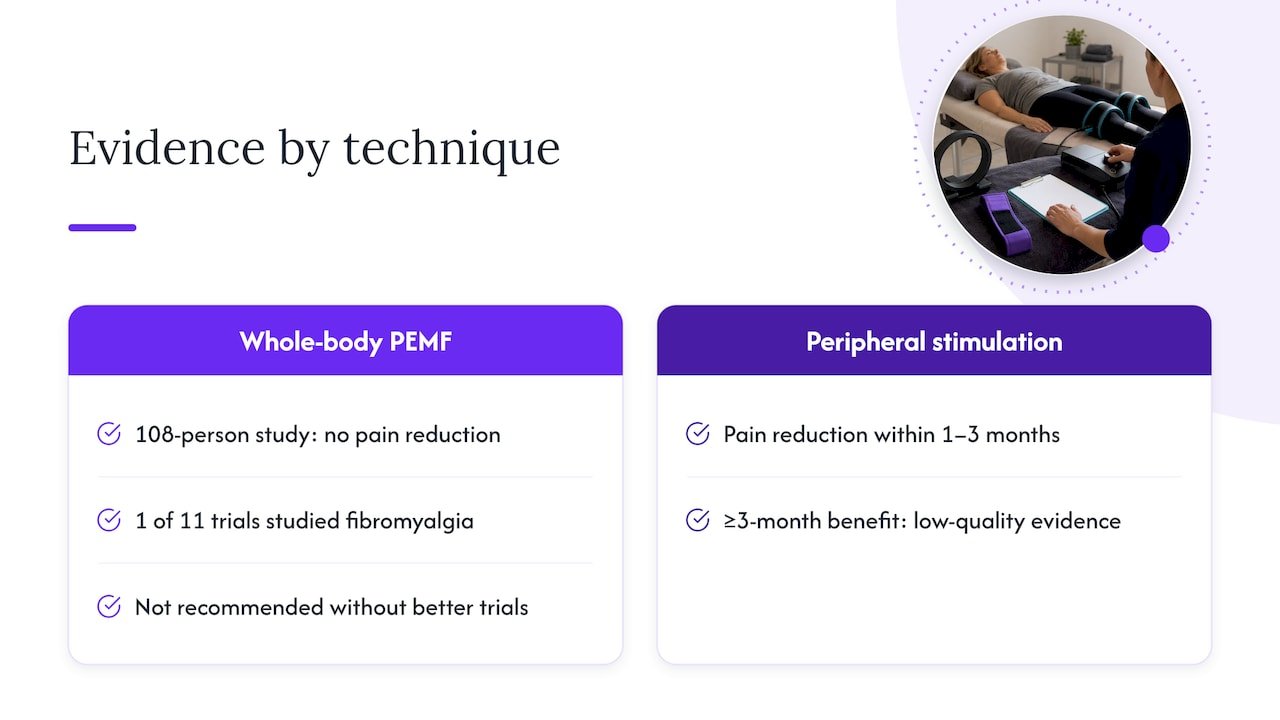
PEMF, or pulsed electromagnetic field therapy, uses magnetic fields that change in intensity, created when electric current passes through a coil. The NCCIH, a US government health body, reports that evidence for magnetic therapy and fibromyalgia is very limited and weak. A 2021 review of 4 studies with 312 participants could not say whether magnetic therapy reduces pain, and the largest electromagnetic-therapy study, with 108 women, found no pain reduction.
The detail agrees. A 2018 randomised study by Multanen and colleagues with 108 participants found no differences between active and sham PEMF for pain, stiffness or function. A 2012 review by Hug and Röösli found only one fibromyalgia trial among 11 whole-body PEMF trials, with small samples and short follow-up, and concluded whole-body PEMF could not be recommended without better trials.
There is a narrower finding worth knowing. A meta-analysis of peripheral magnetic stimulation found it significantly reduced fibromyalgia pain within 1 to 3 months, but evidence for benefit at 3 months or longer was low quality. That is a different technique from a whole-body PEMF mat, so do not assume the two are interchangeable.
Safety with PEMF
According to NCCIH, some magnets may interfere with pacemakers and insulin pumps, and magnetic devices should be removed before an MRI. Anyone who is pregnant or has a health condition should consult a healthcare provider first.
In short: for fibromyalgia, HBOT currently has a stronger research base than PEMF. We offer both, but we would not tell you PEMF is proven for fibromyalgia, because it is not.
Fitting HBOT into a wider plan
No single therapy is likely to carry fibromyalgia on its own. Most people do best with several things working together: medical review, gentle regular movement, sleep support, stress management and treatments they enjoy. Some people also explore calming practices alongside conventional care, and reiki for pain relief is one example of a gentle option people look into. Whatever you choose, tell your GP or rheumatology team what you are trying.
If you are interested in how treatments are layered, our guide to hyperbaric therapy combined with wellness treatments explains common pairings. Heat from a sauna and warm steam can feel soothing on stiff days, though cold plunge may not suit everyone with fibromyalgia, so go gently and ask us first.
Our perspective
We meet many women over 40 who have been told to live with their symptoms. They arrive tired of being tired, and curious. Our view is simple: hope is healthy, hype is not.
We believe HBOT deserves a fair look for fibromyalgia, because the trial results on fatigue, function and quality of life are genuinely encouraging. We also tell every client that the evidence is early, that trial protocols are intensive, and that results differ from person to person. We would rather you start with realistic expectations and a conversation with your doctor than with a promise.
What we focus on is the whole experience: a calm setting, clean energised water throughout the centre, and a choice of therapies that sit well together, from hyperbaric oxygen and red light to PEMF, sauna and massage. Pace yourself, track how you feel, and build a plan that is yours.
— Mark
Try HBOT at our Boyle centre
Our wellness centre in Boyle, County Roscommon offers hyperbaric oxygen therapy, with sessions published at €80 to €120. If you would like to start with something lighter, red light therapy is €20 to €40, and our sauna, steam and cold plunge spa is €30.

We will talk through your health history before your first session, and we ask you to bring your medication list. If you are in cancer treatment, please clear it with your oncology team first. You can see all our therapies, including PEMF, on our homepage, or book through our booking page. If you want to understand the technology before visiting, start with what hyperbaric oxygen therapy is and the wider health benefits of hyperbaric oxygen therapy.
A sensible way to start
- See your GP or specialist. Share that you are considering HBOT and ask whether anything in your history or medication is a concern.
- Set a goal you can measure. For example, sleep quality, morning stiffness or how many good days you have each week. Write a baseline before you start.
- Plan a block, not a single visit. Trials used weeks of regular sessions, so decide what frequency you can sustain.
- Keep your other care going. Do not stop prescribed medication or physiotherapy because you have started a new therapy.
- Review at a set point. After several weeks, compare with your baseline and decide with your doctor whether to continue.
FAQ
Does HBOT work for fibromyalgia?
Some evidence says it can help. A 2023 meta-analysis found pain relief against controls, and a 2026 review reported improvements in pain, function and quality of life. Another 2023 analysis found no clear effect on overall pain, and guidelines do not yet recommend it, so results are not guaranteed.
How many HBOT sessions are used in fibromyalgia studies?
The Canadian trial used five sessions a week for eight weeks at 2.0 atmospheres of 100% oxygen. The Spanish trial of low-pressure HBOT also ran for eight weeks. Your own plan should be agreed with your doctor and your provider.
Is PEMF better than HBOT for fibromyalgia?
On current evidence, no. PEMF research for fibromyalgia is limited and inconsistent, and the largest trial found no difference from sham treatment. HBOT has more positive trial data, though it is still not a proven standard treatment.
Is HBOT safe if I have cancer?
It depends on your diagnosis and treatment. Some chemotherapy drugs, including bleomycin, cisplatin and doxorubicin, mean HBOT should be avoided or used with caution. Always ask your oncology team before booking.
Sources
- Efficacy and safety of hyperbaric oxygen therapy for fibromyalgia, Chen et al. 2023 (PMC)
- Efficacy and safety of hyperbaric oxygen therapy for fibromyalgia (PubMed)
- Effectiveness of hyperbaric oxygen for fibromyalgia, Cao et al. 2023
- Hyperbaric oxygen therapy in managing chronic pain, Leys et al.
- Evaluation of a hyperbaric oxygen therapy intervention in fibromyalgia, Curtis et al. 2021
- Low-pressure hyperbaric oxygen therapy in women with fibromyalgia, 2024
- HBOT vs pharmacological intervention, Scientific Reports 2024
- OncoLink: Hyperbaric oxygen therapy
- NCCIH: Magnets for pain
- PEMF therapy in fibromyalgia, Multanen et al. 2018
- Whole-body pulsed electromagnetic field devices, Hug and Röösli 2012
- Peripheral magnetic stimulation for fibromyalgia
- Emdoc: Should I get hyperbaric oxygen therapy?
- Reiki for pain relief