
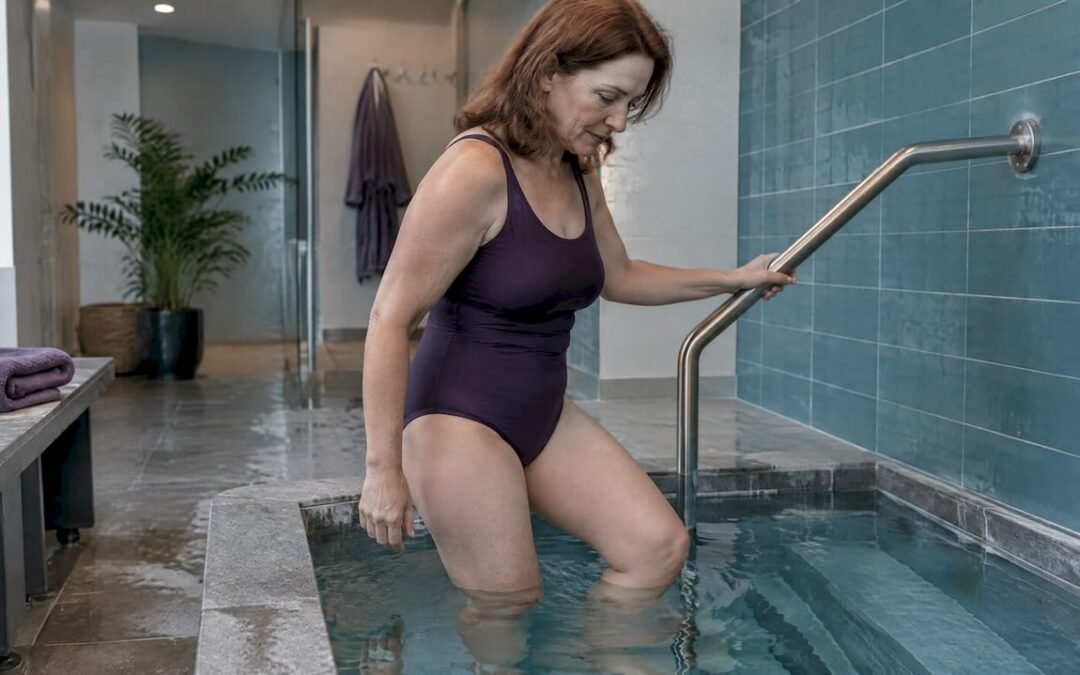
A cold plunge can help some people sleep better, but it is not a quick fix, and the timing matters more than the temperature. The cold itself is stimulating. Any sleep benefit seems to come later, as your body rewarms and settles. So the best approach is to plunge earlier in the evening, keep it short, and avoid it altogether if you have a heart or circulation condition until a doctor has said it is fine.
Below, we explain what the studies actually found, why they are less clear than social media suggests, and how to build a plunge into an evening routine without wiring yourself for the night.
TL;DR
- A 2025 review found cold-water immersion can improve sleep quality, but the studies were small and the sleep finding came from men only.
- Cold water raises alertness first. Plunge at least a couple of hours before bed, not just before lights out.
- Short, cool (not extreme) immersion is the sensible starting point for sleep. Longer or colder is not better.
- Cold water can strain the heart and breathing. If you have heart disease, high blood pressure, asthma or Raynaud’s, speak to your GP first.
- A sauna and plunge session earlier in the evening is a calm way to try it. Never plunge alone.
Table of Contents
- What the research says about cold plunging and sleep
- Why timing matters: alert first, sleepy later
- Temperature and duration when sleep is the goal
- Cold plunge, sauna or both?
- Who should be careful or avoid cold plunging
- Our perspective: calm the evening, do not shock it
- A simple evening routine to try
- Try it with us in Boyle
- FAQ
- Sources
What the research says about cold plunging and sleep
The most useful starting point is a 2025 systematic review and meta-analysis in PLOS One. It pooled 11 studies with 3,177 participants and found that cold-water immersion can improve sleep quality. That is encouraging. The same review is clear about the limits: small samples, few randomised trials, and a lack of diversity among participants. The sleep finding itself came from a study of men only.
That last point matters if you are a woman over 40. Evidence on sleep benefits has shown improvements in men that have not been consistently seen in women, according to one research summary. Sleep in midlife is shaped by hormones, night sweats and stress in ways a group of young male athletes will not reflect. A sleep specialist quoted in Sleep Review makes the same wider point: evidence in the general population is limited, and more high-quality research in diverse groups is needed.
So the honest summary is this: there is a plausible benefit, and no guarantee it will work for you.
What the individual studies found
Most of the small trials come from sports science, where cold water is used after training.
- Trained male runners: 10 minutes of whole-body immersion, head included, at 13.3°C after exercise increased slow-wave (deep) sleep in the first 180 minutes compared with partial immersion. Both whole and partial immersion reduced arousals. The study was small and used well-trained men.
- Highly trained swimmers: in a study of eight swimmers, 5 minutes of immersion at 15°C after training was associated with likely better perceived sleep quality on days 2 to 4 than the control condition.
- Evening cyclists: a 2013 study found that evening exercise followed by cold-water immersion did not change whole-night sleep architecture in trained male cyclists. In other words, it did not harm sleep, but it did not obviously improve it either.
Put together, these results point to “may help, rarely harms, depends on the person”. They do not show that a plunge is a treatment for insomnia.
Why timing matters: alert first, sleepy later
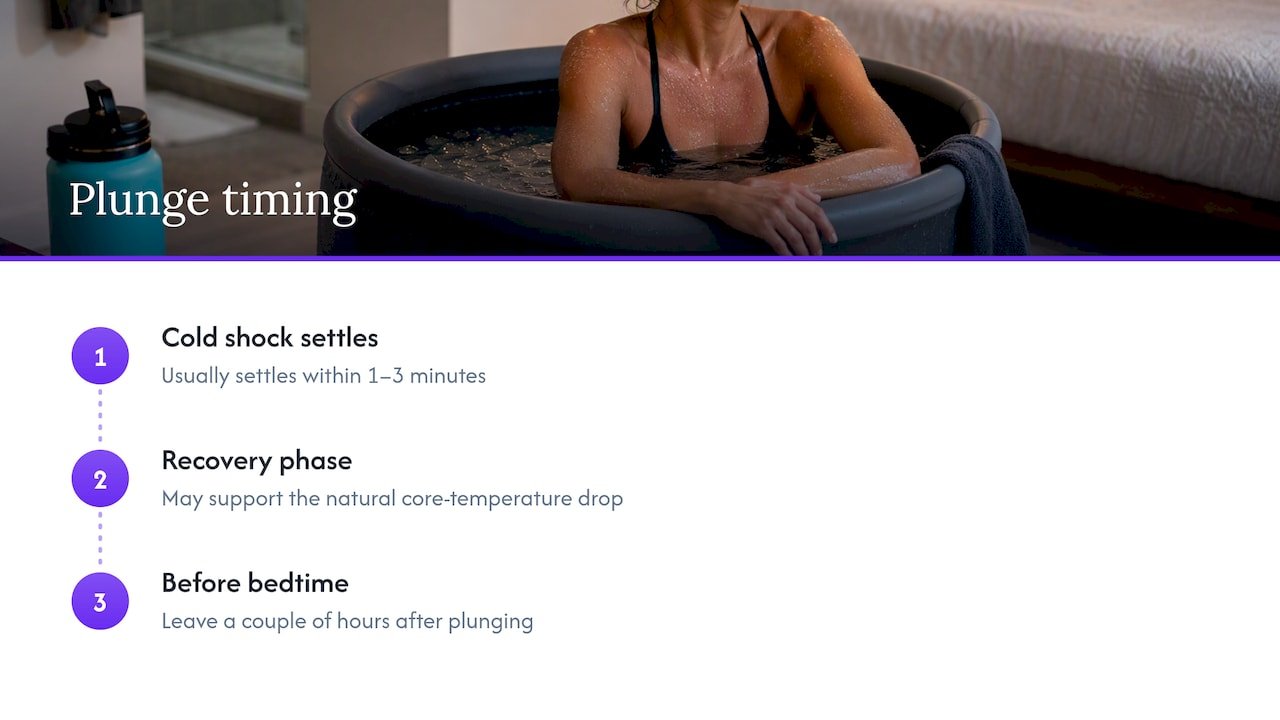
When you step into cold water, your body reacts with a cold shock response: gasping, faster breathing and a racing heart. This usually settles within one to three minutes. Your sympathetic nervous system, the “fight or flight” side, is switched on. Alertness goes up, and that is the opposite of what you want at 10.30pm.
The argument for cold helping sleep rests on what happens afterwards. Your core temperature naturally falls as you head towards sleep, and the recovery phase after cold exposure may support that drop. The catch is that this takes time. If you get out of the water and go straight to bed, you may simply lie there feeling wired.
That is why we suggest treating a plunge as part of the early evening, not the last thing you do. Leaving a gap of a couple of hours between your plunge and bedtime gives the stimulating phase time to pass. This is practical guidance based on how the body responds, not a figure from a clinical trial, so treat it as a starting point and adjust to how you feel.
Should you cold plunge at night?
It depends what “night” means. Late evening, right before bed, is the riskiest time for sleep. Early evening, after work and a few hours before bed, is the better window. If you find that even an early-evening plunge leaves you buzzing, move it to the morning or afternoon. You will still get the mood and energy lift, and your sleep may be better for it.
Temperature and duration when sleep is the goal
More extreme does not mean more relaxing. The studies above used water between roughly 13°C and 15°C for 5 to 10 minutes, mostly after hard training. For a non-athlete aiming at better sleep, we would start at the gentler end:
- Water around 12°C to 15°C, which is cold but manageable.
- One to three minutes to begin, building slowly.
- Breathe out slowly and steadily on entry. Do not jump or dive.
- Keep your head out of the water at first.
If you want to see how ranges and protocols compare, our guide to cold plunge temperature goes through them in more detail. Your own response is the guide: if you are shivering uncontrollably, numb or breathless, you have gone too far.
Cold plunge, sauna or both?
Many people pair a sauna with a plunge, and it is a lovely routine. For sleep specifically, though, the heat may be doing more of the work than the cold. One set of observational data found the sauna improved overnight heart rate and heart rate variability, while adding a cold plunge did not show extra benefit on those measures. That is not a clinical trial, so take it as a hint rather than a verdict.
A sensible evening order is sauna, then a brief cool plunge, then a proper rest period with warm layers, a drink of water and no screens. If you only have time for one, try the sauna first and see how you sleep. Our article on sauna after exercise covers the recovery side.
What about a cold shower?
A cold shower is a gentler way in, and a good option if a plunge is not practical. The evidence for cold showers and sleep is thin, though. Warm showers have stronger support for helping the core-temperature drop that goes with falling asleep. If your goal is only sleep, an unhurried warm shower an hour or so before bed is the better-supported choice, and a cold plunge is a morning or early evening extra.
Who should be careful or avoid cold plunging
Cold water puts real demands on the heart and lungs, and sleep is not worth a risk. Sudden immersion in water below 15°C can trigger the cold shock response, which carries risks of cardiac arrhythmia and drowning.
See your GP before you start if you have:
- Heart disease or a heart rhythm problem
- High blood pressure
- Asthma
- Raynaud’s phenomenon or poor circulation
- A history of fainting
- A seizure disorder or a nerve condition affecting your hands or feet
These groups are named in UK guidance on minimising risks from cold-water therapies, which advises screening, entering water gradually, and using supervised settings or going with experienced people. The same Guardian feature lists heart conditions, high blood pressure, asthma, poor circulation, Raynaud’s and fainting as reasons to consult a medical professional first.
If you are going through cancer treatment or recovering from it, ask your oncology team before using cold immersion, as treatment can affect circulation, blood counts and how well you tolerate temperature extremes. We cover this further in who should avoid cold plunges in the UK and Ireland.
Two rules apply to everyone: never plunge alone, and get out and warm up if you feel dizzy, confused or unable to catch your breath.
Our perspective: calm the evening, do not shock it
We run a wellness centre in Boyle, County Roscommon, and sauna, steam and cold plunge are a core part of what our members use. What we see in practice is that the people who sleep best are not the ones chasing the coldest water. They are the ones who treat the plunge as one part of a calmer evening.
Our view is simple. Use heat and brief cold earlier in the day or early evening. Follow with something genuinely settling: a warm shower, a quiet room, gentle sound or light. If a plunge leaves you wired, that is useful information, not a failure. Move it earlier, shorten it, or swap it for the sauna.
We also think women over 40 deserve more honesty than the male-athlete studies currently give. Try it gently, notice what changes over two to three weeks, and keep a short sleep note. If sleep problems persist, there are often causes worth looking at, which we explain in our guide to sleep problems, causes and treatments.
— Mark
A simple evening routine to try
Here is a plan you can test over two to three weeks. Change one thing at a time so you can tell what is helping.
- Early evening, three or more hours before bed: sauna or steam for a comfortable length of time, and drink water.
- Then a short plunge: one to three minutes in cool water, head out, slow breathing. Someone should know you are in the water.
- Warm up gradually: dry off, dress in warm layers, have a light meal or herbal tea.
- Wind down: dim the lights, put screens away, keep the bedroom cool and dark.
- Note the result: how long you took to fall asleep, how often you woke, how you felt in the morning.
On top of this, outdoor light soon after waking helps anchor your body clock, as we explain in our morning light guide. If you want other gentle evening tools to compare, look at red light for sleep and sound therapy for sleep.
Try it with us in Boyle
If you would rather not set up a plunge at home, our Sauna, Steam and Cold Plunge Spa gives you all three in one visit for €30. It is a comfortable way to test how your body responds, in a setting designed for it. If you have a medical condition, speak to your GP first and talk to our team when you book. You can find out more on our spa day page, or read our broader cold plunge benefits and safety guide.
If you would like a longer reset, our wellness retreats run for 3, 5 or 10 days.
FAQ
Is it good to do a sauna and cold plunge before bed?
It can be relaxing, but not immediately before bed. The sauna may be the part that helps sleep most, while the plunge raises alertness for a while afterwards. Finish a couple of hours before you want to sleep, and see how you feel.
Is a 2-minute cold shower enough?
For a first attempt, yes. Short exposures are enough to trigger the cold shock response and the alert feeling that follows, and the studies on sleep used roughly 5 to 10 minutes in cold water after exercise. You do not need to match them. Build up slowly and stop if you feel unwell.
Is 20 minutes in an ice bath too long?
For most people, yes. The research on sleep used about 5 to 10 minutes at 13°C to 15°C, and long immersion raises the risk of hypothermia and cardiac strain, as a GP quoted in The National warns. If you are plunging for sleep, shorter is better.
Will a cold plunge definitely help me sleep?
No. The best evidence suggests cold-water immersion can improve sleep quality, but the studies are small and mostly in men. Treat it as an experiment: try it for two to three weeks and keep notes.
Sources
- Effects of cold-water immersion on health and wellbeing: a systematic review and meta-analysis (PLOS One, 2025)
- Effect of evening postexercise cold water immersion on sleep (2013)
- Effect of the depth of cold water immersion on sleep
- Effect of daily cold water immersion in swimmers
- Cold water therapies: minimising risks
- The consequences of cold water immersion
- Cure or killer? The rewards and risks of the cold water plunge (The Guardian)
- Can cold-water immersion boost your sleep? (Sleep Review)
- Ice bath deaths and cold water therapy safety (The National)
- Stacking sauna and cold plunge (Terra Research)
- Cold plunge benefits research summary
- Cold shower before bed