
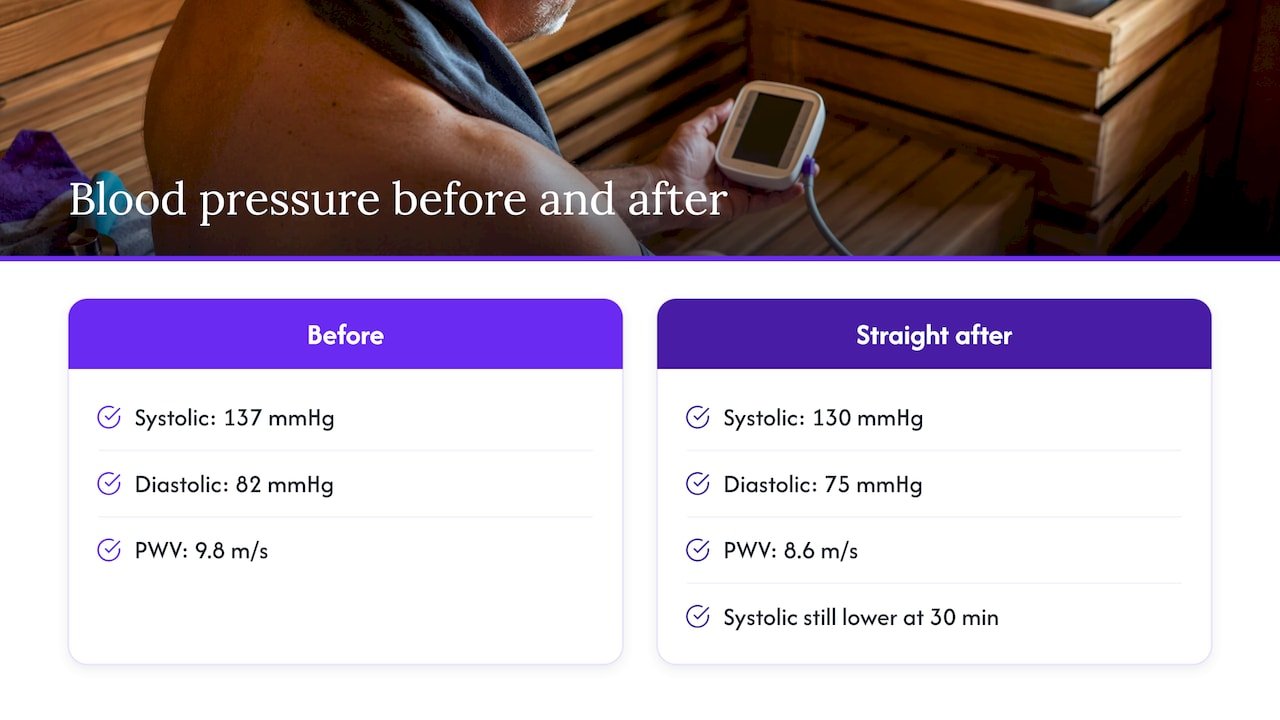
A sauna session usually lowers blood pressure for a short time afterwards, and regular use is linked with a lower risk of developing hypertension later. In one study of 102 people with at least one cardiovascular risk factor, a 30-minute session at 73°C brought systolic pressure down from 137 to 130 mmHg. The detail matters, though: how hot, how long, how often, and what your own readings and medication look like all change the picture. This guide walks through what happens in your body, what long-term studies suggest, and how to use heat sensibly if your blood pressure is high.
TL;DR
- A single sauna session typically lowers blood pressure for a while afterwards, as the blood vessels widen and the heart works a little harder, much like light exercise.
- Large, long-running Finnish research links frequent sauna bathing (4 to 7 times a week) with a lower risk of developing hypertension. It is observational, so it shows an association rather than proof.
- Aim for about 10 to 20 minutes at around 80°C, drink water, skip alcohol and leave slowly. Start at 5 to 10 minutes if you are new to it.
- Talk to your GP or cardiologist first if your pressure is poorly controlled, you have unstable chest pain, or you take blood pressure medication. If you are having cancer treatment, ask your oncologist.
Table of Contents
- What happens to your blood pressure in the sauna
- Regular sauna use and long-term blood pressure
- Key studies at a glance
- Is a sauna safe if you have high blood pressure?
- How to use a sauna sensibly with high blood pressure
- Why this matters for women over 40
- Our perspective
- Book a sauna session in Boyle
- FAQ
- Sources
What happens to your blood pressure in the sauna
Heat makes the blood vessels in your skin widen so your body can lose warmth. Your heart rate rises to keep blood moving, and resistance in the vessels falls. Dr Wen-Chih Hank Wu at Brown University Health describes the response as similar to exercise: a rise in heart rate followed by a drop in blood pressure.
The numbers from the 102-person study above are a useful reference point. Alongside the fall from 137 to 130 mmHg systolic, diastolic pressure went from 82 to 75 mmHg, and systolic pressure was still lower after 30 minutes of recovery. The same study found arterial stiffness, measured as pulse wave velocity, dropped from 9.8 to 8.6 m/s straight after the session. That is a sign the arteries were more relaxed.
It is not a perfectly uniform picture. In a 2025 study of 28 healthy women with normal blood pressure, systolic pressure was higher during the first heating session while diastolic pressure fell by nearly 8 mmHg, and heart rate rose in every session. So during the heat itself, expect your pulse to climb. The relaxed, lower readings are what you tend to see once you have cooled down.
A 2026 narrative review of 21 studies covering saunas, hot spring bathing and hot water immersion reported systolic reductions of roughly 11 to 27 mmHg within 24 hours. The authors point out that most studies had no control group and results varied widely, so treat that range as a sign of direction rather than a promise.
What about sweating?
Sweating is the visible part of the process, but the blood pressure change comes mainly from the widening of your vessels and the shift in circulation, not from the water you lose. This is why drinking enough matters: you want the vessel effect without becoming dehydrated or light-headed. If you sweat heavily, our guide to electrolytes for sauna sessions explains how to replace sodium sensibly.
Regular sauna use and long-term blood pressure
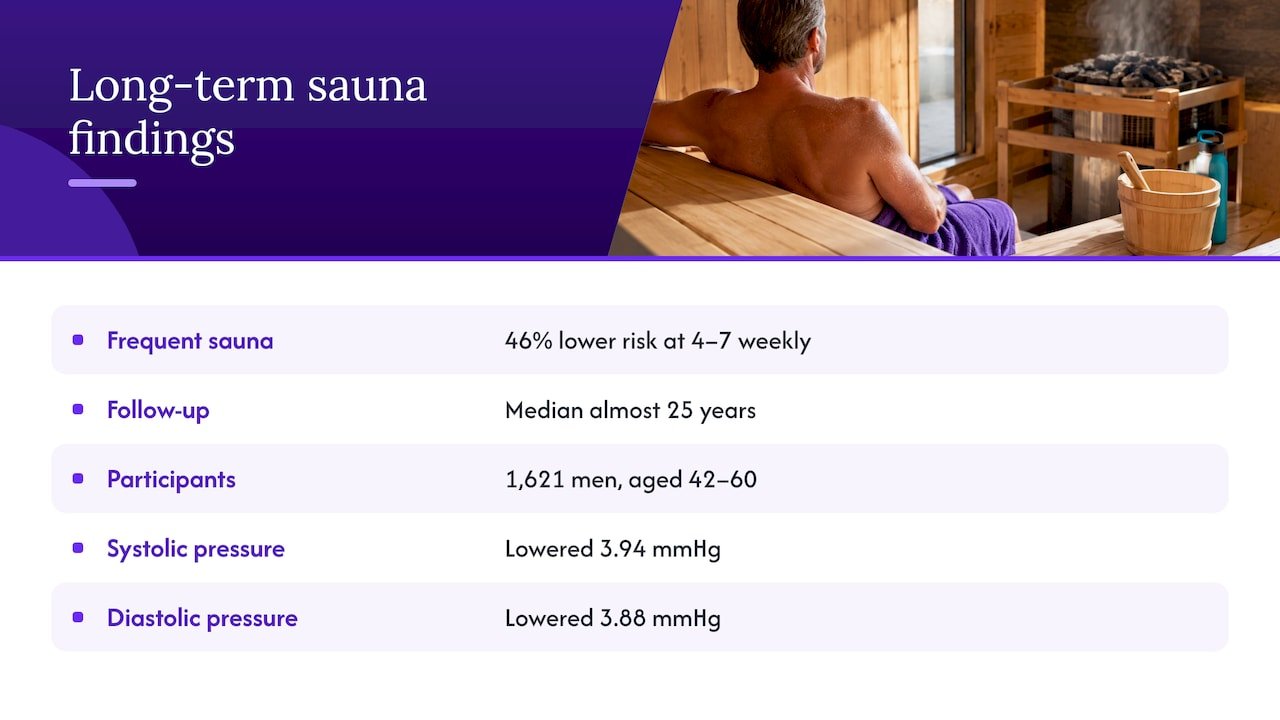
The best-known long-term evidence comes from Finland. A prospective study followed 1,621 men aged 42 to 60 who did not have hypertension at the start. Over a median of almost 25 years, men who used a sauna 4 to 7 times a week had a 46% lower risk of developing hypertension than those who went once a week (hazard ratio 0.54, 95% CI 0.32 to 0.91).
For people who want to understand how traditions of heat bathing differ across cultures, how banya heat differs from sauna is a good companion read. The Finnish findings, however, apply specifically to Finnish-style dry saunas. The study authors note the results cannot be applied directly to steam rooms, hot tubs or other types that may run cooler.
A broader look comes from a 2021 meta-analysis of 15 trials of heat therapy (30 to 90 minutes over 10 to 36 sessions). Compared with control conditions, heat therapy lowered systolic pressure by 3.94 mmHg and diastolic by 3.88 mmHg, with moderate certainty of evidence. The authors conclude heat therapy is an effective tool for reducing blood pressure, and say future work should refine the best mode and dose.
A review by Kunutsor and Laukkanen adds that regular sauna bathing is linked with a lower incidence of conditions including hypertension and cardiovascular disease, with blood pressure lowering, less inflammation and stress reduction among the likely reasons.
Pairing heat with exercise
In a small 2012 study of 16 people with untreated hypertension, exercise followed by a 15-minute sauna significantly reduced daytime and 24-hour systolic pressure, while sauna alone did not change the long-term measures. The same trial reported no adverse effects during sauna sessions in these untreated patients, and vascular resistance stayed lower 15 and 120 minutes afterwards. If you train, finishing with heat is a natural combination. Our page on sauna after a workout sets out a recovery routine.
Reading the research honestly
Harvard Health’s Dr Hutter notes that the benefits seen in frequent users may come from better blood vessel function, healthier cholesterol and less inflammation, and that relaxation and a lifestyle that leaves room for frequent saunas may also play a part. In other words, sauna is best seen as one good habit within a healthy routine, not a replacement for medication or medical advice. The 2026 review adds that the long-term effect of heat therapy as a treatment for hypertension is not yet established.
Key studies at a glance
| Study | Who | What it found |
|---|---|---|
| Acute effects of sauna bathing, 2017 | 102 adults with a cardiovascular risk factor | 30 minutes at 73°C: systolic 137 to 130 mmHg, diastolic 82 to 75 mmHg |
| Sauna and incident hypertension, 2017 | 1,621 Finnish men, 24.7-year follow-up | 4 to 7 sessions a week: 46% lower risk than once a week |
| Heat therapy meta-analysis, 2021 | 15 trials | Systolic down 3.94 mmHg, diastolic down 3.88 mmHg |
| Sauna and post-exercise sauna, 2012 | 16 adults with untreated hypertension | Exercise plus sauna lowered 24-hour systolic pressure |
| Extreme thermal stress, 2024 | Occasional sauna users | 20 minutes at 80°C lowered systolic and diastolic pressure |
Is a sauna safe if you have high blood pressure?
For many people with controlled hypertension, yes, with sensible precautions. A review of the evidence on dry sauna bathing found that adverse effects were mild to moderate, such as light-headedness, and none were severe in the studies included. In the 2021 meta-analysis, 20 adverse events were recorded across 1,390 sessions and none was life-threatening.
The cautions are specific, and they are worth taking seriously:
- Poorly controlled high blood pressure or unstable angina. Harvard Health advises people with unstable chest pain or poorly controlled high blood pressure to avoid saunas and hot baths, while people with stable heart disease can generally use them.
- Very high readings. Healthgrades advises against sauna use when systolic pressure is above 180 or diastolic above 110. If your home readings are that high, speak to your GP before anything else.
- Other heart conditions. Brown University Health lists a recent heart attack (within two weeks), decompensated heart failure and severe aortic stenosis as situations where sauna may not be safe. Ask your cardiologist.
- Low blood pressure or dizziness on standing. The Finnish researchers say people with known orthostatic hypotension should take care, because blood pressure can drop quickly just after a warm sauna. Harvard suggests people in their 70s or older with systolic pressure around 110 mmHg or lower are extra careful.
- Medication. The safety of heat therapy in older, frail adults and people taking blood pressure drugs is still not well defined. Ask your GP or pharmacist whether heat is suitable with your tablets.
- Cancer treatment. If you are on chemotherapy, read why to ask your oncologist first and get their go-ahead before booking.
For a deeper look at the heart side, see our research-led sauna protocols for heart health.
How to use a sauna sensibly with high blood pressure
The advice from the medical sources lines up well. Use this as a practical routine, and adjust it with your doctor.
- Check your reading first. If you measure at home and it is well above your usual, or you feel unwell, leave the sauna for another day.
- Keep the heat moderate. Harvard describes a typical Finnish sauna as around 175°F (80°C). A 2024 study found 80°C was suitable for occasional users, while 120°C was excessive and could lead to fainting. For people with heart disease, Brown University Health suggests not exceeding 212°F (100°C) or 20% humidity.
- Start short. UCLA Health suggests newcomers begin with 5 to 10 minutes and build up, with a limit of 20 minutes. Healthgrades suggests 10 to 15 minutes if you have high blood pressure.
- Hydrate. Drink water before, during and after. UCLA Health also advises avoiding alcohol before or during sauna use.
- Leave and cool down slowly. Sit for a few minutes before standing, and cool gradually. Brown University Health recommends cooling off without ice-water immersion if you have heart disease, so keep any cold plunge for when your doctor confirms it suits you.
- Stop at once if you feel dizzy, breathless or have chest discomfort. Get out, sit down, and seek medical help if symptoms do not settle.
For how often, the Finnish data looked at 4 to 7 sessions a week, but you do not need to begin there. Two or three calm sessions a week is a gentle place to start, and you can build from it if you feel well and your doctor is happy.
Why this matters for women over 40
Blood pressure tends to creep up as we get older, and many women notice changes around menopause, including hot flushes and disrupted sleep. Heat bathing can feel soothing during that stage, and a regular, relaxing routine is good for stress. If that is your situation, our page on sauna for menopause symptoms looks at what is known. Sleep is another connection: sauna before bed explains timing.
Our perspective
We see sauna as one of the most approachable ways to bring more calm and circulation into a week. When clients tell us they have high blood pressure, our first answer is not “yes” or “no”. It is: tell us your readings, tell us your medication, and speak to your doctor if anything is unsettled.
What the research gives us is encouraging. Short sessions at moderate heat, taken regularly, are linked with lower pressure afterwards and with lower hypertension risk over decades. That fits our holistic approach, where heat, movement, good water and rest work together rather than in isolation.
That is why our spa area brings the sauna, steam room and cold plunge under one roof, alongside a gym and energised water throughout the facility. You can take your time, build up gently, and cool down at your own pace. Your best self awaits, one calm session at a time.
Mark
Book a sauna session in Boyle
If you would like to try heat in a calm, welcoming setting, our Sauna, Steam & Cold Plunge Spa session at Live5dhealth in Boyle, County Roscommon is €30. You can build up from short visits, take water with you and move between the sauna and steam room at your own pace.

See the details and book on our sauna, steam and cold plunge spa page. If you would like to bring friends or family, we also take group bookings.
FAQ
Are saunas good for you if you have high blood pressure?
For many people with controlled high blood pressure, sauna use is considered generally safe with precautions, such as short sessions, plenty of water and no alcohol. Poorly controlled hypertension, unstable chest pain and some heart conditions are reasons to avoid it until your doctor says otherwise. Check with your GP or cardiologist first.
Does a sauna lower blood pressure straight away?
In research, blood pressure usually falls after a session. One study of 102 adults saw systolic pressure drop by 7 mmHg and diastolic by 7 mmHg after 30 minutes at 73°C. During the heat your heart rate rises, so the lower readings show up as you cool down.
Does drinking water lower blood pressure?
Drinking water keeps you hydrated, which helps you tolerate the heat and reduces the chance of dizziness. UCLA Health advises drinking plenty before, during and after a sauna. It is a safety habit rather than a treatment for hypertension, so keep taking any prescribed medication.
How long should I stay in the sauna?
Beginners can start with 5 to 10 minutes. Most medical sources suggest keeping sessions to 15 to 20 minutes at most, and Healthgrades suggests 10 to 15 minutes for people with high blood pressure. Shorten the session if your pressure runs low or you feel light-headed.
Can I use a sauna if I take blood pressure tablets?
Often yes, but it depends on the medicine and your condition. Heat widens the blood vessels, and researchers say safety in frail older adults and in people on certain medicines is not fully defined. Ask your GP or pharmacist, and tell us when you book.
Sources
- Acute effects of sauna bathing on cardiovascular function (2017)
- Acute Finnish sauna heating and cold water immersion (2025)
- Acute blood pressure responses and safety considerations in heat therapy (2026)
- Sauna Bathing and Incident Hypertension: A Prospective Study (2017)
- The effect of heat therapy on blood pressure and peripheral vascular function (2021)
- Does the Combination of Finnish Sauna Bathing and Other Lifestyle Factors (2023)
- Effects of Sauna Alone and Postexercise Sauna Baths (2012)
- Hot baths and saunas: Beneficial for your heart? (Harvard Health, 2020)
- Clinical Effects of Regular Dry Sauna Bathing: A Systematic Review (2018)
- Saunas and Your Heart (Brown University Health, 2023)
- High Blood Pressure Risks With Hot Tubs and Saunas (Healthgrades)
- Benefits of sauna bathing for heart health (UCLA Health, 2023)
- The influence of extreme thermal stress on blood pressure (Frontiers in Public Health, 2024)
- Banya vs Sauna: Heat, Ritual and What to Expect