

A sauna supports your body’s own detoxification by making you sweat, relaxing you and helping you build a regular, restful routine. The heavy lifting is done by your liver and kidneys, around the clock. Used well, a sauna is a lovely partner to that work. Used carelessly, or during cancer treatment, it can do harm. This guide explains what sweating really does, how to get the most from a session, and who should speak to their doctor first. At Live5DHealth in Boyle, a sauna, steam room and cold plunge spa session costs €30.
TL;DR
- Your liver, kidneys and gut do your detoxification every day. A sauna adds sweating, heat relaxation and a calming routine around that work.
- Research has found that sweat can carry trace amounts of metals such as arsenic, cadmium, lead and mercury, especially in people with higher exposure.
- Keep sessions short, drink water, avoid alcohol and cool down gradually rather than jumping straight into cold water.
- If you are having chemotherapy, immunotherapy or radiotherapy, saunas are not advised. Speak to your oncology team before any heat treatment.
- Women over 40 with blood pressure, heart or hormonal concerns should check with their GP before starting.
Table of Contents
- What “detox” really means in the body
- What sweat can carry
- Wider benefits that make a sauna worth the habit
- Are the signs of “toxins leaving” reliable?
- How to use a sauna well
- Sauna types: which one suits you?
- Safety first: who should check before using a sauna
- How often should you go?
- Making a sauna part of a wider reset
- Book a sauna session in Boyle
- FAQ
- Sources
What “detox” really means in the body
Detoxification is not something you switch on. It happens continuously. Your liver cells break down alcohol and other chemicals in stages, and the waste leaves mainly through urine and stool, as a liver specialist at the NIHR Birmingham Biomedical Research Centre explains. That is why the most useful “detox” habits are the ones that look after those organs: enough water, good sleep, nourishing food, movement and less alcohol.
Where does a sauna fit? Skin is your largest organ, and sweating is one of the body’s natural ways of releasing heat and a small amount of what the body is carrying. A sauna gives you a calm, structured way to sweat, rest and switch off. For many women over 40, that mix of warmth, stillness and time for yourself is the real attraction, and it is a worthwhile one.
What sweat can carry
Sweat is more than water and salt. A 2012 systematic review of 24 studies found that in people with higher exposure or body burden, sweat concentrations of arsenic, cadmium, lead and mercury generally exceeded the levels found in blood plasma or urine. The authors concluded that sweating deserves consideration as a route for releasing these metals, and they called for appropriately sized trials to establish safe, effective protocols.
A review published in Mayo Clinic Proceedings also discusses toxicology findings that organochlorine pesticides and metals such as cadmium, lead and aluminium can be excreted in sweat. The same paper reports a Finnish population study in which men who used a sauna four to seven times a week had a 66% lower rate of dementia than men who used one once a week. That is an association between habits and outcomes, not proof of cause, but it shows why regular heat bathing has attracted so much scientific interest.
In plain terms: sweating is a real, working part of how your body releases substances, and a sauna is a comfortable way to do it regularly.
Wider benefits that make a sauna worth the habit
A 2018 systematic review of 40 clinical studies covering 3,855 participants found that most reported beneficial health effects from regular dry sauna bathing. Many of the studies were small, so the research is still growing, but the direction is encouraging. Mayo Clinic notes that studies have found some proof that infrared saunas may help with high blood pressure, heart failure, headache, type 2 diabetes and arthritis, and that no harmful effects have been reported with infrared saunas (page updated September 2024).
People who come for a sauna often tell us about the same things they value:
- Relaxation. Warmth encourages muscles to let go and the mind to slow down.
- A rhythm of rest. A regular slot in your week to be still, away from screens.
- Skin that feels fresh. Sweating followed by a rinse leaves skin feeling clean. Our guide to sauna for skin covers routines and the infrared versus traditional question.
- Recovery after exercise. See our sauna after a workout guide.
- Heart and circulation support. Read more in research-led sauna protocols for heart health.
Are the signs of “toxins leaving” reliable?
Many people feel light, tired or a bit flushed after a session and wonder if that means toxins are leaving. Those feelings are mostly the effect of heat, fluid loss and relaxation. Rush University Medical Center advises that tiredness or weight changes are best checked against everyday causes such as sleep, diet and exercise, and that anything that persists should be seen by a doctor.
So use your body’s signals sensibly:
- Feeling calm, warm and relaxed is a good sign the session suited you.
- Dizziness, a pounding heart, nausea or a headache mean you should leave the heat, sit down and sip water.
- Ongoing fatigue is worth a conversation with your GP rather than an assumption that it is part of a cleanse.
The same applies to weight. A sauna session makes you lose water, which returns when you drink. Our sauna and weight loss article goes into what the evidence says.
How to use a sauna well
A good routine is simple. These steps suit a healthy adult. If you have any medical condition, read the safety section below first.
- Hydrate before you go. Have a glass or two of water an hour or so beforehand. Arriving thirsty makes everything harder.
- Keep the first sessions short. The Canadian National Collaborating Centre for Environmental Health rapid review (January 2026) suggests dry saunas at 80 to 85°C, and stays of 10 to 15 minutes for healthy people. It suggests infrared saunas at 60°C and steam at 50 to 60°C.
- Shorten the stay if you are in a higher-risk group. The same review suggests 5 to 10 minutes for people with cardiovascular disease, hypertension, seizure disorders, diabetes, significant obesity, those over 65, and anyone who has had alcohol or drowsiness-causing medication.
- Leave the moment you feel unwell. Light-headedness is a signal, not something to push through.
- Cool down gradually. Sit, breathe and let your body temperature settle before any cold exposure.
- Rehydrate afterwards. Water first. If you sweat heavily or sauna often, replacing minerals can help, and our electrolytes for sauna guide sets out a 30 to 60 minute protocol, with a sugar-free option too.
- Never combine with alcohol. More on that below.
Sauna types: which one suits you?
| Type | Typical heat | What it feels like |
|---|---|---|
| Traditional (Finnish) dry sauna | 80 to 100°C, 10 to 20% humidity (Laukkanen & Kunutsor, 2024) | Intense, enveloping heat, short sessions |
| Steam room | 50 to 60°C suggested by the NCCEH review | Humid, soft warmth, often easier on the lungs and throat |
| Infrared | Around 60°C suggested by the same review | Gentler air temperature, heat felt deeper in the body |
If you are new to heat, a steam room or a lower-temperature session is a comfortable place to begin. Many people then add the dry sauna as they get used to it.
Safety first: who should check before using a sauna
A sauna is a pleasure when it is used with care. These points matter most for the women reading this.
If you have cancer or are in treatment
The Scottish Access to Complementary Therapies for Cancer guidance (SATCC, 2025) says that people undergoing chemotherapy, immunotherapy or radiotherapy should avoid thermal facilities including saunas, because they generally exceed 42°C and cannot be individually controlled. It also advises avoiding direct heat on recently radiated skin, over implanted devices, and on limbs at risk of lymphoedema for three years after lymph-node removal or lymph-targeted radiation.
So please speak to your oncologist or oncology nurse before booking any heat session. Our page on sauna safety during chemotherapy explains what to ask. If heat is not right for you at this stage, gentle supportive care such as oncology massage is a gentler way to look after yourself, and your team can advise on timing.
If you have blood pressure or heart concerns
A 2024 review by Laukkanen and Kunutsor states that people with stable cardiovascular conditions can generally use saunas safely, while those with a recent heart attack, severe aortic stenosis, uncontrolled hypertension or severe valvular disease should be cautious or avoid them. If you take blood pressure medication or have a heart condition, ask your GP or cardiologist first. Our guide on sauna and blood pressure sets out safe use in more detail.
Alcohol, cold water and going alone
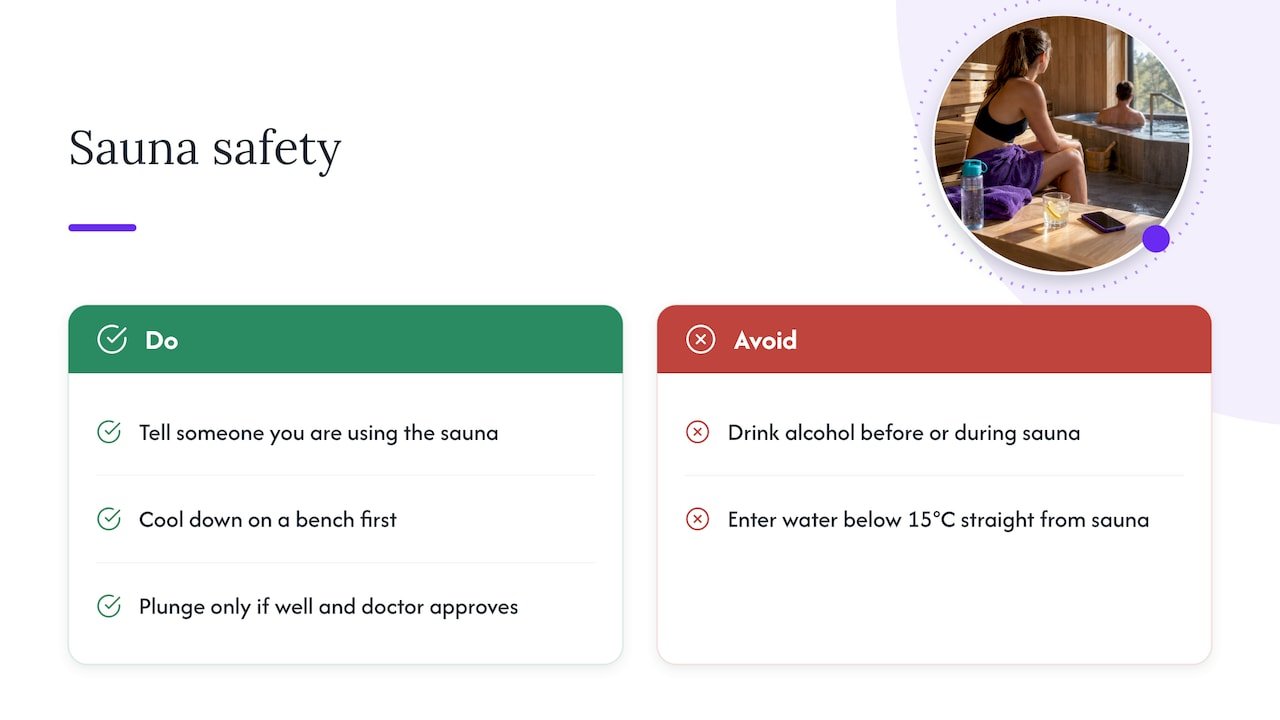
The 2024 review also notes that sauna-related sudden deaths have been largely linked to alcohol, which magnifies the risk of low blood pressure, heart complications and accidents. The NCCEH review adds that at least half of sauna deaths in Swedish and Finnish studies involved alcohol and bathing alone. So: no alcohol before or during, and let someone know you are there.
Hot-to-cold swings deserve respect too. Water Safety Ireland’s sauna and cold-water leaflet (March 2025) warns that entering water below 15°C straight from a sauna can cause cold-water shock, with gasping, rapid breathing, pale or bluish skin, disorientation and loss of coordination. It also advises seeing a doctor before using a sauna. Cool down on a bench first, and only then, if you are well and your doctor is happy, go into a cold plunge.
Heat sensitivity and other conditions
The NCCEH review notes that people with chronic fatigue syndrome, chronic pain, rheumatoid arthritis and ankylosing spondylitis tend to report greater heat intolerance. If this is you, begin with a very short session at a lower temperature, and stop at the first sign of discomfort. The review also lists pregnancy in the first trimester among the situations calling for shorter stays, so speak to your midwife or GP.
How often should you go?
There is no single perfect number. The Finnish research mentioned above looked at people who used a sauna several times a week, but that is a long-term habit built gradually, not a target for week one. A sensible start is one session a week at a comfortable temperature, lengthening or adding sessions as your body adapts and your doctor agrees. Quality beats quantity: a calm, hydrated 15 minutes is better than a long session that leaves you drained.
Making a sauna part of a wider reset
The women who get the most from sauna time tend to treat it as one piece of a routine, not a miracle. Consider pairing it with:
- Plenty of water and mineral-rich food throughout the week
- Regular movement you enjoy, from walking to strength training
- Good sleep, protected as a priority
- Less alcohol, which also takes pressure off your liver
- Time outdoors and time to rest
This is exactly the approach that a day or a stay at a wellness centre can support, because everything is in one place and you are not rushing between appointments.
Our view on sauna and detox
We see the sauna as a gift to your body’s own systems, not a replacement for them. Your liver and kidneys work all day and night, and heat, sweat and stillness give you a lovely way to support that work while you relax and recharge.
That is why our sauna, steam room and cold plunge spa sit alongside everything else at Live5DHealth in Boyle: a holistic approach that blends modern technology with ancient wisdom. Many of our guests want more than one tool for feeling their best, and we have built the centre around that, with clean, energised water throughout the facility and Ireland’s first hydrogen bar.
Start gently, listen to your body and make it a regular, enjoyable ritual. Your best self awaits.
Mark
Book a sauna session in Boyle
Our sauna, steam and cold plunge spa is open to members and drop-in guests at Live5DHealth in Boyle, County Roscommon. A session is €30, and it gives you the three classic heat and cool experiences in one visit. Friends who want to come together can look at our group bookings, and for a longer reset we run 3, 5 and 10-day total wellness retreats.
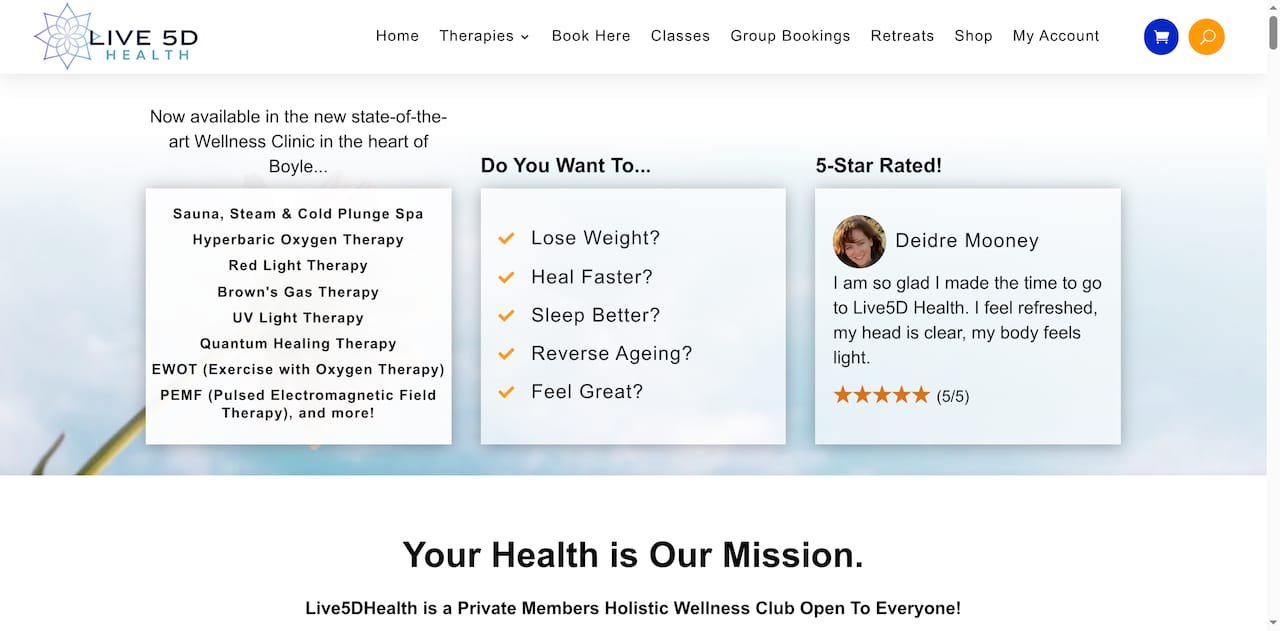
If you are exploring other therapies, our centre also offers hyperbaric oxygen therapy from €80 to €120 per session, and red light therapy from €20 to €40. Browse everything on our main site.
FAQ
How does a sauna detox the body?
A sauna raises your body temperature so you sweat, and sweat can carry small amounts of substances such as metals, as a systematic review of sweat studies found in people with higher exposure. Your liver, kidneys and gut continue to do the main detoxification work. Think of the sauna as a supportive, relaxing extra, best paired with water, good food and sleep.
Can I use a sauna with high blood pressure?
People with stable cardiovascular conditions can often use saunas safely, but those with uncontrolled hypertension should be cautious or avoid them, according to the 2024 Laukkanen and Kunutsor review. Ask your GP first, keep sessions to 5 to 10 minutes and stand up slowly afterwards. Our sauna and blood pressure guide has more detail.
Is it safe to use a sauna during cancer treatment?
Guidance from SATCC says people having chemotherapy, immunotherapy or radiotherapy should avoid saunas, and should avoid direct heat on recently radiated skin and at-risk limbs. Please ask your oncologist or oncology nurse before any heat treatment, and see our page on sauna safety during chemotherapy for questions to bring.
How long should I stay in a sauna?
For healthy adults, 10 to 15 minutes is the stay suggested by the NCCEH rapid review. It suggests 5 to 10 minutes if you have heart disease, high blood pressure, diabetes or are over 65. Leave straight away if you feel dizzy or unwell, and drink water afterwards.
Sources
- The truth about detoxes, by a liver specialist (NIHR Birmingham BRC, January 2026)
- Arsenic, Cadmium, Lead, and Mercury in Sweat: A Systematic Review (2012)
- Sauna Bathing and Healthy Sweating, Mayo Clinic Proceedings (2019)
- Clinical Effects of Regular Dry Sauna Bathing: A Systematic Review (2018)
- Do infrared saunas have any health benefits? Mayo Clinic (2024)
- The Truth About Toxins, Rush University Medical Center
- Rapid review: Environmental health risks and safety considerations of saunas (NCCEH, January 2026)
- The multifaceted benefits of passive heat therapies (Laukkanen and Kunutsor, 2024)
- Updated guidance on the use of heat in treatments for cancer patients (SATCC, 2025)
- Guidelines for Sauna Operators and Users (Water Safety Ireland, March 2025)