

A digital detox retreat gives you a few days away from the constant pull of phones, email and social media, in a place built for rest. The research points to better mood, sharper attention, deeper sleep and more present relationships, and a retreat setting helps because the break is protected, with other things to do in its place. At Live5dhealth in Boyle, County Roscommon, our 3, 5 and 10-day Total Wellness Retreats give you that space alongside spa, sauna, cold plunge and holistic therapies.
TL;DR
- A digital detox means deliberately stepping back from screens, especially phones and social media. A retreat does it somewhere calm, with a structure that fills the gap.
- Studies link time away from devices to fewer depressive symptoms, better sustained attention, improved sleep and greater life satisfaction.
- Longer breaks tend to bring bigger improvements in low mood, so a 3, 5 or 10-day stay gives you more than a weekend of good intentions.
- If you are over 40 or living with or recovering from cancer, a detox is gentle by nature, but talk to your GP or oncology team before adding any therapies to your stay.
- The benefits last when you leave with a few small routines: a phone-free bedroom, device-free meals and time outdoors.
Table of Contents
- What a digital detox retreat actually is
- The benefits, and what the evidence behind each one says
- How long should a digital detox retreat last?
- What you do instead of scrolling
- How to prepare so you can really switch off
- If you are over 40 or affected by cancer
- Making the benefits last after you go home
- Your retreat at Live5dhealth
- Our view: protect the pause
- FAQ
- Sources
What a digital detox retreat actually is
A digital detox is a planned period in which you cut back on or stop using digital devices, usually smartphones and social media. Plenty of people try it at home and find it hard, because work messages, family group chats and the habit of checking are all still within reach.
A retreat changes the conditions. You stay somewhere away from your usual routine, the days have a shape, and there are real things to do instead of scrolling: walking, resting, eating well, being treated, moving your body, talking to people face to face. That substitution matters. One of the clearest findings in the research below is that people who stepped away from their phones did better partly because they spent that time socialising, exercising and being outdoors.
You do not need to be “addicted” to your phone to benefit. A retreat suits anyone who feels permanently switched on: managing a household, a career, caring for others, or getting through a demanding stretch of health treatment and wanting a quieter mind.
The benefits, and what the evidence behind each one says
Research on digital detox is still growing, and most studies look at social media or smartphone breaks of days to weeks. Here is what the better-quality studies have found.
Lower depressive symptoms and a lighter mood
A 2024 systematic review and meta-analysis of 10 studies found that a digital detox significantly reduced depressive symptoms. A wider 2025 scoping review reports that time away from devices can reduce procrastination, boredom, stress, depression and anxiety, and can strengthen self-regulation, sleep quality and life satisfaction. The same review notes that people who voluntarily step back from their phones may feel some craving at first, but the research links this to improved rather than worse mood.
If you carry a lot of worry, this is the benefit most women in midlife and beyond tell us they are looking for: a quieter head.
Sharper attention
In a randomised controlled trial published in February 2025, researchers blocked mobile internet on participants’ smartphones for two weeks. People improved in mental health, subjective well-being and objectively measured sustained attention, and 91% improved on at least one outcome. The gains were partly explained by more time socialising in person, exercising and being in nature.
That is useful for planning your own stay: the detox itself is half the story, and what you do with the freed-up hours is the other half.
Better sleep
Screens in the evening are a common reason people struggle to wind down. A 2025 review of screen effects on eye and nervous system health notes that avoiding screens for 30 minutes before bedtime was linked to shorter time to fall asleep, longer and higher-quality sleep, and better mood and working memory in adults. The scoping review mentioned above suggests limiting evening use and keeping devices out of the bedroom.
A retreat makes this easy because the evening is already full of calmer options: a steam, a soak, a massage, a quiet room. If sleep is your main goal, our guides on sound therapy protocols for better sleep and red light in the evening explain what to try.
More present relationships
The scoping review also describes “phubbing”, ignoring the person in front of you for your phone. It links partner phubbing with lower relationship satisfaction, more stress and poorer sleep. Suggested remedies are simple: device-free mealtimes, limited evening use and no devices in the bedroom. If you come on retreat with a friend, sister or partner, you get days of undivided attention, which is rarer than it sounds.
A real boost to life satisfaction in a retreat setting
Two recent studies looked specifically at retreats and trips rather than simple phone limits. A 2025 experiment with 60 students found that a five-day digital detox retreat with mindfulness, outdoor activities and reflective sessions improved psychological well-being, meaning lower stress and higher life satisfaction. Participants also reported better control over their digital use afterwards.
A 2026 study of digital detox tourism found that time away from devices increased how restorative people found their surroundings, and that this in turn improved attention, life satisfaction and positive emotion, through a more mindful state of mind. In plain words: a peaceful place helps most when it teaches you to notice the moment you are in.

Body markers can move too
A December 2025 study in BMC Medical Education found that a structured two-week digital detox with alternative activities was associated with better psychological well-being and improvements in markers such as cortisol (a stress hormone), blood pressure and heart rate variability in medical students. The study was short and had no follow-up, so it points to a direction rather than a promise, but it fits the picture of a calmer nervous system.
How long should a digital detox retreat last?
A 2025 meta-analysis of 20 randomised trials found that social media detox had a small positive effect on well-being overall, and that longer detox periods were linked to bigger improvements in negative indicators such as low mood. The authors suggest this is because the first days can bring cravings and restlessness, which then settle, so the longer you stay away, the more benefit you see.
That is why length matters. In practical terms:
| Stay | What it suits |
|---|---|
| 3 days | A first reset, getting past the initial restlessness and sleeping well |
| 5 days | Time for the restlessness to settle and for new routines to start feeling natural |
| 10 days | A deeper break from the pattern, with room for therapies, movement and rest in balance |
The research does not set a single “right” number of days, and the studies above ran from five days to two weeks. Choose the length that fits your life and your energy. Our guide to choosing a wellness retreat in Ireland walks through the questions to ask yourself, and Irish wellness retreat costs shows how the options compare.
What you do instead of scrolling
The people who gain most are those who replace screen time with something they enjoy. On retreat, a day might include:
- A morning walk or time outdoors. Light in the first hour or so after waking helps set your body clock, as we explain in our piece on morning light exposure.
- Movement, whether gentle or energetic, in the gym or outdoors.
- Heat and cold: sauna, steam room and cold plunge. At Live5dhealth the Sauna, Steam and Cold Plunge Spa is €30 as a one-off visit.
- Hands-on rest, such as holistic massage.
- Slow meals with other people, phones away.
- A journal, a book, or simply a long conversation.
If you also want to think about how you eat while you reset, remote registered dietitian support is one way people get guidance on food routines without travelling.
How to prepare so you can really switch off
Most of the stress of disconnecting comes from the days before. A few steps make the break calmer:
- Tell people. Let family, friends and work know the dates you will be offline and give one trusted person the retreat’s contact number for real emergencies.
- Set an out-of-office message. It removes the nagging feeling that something is waiting.
- Sort the practical things first. Boarding passes, bills, appointments and directions can be saved or printed before you go.
- Reduce gradually. In the week beforehand, switch off notifications and keep your phone out of the bedroom. You will arrive already calmer.
- Plan your replacements. Bring a book, a notebook, walking shoes and something to listen to offline. Our wellness retreat packing list covers what to bring and what to leave at home.
- Expect a wobble. Restlessness or the urge to check in the first day or two is normal and, according to the research, tends to fade.
If you are over 40 or affected by cancer
Many of the women who look for a retreat are in a busy life stage, often looking after others, and some are living with or recovering from cancer. A digital detox is gentle: it asks you to do less, not more. It is not a medical treatment, and no retreat should be presented as a cure for any illness.
A few considerations:
- Talk to your team first. If you are in treatment or recovering from cancer, tell your GP or oncology team about your plans for the retreat, including any therapies, heat, cold or exercise you are considering. They know your treatment schedule and any precautions that apply to you.
- Keep the line open for medical matters. Going offline does not mean being unreachable by your hospital. Agree with your team and your family how you will be contacted if a result or appointment changes, and give the retreat a contact number for that purpose.
- Pace yourself. Rest is part of the plan. You are not obliged to fill every hour with an activity.
- Use the quiet for support, not isolation. The research on in-person socialising suggests that time with other people is part of why detoxes help. Bringing a friend or booking as a group can make a stay feel safe and warm.
If you are interested in therapies such as hyperbaric oxygen, which we offer from €80 to €120 per session, ask your doctor whether it is suitable for you before you book.
Making the benefits last after you go home
The studies measure effects over days or weeks, so what you do next counts. The easiest changes to keep are the ones the research itself suggests:
- Keep the phone out of the bedroom and buy a simple alarm clock.
- Stop screens about 30 minutes before bed.
- Keep meals device-free.
- Set one or two phone-free windows each day, for example the first hour after waking.
- Keep doing what replaced the scrolling: the walk, the swim, the call with a friend.
The point is not perfection. It is to leave with a clearer sense of how you want to use your devices, rather than the habit using you.
Your retreat at Live5dhealth
Our 3, 5 and 10-Day Total Wellness Retreats take place in Boyle, County Roscommon, in a centre that combines a luxury spa, gym, sauna, steam room, cold plunge and a wide range of therapies, with clean energised water throughout the facility. You can build your days around rest, movement and treatments that suit you, and a quiet break from your phone fits naturally into that rhythm.
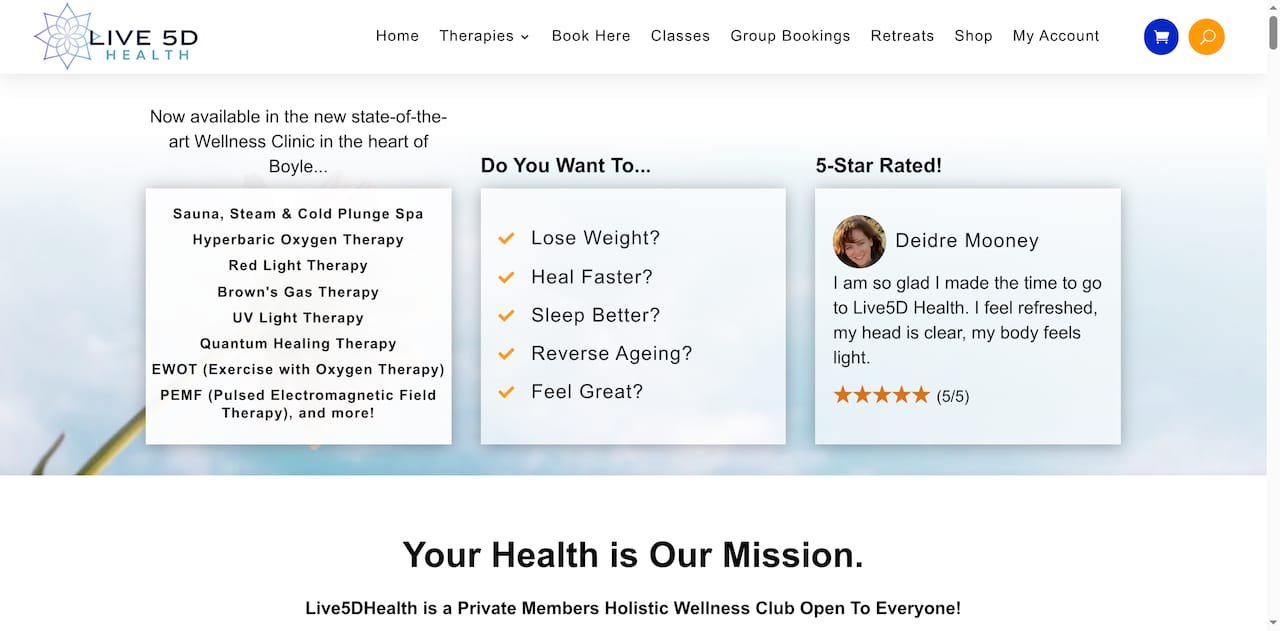
When you are ready, see the retreat options and how to book, or visit our home page to see everything the centre offers.
Our view: protect the pause
We have seen that the hardest part of any reset is not knowing what to do with the quiet. When the phone goes in a drawer, the mind often goes looking for it. That is why we think a digital detox works best inside a full, nourishing day rather than as a test of willpower.
Our centre in Boyle is built around that idea. Heat and cold in the spa, movement in the gym, holistic massage, sound and light sessions and clean energised water all give your attention somewhere better to rest. We bring together modern technology and ancient wisdom because people tell us they want both: the science and the feeling of being cared for.
If you are a woman over 40 who has spent years looking after everyone else, or you are rebuilding your strength after a hard year, you deserve time that asks nothing of you. We would be glad to give you that, at whatever length feels right.
Mark
FAQ
Is a digital detox retreat worth it?
The evidence suggests it can be. Studies link time away from devices to fewer depressive symptoms, better sleep, stronger attention and higher life satisfaction. A retreat adds structure and a calm setting, which helps you fill the gap with restorative activities.
How many days of digital detox do I need?
There is no fixed number, but research suggests longer detoxes are linked to bigger improvements in low mood. Trials have used anything from five days to two weeks. A 3-day stay is a good first reset and 5 or 10 days gives you longer to settle.
What will I feel in the first days?
Some people feel restless or keep reaching for the phone. The research on voluntary phone breaks describes craving, not worsening mood, and it usually settles. Planning offline activities and telling people you are away helps.
Can I do a digital detox retreat if I have cancer?
A digital detox itself is gentle, but your stay should fit your treatment and energy. Speak to your GP or oncology team before you go, and before trying any therapies, so they can tell you what suits your situation.
What should I do on a digital detox day?
Get outdoors in the morning, move your body, eat slowly without screens, rest and spend time with people face to face. The research shows that socialising, exercise and nature explain part of the benefit.
Sources
- Impacts of digital social media detox for mental health: a systematic review and meta-analysis (2024)
- Blocking mobile internet on smartphones improves sustained attention, mental health and well-being (2025)
- Digital Detox Strategies and Mental Health: A Comprehensive Scoping Review (2025)
- The Influence of Digital Detox Retreat on Psychological Well-Being (2025)
- Disconnecting to recover: how digital detox tourism shapes well-being (2026)
- The Impact of Digital Screens on Eye and Nervous System Health (2025)
- From screens to serenity: the effect of digital detox in medical students (BMC Medical Education)
- Am I Happier Without You? Social Media Detox and Well-Being (2025)