
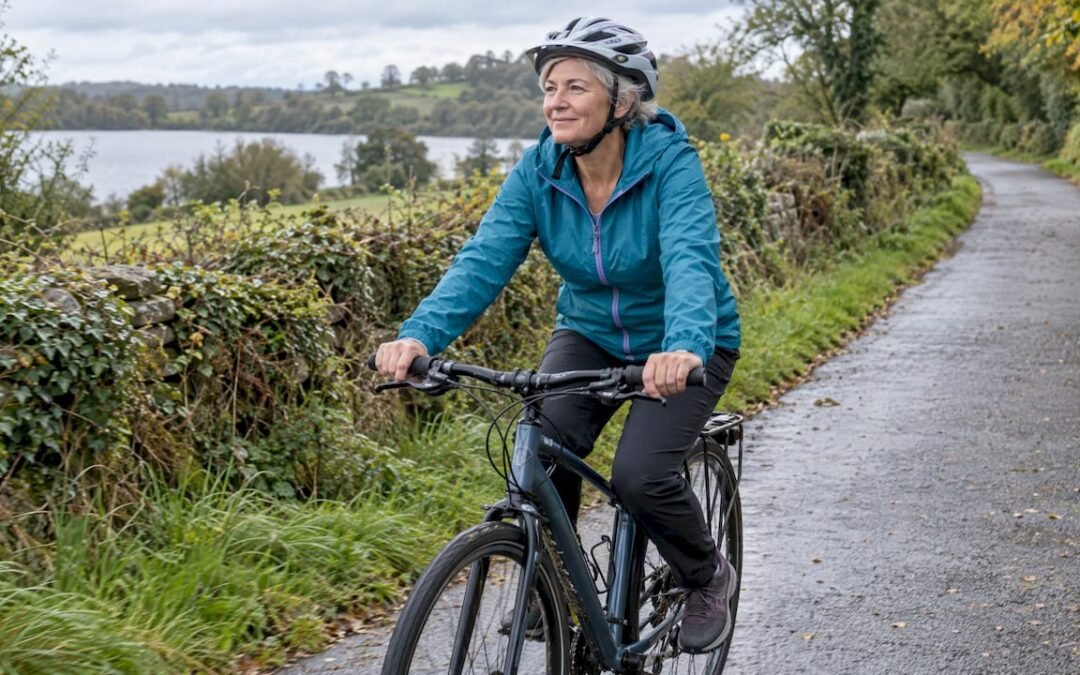
Zone 2 cardio is easy, steady aerobic exercise at roughly 60–70% of your maximum heart rate, an effort where you can still hold a light conversation. Cleveland Clinic describes it as comfortable enough to sustain for a long time. For a woman over 40, or anyone rebuilding strength after illness, that gentleness is the appeal: you build stamina and heart fitness without the exhaustion of hard sessions, and you can do it with a brisk walk, a relaxed cycle or a steady swim.
This guide explains the zone in plain words, shows how to work out your own range, gives a weekly plan, and covers how to adapt it if you are living with or recovering from cancer.
TL;DR
- Zone 2 is the second of five heart-rate zones: easy effort, about 60–70% of your maximum heart rate, and you can talk in full sentences.
- Estimate your maximum as 220 minus your age. At 40, that gives a Zone 2 range of 108–126 beats per minute.
- Ireland’s national guidelines ask adults for at least 2h30m of moderate-intensity activity a week, and Zone 2 sessions count towards it.
- If you are in or after cancer treatment, or take medication that affects heart rate, speak to your oncology or healthcare team first and start with short, light sessions.
- Use the talk test as your everyday guide. Your watch is helpful, but how you feel matters more.
Table of Contents
- What zone 2 cardio actually is
- Why people do it: the benefits
- How to find your zone 2 heart rate
- What counts as zone 2 exercise
- How much zone 2 should you do each week?
- Zone 2 cardio if you have, or have had, cancer
- Recovering well between sessions
- Our perspective
- Make it part of a wellness routine in Boyle
- FAQ
- Sources
What zone 2 cardio actually is
Heart-rate training divides effort into five zones, based on a percentage of your maximum heart rate (the highest number of beats per minute your heart can reach). Zone 1 is very light, such as a slow stroll. Zone 5 is an all-out sprint. Cleveland Clinic’s five-zone guide places Zone 2 at 60–70% of maximum, where a light conversation is possible.
In practice, Zone 2 feels like this:
- You are breathing a little harder than at rest, but never gasping.
- You could chat with a friend or recite a poem without pausing for breath.
- You finish feeling better than when you started, not wrung out.
Because the effort is low, sessions are usually longer. Cleveland Clinic notes that most Zone 2 activities last at least 30 minutes, trading intensity for time.
Why people do it: the benefits
Zone 2 is often called the fat-burning zone. Mayo Clinic Press explains that at this effort your body relies mainly on fat as fuel, and that the training supports overall cardiovascular fitness. Colorado State University’s exercise science team agrees that lower zones burn a higher percentage of their calories from fat and are used to build aerobic, or base, fitness.
Cleveland Clinic lists further benefits of regular Zone 2 work:
- A stronger heart muscle.
- Better mitochondrial function. Mitochondria are the tiny structures in your cells that turn fuel and oxygen into energy.
- More capillaries, the small blood vessels, around your muscles.
- Increased red blood cell production.
- Lower injury risk, because the effort is gentle on joints and muscles.
The wider picture matters too. Ireland’s Every Move Counts guidelines (Department of Health, March 2024) state that regular moderate-to-vigorous activity improves heart health, lowers the risk of cancer and type 2 diabetes, and improves mood and sleep. They also link long sedentary time in adults with cardiovascular disease, cancer and type 2 diabetes. Zone 2 is simply one of the most approachable ways to meet that advice.
How to find your zone 2 heart rate
The quick formula
Cleveland Clinic suggests estimating your maximum heart rate as 220 minus your age, then taking 60–70% of that number. For a 40-year-old, the maximum is 180, so Zone 2 is 108–126 beats per minute.
Using the same method, here is how the range looks at other ages:
| Age | Estimated maximum (220 minus age) | Zone 2 range (60–70%) |
|---|---|---|
| 40 | 180 bpm | 108–126 bpm |
| 45 | 175 bpm | 105–122 bpm |
| 50 | 170 bpm | 102–119 bpm |
| 55 | 165 bpm | 99–115 bpm |
| 60 | 160 bpm | 96–112 bpm |
The two lower rows are my arithmetic from the same formula, rounded to whole numbers. Treat all of them as a starting point. The American Heart Association uses a slightly wider 50–70% band for moderate activity, which gives 90–153 bpm at age 40, so different sources will show different numbers.
The talk test
A formula is an average, and you are not an average. The talk test is the simplest correction. If you can speak in full sentences, you are in Zone 2. If you can manage only a few words at a time, ease off. If you could sing, you can probably pick up the pace slightly.
When the numbers may mislead you
Some medications lower heart rate and shift target zones. The American Heart Association advises people with heart conditions, or who take medication, to ask a health professional what their heart rate should be. Cleveland Clinic adds that an exercise stress test or VO2 max test is the most accurate way to learn your true maximum.
Colorado State University also reminds us that heart-rate monitoring is a helpful guide, not a requirement, and may not suit everyone. If a watch makes you anxious, go by effort alone.
What counts as zone 2 exercise
Any steady, rhythmic activity works. Cleveland Clinic gives these examples:
- Brisk walking: about a mile in 15–20 minutes on flat ground.
- Slow running: 2–3 minutes per kilometre slower than race pace.
- Relaxed cycling: indoors or out.
- Slow, steady swimming.
- Elliptical trainer or rowing machine.
If you are new to exercise, walking is the best place to begin. On a hilly route, you may need to slow down or take a gentler path to stay in range. In an Irish winter, a treadmill or a cross-trainer in a gym makes it easy to keep the effort steady whatever the weather.
Women managing hormonal changes or monthly cycles may find energy varies from week to week. Listening to your body is part of good training, and there are practical period self-care ideas that can help you decide when to push and when to take it easier.
How much zone 2 should you do each week?
The Every Move Counts guidelines recommend that adults aged 18–64 do at least 2h30m to 5h of moderate-intensity aerobic activity a week (or 1h15m to 2h30m of vigorous activity), plus muscle-strengthening on at least two days. Adults over 65 are advised to add varied activity that works on balance and strength on three or more days, to help prevent falls. The American Heart Association’s recommendation of at least 150 minutes a week of moderate activity is in line with this, and Zone 2 falls in that category.
A realistic starting plan:
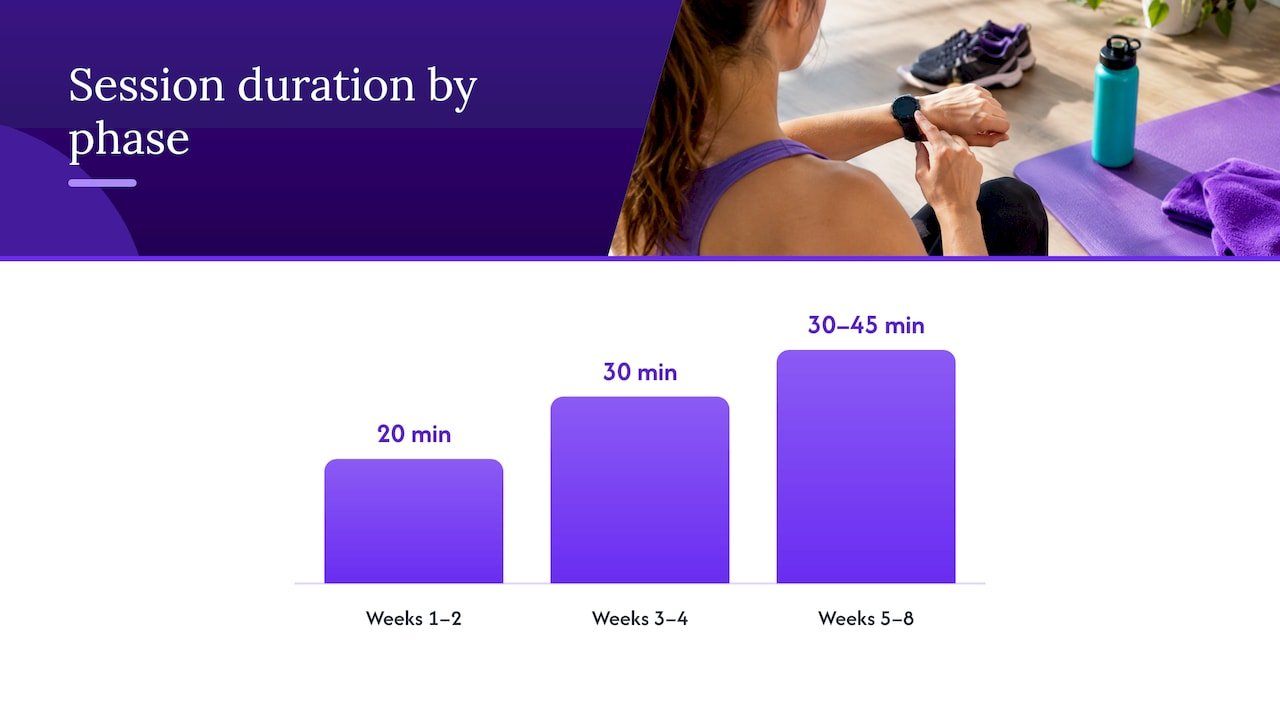
- Weeks 1–2: three sessions of 20 minutes at an easy pace.
- Weeks 3–4: three sessions of 30 minutes.
- Weeks 5–8: three or four sessions of 30–45 minutes, with one slightly longer weekend session.
- Every week: add two short strength sessions. Our 8 to 12 week strength plan for menopause is a good template, and our guide to strength training for osteoporosis suits anyone with bone-health concerns.
Colorado State University advises starting new programmes at the lower zones and building slowly. That is wise advice at any age.
Why it can feel harder, and when results show
Many people expect easy exercise to get easier straight away. In reality, the zone stays the same while your pace and your confidence grow, so you may find yourself walking or cycling faster at the same heart rate. Progress is gradual and personal. Instead of chasing a deadline, track something simple, such as how far you go in 30 minutes at conversation pace, and compare it month to month. Tiredness, poor sleep and stress can all push your heart rate up on a given day, so one off session says little.
Zone 2 cardio if you have, or have had, cancer
The encouraging news is that movement is widely recommended. The American College of Sports Medicine guidance, summarised in a peer-reviewed review, says exercise is safe and should be encouraged at every stage of survivorship, starting slowly and progressing gradually. A 2024 framework update reports that exercise is generally safe and well tolerated during and after treatment. It also reports American Cancer Society guidelines of 150–300 minutes a week of moderate activity, plus muscle-strengthening on two or more days, for survivors who are disease-free or stable.
In Ireland, an Irish thesis from Dublin City University found that most cancer survivors do not reach the recommended 150 minutes, with fatigue, pain and lack of motivation the main barriers. Zone 2’s gentle effort speaks directly to those barriers.
Practical points:
- Speak to your team first. Tell your oncologist, specialist nurse or GP what you plan to do, especially during treatment, with a history of heart problems, or if you take medication that changes your heart rate. Mayo Clinic Press advises consulting your healthcare team before starting a new routine, and says that if something does not feel good, you should not do it.
- Start very light. A peer-reviewed implementation paper says walking begun at a low level, or a stationary bike, is safe for most survivors, that formal exercise testing is not needed for low-to-moderate activity, and that symptoms should guide progression.
- Short bouts count. An Australian GP guideline from RACGP allows continuous exercise or bouts of at least 10 minutes, and says de-conditioned people can begin with just a few minutes.
- Watch for swelling. If you have had lymph nodes removed, read our guide to lymphoedema after cancer and ask your team about exercising safely.
- Check heat first. If you want a sauna after exercise during chemotherapy, read why to ask your oncologist first.
Recovering well between sessions
Zone 2 is gentle, but sessions add up, especially alongside strength work. Sleep, protein, rest days and relaxation all help your body adapt. Our recovery workouts after 40 plan sets out a three-to-four-day structure with protein, sauna and hyperbaric oxygen therapy (HBOT) in mind. If you are curious about the oxygen side, our guide to normobaric and hyperbaric oxygen therapy explains the difference in plain terms.
Our perspective
Zone 2 is the kind of exercise we like to talk about with women over 40 and with people rebuilding after illness: it is steady, kind to the body and easy to start. The trick is consistency, and consistency is easier when everything you need sits in one place.
That is why we built our Boyle centre around the whole week, not a single workout. You can do your steady cardio in our gym, then wind down in the luxury sauna, steam room and cold plunge spa. Alongside that we offer hyperbaric oxygen therapy, red light therapy, PEMF therapy, exercise with oxygen therapy (EWOT) and holistic massage. Our holistic approach combines state-of-the-art technology with ancient wisdom, and membership includes access to unique therapies and free energised water.
Your best self awaits, and it begins with one easy walk at conversation pace. If you are in or after cancer treatment, begin with your healthcare team’s blessing, and let us help you build the rest of the routine around it.
Mark
Make it part of a wellness routine in Boyle
If you would like your cardio, recovery and relaxation in one place, our wellness centre in Boyle, County Roscommon, offers a gym alongside a range of therapies. The spa day with sauna, steam and cold plunge is €30. Red light therapy is €20–40, and hyperbaric oxygen therapy is €80–120, both per session. For a longer reset, our 3, 5 and 10-day wellness retreats give you a structured programme, and you can book your visit online.

You can also explore our wellness store for supplements, electrolytes and structured water products.
FAQ
Is zone 2 cardio the same as the fat-burning zone?
Yes, they are usually the same thing. At 60–70% of maximum heart rate your body draws mainly on fat for fuel, which is why Mayo Clinic Press calls it the fat-burning zone. The percentage of calories from fat is higher in lower zones, but total energy used still depends on how long and how often you exercise.
What is a good zone 2 heart rate at 50?
Using the 220 minus age formula, a 50-year-old has an estimated maximum of 170 bpm, so Zone 2 is about 102–119 bpm. Check it with the talk test: you should be able to speak in full sentences. If you take medication that affects your heart rate, ask your GP or specialist for your own target.
How long should a zone 2 session last?
Most sessions run at least 30 minutes, according to Cleveland Clinic. If you are starting out or recovering from illness, short bouts of 10 minutes still count, and you can build up gradually. Aim to reach the Irish guideline of at least 2h30m of moderate activity a week over time.
Can I do zone 2 cardio during chemotherapy?
Exercise is generally considered safe and well tolerated during and after cancer treatment, but your plan should be personal. Speak to your oncology team before you begin, start with gentle walking or a stationary bike, and let your symptoms guide how quickly you progress. On a tired day, a short, easy session is enough.
Sources
- What Is Zone 2 Cardio? (Cleveland Clinic)
- What Are the Five Heart Rate Zones? (Cleveland Clinic)
- Zone 2 cardio: What is it and why is it trending online? (Mayo Clinic Press)
- How to target heart rate training zones effectively (Colorado State University)
- Target Heart Rates Chart (American Heart Association)
- Every Move Counts: National Physical Activity and Sedentary Behaviour Guidelines for Ireland (gov.ie)
- Initiating Exercise Interventions to Promote Wellness in Cancer Patients and Survivors (2017)
- Implementing the Exercise Guidelines for Cancer Survivors (2012)
- The Physical Activity and Cancer Control (PACC) framework update (2024)
- Development, implementation and evaluation of a physical activity programme for cancer survivors (DCU thesis, 2019)
- Guidelines for implementing exercise programs for cancer patients (RACGP)