

Binaural beats therapy can genuinely support short-term relaxation, faster sleep onset, and situational anxiety for many people. The evidence for large or lasting clinical effects is mixed, but the technique is low-risk, inexpensive, and easy to try at home. If you are looking for a supplementary tool to layer alongside breathing exercises, meditation, or a broader wellness routine, a 10–20 minute session with stereo headphones is a sensible starting point.
Who benefits most:
- People seeking a low-effort, low-risk relaxation or focus aid
- Those using binaural beats alongside other wellness practices such as breathwork, PEMF, or sound therapy.
- Anyone who wants to support sleep onset without medication
Who should be cautious:
- People with epilepsy or seizure disorders: auditory stimulation at certain frequencies may carry risk
- Those with severe psychiatric conditions: consult a clinician before starting
- Anyone who must remain fully alert, such as when driving or operating machinery
Your immediate next step: put on stereo headphones, choose a theta or delta track (4–8 Hz for relaxation, 1–4 Hz for sleep), set the volume to a comfortable conversational level, and listen for 10–20 minutes. Rate your calm and sleepiness on a simple 0–10 scale before and after. That single data point tells you more than any general claim.
Key takeaways
Binaural beats therapy offers credible short-term support for relaxation, sleep onset, and situational anxiety when used correctly with stereo headphones, though the evidence for sustained clinical effects remains mixed.
| Point | Details |
|---|---|
| Stereo headphones are required | The binaural illusion only works when each ear receives a distinct tone; speakers or mono playback remove the effect entirely. |
| Frequency selection matters | Use delta/theta (1–8 Hz) for sleep, alpha (8–13 Hz) for calm focus, and beta/gamma (14 Hz+) for active concentration. |
| Evidence is promising but inconsistent | A systematic review of 14 studies found only five supported entrainment; short-term anxiety and autonomic benefits have stronger trial support. |
| Consistency beats intensity | Repeated 15–30 minute sessions tend to produce more reliable results than a single long session; track your pre/post ratings to identify what works. |
| Live5dhealth offers supervised sessions | Tailored sound therapy protocols, combined with other modalities, are available at the wellness centre in Boyle, Ireland. |
Table of Contents
- What is binaural beats therapy and how does it work?
- What are the real benefits of binaural beats?
- What does the research actually say?
- How to use binaural beats effectively: a practical setup guide
- Is binaural beats therapy safe? Side effects and who should avoid it
- How to choose a trustworthy binaural beats app or track
- Ready-to-use session protocols for sleep, relaxation and focus
- When should you see a clinician instead of self-treating?
- How we assessed the evidence for this article
- A perspective from Live5dhealth on sound therapy in practice
- Experience supervised sound therapy at Live5dhealth
- Sources
What is binaural beats therapy and how does it work?
Binaural beats therapy is a form of sound healing therapy built on a straightforward auditory phenomenon. When your left ear hears a tone at, say, 200 Hz and your right ear hears one at 210 Hz, your brain perceives a third pulsing tone at the difference frequency: 10 Hz. That perceived beat does not exist in the audio file. Your brain constructs it. This is the binaural illusion, and it requires stereo headphones to work. Play the same track through a speaker and the two tones mix in the air before reaching your ears, erasing the effect entirely.
The therapeutic hypothesis rests on a concept called brainwave entrainment, sometimes called the frequency-following effect. The idea is that the brain’s electrical activity, measured as oscillations on an EEG, tends to synchronise with a rhythmic external stimulus. If the perceived beat sits at 10 Hz, the theory holds that your dominant brainwave frequency will shift toward 10 Hz, nudging you into a calmer, more focused state. That is the claim. The evidence for it is real but inconsistent, which matters when you are deciding how much to expect from a session.
Frequency bands and what they are associated with
Different EEG frequency ranges correspond to distinct mental states, and binaural beats are typically designed to target one of them:
- Delta (1–4 Hz): deep, restorative sleep and physical recovery
- Theta (4–8 Hz): meditation, creativity, and the drowsy edge of sleep
- Alpha (8–13 Hz): calm, relaxed alertness and light focus
- Beta (14–30 Hz): active thinking, problem-solving, and sustained attention
- Gamma (40 Hz+): high-level cognitive processing and heightened perception
A typical clinical or research protocol presents a carrier tone, usually somewhere between 100 Hz and 500 Hz, with a difference frequency set to the target band. Sessions in published trials generally run several minutes, often with the beats embedded beneath ambient music or nature sounds to make listening more comfortable.
What are the real benefits of binaural beats?
The honest answer is: it depends on what you are asking the technique to do. Some uses have credible trial support. Others are speculative. Here is a clear breakdown.
Sleep support — supported by some trials
Theta and delta beats are the most commonly studied for sleep onset. Several small trials report faster sleep onset and improved subjective sleep quality, particularly when beats are combined with a wind-down routine. The effect appears modest and most consistent in people with mild sleep difficulties rather than clinical insomnia.
Anxiety reduction — supported by some RCTs
This is the strongest area of evidence. A randomised controlled trial found that 10 Hz binaural beat stimulation reduced preoperative state anxiety more effectively than stimulus-free relaxation, though broad EEG entrainment across the cortex was not established. For situational or mild anxiety, the technique shows genuine promise.

Autonomic regulation — promising but inconsistent
A quasi-experimental study in college students found that 20-minute sessions at theta (6 Hz), alpha (10 Hz), and beta (25 Hz) frequencies all reduced heart rate and blood pressure. Low-frequency beats were particularly effective for relaxation markers, though differences between frequency bands were often nonsignificant.
Focus and cognitive performance — promising but inconsistent
Beta and gamma beats are associated with improved attention in some studies, but results vary considerably with the parameters used. WebMD notes that frequency selection matters: higher frequencies tend to suit cognitive tasks while lower frequencies favour relaxation.
Pain relief and mood enhancement — insufficient evidence
A word on placebo and expectancy
Any relaxation technique benefits from expectancy effects. If you sit quietly with headphones on for 20 minutes, some calm is almost guaranteed regardless of the audio content. Separating the specific binaural effect from the general relaxation response is methodologically difficult, and many studies have not done so convincingly. That does not mean the technique is useless. It means the effect size attributable specifically to the beats may be smaller than enthusiasts claim.
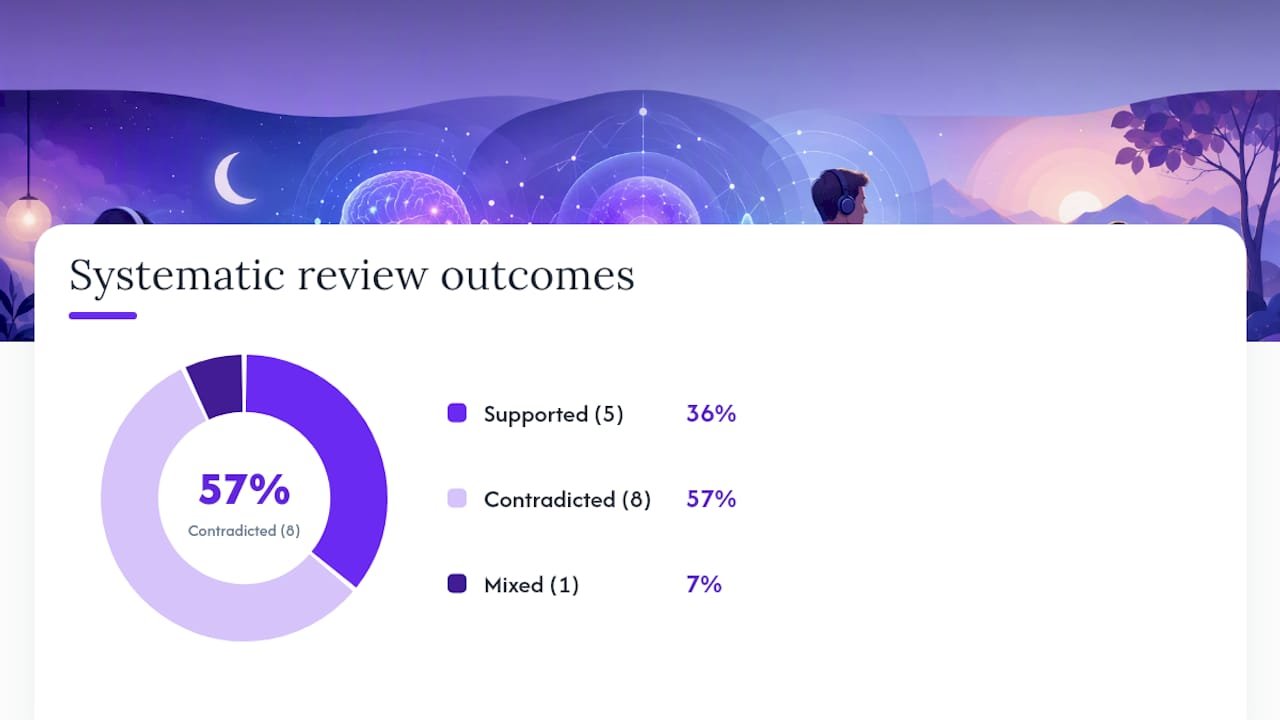
Statistic callout: A systematic review of 14 studies on brainwave entrainment found that five reported entrainment, eight contradicted it, and one returned mixed results, reflecting substantial methodological heterogeneity across the literature.
What does the research actually say?
The honest summary of the binaural beats literature is: promising signals, real methodological problems, and no settled consensus.
The most rigorous overview to date is a systematic review published in PMC examining whether binaural beats actually entrain the brain. Of 14 studies meeting inclusion criteria, five supported entrainment, eight contradicted it, and one returned mixed results. The authors flagged high methodological heterogeneity as the primary obstacle to firm conclusions. Studies differed in carrier tones, difference frequencies, session lengths, EEG measurement approaches, and outcome measures, making direct comparison almost impossible.
Two trials stand out for their clinical relevance. The preoperative anxiety RCT mentioned above used a controlled design and found a measurable reduction in state anxiety with 10 Hz stimulation. The college student ANS study used three frequency conditions and found consistent reductions in heart rate and blood pressure across all of them, though between-frequency differences were often nonsignificant. Both are encouraging, but both are limited by sample size and single-session designs.
A broader methodological review reinforces the same caution: inconsistent carrier tones, session lengths, and measurement approaches limit comparability and therefore any firm conclusions about downstream clinical effects.
| Study type | Finding | Key limitation |
|---|---|---|
| Systematic review (14 studies) | 5 supported entrainment, 8 contradicted it | High heterogeneity; no standardised protocol |
| Preoperative anxiety RCT | 10 Hz beats reduced state anxiety vs. relaxation alone | Small sample; EEG entrainment not established broadly |
| College student ANS study | 20-min sessions reduced heart rate and blood pressure | Quasi-experimental; between-frequency differences often nonsignificant |
What stronger future studies need is standardised protocols, larger samples, active control conditions that match the relaxation effect of simply wearing headphones, and longer follow-up periods. Until those exist, the most defensible position is: binaural beats are a low-risk adjunct with credible short-term benefits for relaxation and situational anxiety, not a clinically proven treatment for any condition.
How to use binaural beats effectively: a practical setup guide
Getting the setup right matters more than most guides acknowledge. A poorly configured session will not produce the intended effect, regardless of how well-designed the audio is.
Equipment and environment
Stereo headphones are non-negotiable. Medical News Today is clear on this: the binaural illusion depends on each ear receiving a distinct frequency, which only stereo headphones can deliver. Over-ear headphones generally provide better stereo separation than earbuds, though quality earbuds work well. Keep the volume at a comfortable conversational level, roughly 60–70 dB, to protect your hearing during repeated sessions.
Choose a quiet environment where you will not be interrupted. Dim lighting, a comfortable seated or lying position, and a room temperature you find relaxing all support the session. You do not need a dedicated meditation space, but you do need to be still.
Choosing your frequency
| Goal | Frequency band | Difference frequency range |
|---|---|---|
| Deep sleep | Delta | 1–4 Hz |
| Meditation or creativity | Theta | 4–8 Hz |
| Calm focus | Alpha | 8–13 Hz |
| Active concentration | Beta | 14–30 Hz |
| High-level cognitive tasks | Gamma | 40 Hz+ |
Step-by-step first session
- Put on stereo headphones and find a comfortable position.
- Select a track matching your goal frequency (theta for relaxation, delta for sleep, alpha or beta for focus).
- Rate your current calm, focus, or sleepiness on a 0–10 scale and note it down.
- Set a timer for 15–20 minutes and press play.
- Breathe slowly and naturally; if your mind wanders, return attention to the sound.
- When the session ends, rate the same measures again and note any physical sensations.
- Log the frequency used, session length, and your pre/post scores.
Tracking your responses across several sessions is the most reliable way to identify which frequencies consistently help you. Consistency across sessions tends to matter more than session length: many applied studies report measurable effects on heart rate and blood pressure after repeated exposure rather than a single long session.
Pro Tip: Pair your binaural session with deep breathing exercises for the first two weeks. The combination gives you a clear baseline: if calm improves, you can later test beats alone versus breathing alone to isolate which element is doing the work.
Is binaural beats therapy safe? Side effects and who should avoid it
For most people, binaural beats therapy carries a low risk profile when used at safe volumes and for reasonable session lengths. That said, adverse effects do occur in some people, and certain groups should approach the technique with caution or avoid it altogether.
Possible side effects:
- Mild headache or nausea, particularly during early sessions or at high volumes
- Dizziness or disorientation, especially with very low delta frequencies
- Increased anxiety or agitation in some people, particularly with higher beta or gamma frequencies
- Disrupted sleep if beats are left playing throughout the night rather than used as a wind-down tool
Who should avoid binaural beats or consult a clinician first:
- People with epilepsy or any seizure disorder: rhythmic auditory stimulation may carry risk, and no adequate safety data exists for this group
- Those with severe psychiatric conditions, including psychosis or bipolar disorder in an active phase
- Anyone taking medications that affect neural excitability
- Children, unless under clinical supervision
- People engaged in any activity requiring full alertness, including driving or operating machinery
Duration and volume guidance:
Keep sessions to moderate lengths when starting out. Do not leave binaural beats playing unattended during sleep. Pre-sleep wind-down sessions of moderate duration are appropriate; prolonged all-night playback is not recommended. Keep volume below 85 dB and take breaks between sessions if you notice any discomfort.
If you are exploring binaural beats specifically for anxiety management, it is worth understanding the full picture of what anxiety is and when self-help tools are sufficient versus when professional support is the right call.
How to choose a trustworthy binaural beats app or track
The market for binaural beats audio is large and largely unregulated. Quality varies enormously, and some products make claims that the evidence simply does not support.
What to look for in a quality source:
- Clear labelling of the difference frequency and carrier tone used
- Stereo playback confirmed (test by listening with headphones and checking that the beat is audible)
- Transparent session length recommendations and volume guidance
- Developer or clinician input disclosed, or references to the research base
- Offline playback available, so you are not dependent on a data connection during a session
- Adjustable volume within the app, separate from device volume
Red flags to avoid:
- Claims of guaranteed cures or healing of specific medical conditions
- “Healing frequency” language without any reference to the evidence base
- No mention of headphone requirements anywhere in the product description
- Tracks that mix binaural beats with subliminal messaging or unverifiable frequency claims
- Apps that do not allow you to identify what frequency band you are listening to
Practical audition checklist before committing to regular use:
- Listen for 5 minutes with headphones and confirm you can perceive the pulsing beat
- Check for distracting audio artefacts or abrupt transitions that interrupt relaxation
- Verify the stated frequency matches your goal (delta for sleep, not beta)
- Read user reviews specifically for mentions of headphone requirements and sound quality
- Try a free trial or sample before purchasing a subscription
Research into consumer sound therapy claims consistently finds that trustworthy resources emphasise safe listening levels and realistic expectations, while products promising broad cures lack robust scientific backing. That distinction is your most reliable filter.
Ready-to-use session protocols for sleep, relaxation and focus
These three protocols are designed to be tried immediately. Each is based on the frequency ranges and session lengths used in published trials.
Protocol 1: sleep wind-down (delta/theta, 20–30 minutes)
- Begin 30–45 minutes before your intended sleep time.
- Dim all lights and put your phone on silent.
- Put on over-ear headphones and select a delta (1–4 Hz) or theta (4–8 Hz) track.
- Lie down in bed or in a reclining position.
- Set a timer for 25 minutes so the audio stops automatically.
- Breathe in for 4 counts, hold for 2, out for 6. Repeat for the first 5 minutes.
- Allow your attention to rest on the sound without trying to analyse it.
- When the timer ends, remove headphones and sleep naturally.
Protocol 2: relaxation reset (theta/alpha, 10–15 minutes)
- Find a quiet seated position, feet flat on the floor.
- Select a theta (4–8 Hz) or alpha (8–13 Hz) track.
- Rate your tension on a 0–10 scale before starting.
- Begin with 2 minutes of progressive muscle relaxation: tense and release each muscle group from feet to shoulders.
- Let the audio play for 10–12 minutes while breathing slowly.
- Rate your tension again at the end. Note the difference.
This protocol pairs well with breathing techniques that calm the nervous system, particularly for those managing work-related stress or anxiety related to hormonal changes.
Protocol 3: study and focus session (alpha/beta, 15–25 minutes)
- Sit upright at a desk with good posture.
- Select an alpha (8–13 Hz) track for the first 5 minutes, then switch to a beta (14–30 Hz) track for the remaining session.
- Work on a single task during the session. Do not multitask.
- Take a 5-minute break without screens after the session ends.
- Never use this protocol while driving or in any situation requiring divided attention.
| Protocol | Duration | Frequency band | Primary goal |
|---|---|---|---|
| Sleep wind-down | 20–30 minutes | Delta/theta (1–8 Hz) | Faster sleep onset, reduced pre-sleep tension |
| Relaxation reset | 10–15 minutes | Theta/alpha (4–13 Hz) | Acute stress relief, autonomic calming |
| Study focus | 15–25 minutes | Alpha/beta (8–30 Hz) | Sustained attention, reduced mental fatigue |
When should you see a clinician instead of self-treating?
Binaural beats are a self-help tool, not a clinical intervention. Knowing when to step beyond them is as important as knowing how to use them.
Seek professional assessment if you experience any of the following:
- Persistent insomnia lasting more than three weeks that does not respond to sleep hygiene or relaxation tools
- Severe anxiety, panic attacks, or anxiety that interferes with daily functioning
- Suicidal thoughts or significant worsening of mood or psychiatric symptoms
- Symptoms that feel physical in origin, such as heart palpitations or chest tightness
- Any adverse reaction during or after a binaural beats session, particularly dizziness or increased agitation
How clinicians integrate binaural beats:
When clinicians do use binaural beats, they typically embed them within a broader protocol. The preoperative anxiety RCT, for example, combined beats with a structured relaxation setting and monitored participants throughout. Brain health clinicians working with audio-based therapies generally pair them with breathing exercises, guided imagery, or cognitive techniques, and record pre/post subjective scales to track benefit over time. That multimodal approach is meaningfully different from simply pressing play on a playlist.
Binaural beats may serve as a useful adjunct to cognitive behavioural therapy for insomnia (CBT-I), mindfulness-based stress reduction, or preoperative anxiety management. They are not a substitute for any of these. If you are already working with a therapist or clinician, share your session logs, including frequency used, duration, and pre/post ratings, so they can assess whether the technique is helping or interfering.
For readers exploring how other evidence-based therapies support mental health and neurological wellbeing, the role of HBOT in mental health offers useful context on multimodal approaches.
How we assessed the evidence for this article
This article prioritised recent systematic reviews, randomised controlled trials, and clinical studies over consumer-facing content and anecdotal reports. Where systematic reviews were available, they were weighted most heavily. RCTs with active control conditions were weighted above observational or quasi-experimental designs.
The primary systematic review cited here examined 14 studies and found inconsistent evidence for brainwave entrainment, with high methodological heterogeneity across protocols. That finding shaped the evidence-level labels used throughout: “supported by some RCTs” reflects genuine trial data; “promising but inconsistent” reflects studies with positive signals but replication problems; “insufficient evidence” reflects areas where the literature is too thin or contradictory to draw conclusions.
Two limitations of the current literature are worth naming directly. First, most trials use small samples and single-session designs, which cannot capture cumulative effects. Second, few studies include active control conditions that match the relaxation effect of simply sitting quietly with headphones on, making it difficult to isolate the specific contribution of the binaural beat. Future research should address both.
Statistic callout: Of 14 studies reviewed in the PMC systematic review, only five supported brainwave entrainment, while eight contradicted it, underscoring why individual experimentation with realistic expectations is the most honest recommendation.
A perspective from Live5dhealth on sound therapy in practice
At Live5dhealth, sound therapy sits alongside HBOT, PEMF, red light therapy, and other modalities as part of a genuinely integrative approach to wellbeing. We do not position binaural beats as a cure for anything. What we do see, consistently, is that people who arrive carrying chronic stress, disrupted sleep, or low-grade anxiety often respond well to sound-based sessions when those sessions are part of a broader programme rather than a standalone fix.
The clinical evidence is mixed, and we are transparent about that. What binaural beats offer is a low-risk, accessible entry point into a state of deeper relaxation, one that many people find easier to reach with audio support than with unaided meditation. When combined with breathwork, supervised relaxation protocols, or therapies like our sound healing bed sessions, the cumulative effect tends to be more meaningful than any single modality alone.
We recommend supervised sessions for anyone with a health condition, and we always suggest starting with a short consultation so that the approach is matched to the individual rather than applied generically. Sound therapy is supportive, not curative, and that framing matters.
Experience supervised sound therapy at Live5dhealth
Live5dhealth offers supervised sound and light therapy sessions at its wellness centre in Boyle, County Roscommon, as part of a broader suite of evidence-informed treatments. A supervised session is meaningfully different from self-administered listening: you receive an initial assessment, a protocol tailored to your goals and health history, and monitoring throughout, rather than simply selecting a track and hoping for the best.

Sound therapy at Live5dhealth can be combined with other modalities, including PEMF, red light therapy, and the luxury spa facilities, as part of a day visit or a multi-day healing retreat in Ireland. For those with specific health concerns, a brief consultation before your first session allows the team to recommend the most appropriate approach and flag any contraindications.
If you are ready to experience what a professionally guided session feels like, visit the Live5dhealth wellness centre page to check availability and book. If you have a health condition and want to discuss suitability first, contact the centre directly before booking.
Sources
- Binaural beats to entrain the brain? A systematic review of the effects of binaural beat stimulation on brain oscillatory activity, and the implications for psychological research and intervention
- Binaural beat stimulation as a tool to reduce preoperative anxiety in patients undergoing elective surgery and general anesthesia – randomized controlled trial
- Effects of binaural beat therapy with different frequencies on autonomic nervous system regulation among college students | BMC Complementary Medicine and Therapies
- Binaural beats: what are they and what are the benefits? | WebMD