

Hyperbaric oxygen therapy (HBOT) is defined as breathing 100% pure oxygen inside a pressurised chamber at levels above normal atmospheric pressure, typically between 2.0 and 2.4 ATA. This process forces significantly more oxygen into your blood plasma and tissues than your lungs can achieve at sea level, delivering it directly to damaged, oxygen-starved wound beds. HBOT is FDA-approved for difficult-to-heal wounds including diabetic foot ulcers, radiation injuries, and severe infections. For anyone recovering from surgery or a serious injury, this HBOT benefits wound healing guide explains exactly how the therapy works, what to expect, and how to get the most from it.
How does hyperbaric oxygen therapy work to improve wound healing?
The core mechanism is straightforward. Wounds that are slow to heal are almost always hypoxic, meaning the tissue is starved of oxygen. Normal red blood cell delivery is compromised by damaged blood vessels, swelling, or poor circulation. HBOT bypasses this problem entirely by dissolving oxygen directly into the blood plasma, independent of haemoglobin. This means oxygen reaches tissues that red blood cells simply cannot access.
The physiological effects of HBOT on wound tissue include four well-documented processes:
- Angiogenesis and neovascularisation. HBOT stimulates the growth of new blood vessels at the wound site, restoring long-term circulation to previously ischaemic tissue. This is not a temporary fix. New vessel networks persist after treatment ends.
- Collagen synthesis. Oxygen is a direct co-factor in collagen production. Higher tissue oxygen levels accelerate the formation of the structural protein your body uses to rebuild skin, fascia, and connective tissue.
- Immune function support. Oxygen-dependent white blood cells, particularly neutrophils, require adequate tissue oxygen to kill bacteria effectively. Hypoxic wounds are far more vulnerable to infection. HBOT restores the oxidative killing capacity of these cells.
- Oedema reduction. The elevated pressure environment causes vasoconstriction in intact vessels, which reduces fluid leakage into surrounding tissue without compromising oxygen delivery. Swelling decreases, and the wound environment becomes more favourable for repair.
A prospective 36-month study found that patients receiving HBOT showed reduced inflammatory markers and improved microvessel density compared to controls, with fewer amputations recorded over the study period. This confirms that the therapy’s benefits extend well beyond the treatment window itself.
Pro Tip: If you want to understand the broader role oxygen plays in tissue repair before starting HBOT, read about oxygen in wound healing to build a clearer picture of why this therapy works at a cellular level.

What does a typical HBOT treatment protocol involve?
Understanding what you are committing to before you begin makes the process far less daunting. HBOT for wound healing is not a single session. It is a structured course of treatment, and the dosing matters considerably.
A standard protocol for chronic wound healing follows this general structure:
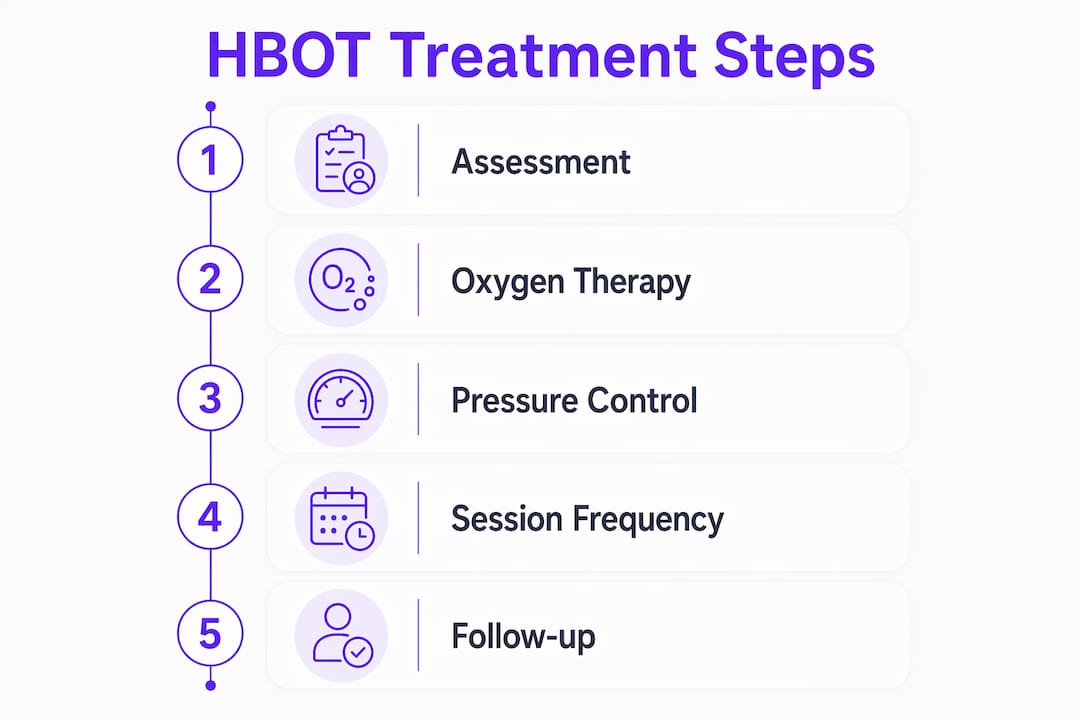
- Pressure and oxygen concentration. Sessions are conducted at 2.0 to 2.4 ATA using 100% oxygen delivered through a mask or hood inside a hard-shell chamber. Soft-shell or low-pressure wellness chambers do not replicate these conditions and should not be confused with clinical HBOT.
- Session duration. Each session typically lasts 90 minutes, including the pressurisation and depressurisation phases. The active treatment period at full pressure is usually around 60 to 75 minutes.
- Frequency and total sessions. Most chronic wound protocols require 20 to 60 sessions delivered five days per week. Radiation injuries and diabetic foot ulcers typically sit at the higher end of this range.
- Clinical assessment before starting. Clinicians use transcutaneous oxygen pressure testing, known as TcPO2, to confirm tissue hypoxia and identify patients most likely to respond. This test measures the oxygen tension at the skin surface adjacent to the wound. A TcPO2 below 40 mmHg at the wound margin is a strong indicator for HBOT candidacy.
The table below summarises typical protocol parameters by wound type:
| Wound type | Pressure (ATA) | Typical sessions |
|---|---|---|
| Diabetic foot ulcer | 2.0 to 2.4 | 30 to 60 |
| Radiation tissue injury | 2.0 to 2.4 | 40 to 60 |
| Post-surgical wound dehiscence | 2.0 to 2.4 | 20 to 40 |
| Crush injury or acute trauma | 2.4 to 3.0 | 20 to 30 |
Pro Tip: Ask your clinician specifically about your TcPO2 result before agreeing to a full course of HBOT. If your tissue oxygen levels are already adequate, the therapy may offer limited additional benefit for your particular wound.
What are the safety considerations and common side effects of HBOT?
HBOT is a well-tolerated therapy when delivered in a properly equipped clinical setting, but it is not without risks. Understanding these risks helps you make an informed decision and prepares you to manage any discomfort that arises during treatment.
The most common complications include:
- Ear and sinus barotrauma. Pressure changes during descent and ascent can cause pain or congestion in the ears and sinuses. This is the most frequently reported side effect. It is manageable with pressure equalisation techniques such as the Valsalva manoeuvre, and clinicians may recommend decongestants such as oxymetazoline or pseudoephedrine before sessions. Barotrauma management may also include analgesics or corticosteroids in more persistent cases.
- Oxygen toxicity. Breathing pure oxygen at elevated pressure carries a small risk of central nervous system or pulmonary oxygen toxicity. Clinical protocols include air breaks during sessions specifically to reduce this risk. Seizures from oxygen toxicity are rare and resolve quickly when oxygen is withdrawn.
- Claustrophobia. Monoplace chambers, which accommodate one person lying down, can trigger anxiety in some patients. Multiplace chambers, where several patients sit together, are often better tolerated. Discussing this with your care team before your first session allows them to prepare appropriately.
- Contraindications. Untreated pneumothorax is an absolute contraindication. Relative contraindications include certain medications, a history of ear surgery, and active upper respiratory infections.
“Careful patient screening and ongoing vigilance are essential because, although complications are uncommon, barotrauma and oxygen toxicity do occur.” Source: StatPearls, HBOT safety profile
Pre-treatment screening is not a formality. It is the mechanism by which your clinical team identifies and mitigates your individual risk profile. Never defer a session during an active upper respiratory infection, as this significantly increases barotrauma risk. Read more about common misconceptions around HBOT if you have concerns about safety claims you have encountered elsewhere.
How can patients maximise the benefits of HBOT for wound healing?
The therapy itself does the physiological work, but your behaviour around it determines how much benefit you actually receive. Patients who approach HBOT passively tend to achieve weaker outcomes than those who treat it as an active part of their recovery.
The most impactful steps you can take include:
- Attend every scheduled session. Skipping sessions disrupts the cumulative oxygen loading effect that drives angiogenesis. A course of 40 sessions completed at 35 is not 87.5% effective. The final sessions often consolidate vascular changes initiated earlier in the course.
- Combine HBOT with standard wound care. HBOT is an adjunct therapy, not a replacement for dressings, debridement, or offloading. Wounds managed with both HBOT and negative pressure wound therapy (NPWT) showed an improved healing odds ratio of 6.77 compared to NPWT alone. That is a substantial difference attributable to combination rather than monotherapy.
- Seek early referral. Early HBOT referral after 30 days of inadequate healing significantly improves limb salvage outcomes. Waiting six months before considering HBOT reduces the window in which the therapy can prevent irreversible tissue loss.
- Discuss progress at regular intervals. If a wound shows no measurable improvement after 20 sessions, your clinical team should reassess. Continuing an ineffective course is neither good medicine nor good use of your time.
Pro Tip: For practical guidance on getting the most from your sessions, the Live5dhealth resource on maximising HBOT results covers adherence strategies and what to track between appointments.
A meta-analysis of 51 randomised controlled trials found that HBOT reduced major amputation risk with a Mantel-Haenszel odds ratio of approximately 0.28 compared to standard care alone. That figure means the risk of major amputation was roughly one quarter of what it would have been without HBOT. For anyone facing a serious diabetic foot ulcer or ischaemic wound, that statistic deserves serious attention.
Key takeaways
HBOT accelerates wound healing by delivering oxygen under pressure to hypoxic tissues, stimulating angiogenesis, collagen synthesis, and immune function in wounds that standard care alone cannot resolve.
| Point | Details |
|---|---|
| Core mechanism | HBOT dissolves oxygen into plasma, bypassing haemoglobin to reach oxygen-starved wound tissue. |
| Proven clinical use | FDA-approved for diabetic foot ulcers, radiation injuries, and difficult-to-heal wounds. |
| Treatment commitment | Most chronic wound protocols require 20 to 60 sessions at 2.0 to 2.4 ATA, five days per week. |
| Combination therapy | Pairing HBOT with NPWT produces significantly better outcomes than either therapy alone. |
| Early referral matters | Referring for HBOT within 30 days of inadequate healing improves limb salvage rates considerably. |
Why I think most people misunderstand what HBOT is actually for
People arrive at HBOT with very different expectations, and I have seen both ends of the spectrum. Some patients expect a miracle after five sessions. Others are so focused on the risks that they delay starting until the window for meaningful benefit has closed.
The honest clinical picture is this: HBOT is not a general wellness upgrade. Its primary value lies in preventing major amputations and rescuing limbs that would otherwise be lost to ischaemic or diabetic wounds. The amputation risk reduction data is genuinely impressive, but it applies to a specific patient population with confirmed tissue hypoxia and wounds that have failed standard care.
What concerns me more is the proliferation of soft-shell, low-pressure chambers marketed as HBOT in wellness settings. Effective HBOT requires hard-shell chambers delivering 100% oxygen at 2.0 to 3.0 ATA. Anything below that threshold does not replicate the physiological conditions that produce the clinical results. If you are considering HBOT for a genuine wound healing indication, verify that the facility you choose operates to medical standards, not wellness-centre approximations.
The most promising direction I see in current practice is combination therapy. HBOT paired with NPWT, or with structured offloading and advanced dressings, consistently outperforms any single modality. Think of HBOT as the engine and wound care as the chassis. Neither works as well without the other.
— Mark
Explore professional HBOT and recovery therapies at Live5dhealth
Live5dhealth, based in Boyle, County Roscommon, offers access to professional hyperbaric oxygen therapy alongside a full range of complementary recovery and wellness services. Whether you are recovering from surgery, managing a chronic wound, or seeking a structured rehabilitation environment, the team at Live5dhealth can help you build a personalised plan.

From HBOT sessions delivered in properly equipped chambers to luxury spa facilities that support post-treatment recovery, Live5dhealth brings together the therapies that matter most in one place. If you are exploring your options, see how Live5dhealth compares to other leading wellness centres in Ireland and take the first step towards a recovery plan that actually works for you.
FAQ
What conditions is HBOT approved to treat?
HBOT is FDA-approved for wounds including diabetic foot ulcers, radiation tissue damage, severe infections, and crush injuries. It is not approved as a general wellness or anti-ageing treatment.
How many HBOT sessions are needed for wound healing?
Most chronic wound protocols require between 20 and 60 sessions, delivered five days per week. The exact number depends on wound type, severity, and your clinical response to treatment.
Is HBOT safe for people recovering from surgery?
HBOT is generally safe when delivered in a clinical setting with proper pre-treatment screening. The most common side effects are ear and sinus discomfort from pressure changes, which are manageable with standard techniques.
Does HBOT work better when combined with other wound treatments?
Yes. Combining HBOT with negative pressure wound therapy produced a healing odds ratio of 6.77 compared to NPWT alone, making combination approaches significantly more effective than monotherapy.
How do clinicians decide if I am suitable for HBOT?
Clinicians use TcPO2 testing to measure tissue oxygen levels at the wound margin. A reading below 40 mmHg typically confirms tissue hypoxia and indicates that HBOT is likely to provide meaningful benefit.