
Hyperbaric oxygen therapy (HBOT) reduces scar tissue by flooding tissues with dissolved oxygen under pressure, reversing the hypoxic state that drives chronic inflammation and excessive collagen deposition. In practical terms, that means less fibrotic scarring, a lower chance of keloid recurrence, and a more organised collagen structure over time. Clinical evidence backs this up: keloid recurrence dropped to 5.97% with adjunctive HBOT after surgery and radiotherapy, compared with 14.15% without it. A head-to-head study also found HBOT outperforms silicone sheets for reducing scar surface area, though silicone holds the edge on pigmentation and pliability.
Pro Tip: Set your expectations around surface area and recurrence, not skin tone. HBOT is most powerful for reducing how much scar tissue forms, not for fading discolouration.
- HBOT reduces keloid recurrence significantly when used alongside surgery and radiotherapy.
- It outperforms silicone sheets on scar surface area in comparative studies.
- Pigmentation and pliability respond better to silicone or laser-based treatments.
- Early intervention, ideally within the first weeks post-injury, gives the best results.
Table of Contents
- How does HBOT change the biology of scar formation?
- What do clinical studies show about HBOT and scar reduction?
- What HBOT reliably helps — and what it usually does not
- What does an HBOT course for scar improvement look like?
- How does HBOT compare with common scar treatments?
- How to choose a safe, evidence-minded HBOT provider
- Aftercare and pairing HBOT with spa and skincare treatments
- Is HBOT safe, and what does UK regulation say?
- Key takeaways
- A practitioner’s perspective on HBOT for scar clients
- Sources and further reading
How does HBOT change the biology of scar formation?
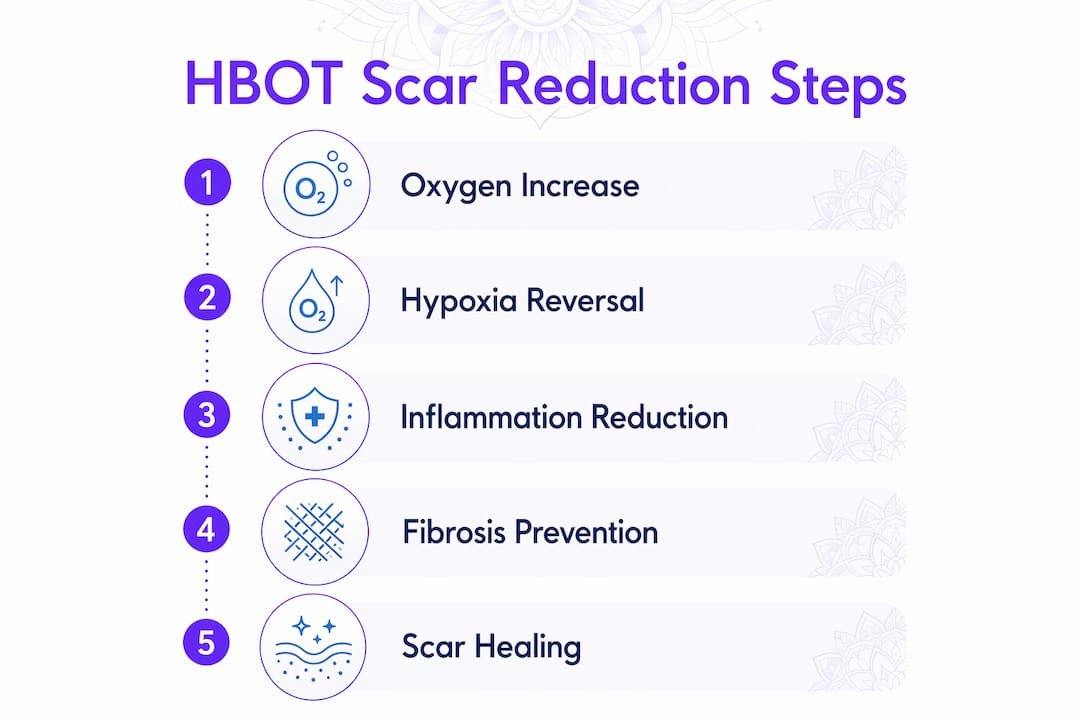
Scar tissue forms when the body’s wound-healing cascade goes into overdrive, usually because the injured tissue stays hypoxic for too long. HBOT corrects that by raising plasma-dissolved oxygen levels well above what breathing normal air can achieve. That single shift has a cascade of downstream effects on how a scar ultimately looks and feels.
Hypoxia is not just a side effect of injury — it is an active driver of pathological scarring. Elevated HIF-1α in oxygen-starved tissue sustains inflammation and signals fibroblasts to keep producing collagen long after the wound has closed, which is precisely how keloids and hypertrophic scars develop. HBOT suppresses HIF-1α, interrupting that cycle at its source.
With hypoxia corrected, the inflammatory phase shortens. Markers including IL-6, TNF-α, and NF-κB all fall measurably in HBOT-treated tissue, which means fibroblasts receive a cleaner, less inflammatory signal. The result is more organised collagen synthesis rather than the tangled, excessive deposition that defines a raised scar. HBOT also stimulates angiogenesis and fibroblast proliferation, improving tensile strength in healing tissue and supporting the remodelling phase. Small aesthetic studies report measurable increases in elastic fibre length and collagen density after a course of sessions.
Timing matters considerably here. Starting HBOT early in the healing cascade, before fibrosis becomes entrenched, gives the therapy its best chance to steer collagen remodelling in the right direction. Mature, long-standing scars can still respond, but the degree of change is typically more modest.
| Mechanism | Effect on scar tissue |
|---|---|
| Raised plasma-dissolved oxygen | Reverses tissue hypoxia; shortens inflammatory phase |
| HIF-1α suppression | Reduces fibroblast over-stimulation and collagen overproduction |
| Reduced IL-6, TNF-α, NF-κB | Less chronic inflammation driving keloid/hypertrophic growth |
| Angiogenesis stimulation | Improves vascular supply; supports healthy remodelling |
| Fibroblast regulation | More organised collagen synthesis; improved tensile strength |
What do clinical studies show about HBOT and scar reduction?
The strongest single data point comes from a controlled study of 240 patients: adjunctive HBOT after keloid surgery and radiotherapy produced a recurrence rate significantly lower with adjunctive HBOT versus without it in the non-HBOT group, a statistically significant difference. Patient satisfaction scores were also higher in the HBOT group.
A systematic review and meta-analysis found a pooled relative risk for pathological scar recurrence of approximately 0.26 (95% CI: 0.13–0.52, p=0.0001), meaning treated patients were roughly a quarter as likely to experience recurrence. The reviewers were clear, however, that larger, higher-quality trials are still needed before this becomes a universal standard of care.
The comparative picture is nuanced. HBOT reduces scar surface area more effectively than silicone sheets, while silicone performs better for pigmentation and pliability. That finding is practically useful: it tells you which tool to reach for depending on what bothers you most about a scar.
| Study type | Key finding | Caveat |
|---|---|---|
| RCT (n=240, keloids) | Recurrence significantly lower with HBOT compared with no HBOT | Single-centre; keloid-specific |
| Meta-analysis | Pooled RR ~0.26 for recurrence | High risk of bias in included studies |
| Prospective observational | HBOT superior for surface area; silicone superior for pigmentation | Small sample sizes |
| Aesthetic review (multiple studies) | Promising tissue regeneration; most studies at high risk of bias | Off-label; no standardised protocols |
HBOT is also considered cost-effective in wound management contexts because it reduces dressing changes and overall care resource use per patient, a signal worth noting when weighing the upfront cost of a course of sessions.
What HBOT reliably helps — and what it usually does not
HBOT is genuinely effective for certain scar features. For others, you will get better results from a different treatment. Knowing the difference saves you time, money, and disappointment.
Where HBOT tends to deliver:
- Reduced scar surface area and raised profile
- Lower recurrence risk for keloids and hypertrophic scars after surgery
- Improved collagen organisation and, in some studies, improved pliability
- Reduced inflammatory markers in scar tissue
Where results are often limited:
- Post-inflammatory pigmentation responds poorly to HBOT; silicone or laser is more appropriate
- Contracture scars and deep textural changes may need surgical revision
- Long-standing, fully mature scars show less dramatic change than early-stage ones
Pro Tip: Younger, non-smoking clients with no systemic inflammatory conditions tend to use the increased oxygen most effectively. If you have active autoimmune conditions or circulatory issues, discuss these with a clinician before booking.
What does an HBOT course for scar improvement look like?
Sessions typically run at pressures of 2.0–2.5 ATA for 60–120 minutes, though protocols vary by indication and provider. Course length ranges from a handful of sessions to several weeks of daily treatment, depending on scar type, severity, and whether HBOT is being used prophylactically or as a standalone intervention.
- Pre-operative or early post-operative start: Beginning HBOT within the first days to weeks after surgery gives the best chance of moderating the initial inflammatory response before fibrosis sets in.
- Acute wound phase (weeks 1–4): Sessions target the inflammatory and proliferative phases, aiming to reduce IL-6 and HIF-1α before collagen deposition becomes disorganised.
- Remodelling phase (weeks 4–12+): Continued sessions support collagen reorganisation and angiogenesis; this is where surface area improvements become visible.
- Combination protocols: Trials have used HBOT alongside silicone sheeting or steroid injection. Combining modalities tends to produce superior cosmetic outcomes because each targets different scar features.
| Parameter | Typical range in studies |
|---|---|
| Chamber pressure | 2.0–2.5 ATA |
| Session duration | 60–120 minutes |
| Course length | Variable; often multiple sessions |
| Timing (post-surgery) | Ideally within first 1–4 weeks |
Visible change is rarely immediate. Most clients notice meaningful improvement after several weeks of consistent treatment, with continued remodelling for months afterwards. Explore what to expect from HBOT treatment for a practical session-by-session breakdown.
How does HBOT compare with common scar treatments?
No single treatment wins across every scar feature. The smart approach is matching the treatment to the specific problem.
- HBOT: Best for reducing surface area and recurrence risk; works at the biological level to correct hypoxia and inflammation.
- Silicone sheets: Outperform HBOT for pigmentation and pliability; low-risk, non-invasive, and suitable for home use between sessions.
- Steroid injections: Effective for reducing scar thickness and vascularity in raised scars; often used alongside HBOT in clinical protocols.
- Laser therapy: Targets vascularity, redness, and surface texture; complements HBOT rather than replacing it.
- Pressure therapy: Useful for large-area hypertrophic scars, particularly post-burn; typically used as part of a multimodal plan.
- Surgical revision: Reserved for contractures, functional impairment, or scars unresponsive to conservative treatment.
HBOT works best as part of a multimodal plan rather than a standalone solution. If pigmentation is your primary concern, start with silicone or laser. If recurrence prevention after keloid surgery is the goal, HBOT has the strongest evidence base.
How to choose a safe, evidence-minded HBOT provider
Not all HBOT facilities are equal. Before booking a course, ask these questions:
- Chamber type: Monoplace (single-person) or multiplace (group)? Both are clinically valid; what matters is that the chamber is medically certified.
- Staff credentials: Is there a qualified clinician (doctor or nurse) supervising sessions, not just a wellness technician?
- Medical screening: Does the provider screen for contraindications before your first session? This is non-negotiable.
- Emergency protocols: What happens if you experience ear pain, dizziness, or oxygen toxicity symptoms mid-session?
- Outcome tracking: Does the provider document your scar measurements or photographs before and after treatment?
- Package transparency: Are session costs, course lengths, and refund policies clearly stated upfront?
Pro Tip: Ask specifically whether the provider uses a standardised protocol for scar indications or adapts sessions to your case. A provider who cannot answer that question has not thought carefully enough about your outcome.
Review the full HBOT contraindications checklist before your consultation so you arrive informed.
Aftercare and pairing HBOT with spa and skincare treatments
What you do between sessions shapes your results as much as the sessions themselves.
- Moisturise consistently: Well-hydrated skin remodels more effectively; use a fragrance-free, barrier-supporting moisturiser.
- Sun protection: Healing scar tissue is highly photosensitive; SPF 50 daily is the minimum.
- Gentle massage: Circular massage over the scar area, once the wound is fully closed, helps break down adhesions and improve pliability.
- Silicone sheeting: Start between HBOT sessions once the skin surface is intact; the two approaches complement each other well.
- Low-level LED therapy: Pairs safely with HBOT and may support collagen synthesis in the remodelling phase.
- Gentle facials: Fine for the days between sessions, provided no aggressive exfoliation is involved.
- Avoid immediately after sessions: Deep chemical peels, aggressive microneedling, and ablative resurfacing should be delayed by at least 48–72 hours post-HBOT to avoid compounding skin sensitivity.
For a full guide on combining HBOT with wellness treatments, Live5dhealth has detailed protocols for pairing hyperbaric sessions with spa modalities safely.
Is HBOT safe, and what does UK regulation say?
HBOT has a well-established safety profile when delivered by trained staff with proper screening. Common adverse effects are generally mild and manageable:
- Ear and sinus barotrauma: The most frequent issue; managed by equalising pressure during descent.
- Transient myopia: Temporary changes in vision can occur with extended courses; these typically resolve after treatment ends.
- Oxygen toxicity: Rare at standard aesthetic pressures (2.0–2.5 ATA) but possible; requires immediate session termination.
- Claustrophobia: More common in monoplace chambers; discuss this with your provider beforehand.
Absolute contraindications include untreated pneumothorax. Relative contraindications include certain respiratory conditions, active ear infections, and some medications. Always complete a full medical screening before starting.
On regulatory status in the UK: HBOT for aesthetic and scar-reduction purposes is currently considered an off-label application. There is no standardised aesthetic protocol endorsed by a formal UK consensus body. That does not mean it is unsafe — it means the evidence base is still maturing and that aesthetic applications remain emerging rather than universally standardised. Choose a provider who acknowledges this honestly rather than one who overpromises.
This article is general information, not medical advice. Confirm suitability for your own situation with a qualified clinician before beginning any HBOT course.
Key takeaways
HBOT reduces scar tissue most effectively by reversing tissue hypoxia early, cutting keloid recurrence risk significantly, and working best as part of a multimodal plan that includes silicone sheeting or other targeted treatments.
| Point | Details |
|---|---|
| Recurrence reduction | Keloid recurrence was 5.97% with HBOT compared with 14.15% without it in a controlled study. |
| Surface area vs pigmentation | HBOT outperforms silicone on surface area; silicone outperforms HBOT on pigmentation and pliability. |
| Start early | Beginning sessions within the first 1–4 weeks post-surgery gives the best chance of moderating fibrosis. |
| Combine modalities | Pairing HBOT with silicone sheeting or steroid injection produces superior outcomes to either alone. |
| Off-label status | Aesthetic HBOT is emerging, not universally standardised; choose a clinically supervised provider. |
A practitioner’s perspective on HBOT for scar clients
The clients who see the most meaningful change from HBOT tend to share a few things: they start early, they are consistent, and they come in with realistic expectations. The therapy is not a magic eraser for every scar. What it does exceptionally well is interrupt the inflammatory cycle that turns a healing wound into a raised, fibrotic problem. For keloid-prone clients who have already had surgical excision, the recurrence data is genuinely compelling and worth a serious conversation with their surgeon.
What I find underappreciated is the importance of outcome monitoring. Too many wellness clients complete a course of sessions with no before-and-after photography, no scar scale measurement, nothing to objectively assess whether the treatment worked. If your provider is not tracking your progress, push for it. You deserve to know what your investment is actually achieving.
The other thing worth saying plainly: HBOT works best as part of a plan, not as a solo intervention. Pair it with silicone sheeting between sessions, protect the skin from UV, and consider whether a targeted steroid or laser treatment might address the features HBOT cannot. That combination approach is where the real results live. If you are ready to explore what that looks like in practice, a luxury healing retreat at Live5dhealth offers a considered, multimodal environment to do exactly that.
Sources and further reading
The following studies and reviews informed this article’s claims on mechanism, recurrence statistics, comparative efficacy, and cost-effectiveness.
| Source | Key claim supported |
|---|---|
| HBOT reduces keloid recurrence after surgery and radiotherapy | Recurrence rate 5.97% (HBOT) vs 14.15%; HIF-1α and IL-6 suppression mechanism |
| Systematic review and meta-analysis: pathological scar recurrence | Pooled relative risk ~0.26 for recurrence; call for higher-quality trials |
| Comparative efficacy: silicone sheets vs HBOT | HBOT superior for surface area; silicone superior for pigmentation and pliability |
| HBOT in surgical wound healing: structured narrative review | Mechanisms (angiogenesis, fibroblast stimulation); session parameters 2.0–2.5 ATA, 60–120 min |
| HBOT in aesthetic practice: evidence-based review | Multiple studies; high risk of bias; off-label status in aesthetics |
| Cost-effectiveness of HBOT in wound management | Reduced dressing changes and overall care resource use |