
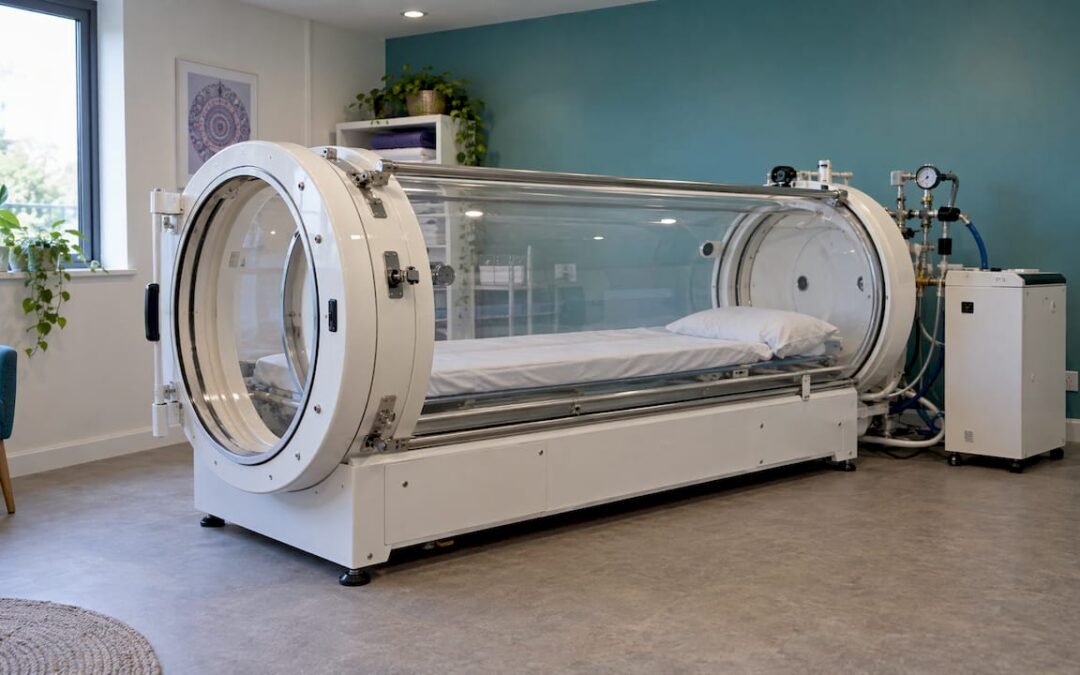
Hyperbaric oxygen therapy (HBOT), breathing oxygen inside a pressurised chamber, has been shown in human studies to release stem cells from your bone marrow into your bloodstream. That is called stem cell mobilisation. It is not the same as growing new stem cells, and it is not the same as a stem cell treatment. Once you know the difference, the research becomes much easier to read and you can decide with confidence whether a course of sessions suits you. At Live5DHealth in Boyle, County Roscommon, we offer hyperbaric oxygen therapy, and this guide sets out what the science says, in plain terms.
TL;DR
- In human studies, a course of HBOT was followed by higher numbers of circulating stem and progenitor cells. The cells come from your existing bone marrow stores, so HBOT mobilises them rather than creating new ones.
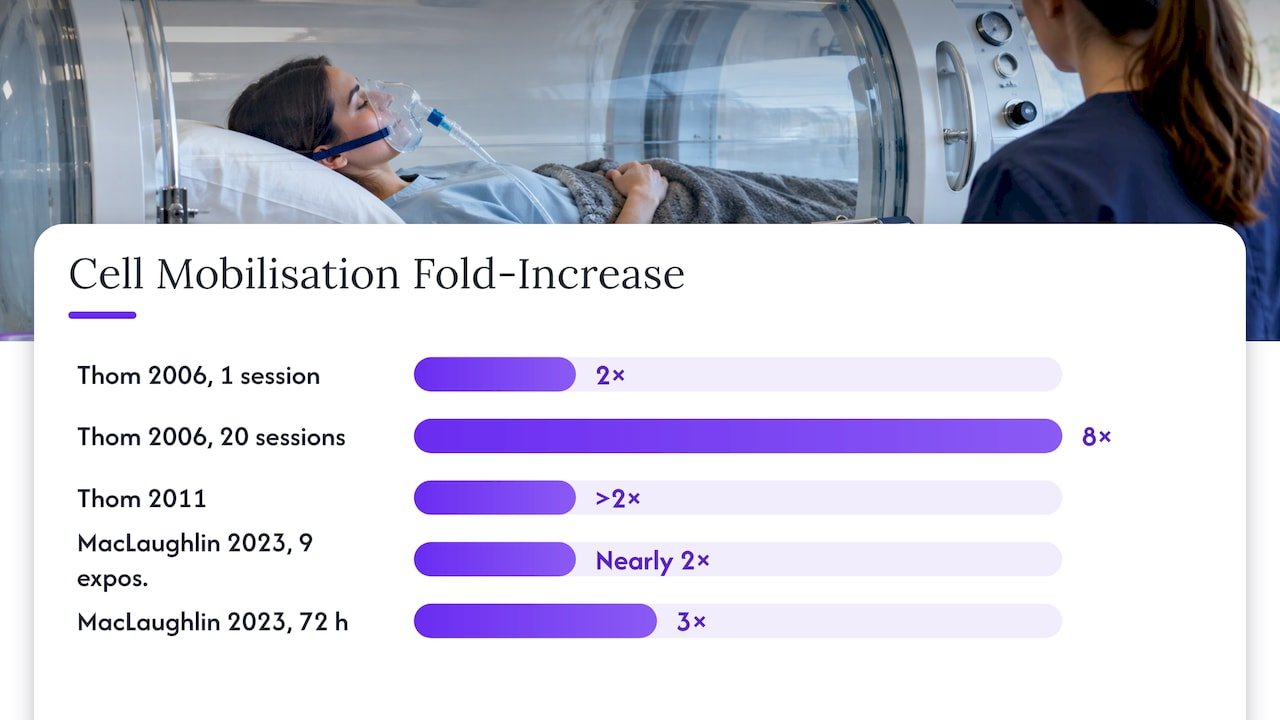
- A 2006 study found that one 2-hour session at 2.0 ATA doubled CD34+ cells in the blood, and a course of 20 sessions raised them eightfold.
- The rise is temporary and tends to fall back between sessions, which is why studies measure across a full course.
- Mobilising your own cells is different from stem cell therapy, which is a regulated medical treatment in Ireland.
- If you have or have had cancer, speak to your oncology team before booking any hyperbaric session.
Table of Contents
- Mobilising stem cells is not the same as making them
- What human studies actually measured
- How long the effect lasts
- What the released cells are thought to do
- Mobilised stem cells versus stem cell therapy
- What HBOT is authorised for in Ireland
- If you have or have had cancer
- Safe use: what to check before a course
- Our perspective
- Book hyperbaric oxygen in Boyle
- FAQ
- Sources
Mobilising stem cells is not the same as making them
Stem cells are the body’s repair reserve. They sit mostly in bone marrow and, when called on, can develop into the cells that rebuild blood vessels and tissue. Researchers often track them by a marker on their surface called CD34. A count of CD34+ cells in a blood sample gives a snapshot of how many repair-ready cells are circulating at that moment.
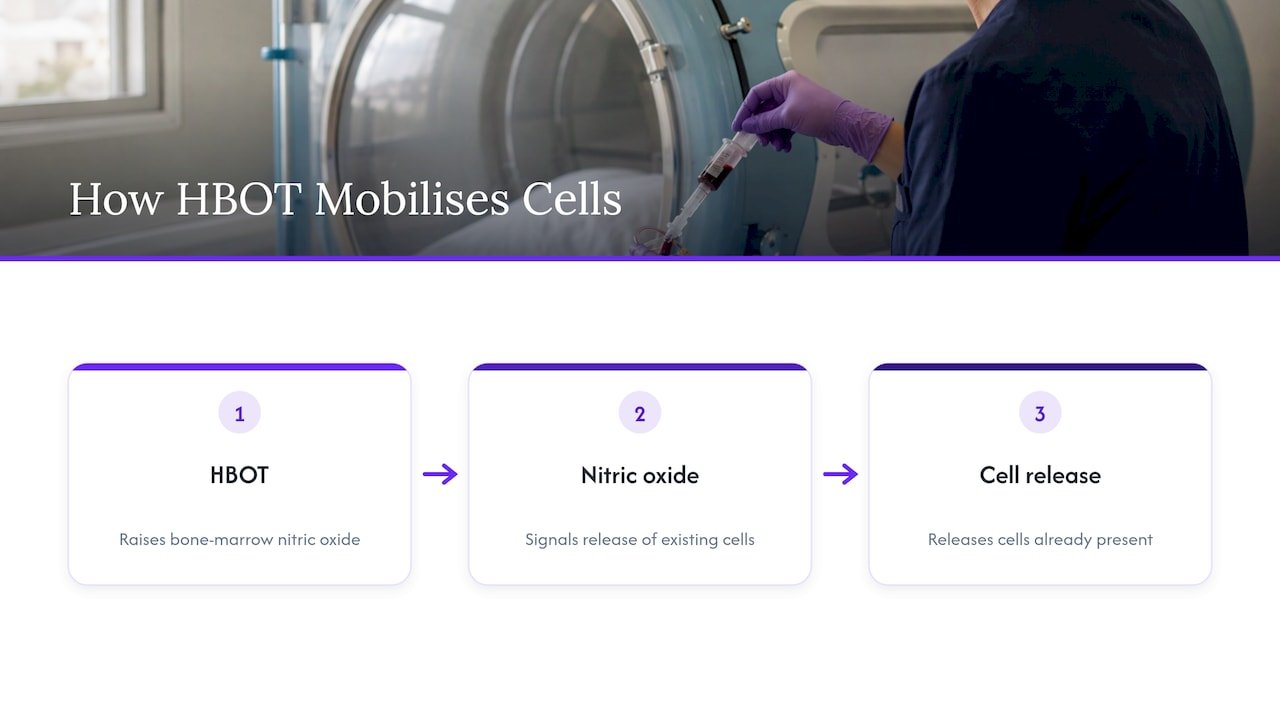
The key research here comes from a team led by Dr Stephen Thom. They found that hyperbaric oxygen works through nitric oxide: bone marrow nitric oxide levels rose sharply with HBOT, and mobilisation did not occur in mice that lacked the gene needed to make it. In other words, the signal is chemical, and the cells released were already there. Thom’s later review adds that, unlike growth-factor injections, HBOT does not push up the circulating white blood cell count at the same time, and that in animal models the released cells travel to wounds and help healing.
So when you see a claim that oxygen “produces” stem cells, read it as “releases” them. That is the accurate and still encouraging version: your body already holds a reserve, and pressurised oxygen is one of the signals shown to call it out.
What human studies actually measured
The figures below come from published studies in people. They measured blood counts, not symptoms, so they show that mobilisation happens rather than promising a particular result for you.
| Study | Who took part | What was measured |
|---|---|---|
| Thom et al., 2006 | Human volunteers | One 2-hour session at 2.0 ATA doubled CD34+ cells; 20 sessions gave an eightfold increase, with no significant rise in total white cell count |
| Heyboer et al., 2014 | 20 patients | CD34+/CD45-dim counts about twice pre-treatment levels at both 2.0 and 2.5 ATA |
| Thom et al., 2011 | Diabetic patients with stubborn foot ulcers | More than a twofold rise in circulating stem and progenitor cells after HBOT |
| MacLaughlin et al., 2023 | 10 healthy volunteers | At a gentler 1.27 ATA with room air, nearly twofold mobilisation after 9 exposures and threefold 72 hours after the last |
ATA stands for atmospheres absolute, a measure of pressure: 1.0 is normal air pressure at sea level, so 2.0 ATA is double that.
Two details are worth noticing. First, in the 2014 study the group treated at 2.5 ATA showed significantly greater mobilisation at later treatment points, by 1.9 to 3 times, than the 2.0 ATA group. Pressure and course length both appear to matter. Second, the 2023 study found that mobilisation is not exclusive to 100% oxygen, since pressurised room air also produced a rise. Research is still exploring exactly which combination of pressure, gas and number of sessions does what.
How long the effect lasts
This is where honest reading helps. In the diabetic ulcer study, the cell count rose more than twofold after treatment, then returned to baseline before the tenth session and sat 1.6 times above the starting level before the twentieth. The nitric oxide enzyme activity measured in platelets, a related marker, stayed elevated when re-tested 22 hours later.
In the 2023 volunteer study, the highest level was recorded three days after the final session. The practical lesson is that the benefit of mobilisation is described across a course, not a single visit. Studies use 10 or 20 sessions for that reason, and any provider telling you one session transforms your stem cell count is going beyond the evidence.
If you want to get the most from a course, our guide on how to maximise results from hyperbaric oxygen therapy covers preparation, regularity and what to do between sessions.
What the released cells are thought to do
Thom’s review describes a proposed repair pathway: nitric oxide, together with growth signals known as VEGF and stromal-derived factor, helps form new blood vessels and recruit cells to wounds. A 2022 survey of the field covers experimental and clinical work on tissue repair in neural, bone, cartilage, muscle and cardiac tissue. That is the reason people ask whether stem cells can help the lungs or heart.
The honest answer is that these are active research areas. The survey describes experimental findings, and does not show that HBOT reliably regenerates a human heart or repairs human lungs. If you are living with a heart or lung condition, your consultant or GP remains the person to guide your care, and HBOT is something to discuss with them.
For a wider view of the established uses and the areas under study, see our hyperbaric oxygen therapy health benefits guide and our explanation of why pure oxygen promotes healing.
Mobilised stem cells versus stem cell therapy
These two phrases get blurred online, so here is the line between them.
- Stem cell mobilisation (what HBOT is studied for): your own cells are released from your own bone marrow into your blood. Nothing is taken out, grown or put back.
- Cell-based therapy: cells from you or a donor are collected and often processed in a laboratory, then given as a medicine.
In Ireland the second category sits under medicines regulation. The Health Products Regulatory Authority (HPRA), the national medicines regulator, explains that cell-based therapies use blood or cells from a patient or donor, that substantially manipulated cells must follow special safety rules, and that stem cells usually need specific laboratory preparation to target particular diseases. The HPRA also reported the withdrawal of one authorised stem cell medicine, Alofisel, from the EU market in December 2024, a reminder that authorised stem cell medicines are specific products for specific conditions.
If you are weighing up any regenerative offer, a useful habit is to ask what exactly is being given, under what authorisation, and for which condition. For help thinking through how to assess regenerative claims, you can read this resource on evaluating regenerative research claims.
What HBOT is authorised for in Ireland
The HPRA’s product information for medical oxygen in hyperbaric use, revised April 2024, lists the authorised hospital indications: serious carbon monoxide poisoning, decompression sickness or gas embolism, and supporting treatment for osteoradionecrosis (bone damage after radiotherapy) and clostridial myonecrosis (a severe tissue infection). It describes sessions of 45 to 300 minutes at 1.4 to 3.0 atmospheres, and names untreated pneumothorax (a collapsed lung) as the one absolute contraindication.
Wellness sessions are a different setting from those hospital uses. The stem cell findings above come from research studies, and they explain why many people are interested in a course of sessions as part of looking after their health.
If you have or have had cancer
Many women over 40 who contact us are navigating a cancer diagnosis or recovery, so this deserves care. The evidence here is a field under investigation, and decisions belong with your oncology team.
- A 2020 review describes hyperoxia, meaning raised oxygen levels, as an investigated adjunct rather than an established stand-alone cancer treatment. HBOT is not a replacement for surgery, chemotherapy, radiotherapy or any treatment your team recommends.
- A 2025 review of brain tumour research reports that preclinical findings point in different directions and that clinical application remains unsettled. Because stem and progenitor cells take part in tissue growth, ask your oncologist whether a course is appropriate for your specific cancer and stage before you book.
- The Undersea and Hyperbaric Medical Society reviewed the question in 2003 and concluded that a history of cancer should not itself be considered a contraindication, while that review does not replace advice on your own case.
- After head and neck radiotherapy, the 2024 ISOO-MASCC-ASCO guidance says that HBOT for preventing or managing jaw osteoradionecrosis has limited supporting evidence. This is international professional guidance, not Irish national guidance, so talk it through with your radiation oncologist.
Our guide on how HBOT supports cancer treatment goes deeper into this for people in your position.
Safe use: what to check before a course
HBOT has a well-documented safety profile when it is used properly, and knowing the points below helps you use it well.
- Ears and sinuses. Pressure changes can affect the middle ear. A 2026 review identifies middle-ear barotrauma as the most common adverse event, at 9.3% among 5,900 patients in a cited review. Difficulty equalising ear pressure, a cold or sinus congestion are worth mentioning before a session.
- Lungs. Untreated pneumothorax is the one absolute contraindication in the HPRA product information. Mention any lung disease in advance.
- Seizure risk. Central nervous system oxygen toxicity, which can show as a seizure, occurs at roughly 1 to 4 per 10,000 treatments. Tell us about any history of seizures.
- Eyes. Prolonged daily courses can cause temporary short-sightedness that typically reverses within six weeks of finishing.
- Diabetes. Blood sugar can dip during treatment, so people with diabetes should plan around that with their care team.
- Claustrophobia. Some people find the chamber enclosed. Tell us beforehand.
Our hyperbaric therapy contraindications guide lists these in full so you can go through them with your GP or specialist.
Our perspective
We meet people every week who have read that oxygen “grows stem cells” and want to know if it is true. We say it the way the research does: HBOT is studied for releasing your own stem and progenitor cells from bone marrow, and the strongest figures come from courses of sessions rather than a single visit.
That is why we think of HBOT as a course you commit to, at a centre built around your whole wellbeing. Alongside hyperbaric oxygen, Live5DHealth offers red light therapy, PEMF, EWOT and a sauna, steam room and cold plunge spa, and we aim for a holistic approach that combines modern technology with ancient wisdom. You can read more on how these fit together in our guide to combining hyperbaric therapy with other wellness treatments.
Your body already holds a remarkable repair reserve. Giving it the right conditions, with guidance from your own doctors, is a hopeful place to start.
Mark
Book hyperbaric oxygen in Boyle
Hyperbaric oxygen therapy at Live5DHealth is priced at €80–€120 per session. You will find the details and booking on our hyperbaric oxygen therapy page. If you would like to build a longer programme around it, our 3, 5 and 10-day wellness retreats are an option, and membership includes free energised water.

If you are living with cancer or recovering from it, speak to your oncology team first, then get in touch and we will be glad to help you plan your sessions.
FAQ
Does hyperbaric oxygen therapy create new stem cells?
No. The research shows HBOT releases existing stem and progenitor cells from your bone marrow into the blood, through a nitric oxide signal. The effect is measured in blood counts across a course of sessions.
How many sessions are used in the studies?
The key studies sampled blood across courses of 10 or 20 sessions. In the 2006 study, one session doubled CD34+ cells and 20 sessions gave an eightfold rise. Your own plan should be agreed with your doctor and with us.
Is hyperbaric oxygen the same as stem cell therapy?
No. Stem cell therapy is a cell-based medicine, using cells from you or a donor, and it is regulated in Ireland by the HPRA. HBOT is studied for mobilising your own cells and involves no cells being taken out or put back.
Can I have hyperbaric oxygen if I have had cancer?
A history of cancer has not itself been considered a contraindication in professional reviews, but your situation is individual. Ask your oncologist before booking, and bring any questions about your treatment stage and type of cancer.
Sources
- Stem cell mobilization by hyperbaric oxygen, Thom et al. 2006
- Hyperbaric oxygen: its mechanisms and efficacy, Thom 2011
- CD34+/CD45-dim stem cell mobilization by hyperbaric oxygen, Heyboer et al. 2014
- Vasculogenic stem cell mobilization and wound recruitment, Thom et al. 2011
- Hyperbaric air mobilizes stem cells in humans, Frontiers in Neurology 2023
- Hyperbaric Oxygen Therapy and Tissue Regeneration: a survey, 2022
- HPRA: Cell-based therapies, advice for patients
- HPRA: Alofisel withdrawal from EU market, 19 December 2024
- HPRA: Summary of Product Characteristics, April 2024
- Role of hyperoxic treatment in cancer, 2020
- Dual effects and clinical application prospects of hyperbaric oxygen, 2025
- ISOO-MASCC-ASCO guideline on osteoradionecrosis, May 2024
- UHMS: Does hyperbaric oxygen promote growth or recurrence of cancer, 2003
- Perioperative hyperbaric oxygen therapy: mechanisms, 2026