
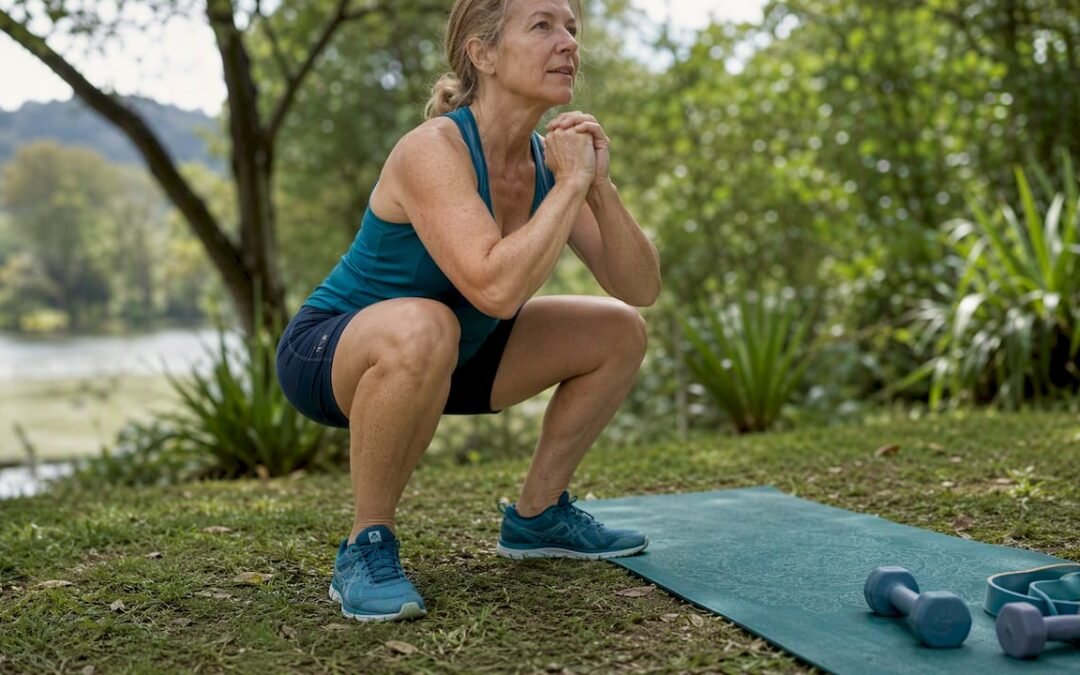
Functional fitness for women means training the movement patterns you already use every day, such as squatting, bending, pushing, pulling and carrying, so those movements become stronger, safer and easier. As the Cleveland Clinic explains, it is best understood relative to your own daily demands, whether that means lifting a toddler, carrying shopping bags, or getting up from the floor with confidence. The goal is not aesthetics. It is capability.
Quick takeaways before you read on:
- What it trains: seven core movement patterns (squat, hinge, lunge, push, pull, carry, rotation/balance) rather than isolated muscles. The specific movement patterns most programmes emphasise may vary slightly, but always include those needed for daily function.
- Who benefits: women at every life stage, from beginners and postpartum women to those navigating menopause and older adults
- Equipment needed: bodyweight, dumbbells, kettlebells or resistance bands; a gym is optional
- The immediate result: everyday tasks feel less effortful, your balance improves, and your risk of injury drops
A ready-to-use 15–20 minute starter circuit appears later in this guide. You can run it at home today with no equipment.
Key takeaways
Functional fitness for women is one of the most evidence-backed, life-stage-adaptable approaches to movement available. Programmes and circuits typically last 15–20 minutes and can be tailored to current fitness and needs, with specific movement patterns and intensity adjusted for individual life stage and ability.
| Point | Details |
|---|---|
| Core definition | Functional fitness trains movement patterns (squat, hinge, push, pull, carry) used in daily life, not isolated muscles. |
| Evidence base | A six-week RCT in women aged 63.5 on average showed significant gains in balance, strength and walking speed. |
| Mental health benefit | A systematic review of 21 studies found moderate-intensity functional training reduces anxiety and depression in older women. |
| Safe for all life stages | Any movement can be modified by adjusting tempo, reps or resistance, making it accessible from postpartum to older adulthood. |
| Live5dhealth | Live5dhealth in Boyle offers tailored functional movement programmes alongside recovery therapies for women at every life stage. |
Table of Contents
- What does functional fitness mean for women?
- Why functional fitness matters for women at every life stage
- What does functional training actually include?
- Essential functional exercises for women, with regressions and progressions
- How to build short functional workouts that fit your week
- How does functional fitness compare to strength training and HIIT?
- Safety guidance and life-stage considerations
- What the evidence says about functional training for women
- A 15–20 minute starter circuit you can do today
- Why functional fitness is the most honest form of training
- Functional fitness and wellness at Live5dhealth
- Sources
What does functional fitness mean for women?
Functional fitness is a training method designed to mirror real-life movements rather than isolate individual muscles. Nike’s training resource notes it originated in physical therapy before spreading into athletic and military conditioning, and the core principle has never changed: build transferable movement competency. You train the body to work as a coordinated system, not a collection of parts.
For women specifically, that principle lands differently at different life stages. A new mother needs hip-hinge strength to lift safely from the floor. A woman in her fifties needs single-leg balance to navigate stairs confidently. A woman managing a chronic condition needs low-impact, scalable movement that keeps her active without flaring symptoms. Functional training addresses all three scenarios with the same toolkit, adjusted for the individual.
What sets it apart from traditional gym work is its emphasis on multi-joint, multi-plane movements. A bicep curl trains one muscle in one plane. A single-arm farmer’s carry trains your grip, core, shoulders, hips and ankles simultaneously, in the same way carrying a heavy bag of groceries does. That transfer to real life is the point.
Why functional fitness matters for women at every life stage
Strength for daily tasks
The most immediate benefit is practical strength. Squatting to pick something up, pushing open a heavy door, carrying bags from the car: these are loaded movements your body performs dozens of times a day. Functional training builds the specific strength those tasks require, which means less strain, fewer minor injuries, and noticeably more energy at the end of a busy day.
Balance, fall prevention and bone health
Balance deteriorates gradually and quietly, and for women the consequences are significant. Harvard Health identifies functional tests such as the single-leg stance and sit-to-stand as reliable indicators of fall risk, and functional training directly targets both. Weight-bearing exercises like carries and split squats also place mechanical load on bone, which is the stimulus bone needs to maintain density. This is particularly relevant during and after menopause, when oestrogen decline accelerates bone loss. Understanding the cardiovascular and metabolic changes at menopause adds further context for why structured, progressive movement matters so much during this period.
Mental health and quality of life
The psychological benefits are well-supported. A systematic review across 21 studies from 12 countries found that the majority of functional fitness interventions in women aged 60 and over produced statistically significant reductions in anxiety and depression, alongside improvements in social functioning. Notably, moderate-intensity exercise delivered similar mental health gains to high-intensity work, which means you do not need to push hard to feel better.
Statistic callout: A systematic review found most studies reported significant mental health benefits from functional fitness in older women, including reduced anxiety and improved social functioning, at moderate intensity.
Pro Tip: If you are postpartum or managing a chronic condition, even two short functional sessions per week can support mood and energy. Pair your training with adequate protein; the best protein powders for women over 40 can help meet recovery needs when whole-food intake is difficult.
What does functional training actually include?
The seven movement patterns
Every functional programme is built around a small set of movement patterns. Learn to recognise them and you can assess any exercise instantly.
- Squat: sitting down and standing up; trains quads, glutes, core
- Hinge: bending to pick something up from the floor; trains hamstrings, glutes, lower back
- Lunge: stepping up stairs or stepping off a kerb; trains single-leg stability and hip strength
- Push: pushing a pram, opening a door; trains chest, shoulders, triceps
- Pull: lifting a bag overhead, opening a drawer; trains back, biceps, rear shoulders
- Carry: walking with shopping, carrying a child; trains grip, core, full-body stability
- Rotation and balance: turning to reach behind you, stepping on uneven ground; trains core and proprioception
Training principles that make it “functional”
Healthline notes that functional training uses bodyweight and simple equipment and tends to be lower impact than high-intensity trends, making it well-suited to beginners and those in rehabilitation. The principles that define it are: multi-joint loading, movement across multiple planes, progressive overload matched to daily-life demands, and a consistent emphasis on mobility and coordination alongside strength.
Equipment choices are simple. Bodyweight is sufficient for beginners and for home training. Resistance bands add load without requiring a gym. Dumbbells and kettlebells extend the range of exercises available and allow precise load progression. A gym setting adds barbells, cable machines and coaching access, but none of these are necessary to start.
One practical note: for any exercise you have not done before, seek a short video demonstration or a single coached session before adding load. Technique errors under fatigue are where most functional training injuries occur.
Essential functional exercises for women, with regressions and progressions
Women’s Health UK confirms that functional training is adaptable across ages and abilities because any movement can be altered by adjusting tempo, repetitions or resistance. The exercises below reflect that principle. Each includes a regression for beginners or those returning from injury, a progression for when the base movement feels easy, and brief coaching cues.
Bodyweight squat
Why it’s functional: mirrors sitting and standing, the most repeated movement in daily life.
Regression: sit to a chair and stand, using hands lightly for balance. Progression: goblet squat holding a dumbbell or kettlebell at the chest. Cues: feet hip-width apart, chest tall, knees track over toes, lower until thighs are parallel to the floor.
Hip hinge / Romanian deadlift
Why it’s functional: trains the bending pattern used every time you lift from the floor.
Regression: hinge against a wall, pushing hips back to touch it. Progression: single-leg Romanian deadlift with a light dumbbell. Cues: soft knees, neutral spine, hinge from the hips not the waist, feel the hamstrings load.
Pregnancy/postpartum note: keep the load light and avoid breath-holding (Valsalva); consult a pelvic health physiotherapist before returning to loaded hinges postpartum.
Reverse lunge
Why it’s functional: replicates stepping down stairs and recovering balance after a stumble.
Regression: step back onto a low step rather than the floor. Progression: add a dumbbell in each hand or a front-foot elevation. Cues: keep the front shin vertical, lower the back knee toward the floor with control, drive through the front heel to return.
Push-up
Why it’s functional: trains the pushing pattern used in getting up from the floor and pushing objects.
Regression: hands on a bench or wall (incline push-up). Progression: feet elevated on a bench (decline push-up) or add a resistance band across the back. Cues: body forms a straight line from head to heels, elbows at roughly 45 degrees, lower chest to surface.
Bent-over row
Why it’s functional: mirrors pulling open a heavy door or lifting a bag from a low shelf.
Regression: seated resistance-band row. Progression: single-arm dumbbell row with a hip-hinge position. Cues: hinge forward 45 degrees, pull the elbow past the hip, squeeze the shoulder blade at the top.
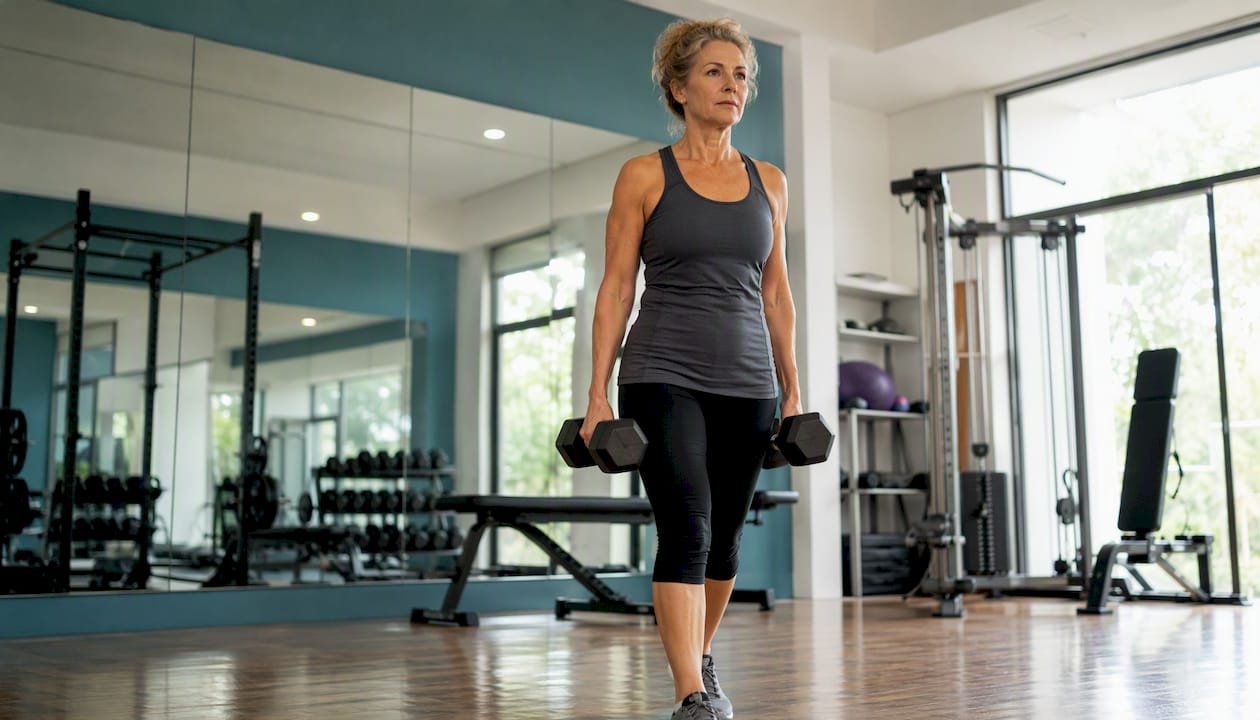
Farmer’s carry
Why it’s functional: Harvard Health recommends the farmer’s walk specifically for building the carrying strength older adults need for independence. Regression: carry one light dumbbell at the side (suitcase carry). Progression: heavier dumbbells or a single kettlebell overhead. Cues: shoulders back and down, core braced, walk with short deliberate steps.
Plank and anti-rotation hold
Why it’s functional: builds the core stability that protects your spine during every other movement.
Regression: plank from the knees. Progression: plank with alternating arm or leg lift. Cues: hips level, breathe steadily, avoid letting the lower back sag.
Older adult note: the split squat (a stationary lunge) and the kettlebell deadlift are particularly well-suited to older women because they directly address the sit-to-stand and bending tasks that most affect independence.
Pro Tip: Start each session with two minutes of hip circles, ankle rolls and shoulder rotations. Warming up the joints before loading them reduces injury risk and makes every rep feel cleaner.
How to build short functional workouts that fit your week
Frequency and session structure
Two to four sessions per week is the practical range for most women. Two sessions maintain function and support recovery; four sessions allow meaningful progression. Each session follows the same basic structure:
- Warm-up (5 minutes): joint mobility, light cardio (marching, step-touches), activation (glute bridges, band pull-aparts)
- Movement practice (15–20 minutes): the main exercises, performed with attention to technique
- Conditioning (optional, 5 minutes): a short circuit or carries to raise heart rate
- Cool-down (5 minutes): static stretches targeting hips, hamstrings and thoracic spine
Sample one-week plan (three sessions)
Women’s Health UK’s four-week functional plan demonstrates how to combine strength, aerobic work and metabolic conditioning across a week. A simple three-session structure looks like this:
- Monday: lower-body focus (squat, hinge, lunge variations) — 3 sets of 10–12 reps each
- Wednesday: upper-body and carry focus (push-up, row, farmer’s carry) — 3 sets of 8–10 reps each
- Friday: full-body circuit (one exercise per pattern, 40 seconds on/20 seconds off, three rounds)
Rest at least one day between sessions. On rest days, a 20-minute walk counts as active recovery and reinforces the gait pattern.
Progression checklist
Move to the next level when you can complete all sets with clean technique and without excessive fatigue. Progress in this order:
- Movement quality (no compensation, full range)
- Volume (add one set before adding load)
- Load (increase weight by the smallest available increment)
- Range of motion (deepen the squat, lengthen the hinge)
- Complexity (add a balance challenge or a second movement in the same rep)
How does functional fitness compare to strength training and HIIT?
Each approach has a distinct primary purpose, and the best programmes for most women combine elements of all three.
| Attribute | Functional fitness | Traditional strength training | HIIT |
|---|---|---|---|
| Primary goal | Transfer to daily life movements | Maximise force output or muscle size | Cardiorespiratory conditioning |
| Movement type | Multi-joint, multi-plane | Often single-joint or bilateral | Varied; often plyometric |
| Typical equipment | Bodyweight, bands, dumbbells, kettlebells | Barbells, machines, heavy dumbbells | Bodyweight, light equipment |
| Impact level | Low to moderate | Low to moderate | Moderate to high |
| Best suited for | All life stages, beginners, rehab, busy schedules | Intermediate to advanced; hypertrophy goals | Those with a solid movement base |
| Injury risk for beginners | Low when technique is sound | Moderate with heavy loads | Higher without conditioning base |
Functional training trains multi-joint, multi-muscle patterns rather than isolated exercises, which means it builds the mobility and coordination that strength training and HIIT often assume you already have. A practical combination for a busy woman: two functional sessions per week as the foundation, with one strength session added when confidence grows. HIIT fits well once movement quality is established, typically after six to eight weeks of consistent functional work.
Safety guidance and life-stage considerations
Pregnancy and postpartum
- Consult your midwife or GP before starting or continuing any exercise programme during pregnancy; most low-impact functional work is safe with clearance.
- Avoid exercises that create high intra-abdominal pressure (heavy loaded carries, breath-holding under load) in the third trimester and early postpartum period.
- Postpartum: begin with pelvic floor activation and gentle walking before progressing to loaded movements; a pelvic health physiotherapist can assess readiness. Guidance on exercise during pregnancy confirms that appropriate movement supports recovery and wellbeing.
- Return to impact exercise (jumping, running) only after pelvic floor function is confirmed, typically no earlier than 12 weeks postpartum.
Menopause and bone health
- Weight-bearing functional exercises (carries, squats, lunges) place the mechanical load on bone that helps maintain density during oestrogen decline.
- Progress loading gradually; bone adaptation is slow and responds to consistent, progressive stimulus over months.
- Avoid high-impact moves if osteoporosis has been diagnosed; focus on resistance-based functional work and balance training instead.
Older adults and fall prevention
- Prioritise balance work (single-leg stance, tandem walking) and the sit-to-stand pattern in every session.
- Begin with bodyweight only and progress load only when movement quality is consistent.
- A physiotherapist assessment is worthwhile before starting if you have had a fall in the past year or have a diagnosed balance condition.
Red flags: when to consult a professional
- Unusual or sharp pain during any exercise
- Pelvic pressure, heaviness or bulging sensation (possible pelvic organ prolapse)
- Vaginal bleeding outside of normal menstruation
- Dizziness, chest pain or shortness of breath disproportionate to effort
- Any of the above warrant a GP or pelvic health physiotherapist appointment before continuing. Women managing chronic fatigue may also benefit from reviewing how HBOT supports chronic fatigue as a complementary approach.
What the evidence says about functional training for women
Two studies in particular give the clearest picture of what functional training actually delivers.
A randomised controlled trial of older women put participants through a functional training programme lasting several weeks with frequent sessions. Compared with controls, the training group showed statistically significant improvements (p < .05) in dynamic balance, lower-body strength, walking speed and aerobic endurance, alongside improved quality of life. The limitation is the small sample and short duration; longer trials with larger groups are needed to confirm how long gains persist.
A systematic review of 21 studies from 12 countries examined mental health outcomes after functional fitness interventions in women aged 60 and over. Most studies reported significant reductions in anxiety and depression and improved social functioning. Crucially, moderate-intensity exercise produced similar mental health benefits to high-intensity work, which has direct practical implications for women who cannot or prefer not to train hard.
The overall practical implication is clear: functional training is safe and effective when tailored to the individual, and even short, moderate-intensity programmes produce meaningful improvements in physical function and wellbeing.
A 15–20 minute starter circuit you can do today
This circuit uses four moves drawn from the core movement patterns. It requires no equipment, though a pair of light dumbbells extends the challenge. Run it two to three times per week.
Format: 40 seconds work / 20 seconds rest per exercise; complete three rounds; rest 60–90 seconds between rounds.
-
Bodyweight squat (or goblet squat with a dumbbell)
Regression: squat to a chair. Progression: add a dumbbell held at the chest.
Cues: chest tall, knees track toes, lower until thighs are parallel. -
Hip hinge (or Romanian deadlift with dumbbells)
Regression: hinge against a wall. Progression: single-leg hinge with a light dumbbell.
Cues: soft knees, neutral spine, push hips back until you feel the hamstrings load. -
Incline or full push-up
Regression: hands on a kitchen counter or wall. Progression: feet elevated on a step.
Cues: straight line from head to heels, elbows at 45 degrees, lower chest to surface. -
Reverse lunge (or split squat hold)
Regression: step back onto a low step. Progression: hold a dumbbell in each hand.
Cues: front shin vertical, back knee lowers with control, drive through the front heel to return.
How to track progress: after each session, note your perceived effort on a scale of 1–10 (RPE). When the circuit feels like a 5 or below, add a fourth round, increase the dumbbell weight, or swap in the progression variant. Cleaner technique on the same weight is also progress; do not overlook it.
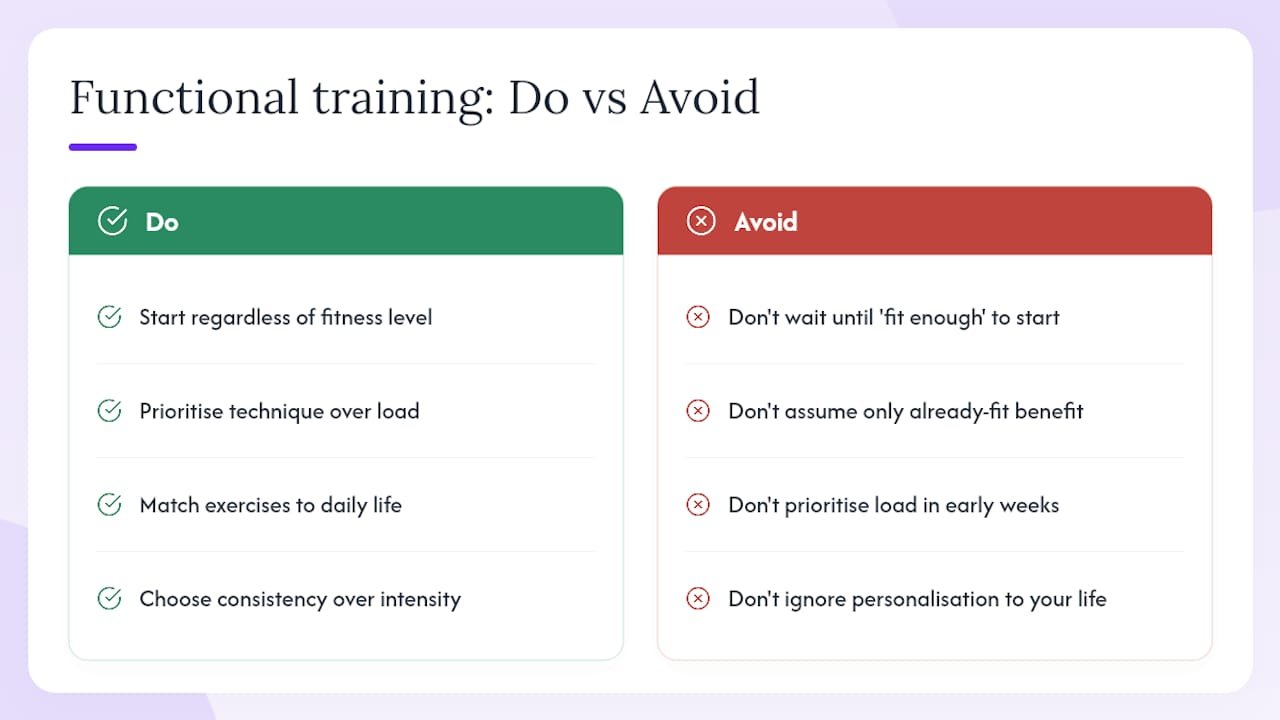
Why functional fitness is the most honest form of training
There is a version of fitness culture that optimises for how you look in a mirror. Functional training optimises for how you move through your actual life, and that distinction matters more than most people realise when they start out.
The evidence from the RCT and systematic review cited in this guide points to something that gets underplayed in mainstream fitness content: the women who benefit most from functional training are not the ones who were already fit. They are the ones who had lost confidence in their bodies, whether through age, childbirth, illness or simply years of sedentary work. A six-week programme of modest intensity produced measurable improvements in balance, strength and quality of life. That is not a small thing.
What I find most compelling about functional training for women is the personalisation principle. The Cleveland Clinic’s guidance is explicit: the most effective routines mirror the specific physical demands an individual faces in daily life, whether that is gardening, childcare or a physically demanding job. A programme built around your life is one you will actually keep doing. And consistency, not intensity, is what produces lasting change.
The common mistake is waiting until you feel “fit enough” to start. You do not need a fitness base to begin functional training. You need the willingness to move, a few square metres of floor space, and the patience to prioritise technique over load in the first few weeks.
Functional fitness and wellness at Live5dhealth
If you want the benefits of functional training with expert guidance from day one, Live5dhealth in Boyle offers a genuinely different starting point. Rather than a standard gym membership, you get access to a wellness environment that combines movement coaching with recovery therapies, including luxury sauna, cold plunge, and red light therapy, all designed to support the kind of consistent, progressive training that produces real results.

For women navigating menopause, postpartum recovery, or chronic conditions, the combination of coached functional movement and evidence-based recovery therapies is particularly well-suited. Programmes are tailored to your current ability and daily demands, so you are never handed a generic plan. Whether you are looking for a luxury spa and wellness experience or a structured health retreat in Ireland that includes movement workshops, Live5dhealth has the facilities and the expertise to support your goals. Visit the website or contact the team in Boyle to find out what is available for your life stage and starting point.
Sources
The sources below are worth bookmarking if you want to go deeper on any aspect of functional training.
Cleveland Clinic: Getting Started With Functional Strength Training covers the core definition, movement-pattern framework and personalisation principle in clear, clinician-reviewed language. It is the most practical starting point for understanding what makes a movement “functional.”
PubMed / NCBI (RCT, 2024) hosts the full text of the randomised controlled trial in older women referenced throughout this guide. Reading the methods section gives a clear picture of what a six-week functional programme actually looks like in practice.
PubMed / NCBI (Systematic Review, 2025) provides the full systematic review on mental health outcomes of functional fitness in older women, including the breakdown of study quality and intensity comparisons across 21 articles.
Harvard Health: Three Moves for Functional Fitness offers a concise, expert-written introduction to the split squat, kettlebell deadlift and farmer’s walk, with clear explanations of why each addresses a specific daily-life task.
Women’s Health UK: Functional Training gives practical programming guidance and a four-week starter plan, with modifications for different fitness levels. Particularly useful for readers who want a structured weekly template.
Healthline: Why Functional Fitness Is Important for Everyone provides accessible background on equipment options, impact levels and suitability for beginners and those in rehabilitation.
Live5dhealth: Why Cardiovascular Risk Rises at Menopause offers context on the physiological changes during menopause that make functional training and progressive loading especially valuable for women in this life stage.
This article is general information, not a substitute for advice from a qualified doctor. Consult a qualified healthcare professional about your own circumstances before acting on anything here.
- Getting Started With Functional Strength Training
- Randomised controlled trial of functional training in older women
- Systematic review: mental health outcomes of functional fitness in older women
- Three moves for functional fitness (Harvard Health)
- What Is Functional Training?
- Why Functional Fitness Is Important for Everyone (Healthline)