

Hyperbaric therapy combined wellness treatments are defined as structured, multi-modality programmes that pair hyperbaric oxygen therapy (HBOT) with complementary treatments such as red light therapy, cryotherapy, and compression therapy to accelerate cellular repair and recovery. For adults over 40, this approach addresses the compounding effects of ageing: slower tissue repair, chronic inflammation, declining cognitive function, and reduced mitochondrial efficiency. The core industry term is hyperbaric oxygen therapy, or HBOT. When combined thoughtfully with other evidence-based modalities, HBOT produces benefits that no single treatment achieves alone.
1. What is medical-grade hyperbaric oxygen therapy and how does it work?
Medical-grade HBOT is defined by two non-negotiable parameters: 100% pure oxygen delivered at pressures between 1.5 and 3.0 ATA inside a hard-shell monoplace chamber. At that pressure, oxygen dissolves directly into your blood plasma at concentrations 10 to 20 times higher than normal. That saturated oxygen reaches tissues that standard circulation cannot adequately supply.
The physiological effects are specific and measurable. HBOT drives angiogenesis (the formation of new blood vessels), reduces systemic inflammation, and boosts BDNF, the protein responsible for neuroplasticity and cognitive function. Studies show prolonged therapy can lengthen telomeres and clear senescent cells. For anyone over 40, those two outcomes alone are worth understanding.

Sessions typically last 90 minutes at therapeutic pressure. Wound healing benefits emerge between 10 and 20 sessions; neurological conditions may require up to 40 sessions. This is not a single-visit treatment. It is a course of therapy requiring commitment and physician oversight.
The distinction between medical-grade chambers and mild “soft-shell” wellness devices matters enormously. Soft-shell chambers operate at only 1.1–1.3 ATA using ambient air, not pure oxygen. They do not meet the clinical thresholds required for the benefits described above. If you are serious about results, the chamber specification is the first question to ask.
- Sessions: 90 minutes at 1.5–3.0 ATA, breathing 100% oxygen
- Course length: 10–40 sessions depending on condition
- Chamber type: hard-shell monoplace or multiplace only for clinical benefit
- Physician referral: required for safety and protocol design
- Key effects: angiogenesis, inflammation reduction, cognitive support, cellular repair
Pro Tip: Ask any clinic for their chamber’s ATA rating and oxygen source before booking. If they cannot confirm 100% oxygen at 1.5 ATA or above, the treatment will not deliver clinical-grade results.
2. Which wellness treatments combine effectively with hyperbaric therapy?
The most effective complementary treatments target different cellular systems simultaneously, so their combined effect exceeds what each achieves separately. Sequencing matters as much as selection. Randomly pairing treatments reduces effective outcomes, particularly in non-medical wellness settings.
Red light therapy uses wavelengths of 630–850 nanometres to stimulate mitochondria, the energy-producing structures inside every cell. When red light therapy precedes HBOT, it primes mitochondria to use the incoming oxygen surge more efficiently. This synergistic effect produces higher ATP output and faster cellular repair than either treatment alone.
Cryotherapy works best after HBOT, not before. Cold exposure causes vasoconstriction. Applied before HBOT, it would restrict the blood flow needed to distribute the oxygen-rich plasma. Applied after HBOT, it reduces post-session inflammation and supports muscle recovery without interfering with oxygen delivery.
Compression therapy and lymphatic drainage act as adjuncts that move metabolic waste out of tissues. After HBOT increases cellular activity and repair, lymphatic drainage helps clear the byproducts of that repair process. This is particularly relevant for adults over 40 managing chronic oedema, post-surgical recovery, or joint inflammation.
- Red light therapy: mitochondrial priming before HBOT
- Cryotherapy: anti-inflammatory recovery after HBOT
- Compression therapy: lymphatic clearance post-session
- IV nutrient therapy: cellular fuel support, sequenced with physician guidance
- Infrared sauna: circulatory support, typically used on separate days
Pro Tip: Do not add treatments simply because they are available at the same centre. Each modality should have a defined physiological purpose within your programme. Ask your supervising physician to justify every addition.
3. How to sequence and schedule combined wellness therapies for optimal results
Sequencing is the difference between a well-designed programme and an expensive collection of unrelated treatments. Intentional sequencing produces the best cellular response by working with your body’s physiology rather than against it.
A well-structured session for adults over 40 follows this order:
- Red light therapy (20–30 minutes). This primes mitochondria and increases cellular energy availability. Your cells are now prepared to use the incoming oxygen more efficiently.
- Hyperbaric oxygen therapy (90 minutes). HBOT anchors the session. Plasma oxygen rises to therapeutic levels, driving angiogenesis, reducing neuroinflammation, and initiating tissue repair.
- Compression therapy or lymphatic drainage (20–30 minutes). This clears metabolic waste generated during the HBOT session and supports circulation.
- Cryotherapy (3–5 minutes). Cold exposure at this stage reduces residual inflammation and supports muscle recovery without restricting the oxygen delivery that has already occurred.
- Rest and hydration. Cellular repair continues for hours after the session ends. Adequate hydration supports plasma volume and oxygen transport.
Physician supervision is not optional in this structure. Hyperbaric oxygen functions pharmacologically as a drug, requiring dosing protocols to modulate immune responses and stimulate angiogenesis. Combining it with other active treatments amplifies both its benefits and its risks. A supervising physician coordinates the programme, adjusts session frequency, and monitors for contraindications across all modalities.
Aim for two to three combined sessions per week during an active treatment course. Spacing sessions 48 hours apart allows the repair processes initiated by HBOT to complete before the next stimulus. Consistency over weeks, not intensity in a single session, drives lasting results.
4. Comparison of combined hyperbaric healing therapies and clinical considerations
| Treatment combination | Primary benefit | Typical session time | Clinical evidence | Key consideration |
|---|---|---|---|---|
| HBOT alone | Tissue repair, angiogenesis | 90 minutes | Strong for 14 UHMS-approved conditions | Requires physician referral |
| HBOT + red light therapy | Mitochondrial energy, faster recovery | 110–120 minutes | Growing body of evidence | Sequence red light before HBOT |
| HBOT + cryotherapy | Inflammation control, muscle recovery | 100–110 minutes | Moderate, practitioner-reported | Cryotherapy must follow HBOT |
| HBOT + compression therapy | Lymphatic clearance, oedema reduction | 110–120 minutes | Clinical support for post-surgical use | Confirm no DVT risk before use |
| HBOT + cognitive rehabilitation | Neuroplasticity, cognitive function | 90+ minutes plus rehab | Emerging clinical data | Requires neurological assessment |
Several clinical considerations apply across all combinations:
- HBOT is approved as an adjunct therapy for 14 UHMS-recognised medical conditions. Treatments outside these indications require careful informed consent.
- Cost and accessibility vary significantly. Medical-grade HBOT in a clinical setting costs more than wellness-centre alternatives, but the clinical protocols justify the difference.
- Contraindications exist for every modality. Review the HBOT safety checklist before beginning any combined programme.
- Session time commitment is substantial. A full combined session runs 2.5–3 hours. Plan your schedule accordingly.
5. Who should consider combined wellness and recovery treatments?
Adults over 40 are the primary candidates for combined HBOT programmes, precisely because the conditions HBOT addresses become more prevalent with age. Chronic inflammation, cognitive decline, slow wound healing, and reduced mitochondrial function are not inevitable. They are treatable.
Common indications for combined programmes include:
- Cognitive support: HBOT increases cerebral blood flow and reduces neuroinflammation. Paired with cognitive rehabilitation, it supports memory and mental clarity in older adults.
- Recovery from injury or surgery: Wound healing benefits emerge between 10 and 20 sessions. Combined with compression therapy, recovery time shortens measurably.
- Chronic inflammation: HBOT modulates the immune response at a cellular level. Cryotherapy and lymphatic drainage reinforce that effect post-session.
- Athletic recovery over 40: Muscle repair slows with age. Combined HBOT and red light therapy accelerates the process. The sports recovery applications of HBOT are well-documented.
- General health enhancement: For adults seeking to maintain vitality and slow age-related decline, a structured HBOT programme offers measurable cellular benefits.
Set realistic expectations before you begin. Clinical guidelines confirm HBOT is not a quick fix. Time commitment and physician referral are non-negotiable for safety and effectiveness. A medical assessment before your first session identifies contraindications, establishes your baseline, and allows your physician to design a programme matched to your specific health goals. You can review the full contraindications guide to understand what conditions require additional caution.
Key takeaways
Combined HBOT programmes deliver the strongest results when red light therapy, cryotherapy, and compression therapy are sequenced deliberately around a 90-minute medical-grade HBOT session under physician supervision.
| Point | Details |
|---|---|
| Medical-grade chambers only | Use hard-shell chambers at 1.5–3.0 ATA with 100% oxygen for clinical results. |
| Sequence treatments deliberately | Red light before HBOT, cryotherapy and compression therapy after. |
| Commit to a full course | Wound healing needs 10–20 sessions; neurological goals may need up to 40. |
| Physician supervision is required | HBOT functions pharmacologically and must be dosed and monitored by a doctor. |
| Set realistic timelines | Benefits build over weeks of consistent treatment, not after a single session. |
Why I believe sequencing is the most underrated factor in combined HBOT programmes
Most people researching combined wellness treatments focus on which therapies to add. The question they should be asking is in what order. I have seen adults over 40 invest significantly in combined programmes and achieve mediocre results, not because the treatments were wrong, but because the sequencing was arbitrary.
Red light therapy before HBOT is not a preference. It is a physiological necessity if you want mitochondrial priming to amplify the oxygen surge that follows. Cryotherapy after HBOT is not just a recovery bonus. Applied before, it actively works against the vasodilation that makes HBOT effective. These are not subtle differences. They determine whether your programme produces clinical outcomes or expensive fatigue.
My other strong view is this: avoid any centre that cannot explain why they sequence treatments the way they do. A credible clinic has a rationale grounded in physiology for every decision. If the answer is “we do it this way because it fits the schedule,” walk away. The science behind maximising HBOT results is clear enough that there is no excuse for guesswork.
For adults over 40, the investment in a properly supervised, well-sequenced programme is one of the most evidence-backed decisions you can make for your long-term health. Start with a medical assessment, commit to the full course, and trust the physiology.
— Mark
Complement your HBOT programme with Live5dhealth
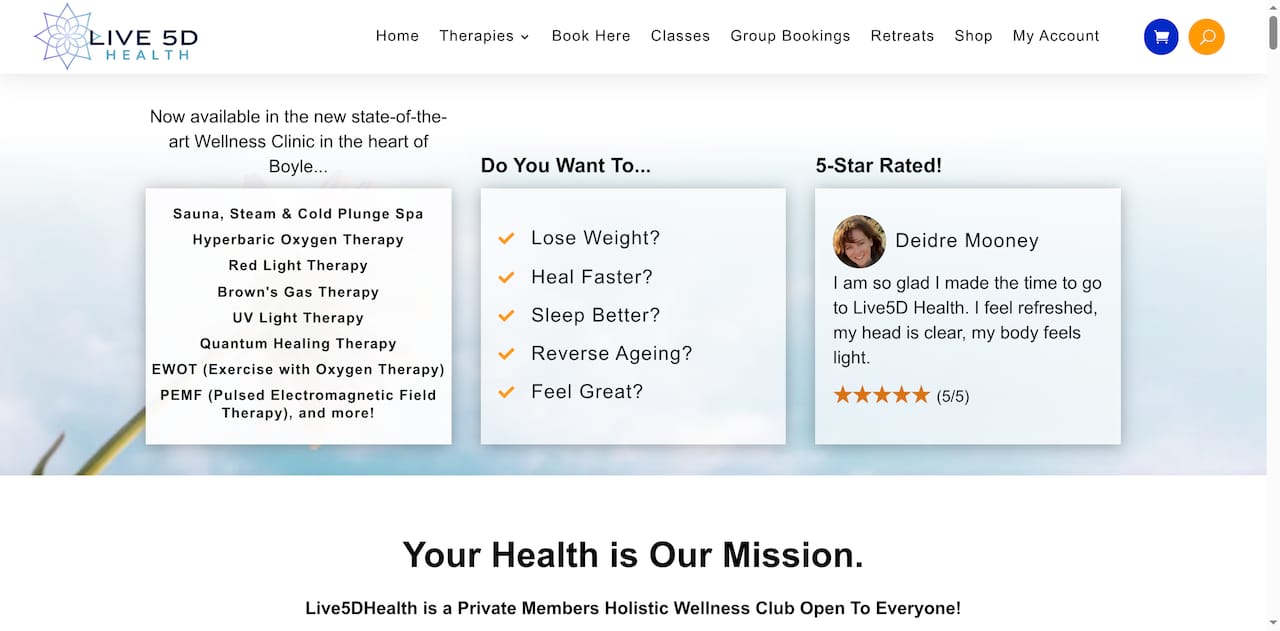
Live5dhealth, based in Boyle, County Roscommon, offers a luxury spa, wellness centre, and retreat experience designed to support exactly the kind of integrated recovery programme described here. Whether you are looking for treatments that align with your HBOT course or natural supplements to support oxygen utilisation and cellular repair, Live5dhealth has you covered.
The Live5dhealth online shop stocks a curated range of natural recovery supplements chosen to complement active wellness programmes, including options that support mitochondrial function, inflammation management, and cellular health. If you are ready to take your recovery and vitality seriously, explore the full wellness supplement range and find what fits your programme. Your best health is built session by session, and the right nutritional support makes every session count.
FAQ
What is hyperbaric oxygen therapy?
Hyperbaric oxygen therapy (HBOT) is a medical treatment in which you breathe 100% pure oxygen inside a pressurised chamber at 1.5–3.0 ATA. The increased pressure dissolves oxygen directly into blood plasma at concentrations 10 to 20 times higher than normal.
How does hyperbaric therapy work alongside red light therapy?
Red light therapy stimulates mitochondria before HBOT, priming cells to use the incoming oxygen surge more efficiently. This sequencing produces higher ATP output and faster cellular repair than either treatment alone.
How many HBOT sessions do you need to see results?
Wound healing benefits typically emerge between 10 and 20 sessions. Neurological conditions may require up to 40 sessions. Consistency across a full course is more important than session intensity.
Is hyperbaric therapy safe to combine with cryotherapy?
Yes, when sequenced correctly. Cryotherapy must follow HBOT, not precede it. Applied before HBOT, cold exposure causes vasoconstriction that restricts the blood flow needed to distribute oxygen-rich plasma.
Who should get a medical assessment before starting combined HBOT treatments?
Every adult considering HBOT should have a physician assessment before their first session. This is particularly important for adults over 40, as certain conditions including untreated pneumothorax and some ear disorders are contraindications that must be identified in advance.