
Neoadjuvant therapy is cancer treatment given before the main treatment, which is usually surgery, with the aim of shrinking the tumour and assessing how well it responds. According to the National Cancer Institute, examples include chemotherapy, radiation therapy, and hormone therapy. Here are three things to hold onto from the start:
- What it does: shrinks the tumour (downstaging), treats microscopic disease that may have spread, and gives clinicians a live test of how your cancer responds to treatment.
- How it is delivered: through chemotherapy, hormone or endocrine therapy, targeted therapy, immunotherapy, radiotherapy, or a combination of these.
- When surgery happens: treatment runs for weeks to months; surgery is usually planned after a response assessment, typically within about one month of completing neoadjuvant therapy.
NHS England, NICE, and Cancer Research UK all recognise neoadjuvant therapy as a standard part of care for several cancer types. Understanding what it involves, and why your team may recommend it, puts you in a stronger position for every conversation ahead.
Key takeaways
Neoadjuvant therapy is cancer treatment given before surgery to shrink the tumour, treat micrometastatic disease, and use the tumour’s response as a guide for all subsequent treatment decisions.
| Point | Details |
|---|---|
| Treatment comes before surgery | Neoadjuvant therapy shrinks tumours and assesses response before the operation, unlike adjuvant therapy given after. |
| Surgery timing is predictable | Most patients have surgery within about one month of completing neoadjuvant therapy. |
| pCR is a key prognostic marker | Pathological complete response after treatment is strongly linked to better outcomes in HER2-positive and triple-negative breast cancer. |
| MDT and NICE guidance decide your plan | All neoadjuvant recommendations in the UK are made by a multidisciplinary team following NHS and NICE guidelines. |
| Ask about fertility before you start | Fertility preservation options must be discussed before the first treatment cycle, not after. |
Table of Contents
- What is neoadjuvant therapy and how does it differ from adjuvant treatment?
- What types of neoadjuvant treatment might you be offered?
- Why do clinicians recommend treatment before surgery?
- Which cancers are commonly treated with neoadjuvant therapy in the UK?
- How do clinicians decide whether neoadjuvant therapy is right for you?
- What does the treatment timeline look like in practice?
- What are the side effects and risks of neoadjuvant therapy?
- What does pathological complete response mean, and does neoadjuvant therapy improve survival?
- Questions to ask your cancer team and how to prepare
- How is neoadjuvant therapy arranged on the NHS in the UK?
- Supporting your body through neoadjuvant therapy and beyond
- A perspective on shared decision making in neoadjuvant therapy
- Sources
What is neoadjuvant therapy and how does it differ from adjuvant treatment?
Neoadjuvant therapy sits at the beginning of the treatment sequence. You receive it before surgery, not after. The NCI Thesaurus lists several synonymous terms you may encounter: preoperative therapy, induction therapy, and perioperative therapy are all used interchangeably in clinical settings, so do not be surprised if your team uses a different label.
The contrast with adjuvant therapy is straightforward: adjuvant treatment comes after surgery, with the goal of reducing the risk of the cancer returning. Neoadjuvant treatment comes before, with the goal of making surgery more effective or less extensive, and of treating any microscopic spread as early as possible.
| Neoadjuvant therapy | Adjuvant therapy | |
|---|---|---|
| Timing | Before surgery | After surgery |
| Primary purpose | Shrink tumour, assess response, treat micrometastases | Reduce recurrence risk |
| Common examples | Chemotherapy, hormone therapy, targeted therapy, radiotherapy | Chemotherapy, hormone therapy, radiotherapy, targeted therapy |
Both approaches use many of the same drugs and techniques. The difference is sequencing and intent.
What types of neoadjuvant treatment might you be offered?
Treatment type depends on your cancer and its biology. Cleveland Clinic notes that duration can range from a few weeks to several months, and sometimes up to a year, before surgery. The main categories are:
- Chemotherapy: Drugs that kill rapidly dividing cells. Used across many cancer types, including breast, oesophageal, and bladder cancer. Often given in cycles over several months.
- Hormone (endocrine) therapy: Blocks hormones that fuel certain cancers. Commonly used in hormone receptor-positive breast cancer, particularly in older patients or where chemotherapy is not appropriate.
- Targeted therapy: Drugs designed to act on specific molecular features of a tumour. For example, HER2-positive breast cancer is frequently treated with trastuzumab (Herceptin) alongside chemotherapy before surgery.
- Immunotherapy: Activates your immune system to recognise and attack cancer cells. Increasingly used in triple-negative breast cancer and some lung and bladder cancers.
- Radiotherapy: High-energy radiation to shrink the tumour. Standard in locally advanced rectal cancer, where it is often combined with chemotherapy (chemoradiotherapy).
- Combined approaches: Many protocols pair two or more of the above. HER2-positive breast cancer, for instance, typically receives dual HER2-targeted agents alongside chemotherapy before surgery.
Your team will explain which combination fits your diagnosis. No single approach suits every patient.
Why do clinicians recommend treatment before surgery?
The goals are downstaging, organ preservation, early treatment of micrometastatic disease, and using the tumour’s response as a prognostic test. Each of these has a direct impact on what happens next.
Downstaging means reducing the tumour’s size and spread before the surgeon operates. In breast cancer, this can mean the difference between a mastectomy and breast-conserving surgery. In rectal cancer, it can convert a tumour that would require a permanent stoma into one that allows sphincter preservation.

Treating micrometastatic disease early matters because surgery alone addresses only the visible tumour. Microscopic cells that have already travelled to lymph nodes or distant sites are reached by systemic therapy from the outset, rather than waiting until after recovery from an operation.
The third goal is arguably the most clinically powerful. As UpToDate explains, neoadjuvant therapy permits in vivo assessment of tumour response and provides prognostic information that can guide adjuvant recommendations. Put simply: the tumour itself tells you whether the drugs are working, while it is still in the body. That information is unavailable if surgery comes first.
Neoadjuvant therapy is also an integrated strategy to reduce systemic disease burden, not simply a technique to shrink a mass for surgical convenience. It can open the door to clinical trial participation, because some trials require measurable disease at the start of treatment.
Which cancers are commonly treated with neoadjuvant therapy in the UK?
Neoadjuvant approaches are standard in several cancer types across NHS practice. The rationale differs slightly for each:
- Breast cancer (locally advanced or inflammatory): Standard of care. Downstaging enables less extensive surgery and provides prognostic data via pathological response.
- Rectal cancer: Chemoradiotherapy before surgery is the established NHS pathway for locally advanced tumours, reducing local recurrence and enabling sphincter preservation.
- Oesophageal and oesophagogastric cancer: Perioperative chemotherapy (before and after surgery) is standard in the UK for resectable cases, based on trial evidence supporting improved survival.
- Bladder cancer (muscle-invasive): Cisplatin-based chemotherapy before cystectomy is recommended in eligible patients.
- Lung cancer (non-small cell, resectable stage III): Neoadjuvant chemotherapy or immunotherapy-based regimens are used selectively to improve resectability.
- Sarcoma (soft tissue): Neoadjuvant radiotherapy is used for large, high-grade limb sarcomas to reduce tumour size and improve surgical margins.
- Pancreatic and gastric cancer: Neoadjuvant chemotherapy is considered in borderline resectable or locally advanced cases, though evidence continues to evolve.
In the UK, locally advanced and inflammatory breast cancer, and locally advanced rectal cancer, represent the clearest examples where neoadjuvant therapy is the standard first step rather than an option.
How do clinicians decide whether neoadjuvant therapy is right for you?
Selection is personalised and decided by a multidisciplinary team (MDT) using tumour stage, biology, patient fitness, and your own priorities. No single clinician makes this call alone.
Before a recommendation is made, you will typically undergo:
- Imaging: MRI, CT, or PET-CT to stage the tumour accurately and establish a baseline for measuring response.
- Biopsy with biomarker testing: Tissue analysis to determine hormone receptor status, HER2 status, and other molecular markers that predict which treatments are likely to work.
- Blood tests and fitness assessment: To confirm your organs can handle the proposed treatment and to flag any conditions that need managing first.
- MDT meeting: A formal discussion involving oncologists, surgeons, radiologists, pathologists, and specialist nurses, who review all findings and agree on a recommendation.
The MDT meeting is where your case is seen as a whole, not just a tumour type. Your preferences, fertility plans, and any concerns you have raised with your clinical nurse specialist all feed into that discussion.
Pro Tip: Before your MDT meeting or oncology appointment, write down your priorities: what matters most to you about surgery, your fertility, your work or family commitments, and any clinical trials you have heard about. Your team cannot factor in what they do not know.
What does the treatment timeline look like in practice?
Duration varies, but Cleveland Clinic’s guidance is clear: treatment may last weeks, months, or up to a year before surgery, and most people have surgery within about one month after completing neoadjuvant therapy. That waiting period before the operation is not passive. It is actively used for therapy, monitoring, and prehabilitation to improve surgical outcomes.
A typical pathway looks like this:
- Initial assessment: Staging scans, biopsy, biomarker testing, and MDT discussion.
- Treatment cycles: Chemotherapy or other agents given in scheduled cycles, usually every two to three weeks, with clinical reviews between cycles.
- Mid-treatment imaging: A scan (often MRI or CT) partway through to check whether the tumour is responding.
- End-of-treatment response assessment: Final imaging and clinical review before surgery is planned.
- Surgery window: Typically scheduled within four weeks of completing neoadjuvant therapy, once the team confirms you have recovered sufficiently.
During treatment, your team will monitor you with:
- Regular blood tests to check blood counts, kidney and liver function.
- Imaging at defined intervals to assess tumour response.
- Symptom checks at each clinic visit, including review of side effects and any new concerns.
- Clinical judgement on whether apparent changes on imaging reflect treatment effect or true disease progression. Inflammatory reactions can sometimes mimic progression on scans, and experienced teams interpret these findings in full clinical context.
What are the side effects and risks of neoadjuvant therapy?
Neoadjuvant therapy is often helpful, but it carries real risks that your team will discuss with you openly. Memorial Sloan Kettering Cancer Center’s patient information emphasises that active side-effect management during treatment is a core part of the neoadjuvant approach, not an afterthought.
Common side effects by treatment type:
- Chemotherapy: Fatigue, nausea, hair loss, increased infection risk (neutropenia), mouth sores, peripheral neuropathy.
- Hormone therapy: Hot flushes, joint pain, mood changes, bone density loss with longer courses.
- Targeted therapy (e.g. trastuzumab): Cardiac monitoring is required; potential for heart function changes.
- Radiotherapy: Skin reactions, fatigue, and localised effects depending on the treatment site.
- Immunotherapy: Immune-related side effects affecting skin, gut, lungs, or endocrine glands.
Key risks beyond side effects include:
- Disease progression during treatment: A small proportion of patients do not respond, and the tumour may grow. Your team monitors for this and will change or stop therapy if it occurs.
- Delayed surgery: If side effects are severe, surgery may need to be postponed. Your team will balance treatment intensity against surgical readiness.
- Fertility impact: Chemotherapy and some targeted agents can affect fertility in both women and men. This conversation must happen before treatment starts, not after. NHS fertility preservation services and Cancer Research UK’s guidance both outline the options available, including egg or embryo freezing.
Your team can adjust doses, prescribe supportive medicines (anti-nausea drugs, growth factors to support white blood cell counts), and refer you to specialist services when needed. You do not have to manage side effects alone.
What does pathological complete response mean, and does neoadjuvant therapy improve survival?
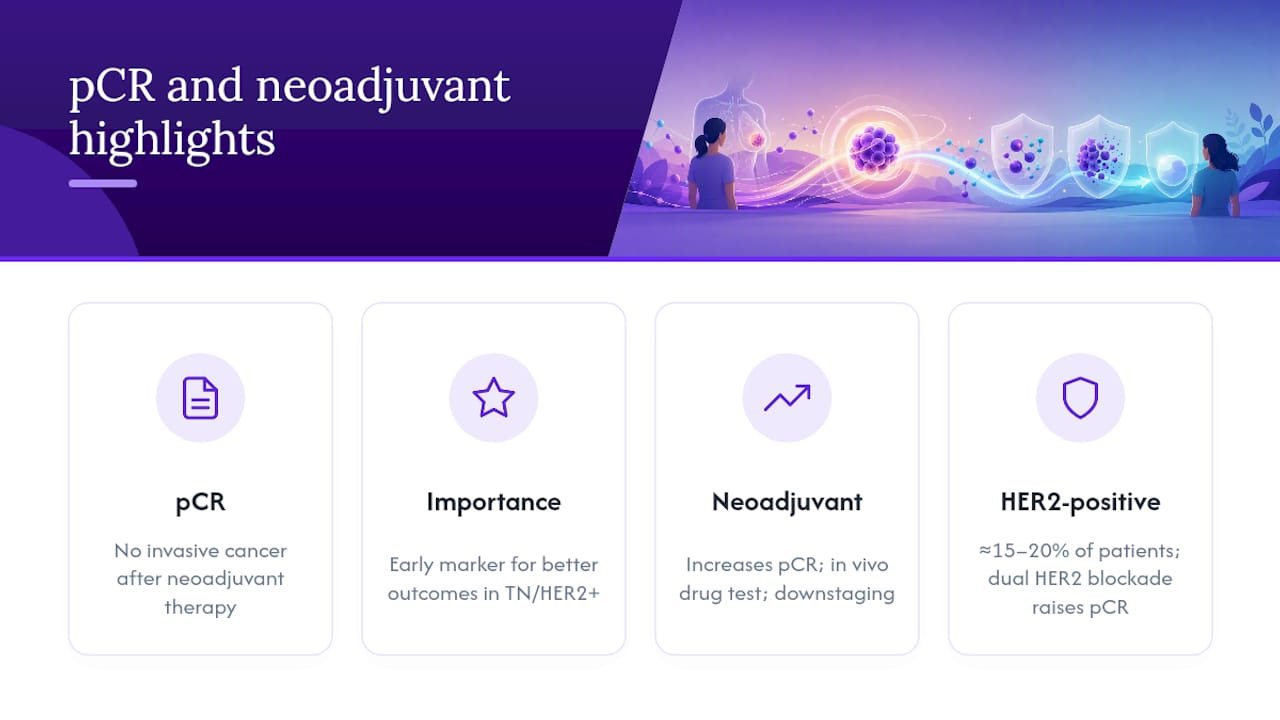
Pathological complete response (pCR) means no residual invasive cancer is found in the surgical specimen after neoadjuvant therapy. It is one of the most meaningful early markers of treatment success, particularly in triple-negative and HER2-positive breast cancer, where achieving pCR is strongly associated with better long-term outcomes.
UpToDate’s clinical review highlights that neoadjuvant therapy is especially valuable as an in vivo test of drug activity, helping clinicians identify predictive biomarkers and guide adjuvant therapy decisions. If pCR is not achieved, additional adjuvant treatment (such as capecitabine or T-DM1 in HER2-positive disease) may be recommended.
On overall survival, the picture is nuanced. A PMC review of randomised trials found that neoadjuvant and adjuvant systemic chemotherapy generally show similar overall survival in many breast cancer patient groups, though neoadjuvant therapy increases pCR rates and assists downstaging. The benefit of neoadjuvant therapy in terms of survival is clearest in cancers where downstaging enables surgery that would otherwise not be possible, or where pCR is a validated surrogate endpoint.
HER2-positive breast cancer affects approximately 15–20% of breast cancer patients and represents one of the clearest examples where neoadjuvant dual HER2 blockade plus chemotherapy consistently improves pCR rates and informs subsequent treatment decisions.
The ASCO guideline on systemic neoadjuvant therapy provides recommendations on optimal use of chemotherapy, endocrine, and targeted therapies, and endorses MDT involvement in all decisions about neoadjuvant systemic therapy.
Questions to ask your cancer team and how to prepare
Walking into your oncology appointment with a clear list of questions makes a real difference. Here are the most useful ones to raise:
- What is the goal of neoadjuvant therapy in my specific case: downstaging, organ preservation, or both?
- How will you measure whether the treatment is working?
- What is the likely timing from starting treatment to surgery?
- What are the fertility implications, and what preservation options are available to me?
- Are there any clinical trials I am eligible for?
- What supportive care services are available (dietitian, psychological support, physiotherapy)?
- What happens if the treatment does not work as expected?
Practical preparation steps:
- Bring a written list of all current medications and supplements to every appointment.
- Arrange transport for treatment days, particularly if you expect fatigue after chemotherapy.
- Ask your clinical nurse specialist about nutritional support services before treatment starts.
- Contact your GP about any pre-existing conditions that may need managing during treatment.
- If you are considering a clinical trial, ask early. Neoadjuvant timing often enables trial participation because measurable disease is present at the start.
Patient advocacy matters too. If you feel your concerns are not being heard, you have every right to ask for clarification, a second opinion, or a written summary of the MDT recommendation. Understanding how to communicate your priorities to the MDT can shape the care you receive.
How is neoadjuvant therapy arranged on the NHS in the UK?
Most neoadjuvant therapy in the UK is arranged through the NHS and coordinated by a multidisciplinary team. NICE guidance and NHS clinical pathways inform which patients are offered neoadjuvant treatment and how it is delivered. You do not need to self-refer or arrange this independently.
The NHS pathway typically follows these steps:
- Referral: Your GP or a specialist refers you to a cancer centre or oncology unit following diagnosis.
- Oncology clinic: A medical or clinical oncologist reviews your case, explains options, and arranges further tests if needed.
- MDT meeting: The full team reviews your staging, biomarkers, and fitness before agreeing on a treatment plan.
- Prehabilitation: Some NHS trusts offer prehabilitation services (exercise, nutrition, psychological support) during the neoadjuvant period to optimise your fitness for surgery.
- Treatment delivery: Chemotherapy is usually given in a day unit; radiotherapy at a radiotherapy centre; hormone therapy is often oral and taken at home.
For authoritative guidance, Nhs and NICE publish clinical guidelines by cancer type. Cancer Research UK provides patient-facing information and support resources. The Royal College of Radiologists publishes clinical oncology guidelines relevant to radiotherapy-based neoadjuvant protocols.
Private neoadjuvant treatment is available in the UK, and some patients choose it for faster access or a preferred consultant. Costs vary considerably depending on treatment type and duration. If you are considering private care, discuss the financial and timing implications with your team before committing, and confirm that your private and NHS care will be coordinated if you move between the two.
Supporting your body through neoadjuvant therapy and beyond
Neoadjuvant therapy is a significant undertaking, and the period between starting treatment and reaching surgery is one where your overall wellbeing deserves as much attention as the clinical protocol. Nutrition, rest, and gentle movement all contribute to how well you tolerate treatment and how quickly you recover after surgery.
Some patients find that complementary wellness approaches, used alongside conventional treatment and with their oncology team’s knowledge, help them feel more in control during this period. If you are curious about what adjunctive support might look like, our guide to alternative cancer therapies covers the evidence base and the questions worth raising with your team.

At Live5dhealth, we support people navigating cancer treatment and recovery through evidence-informed wellness therapies, including red light therapy, hyperbaric oxygen therapy, and restorative spa treatments at our centre in Boyle, County Roscommon. Research into light therapy and pre-surgical preparation suggests potential immune and recovery benefits that may complement prehabilitation during the neoadjuvant period. If you are looking for a supportive environment during or after treatment, our healing retreats in Ireland are designed with exactly that in mind.
A perspective on shared decision making in neoadjuvant therapy
What strikes me most, reading the evidence on neoadjuvant therapy, is how much the framing matters for patients. The period before surgery can feel like a delay, an obstacle between diagnosis and the operation that feels like “doing something.” But that framing misses the point entirely.
Neoadjuvant therapy is not waiting. It is the first act of treatment, and in many cases the most information-rich one. The tumour’s response tells your team things about your cancer’s biology that no pre-surgical test can reveal. That information shapes every decision that follows, from whether you need a mastectomy to what adjuvant therapy, if any, makes sense afterwards.
The patients who tend to navigate this period best are those who understand the goals clearly. Are you aiming for organ preservation? For downstaging to make surgery possible? For a pCR that might reduce the need for further treatment? These are not abstract clinical questions. They are the questions that help you weigh side effects against benefits, decide whether a clinical trial is worth exploring, and know what a good outcome actually looks like for your specific situation.
Ask your MDT to be explicit about the goal. Ask about fertility before the first cycle, not after. And use NICE and NHS guidance as your baseline for what standard care looks like, so you can ask informed questions if something differs from that standard.
Sources
These organisations publish authoritative, UK-relevant information on neoadjuvant therapy and cancer treatment pathways:
Your local cancer centre team will follow NHS and NICE guidance as their clinical framework. These sources help you understand that framework before your appointments, so your questions are sharper and your conversations more productive.
This article is general information, not a substitute for advice from a qualified doctor. Consult a qualified healthcare professional about your own circumstances before acting on anything here.