

Cardiovascular risk increases at menopause primarily because oestrogen withdrawal triggers specific vascular and metabolic changes that accelerate atherosclerosis. The American Heart Association’s scientific statement in Circulation identifies the menopausal transition as a distinct, critical period when adverse shifts in lipids, body composition, and vascular function converge to raise cardiovascular disease (CVD) risk beyond what normal ageing alone explains. The practical takeaway is straightforward: ask your GP for a midlife cardiovascular review now, before symptoms appear.
Three steps you can take this week:
- Check your blood pressure. Many pharmacies offer free readings; anything consistently above 130/80 mmHg warrants a GP conversation.
- Request a fasting lipid profile and HbA1c. These two tests reveal cholesterol changes and early insulin resistance, both of which accelerate around the final menstrual period.
- Review your smoking status and current medications with your GP, as both interact directly with menopausal cardiovascular changes.
Pro Tip: When you book your GP appointment, use the phrase “midlife cardiovascular review” and mention that you are in the menopausal transition. This frames the conversation clinically and increases the likelihood of getting a full lipid panel rather than just a blood-pressure check.
Table of Contents
- What the menopausal transition actually is, and why it differs from normal ageing
- How oestrogen loss damages your heart and blood vessels
- Metabolic changes during menopause: lipids, fat distribution, and insulin resistance
- How blood pressure and arterial stiffness change around menopause
- Sleep, mood, inflammation, and lifestyle: the indirect pathways that raise heart risk
- What the evidence says: who is most at risk and what the studies show
- Menopausal hormone therapy: what it can and cannot do for your heart
- Practical steps you can take now: UK-focused screening and lifestyle changes
- Your monitoring schedule and red flags to watch for
- Key takeaways
- A clinician’s perspective on midlife heart health
- How Live5dhealth can support your cardiovascular health during menopause
- Useful sources and further reading
What the menopausal transition actually is, and why it differs from normal ageing
Menopause is defined as 12 months after the final menstrual period (FMP). The transition leading up to it, perimenopause, typically begins in the mid-to-late 40s and can last four to eight years. During this window, ovarian oestrogen production becomes erratic and then falls sharply.
What makes this biologically distinct from simply getting older is the rate of hormonal change. Chronological ageing brings gradual cardiovascular wear; the menopausal transition superimposes a rapid hormonal withdrawal on top of that background process. Longitudinal cohort studies confirm that the menopausal transition is an independent contributor to increased cardiovascular risk, separate from the effects of age.
Key cardiometabolic changes and when they typically appear:
- Late perimenopause (1–2 years before FMP): LDL cholesterol begins rising; visceral fat starts accumulating.
- Around the FMP: Arterial stiffness increases measurably; blood pressure starts trending upward.
- Early postmenopause (0–2 years after FMP): Insulin sensitivity worsens; carotid atherosclerosis accelerates.
- Established postmenopause: Cumulative risk from all the above compounds over time.
This timeline matters for screening. Waiting until your mid-50s to check cholesterol means missing the window when intervention is most effective.
How oestrogen loss damages your heart and blood vessels
Oestrogen is not merely a reproductive hormone. It actively protects the cardiovascular system through several mechanisms, and its loss removes those protections simultaneously.
What oestrogen does while it is present:
- Stimulates nitric oxide production in the endothelium, keeping blood vessels relaxed and responsive.
- Suppresses pro-inflammatory cytokines such as interleukin-6 and tumour necrosis factor-alpha.
- Promotes favourable lipid handling: higher HDL, lower LDL, and reduced triglyceride deposition.
- Inhibits smooth muscle cell proliferation, slowing plaque formation in arterial walls.
When oestrogen falls, each of these protective effects diminishes. Endothelial dysfunction, the earliest detectable stage of atherosclerosis, begins in the early postmenopausal period, often before any symptoms appear. The SWAN study and related cohort analyses show marked increases in carotid atherosclerosis around the FMP, independent of chronological ageing.
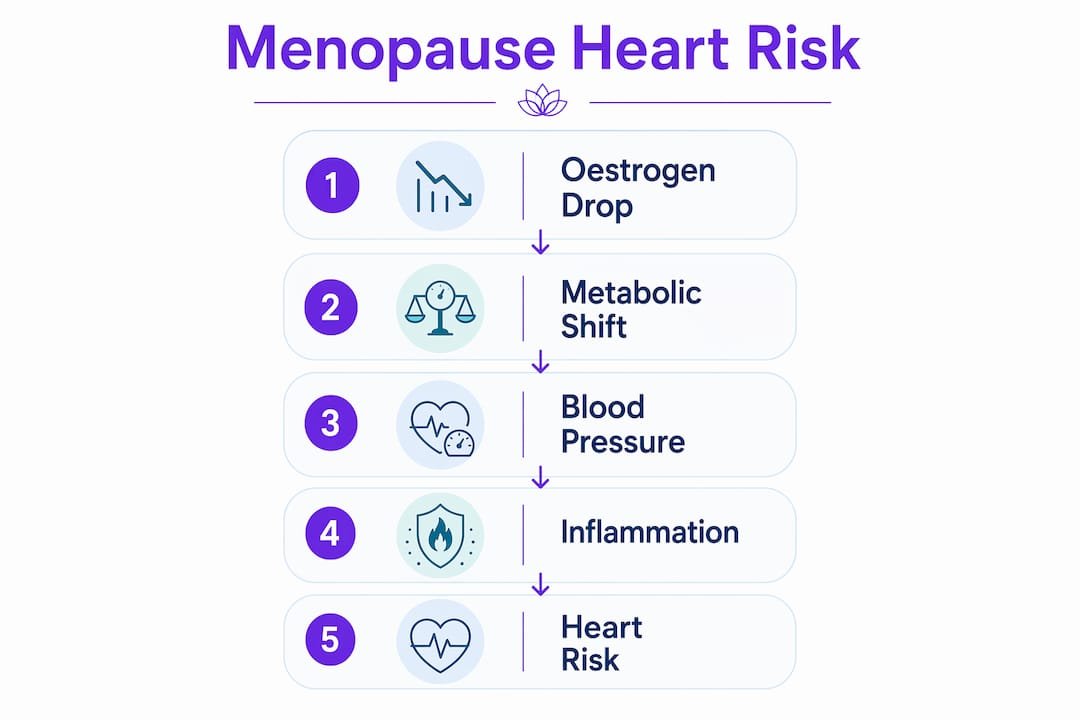
The cascade looks like this:
- Oestrogen falls → nitric oxide production drops → endothelial dysfunction
- Endothelial dysfunction → arterial stiffness increases → pulse-wave velocity rises
- Reduced anti-inflammatory signalling → low-grade systemic inflammation
- Inflammation + dyslipidaemia → accelerated plaque progression (subclinical atherosclerosis)
Statistic: The AHA’s Circulation scientific statement notes that endothelial dysfunction starts in the early postmenopausal period, before signs of subclinical atherosclerosis are clinically detectable, which is why proactive screening rather than symptom-driven testing is the appropriate strategy.
Metabolic changes during menopause: lipids, fat distribution, and insulin resistance
The metabolic picture shifts noticeably across the menopausal transition, and the changes are not trivial. Contemporary reviews report menopause-associated rises in total cholesterol and LDL-C increases beyond what ageing alone explains. HDL changes are more complex: total HDL may not fall dramatically, but the HDL2 subfraction, the most cardioprotective component, does decline. Triglycerides tend to rise, and apolipoprotein B concentrations increase, making LDL particles smaller and denser, which are more atherogenic.

Body composition shifts in a particularly unfavourable direction. Fat redistributes from the hips and thighs to the abdomen. Imaging studies show that visceral and ectopic fat, including fat deposits around the heart itself, increase more in late perimenopause and postmenopause than in premenopause. Visceral fat is metabolically active in a harmful way: it secretes inflammatory adipokines, drives insulin resistance, and feeds directly into hepatic lipid production.
Insulin resistance worsens meaningfully around the FMP. Postmenopausal women face a roughly twofold increased risk of non-alcoholic fatty liver disease compared with premenopausal women, and the risk of type 2 diabetes rises in parallel. Since type 2 diabetes is itself a major independent cardiovascular risk factor, this metabolic chain from oestrogen loss to insulin resistance to diabetes to CVD is one of the most clinically significant pathways to understand.
Key metabolic changes to monitor:
- Rising LDL-C and total cholesterol (request a full fasting lipid profile including ApoB if your GP agrees)
- Increasing waist circumference (above 80 cm in women signals elevated visceral fat risk)
- Worsening fasting glucose or HbA1c (prediabetes range: HbA1c 42–47 mmol/mol)
- Triglyceride creep, particularly if combined with low HDL
How blood pressure and arterial stiffness change around menopause
Blood pressure tends to rise during the menopausal transition, and even modest population-level increases carry significant clinical weight. Reviews and cohort studies report average systolic and diastolic blood pressure rises during the transition during the transition. Those numbers sound small individually, but a 5 mmHg rise in systolic blood pressure across a population translates into a meaningful increase in stroke and myocardial infarction rates.

Arterial stiffness, measured by pulse-wave velocity, increases around the FMP independently of age-related changes. Stiffer arteries mean the heart works harder with each beat, left ventricular load increases, and the risk of both heart failure and stroke rises. Vasomotor symptoms, particularly hot flushes, are associated with acute blood-pressure spikes driven by autonomic nervous system activation. Women with frequent, severe hot flushes show higher resting blood pressure variability, which is itself a cardiovascular risk marker.
Practical blood-pressure guidance:
- At home: Measure sitting, after five minutes of rest, twice in the morning and twice in the evening for seven days. Bring the log to your GP.
- Clinic target: Below 130/80 mmHg is the current UK guidance for most adults.
- Prompt review: Any reading consistently above 140/90 mmHg, or a single reading above 180/110 mmHg, warrants same-day GP contact.
Pro Tip: Electrolyte balance, particularly sodium and potassium intake, directly affects blood pressure. If you are using a sauna or cold plunge regularly, read up on electrolyte needs for over-40s to support healthy blood-pressure management.
Sleep, mood, inflammation, and lifestyle: the indirect pathways that raise heart risk
The biological mechanisms above do not operate in isolation. Menopausal symptoms create a second layer of cardiovascular risk through behavioural and psychosocial pathways that are just as real, even if less discussed in clinical settings.
Vasomotor symptoms affect many women during perimenopause and menopause. Night sweats fragment sleep, and poor sleep quality drives up cortisol, increases appetite for calorie-dense foods, worsens insulin sensitivity, and raises resting blood pressure. The AHA’s scientific statement explicitly identifies vasomotor symptoms and sleep loss as clinical signals that should prompt earlier cardiovascular assessment, not merely quality-of-life management.
Mood changes and psychosocial stress during the menopausal transition are also independent contributors. Depression and anxiety, which are more prevalent during perimenopause, are associated with elevated inflammatory markers, reduced physical activity, and poorer dietary choices. All three of these downstream effects directly worsen cardiometabolic risk. If you are experiencing mood changes alongside physical symptoms, addressing them is not separate from protecting your heart. Our guide to managing anxiety symptoms covers non-pharmacological approaches that can help.
Behavioural interventions that directly address these indirect risks:
- Sleep hygiene and CBT for insomnia (CBT-I): Structured sleep restriction and stimulus control techniques reduce night-time waking more effectively than sleep hygiene advice alone.
- Regular moderate activity: Even 30 minutes of brisk walking five days a week measurably improves sleep quality, reduces hot-flush frequency, and lowers blood pressure.
- Stress management: Mindfulness-based stress reduction and breathing techniques lower cortisol and reduce blood-pressure variability.
Pro Tip: Treating vasomotor symptoms as a cardiovascular signal, not just a comfort issue, changes how you prioritise them with your GP. Severe, frequent hot flushes are a reason to accelerate your cardiovascular screening, not wait for the next routine check.
What the evidence says: who is most at risk and what the studies show
The evidence base for the menopausal transition as a cardiovascular risk period is now substantial. The SWAN (Study of Women’s Health Across the Nation) cohort, one of the most detailed longitudinal studies of midlife women, documented rapid changes in lipids, body composition, and carotid intima-media thickness concentrated around the FMP, changes that could not be attributed to chronological ageing alone.
The risk is amplified significantly for women who experience early menopause, defined as before age 45. A meta-analysis of 32 studies involving over 310,000 postmenopausal women found that early menopause is associated with an increased risk for ischaemic heart disease compared with menopause at the typical age. The same analysis found elevated risks for cardiovascular mortality and all-cause mortality. Surgical menopause, where both ovaries are removed, carries an even sharper risk profile because the hormonal withdrawal is abrupt rather than gradual.
Women with additional female-specific risk enhancers, including a history of pre-eclampsia, gestational diabetes, or polycystic ovary syndrome, carry compounded risk during the transition. Standard risk calculators such as QRISK3 do not fully capture these factors, which is why specialists increasingly recommend including them in personalised risk conversations.
Menopausal hormone therapy: what it can and cannot do for your heart
Menopausal hormone therapy (MHT) is one of the most nuanced topics in women’s cardiovascular health, and the evidence has shifted considerably since the early Women’s Health Initiative trials. The key message is that formulation and timing matter enormously.
What contemporary evidence shows:
- Transdermal oestrogen (patches, gels) does not raise triglycerides and is not associated with increased venous thromboembolism (VTE) risk, unlike older oral synthetic oestrogens.
- Micronized progesterone (body-identical) carries a more favourable metabolic and blood-pressure profile than older synthetic progestogens.
- MHT started within 10 years of the FMP, or in women under 60 at low-to-moderate CVD risk, may have a neutral or even reduced CVD event risk.
- MHT is not currently recommended as a sole strategy for CVD prevention; lifestyle and clinical screening remain the foundation.
| Formulation | VTE risk | Triglyceride effect | BP effect | Preferred for CV risk? |
|---|---|---|---|---|
| Oral synthetic oestrogen | Increased | Raises TG | May raise | No |
| Transdermal oestradiol | Neutral | Neutral | Neutral/slight reduction | Yes |
| Synthetic progestogen | Slightly elevated | Variable | Variable | Less preferred |
| Micronized progesterone | Neutral | Neutral | Neutral | Yes |
Checklist for your MHT conversation with a clinician:
- Ask for a baseline cardiovascular risk assessment (BP, lipids, HbA1c, BMI, smoking status, family history).
- Discuss route of administration: transdermal oestradiol is generally preferred for women with any CV risk factors.
- Ask about progestogen type: micronized progesterone where appropriate.
- Agree a follow-up review at three months and annually thereafter.
- Confirm whether you have any contraindications: personal or strong family history of VTE, stroke, or oestrogen-sensitive cancer.
Pro Tip: Women with premature ovarian insufficiency (POI) should receive MHT at least until the average age of menopause (around 50–52 years) to protect against the excess cardiovascular risk that comes with prolonged oestrogen deficiency. If you have had an early menopause, raise this specifically with your GP.
Practical steps you can take now: UK-focused screening and lifestyle changes
The British Heart Foundation and NHS guidance both emphasise that blood pressure, blood glucose, and cholesterol screening during the menopausal transition are the immediate clinical priorities, with lifestyle interventions as the first-line prevention strategy.
Clinical screening to request:
- Clinic or ambulatory blood-pressure measurement
- Fasting lipid profile (total cholesterol, LDL-C, HDL-C, triglycerides; add ApoB and Lp(a) if there is a family history of early heart disease)
- HbA1c (to detect prediabetes or early type 2 diabetes)
- BMI and waist circumference measurement
- Smoking status and alcohol review
- QRISK3 score calculation (your GP can run this; it estimates your 10-year CVD risk)
Lifestyle targets with measurable goals:
- Aerobic activity: 150–300 minutes of moderate-intensity exercise per week (brisk walking, cycling, swimming).
- Strength training: At least twice weekly to preserve lean mass and improve insulin sensitivity.
- Diet: Mediterranean-style eating pattern: oily fish twice weekly, abundant vegetables, legumes, olive oil, reduced ultra-processed foods.
- Smoking cessation: The single most impactful modifiable risk factor; ask your GP about NHS Stop Smoking services.
- Alcohol: Keep within 14 units per week with alcohol-free days; alcohol raises blood pressure and triglycerides.
- Weight management: Even a 5–10% reduction in body weight in women with central adiposity measurably improves lipids, blood pressure, and insulin sensitivity.
When to consider statin or antihypertensive review:
If your QRISK3 score is 10% or above, your GP should discuss statin therapy. If blood pressure consistently exceeds 140/90 mmHg despite lifestyle changes, antihypertensive medication is appropriate. For women with a strong family history or suspected subclinical disease, coronary artery calcium (CAC) scoring can refine risk assessment beyond what QRISK3 captures.
Referral guidance:
- See your GP first for baseline screening and QRISK3.
- Ask for a menopause specialist referral if symptoms are severe or MHT decisions are complex.
- Request a cardiology referral if QRISK3 is high, symptoms suggest cardiac involvement, or CAC scoring is being considered.
Pro Tip: Before your GP appointment, write down your family history of heart disease, stroke, and diabetes, including the age at which relatives were affected. This information directly influences your QRISK3 score and may change the clinical recommendations you receive.
Your monitoring schedule and red flags to watch for
A clear, consistent monitoring routine is one of the most practical things you can put in place during the menopausal transition. The schedule below reflects UK guidance from the British Heart Foundation and NHS.
| Test | Frequency | Notes |
|---|---|---|
| Blood pressure | At least annually; every 3–6 months if elevated | Home monitoring log useful; bring to GP |
| Fasting lipid profile | Every 1–3 years depending on baseline risk | More frequently if on statin or lipids are borderline |
| HbA1c | Every 1–3 years; annually if prediabetes or risk factors present | Fasting not required but preferred |
| BMI and waist circumference | At routine GP visits | Waist above 80 cm warrants discussion |
| QRISK3 | Every 5 years, or sooner if risk factors change | Ask GP to run this proactively |
| ECG | If symptomatic (palpitations, chest pain, breathlessness) | Not a routine screening test |
Red flags that require prompt assessment (same-day GP contact or 999):
- New chest pain or tightness, especially on exertion
- Unexplained breathlessness at rest or with minimal activity
- Palpitations with dizziness or near-fainting
- Sudden severe headache unlike any previous headache
- Syncope (loss of consciousness) or near-syncope
- Sudden weakness or numbness in the face, arm, or leg (call 999 immediately)
Tips for accurate home blood-pressure measurement:
- Sit quietly for five minutes before measuring.
- Use a validated upper-arm cuff (not a wrist monitor).
- Take two readings, one minute apart, morning and evening, for seven consecutive days.
- Record all readings and bring the log to your GP appointment.
Key takeaways
Cardiovascular risk rises at menopause because oestrogen withdrawal simultaneously drives endothelial dysfunction, adverse lipid shifts, central fat gain, and worsening insulin sensitivity, all of which accelerate atherosclerosis during a window when prevention is still highly effective.
| Point | Details |
|---|---|
| Oestrogen withdrawal is the driver | Falling oestrogen removes vascular protection, raising LDL, stiffening arteries, and promoting visceral fat accumulation. |
| Lipid changes are measurable and significant | Total cholesterol rises 10–14% and LDL-C rises approximately 14–19% beyond what ageing alone explains. |
| Early menopause carries higher risk | Women with menopause before age 45 face a 1.5-fold increased risk of ischaemic heart disease compared with typical-age menopause. |
| Screening is the immediate priority | Request BP, fasting lipid profile, and HbA1c from your GP; ask for a QRISK3 score calculation. |
| Live5dhealth supports prevention | Live5dhealth’s wellness therapies, including EWOT, sauna, and recovery sessions, complement GP-led cardiovascular prevention during midlife. |
A clinician’s perspective on midlife heart health
The conversation I wish more women had with their doctor is not about menopause symptoms in isolation. It is about what those symptoms signal for the next 20 years of cardiovascular health.
Here is what often gets missed in standard consultations: female-specific risk enhancers, such as early menopause, a history of pre-eclampsia, or gestational diabetes, are frequently absent from the QRISK3 calculation because the patient never mentions them and the clinician never asks. A woman who had pre-eclampsia in her 30s and reaches menopause at 44 has a compounded risk profile that a standard algorithm will underestimate. She needs to know that, and she needs to say it out loud in the appointment.
The timing hypothesis for MHT is also frequently misunderstood. The older trial data that frightened a generation of women and clinicians referred largely to older oral synthetic formulations started in women who were already a decade or more postmenopausal. Contemporary transdermal oestradiol with micronized progesterone, started within 10 years of the FMP in a woman without contraindications, is a different clinical picture entirely. That distinction matters for shared decision-making.
Prevention during the menopausal transition is not one-size-fits-all. A woman with a strong family history and early menopause needs a more aggressive screening and intervention plan than a woman with average-age menopause and no additional risk factors. The goal is personalised, proactive care, not a blanket prescription. If your current GP appointment feels rushed or generic, it is entirely reasonable to ask for a longer appointment specifically for a cardiovascular risk review, or to request a referral to a menopause specialist who integrates cardiovascular assessment into their practice.
How Live5dhealth can support your cardiovascular health during menopause
Clinical screening and lifestyle change are the foundation of cardiovascular prevention at menopause, and your GP is the right first port of call. Live5dhealth offers a complementary layer of in-person wellness support for women who want to go further.

At the Live5dhealth wellness centre in Boyle, County Roscommon, therapies such as Exercise with Oxygen Therapy (EWOT), infrared and traditional sauna, cold plunge, and PEMF therapy are particularly well suited to the metabolic challenges of midlife. EWOT, for example, directly addresses insulin resistance and visceral fat accumulation by combining cardiovascular effort with enhanced oxygen delivery, making it a practical option for women building or rebuilding an exercise habit. The luxury spa and recovery facilities support sleep quality, stress reduction, and circulatory health, all of which feed directly into the indirect cardiovascular risk pathways discussed above.
Live5dhealth also offers wellness retreats in Ireland designed around structured rest, movement, and recovery, a meaningful option for women who want an immersive reset alongside their clinical prevention plan. These are not a substitute for medical care or MHT decisions, which must be made with your GP or menopause specialist. They are a practical, evidence-informed complement to it.
Useful sources and further reading
The following peer-reviewed studies, clinical statements, and patient resources underpin the claims in this article and are recommended for further reading.
Peer-reviewed studies and clinical statements:
- AHA Circulation scientific statement: menopause transition and cardiovascular disease risk — the primary high-authority statement summarising longitudinal evidence and prevention recommendations.
- PMC review: menopause-associated risk of cardiovascular disease — comprehensive review covering lipid changes, insulin resistance, MHT evidence, and early menopause risk data including the 1.5-fold IHD risk figure.
- PMC review: menopause and CVD — independent contributor evidence — longitudinal cohort findings confirming the menopausal transition as an independent cardiovascular risk factor.
- Nature Reviews Cardiology: the menopausal transition period and cardiovascular risk — covers SWAN findings, arterial stiffness, and timing of atherosclerotic changes around the FMP.
- Springer review: cardiovascular risk, MHT formulations, and metabolic changes — detailed review of lipid changes (10–14% total cholesterol rise), blood-pressure data (4–7 mmHg systolic), visceral fat imaging findings, and MHT formulation comparisons.
UK patient-facing resources:
- British Heart Foundation: menopause and heart disease — practical patient guidance on screening priorities, lifestyle advice, and when to seek help.
- NHS: menopause — overview of symptoms, treatments, and when to see a GP, including MHT information.
- NHS: metabolic syndrome — useful background on the cluster of conditions (central obesity, raised BP, dyslipidaemia, insulin resistance) that overlap significantly with postmenopausal cardiometabolic risk.
This article is general health information, not medical advice. Always confirm your individual cardiovascular risk and any treatment decisions, including MHT, with your GP or a qualified clinician.