

Yes, but with real limits. Randomised, double-blind trials show red light therapy can meaningfully increase hair counts in people with early-to-moderate thinning, with gains of approximately one-third over sham treatment after 16 weeks. The effect is real, modest, and depends entirely on consistent use — it works best alongside a proper diagnosis, not as a blind first move.
TL;DR:
- Red light therapy can increase hair counts by about one-third after 16 weeks of consistent use in early-to-moderate thinning cases, but effectiveness varies.
- The treatment works by stimulating energy production in hair follicle cells, encouraging dormant follicles to re-enter active growth phases.
- It benefits those with viable follicles still capable of growth, such as early-stage androgenetic alopecia, but is ineffective for scarring or long-standing bald patches.
- Optimal devices deliver specific wavelengths, proper coverage, and consistent sessions similar to clinical trial protocols, typically 20-25 minutes every other day.
- Combining red light therapy with other treatments like minoxidil can improve results, but a proper diagnosis and realistic expectations are essential.
Table of Contents
- How red light hair growth therapy works and what the research shows
- Who benefits from red light therapy and who should skip it
- What treatment protocols and devices actually look like
- What results look like and how long they take
- Choosing a safe, evidence-aligned option
- What Live5DHealth offers people exploring red light for hair loss
- The honest case for red light as part of a wider plan
- Ready for a clinical assessment rather than guesswork?
- Sources
How red light hair growth therapy works and what the research shows
The mechanism starts inside the cell, not on the scalp’s surface. Red and near-infrared light penetrates the skin and gets absorbed by cytochrome c oxidase, an enzyme sitting inside the mitochondria of your hair follicle cells. That absorption boosts ATP production, the cell’s basic energy currency, and the extra fuel appears to nudge dormant follicles out of the resting telogen phase and back into active anagen growth. It’s the same photobiomodulation principle used in wound healing and muscle recovery, just aimed at a different target.
The clinical evidence behind this isn’t thin. Two randomised, double-blind trials using the TOPHAT655 laser helmet, one in women and one in men, found statistically significant increases in terminal hair counts against sham devices. The female arm of the trial reported a 48.07% increase in hair counts among active-treatment participants versus 11.05% in the sham group after 25-minute sessions every other day for 16 weeks. The male trial found comparable gains, suggesting the response isn’t sex-specific.
Average reported gain: Meta-analyses pooling multiple LLLT trials continue to find statistically significant increases in hair density versus sham treatment, though the size of that benefit varies by device and protocol.
Stanford Medicine’s clinical overview confirms red light stimulates follicle activity and has a place in dermatology, while flagging where the evidence gets shakier. Worth knowing before you get too excited:
- Most trials run 16 to 26 weeks, which tells you little about years-long outcomes.
- Device wavelength, irradiance, and coverage vary enormously between studies, making direct comparisons tricky.
- Cohort sizes in several trials are modest, and some studies carry manufacturer funding, which warrants a critical eye on reported effect sizes.
None of that undermines the core finding. It does mean treating any single percentage as gospel is a mistake.
Who benefits from red light therapy and who should skip it
Red light therapy performs best on follicles that are struggling, not dead. If you have early-to-moderate androgenetic alopecia, patchy diffuse thinning, or a recent bout of telogen effluvium (the shedding that often follows illness, stress, or childbirth), your follicles are typically still present and viable, just underperforming. That’s exactly the population the TOPHAT655 trials studied, and where the Stanford Medicine review says the technology has the strongest support.
Poor candidates include people with long-standing bald patches where follicles have miniaturised beyond recovery, and anyone with scarring (cicatricial) alopecia, where the follicle structure itself has been destroyed. Light can’t stimulate a follicle that no longer exists. Some autoimmune conditions and photosensitivity disorders also complicate things.
- Long-standing baldness with no visible fine or vellus hairs
- Scarring alopecia or diagnosed autoimmune hair-loss conditions
- Current use of photosensitising medication
- History of epilepsy triggered by light, or a history of scalp skin cancer
Pro Tip: If you’re unsure which category you fall into, a scalp examination under magnification (trichoscopy) takes minutes and tells a dermatologist far more than guessing from mirror photos ever will.
Anyone with contraindications, or genuine uncertainty about their hair loss pattern, should speak to a professional before starting light therapy rather than self-treating.
What treatment protocols and devices actually look like
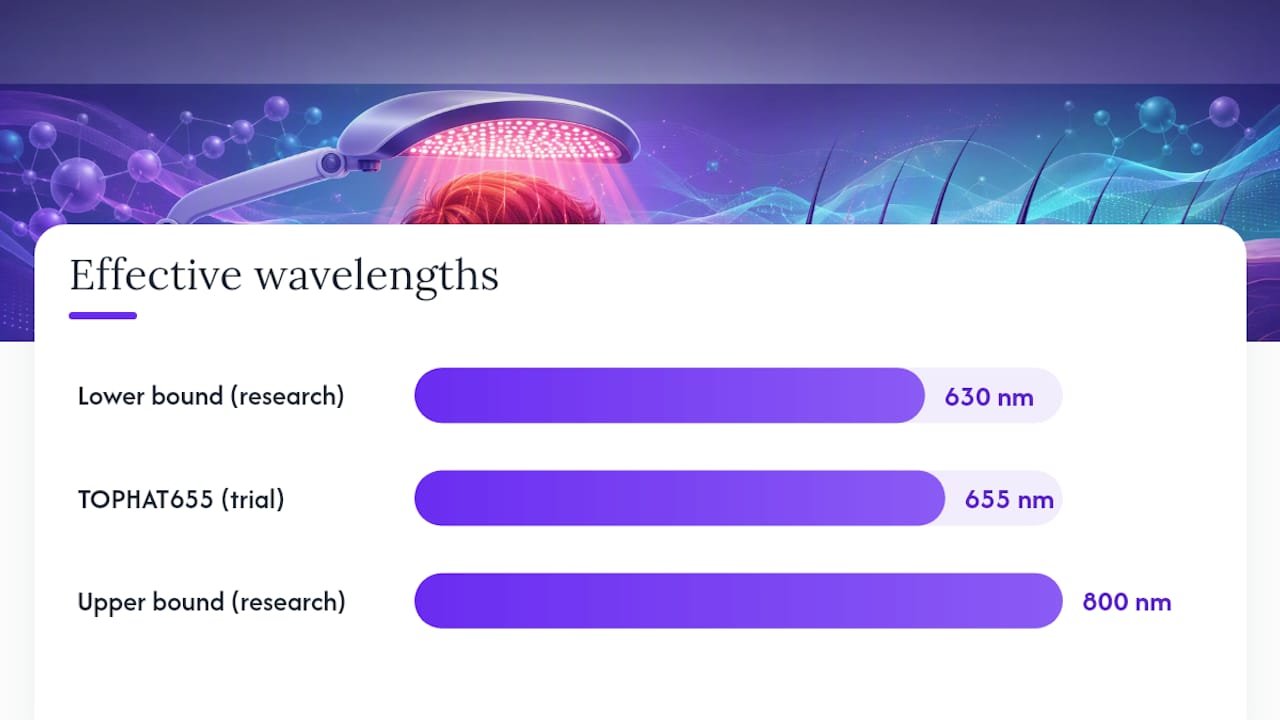
Trial protocols are more specific than most marketing copy lets on. The TOPHAT655 studies used a wavelength of 655 nanometres, delivered in 25-minute sessions every other day across 16 weeks. Other research extends the useful range from roughly 630 nm up to around 800 nm, including some near-infrared wavelengths that penetrate slightly deeper into scalp tissue.
Three things separate a device that mirrors trial conditions from one that doesn’t:
- Diode type. Laser diodes and standard LEDs behave differently in terms of coherence and depth of penetration; most of the strongest published results used laser-diode helmets.
- Irradiance and coverage. A device needs enough power density (measured in mW/cm² or delivered as J/cm²) across the whole scalp, not just a narrow beam that misses half your crown.
- Session consistency. Skipping weeks undermines the cumulative ATP-boosting effect the trials relied on.
Trials showing the clearest benefit used well-specified helmets or panels with known wavelength and dose, not generic devices with vague marketing claims.
In-clinic treatments generally deliver more controlled, higher-output energy under supervision, which is one reason some people move from an at-home cap to a professional setting once initial shedding has stabilised. For home use, keep the scalp clean and product-free before each session, hold the device at the manufacturer’s recommended distance, and treat consistency as the single biggest variable in your control.
What results look like and how long they take
Shedding usually slows before anything visibly regrows. Most people notice reduced hair fall within the first six to eight weeks, with visible improvements in density or shaft thickness typically appearing between three and six months, matching the 16 to 26-week windows used in most trials.
- Weeks 1–8: reduced shedding, often the first sign treatment is working
- Months 3–6: measurable increases in terminal hair count and thickness
- Ongoing: maintenance sessions required to preserve gains
The PMC-published RCT recorded a 48.07% increase in active-treatment hair counts against 11.05% in the sham group over 16 weeks, a statistically significant but modest gain, not a dramatic transformation.
The catch that trips people up: these benefits are maintenance-dependent. Clinical commentary consistently notes that stopping treatment tends to reverse the gains over subsequent months, because the underlying biological stimulus disappears the moment the light does. Think of it less like a one-off fix and more like a fitness habit for your follicles.
Choosing a safe, evidence-aligned option
Buying a red light device or booking a clinic session should follow the same logic as buying any medical-adjacent product: check the specifics, not the marketing.
- Does the listing state an exact wavelength (ideally in the 630–665 nm range studied in trials) and an irradiance figure in mW/cm² or J/cm²?
- Is it a laser diode or LED array, and does the coverage match your scalp area rather than a single narrow patch?
- Is there any published clinical data behind this specific device, or only stock photography and testimonials?
- Does the recommended session length and frequency roughly match the 20 to 25-minute, every-other-day protocols used in trials?
- Are contraindications and safety information clearly listed, rather than buried or absent?
Pro Tip: Walk away from any device or clinic promising complete regrowth in weeks. Every published RCT shows gradual, partial improvement, not overnight transformation.
Red light also works well as one part of a broader plan. Pooled trial data shows combining LLLT with topical minoxidil outperforms minoxidil alone, and some clinicians add finasteride for pattern hair loss in men. Readers interested in adjunct research on follicle-supporting compounds can also look at peptide-based approaches to hair growth, though these should be discussed with a clinician rather than tried in isolation. Before combining anything, a proper medical evaluation of your hair loss pattern remains the sensible starting point.
Finasteride is FDA-indicated for men only. Women who are or may become pregnant must not handle crushed or broken finasteride tablets, due to the risk of harm to a male fetus. It can also cause sexual side effects (reduced libido, erectile dysfunction) in a minority of men, which usually resolve after stopping treatment. Discuss these risks with a physician before starting.
What Live5DHealth offers people exploring red light for hair loss
At Live5DHealth, our wellness centre in Boyle, County Roscommon, we’ve built our red light therapy protocols around the same evidence base covered above, not around inflated promises. Supervised, clinic-grade sessions allow for more controlled energy delivery than most home devices manage, which matters for people whose thinning has progressed enough that consistency and dosage precision genuinely count.
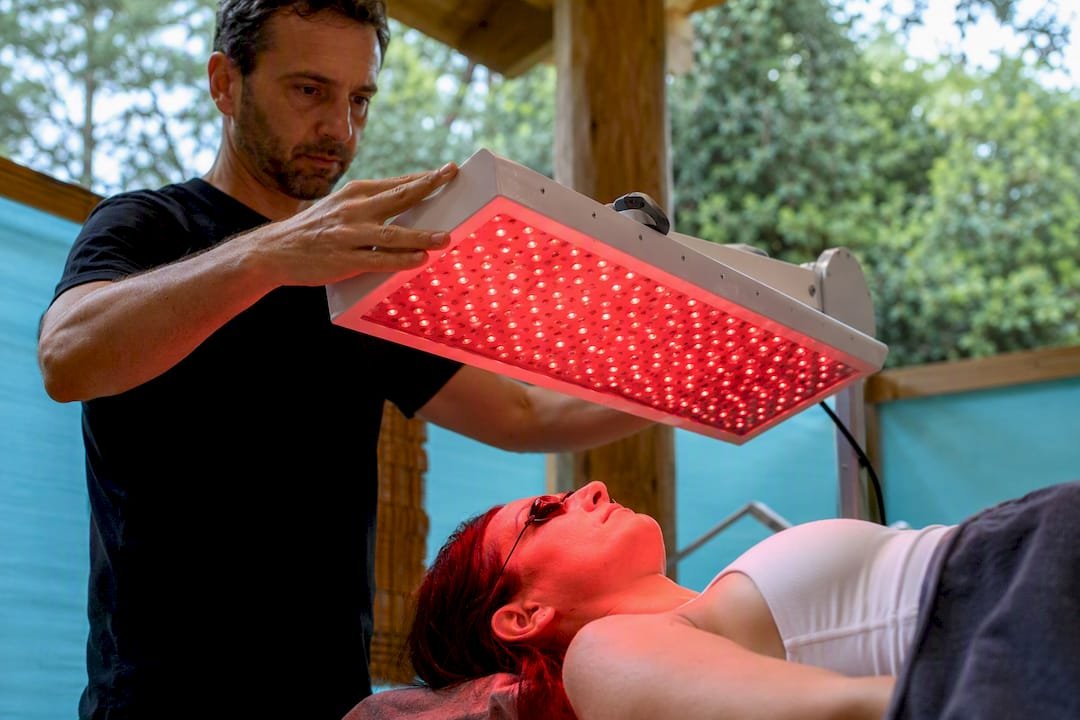
A first appointment typically starts with a proper conversation about your hair loss pattern and history, so we can assess whether red light alone is likely to help or whether it fits better as part of a wider plan alongside nutrition, supplement support, or other therapies we offer. We’d rather give you an honest assessment than sell you a session you don’t need.
The honest case for red light as part of a wider plan
Red light therapy earns its place through data, not hype. What I’d stress to anyone reading this is that the evidence supports realistic, incremental improvement for the right candidate but does nothing meaningful for the wrong one. Skipping a proper diagnosis before starting is the single most common mistake I see, because it wastes months on a treatment that was never going to work for that person’s specific hair loss pattern. Used consistently, on the right follicles, with expectations calibrated to what randomised trials actually show, red light is a genuinely useful tool. Used as a miracle cure for years of established baldness, it isn’t.
— Mark
Ready for a clinical assessment rather than guesswork?
Buying an at-home device without knowing your hair loss pattern means gambling on whether your follicles can still respond at all. Live5DHealth offers something a laser cap sitting in an Amazon warehouse cannot: an actual scalp assessment before you spend a penny, delivered at our wellness centre in Boyle, County Roscommon.

A first visit means talking through your history, checking whether your thinning fits the early-to-moderate pattern the research supports, and building a supervised treatment plan around clinic-grade equipment rather than a guess. If nutrition or hormonal factors are contributing, our team can also point you toward supporting options, including the supplement range in our online shop. Book a red light therapy consultation at Live5DHealth and get a plan built around your actual scalp, not a generic protocol.
This article is general information, not a substitute for advice from a qualified doctor. Consult a qualified healthcare professional about your own circumstances before acting on anything here.
Sources
- The growth of human scalp hair in females using visible red light laser and LED sources – PMC
- The growth of human scalp hair mediated by visible red light laser and LED sources in males
- Red light therapy: What the science says – Stanford Medicine
- Does Red Light Therapy Work for Hair Loss? Evidence, Benefits & Results