
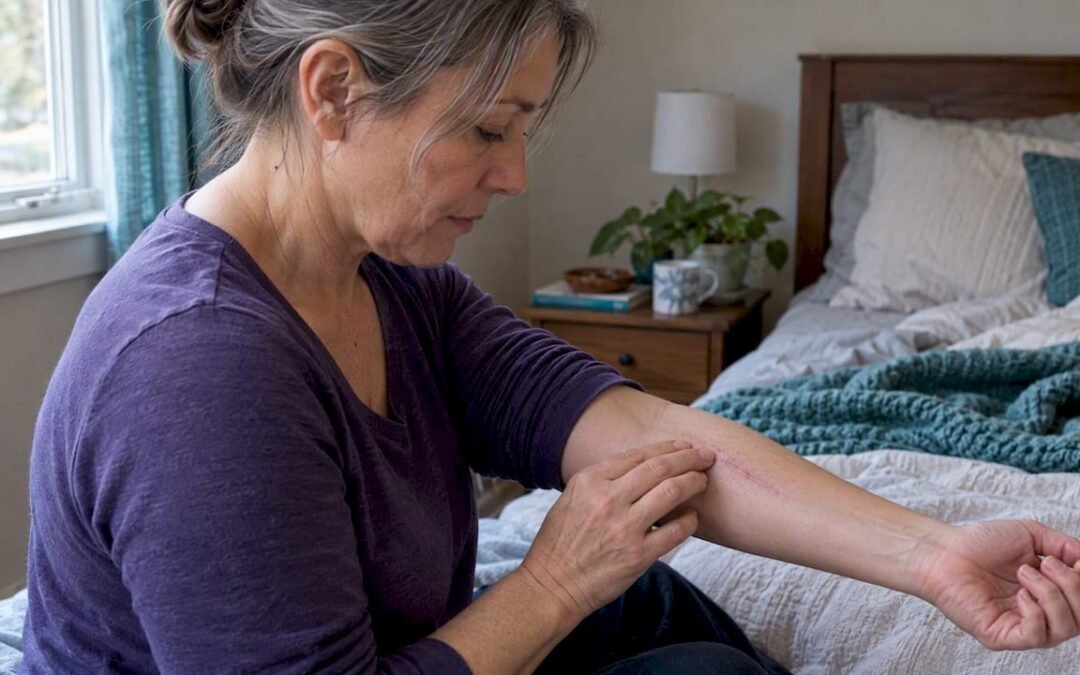
Massage can help a healed scar feel softer, itch less and move more freely, provided you do it correctly. The one rule that comes first: begin only when the wound is fully closed, with no stitches or scabs, as the NHS scar guidance advises. Confirm with your clinician, then start with a short daily routine.
TL;DR:
- Start only when the wound is fully closed, dry, and free of stitches or scabs; confirm with your clinician before beginning.
- Use light circles and strokes, then gently lift and move the skin; increase pressure only until it blanches, never into pain.
- Hospital guidance commonly recommends 5–10 minutes two or three times daily for about six months, though beginners can start with shorter sessions.
- Pause and seek medical review for increasing redness, warmth, blistering, bleeding, a rash, severe pain, or a reopening wound; never massage an infection.
- Silicone and sun protection can support care, while raised or growing scars, restricted movement, or stalled progress call for clinical assessment.
Table of Contents
- Why does massage help scar tissue, and what does the evidence show?
- When should you start scar massage, and what should you avoid?
- How do you massage a scar at home, step by step?
- How often should you massage, and when will you see results?
- Which extras work alongside scar massage?
- When is home massage not enough?
- Where does hands-on assessment add value?
- Book a professional assessment or treatment with us
- FAQ
- Sources
Why does massage help scar tissue, and what does the evidence show?
Scar tissue is built differently from the skin around it, and it can feel tight, dry or stuck to the layers beneath. Gentle, repeated pressure is thought to encourage the scar to hydrate, glide more easily and settle into a more flexible pattern as it matures. Clinical leaflets describe this as softening, flattening and reducing adhesions, which is why leaflets for patients after skin surgery recommend it.
Research on the symptoms is encouraging, though it mostly comes from burn studies.
A systematic review and meta-analysis of scar massage in burn patients reported significant reductions in itching and pain, plus some improvement in pliability.** That makes itch and discomfort the most realistic early wins.
Results for range of movement are more mixed, so treat massage as one useful tool rather than a cure. Hospital guidance also stresses that technique should match the maturity of the scar. Fresh, red or inflamed scars need a lighter touch, because aggressive work can aggravate them.
When should you start scar massage, and what should you avoid?
Timing matters more than technique. Wait until the wound is completely closed, dry and free of scabs, and check with the team that treated you. For a surgical scar, that is commonly a few weeks after the stitches come out.
Keep these precautions in mind:
- Never massage an open wound, a scab or an area that looks infected.
- Stop and seek medical review if you notice increasing redness, warmth, blistering, bleeding or a new rash, as the Cambridge University Hospitals leaflet advises.
- Ask a professional first if your skin is prone to keloid scarring, if you have recently had radiotherapy, or if your immune system is suppressed.
- Pause if the area becomes sore, inflamed or blistered, and restart gently once it settles.
If you are recovering after cancer treatment, our guide to oncology massage and safer sessions explains how professional massage is adapted.
How do you massage a scar at home, step by step?
Start with clean, dry skin. A small amount of light, unperfumed moisturiser helps your fingers move, but heavy oils make the scar hard to grip. For skin-fold techniques, NHS guidance notes that dry fingertip contact engages the tissue better.
You will use three core motions:
- Circles: Using the pads of two fingers or your thumb, make small, slow circles along the scar.
- Along the scar: Glide up and down the length of the scar in smooth, even strokes.
- Across the scar: Move side to side across the scar, a technique known as cross-friction.
Then try skin-fold mobilisation. Gently pinch or lift the scar and the skin around it, and glide it a little in each direction. Keep this light on newer scars, since forceful shearing can irritate them.
Pressure builds over time. Work from gentle to firmer until the skin turns pale under your fingers, but never into pain. The Sussex hospitals scar leaflet describes this blanching point as the target, and says to begin with lighter circles on young scars.
A simple session runs like this:
- Wash and dry the area, then apply a little moisturiser if you need it.
- Spend a short time on light circles along the whole scar.
- Spend a short time on strokes along its length.
- Spend a short time on side-to-side strokes.
- Finish with gentle skin-fold lifting, then moisturise.
Pro Tip: Play something calm while you work. Slow music, such as healing meditation music, can help you keep an even, unhurried rhythm and relax tense muscles around the scar.
How often should you massage, and when will you see results?
A common protocol across UK hospital trusts is 5–10 minutes per session, two to three times a day, kept up for approximately six months or until the scar matures, as the Sussex leaflet sets out. If that feels like a lot, East Sussex guidance suggests starting with two to three minutes and building up.
- Consistency beats the occasional long session, so little and often is the aim.
- Itch, tightness and oversensitivity usually ease before the scar looks different.
- Visible changes in colour and texture take longest.
Scars can keep changing for 12 to 24 months, so judge progress over months, not days.
Taking a photo every few weeks and jotting down how the scar feels will show you changes you would otherwise miss.
Which extras work alongside scar massage?
Massage rarely works alone. Clinicians commonly pair it with a few simple measures:
- Silicone gel or sheets: used regularly, these can help flatten and hydrate a scar, as the CUH scar massage leaflet explains.
- Moisturiser: use a non-scented, non-irritating cream to prevent dryness. No single brand has been shown to be better than another.
- Sun protection: protect healing scars from the sun to reduce darkening.
For everyday skin care, our CastorLife Body and Face Brush Kit is one gentle option some people like alongside a moisturising routine.
When is home massage not enough?
Home care has limits, and knowing them keeps you safe. Seek review from your GP, a dermatologist or a plastic surgeon if:
- the scar turns red, warm or blistered, re-opens or bleeds;
- you develop new severe pain;
- the scar is raised, thick or growing beyond its original edges, which can signal hypertrophic or keloid scarring;
- the scar tethers the skin enough to restrict movement;
- you have diabetes or a suppressed immune system and want to massage firmly, in which case get clearance first.
Infection is a medical matter, so do not try to massage through it.
Where does hands-on assessment add value?
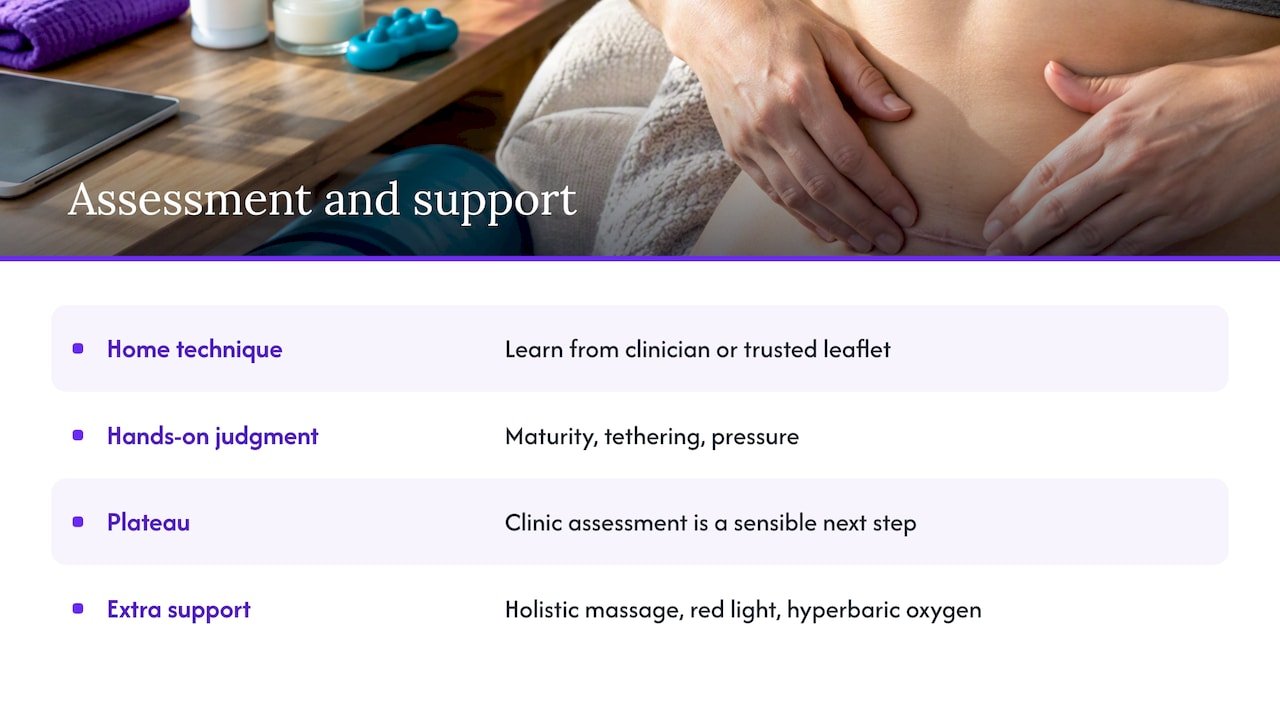
Home massage works best when the technique is right, and learning it from a clinician or a trusted leaflet is time well spent. Practise gently, progress slowly, and keep notes and photos so you can see what is changing. Combine steady massage with moisturiser, silicone and sun protection before deciding that you need anything more.
Where we think a professional adds real value is in reading the scar for you: how mature it is, where it is tethered and how firm your pressure should be. That is a hands-on judgement a leaflet cannot make. If home care has plateaued, a clinic assessment is a sensible next step, and our holistic massage, red light therapy and hyperbaric oxygen therapy are options for people who want extra support.
— Mark
Book a professional assessment or treatment with us
If you would rather have an expert look at your scar, we can help. Here is what we offer that supports scar management:
- Holistic massage: hands-on work to ease tightness and improve how the tissue moves.
- Red light therapy: a gentle, non-invasive session that many clients pair with massage.
- Hyperbaric oxygen therapy: for clients exploring in-centre options, with more in our guide to how HBOT may reduce scar tissue.
A visit starts with a functional check of the area, then a mobilisation plan built around your scar, and our recommendations for adjunct therapies. Ready to arrange it? Book your session with us and tell us about your scar when you enquire.

FAQ
Can you massage out scar tissue?
Massage cannot remove a scar, but it can make one softer, flatter and less sensitive. Clinical reviews report clear reductions in itch and pain rather than a scar that disappears.
How long does it take for massage to break up scar tissue?
Expect itch and tightness to ease first with regular practice, though the timing varies. Scars can keep maturing as they heal, so cosmetic changes take much longer.
How often should scar tissue be massaged?
The usual hospital advice is 5–10 minutes, two to three times a day, as set out in the Sussex scar leaflet. Beginners can start with shorter sessions and build up.
What should you do before starting scar massage?
Check that the wound is fully closed and healed, with no scabs or stitches, and confirm with your clinician. Then use clean, dry skin and a light, unperfumed moisturiser if your fingers need help gliding.