
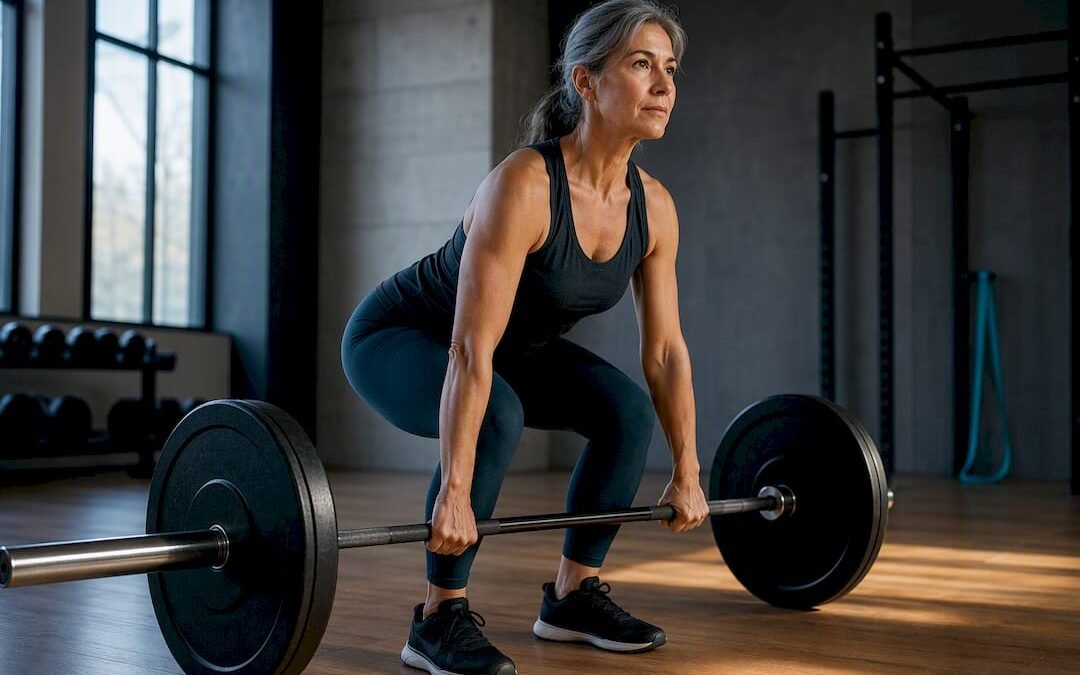
Yes, strength training belongs at the centre of any menopause fitness plan. Aim for around three progressive resistance sessions a week, each lasting roughly 40 to 60 minutes, working close to your capacity on the main lifts. Done consistently, this preserves muscle, protects bone density, and sharpens balance. If you have osteoporosis or a recent fracture, get medical clearance before you load up.
TL;DR:
- Training three times per week at 70% or higher of your one-rep max for 40 to 90 minutes significantly improves bone density, muscle strength, and balance.
- Progression should involve increasing load by approximately 5% once your current set feels manageable, with deload weeks every four to five weeks.
- Key exercises like squats, deadlifts, step-ups, rows, and push-ups are safest when performed with proper technique and gradual load increases, especially if managing osteoporosis.
- Signs like sudden pain or new dizziness indicate you should pause training and seek professional advice before continuing.
- Supporting recovery with adequate protein, sleep, and calcium helps maintain gains, especially for women with bone health concerns.
Table of Contents
- Why strength training matters for muscle, bone and balance in menopause
- What the research recommends: frequency, duration and intensity
- An 8 to 12 week starter programme for building strength safely
- Key exercises and how to do them safely
- Training safely through osteoporosis, joint pain and fracture risk
- Nutrition and recovery to support your training
- How Live5dhealth supports safe, structured strength training
- A trainer’s view on what actually moves the needle
- Ready for supervised, personalised strength coaching?
- Primary sources and further reading
- Sources
Why strength training matters for muscle, bone and balance in menopause
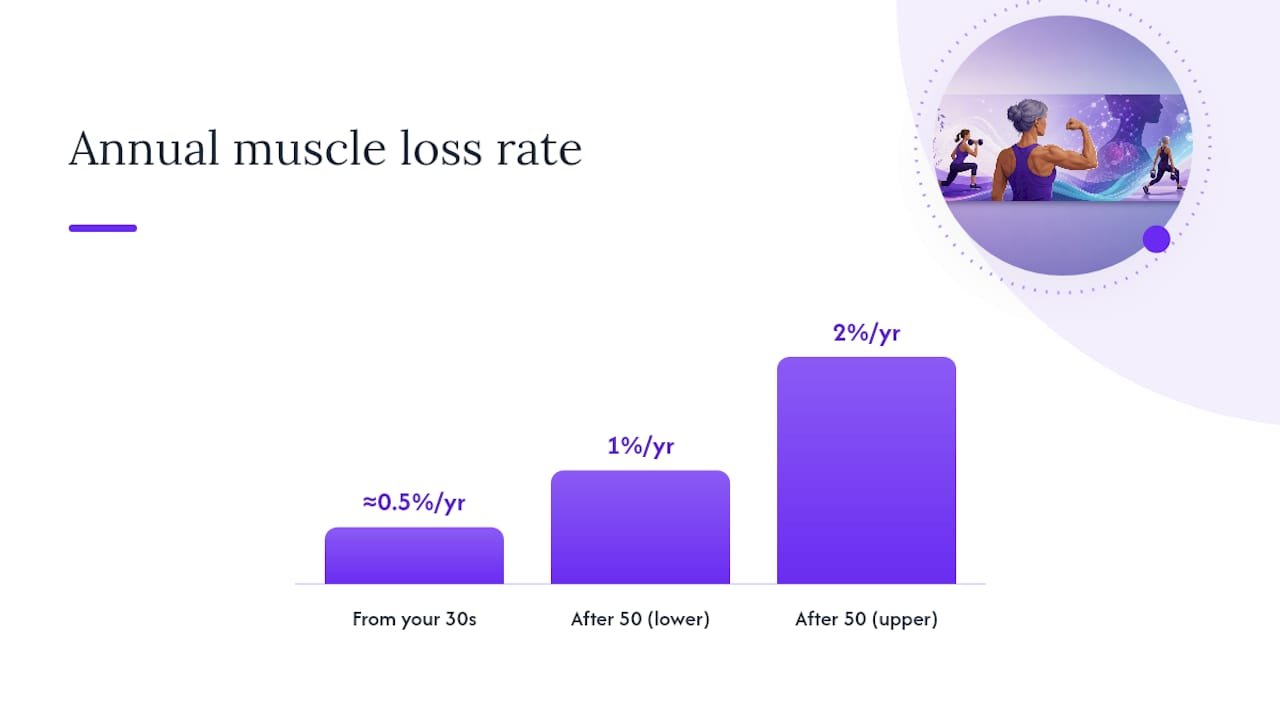
Falling oestrogen doesn’t just affect hot flushes and sleep. It accelerates the loss of muscle and bone that would happen anyway with age, compressing years of gradual decline into a much shorter window. Muscle mass typically drops by around 0.5% a year from your thirties, then speeds up to 1 to 2% annually after 50. Left unchecked, that trajectory leads to sarcopenia (significant, function limiting muscle loss) and raises your risk of osteoporosis, the bone-thinning condition that makes fractures far more likely after a fall.
Strength training interrupts that slide. It doesn’t just slow the decline, it actively reverses parts of it.
Clinical experts at Stanford Lifestyle Medicine point out that resistance training remains just as effective regardless of menopausal status. Declining oestrogen raises the risk, but it doesn’t cap what your muscles and skeleton can still achieve.
Trials back this up with measurable results:
- Improvements in muscle strength and lean mass, confirmed through RCTs and a systematic review of strength exercises for menopausal women.
- Gains in bone mineral density (BMD) tracked using DXA scans, the gold-standard bone density test.
- Better balance and a lower risk of falls, which matters more with each decade past 50.
- Improved lower-body function, including everyday tasks like climbing stairs or standing from a chair without using your hands.
None of this requires becoming a competitive lifter. It requires showing up, loading your muscles progressively, and giving your body a reason to hold onto what it has.
What the research recommends: frequency, duration and intensity
The clinical consensus has firmed up considerably in recent years, and it’s more specific than “just do some weights.”
Systematic reviews and meta-analyses as of 2025 point to a fairly consistent formula for postmenopausal women: about three sessions a week, 40 to 90 minutes each, with intensities of 70% of your one-rep max (1RM) or higher for the biggest bone density gains. Your 1RM is simply the heaviest weight you can lift once with good form; 70% of that is heavy enough to create a real mechanical stress on bone, but manageable with proper technique.
Statistic Callout: Reviews across the field converge on the same three numbers: 3 sessions per week, 40 to 90 minute sessions, and ≥70% 1RM for meaningful bone mineral density improvement.
Researchers measure these outcomes in specific ways, and it’s worth knowing what’s behind the numbers:
- Bone mineral density is tracked with DXA scans, usually repeated after 6 to 12 months of consistent training, since bone remodels slowly.
- Strength gains are measured against 1RM or estimated maximums, often showing improvement within 8 to 12 weeks.
- Functional outcomes, like balance and hip strength, are assessed through standardised movement tests, sometimes showing change even faster than bone or strength metrics.
Not every study used identical methods, and that matters. A systematic review of RCTs on strength exercises in menopause found that varied training modalities, from resistance bands to free weights to machines, all produced genuine benefits. Higher-volume programmes sometimes delivered bigger lean-mass gains, but the same review flagged adherence as the real deciding factor. A moderate programme you actually finish beats an ambitious one you abandon after three weeks.
An 8 to 12 week starter programme for building strength safely
Here’s a template you can start this week and adjust as you go, based on the evidence above and designed for someone new to structured resistance training.
Each session (roughly 45 to 60 minutes):
- Warm-up (5 to 10 minutes): Light cardio plus mobility work for hips, shoulders and ankles.
- Three to four compound lifts: Squat pattern, hip hinge, a push, and a pull. Three sets of 6 to 12 reps, adjusting load so the final reps feel genuinely demanding.
- One to two accessory moves: Targeting weaker areas or specific goals, such as glute bridges or lateral raises.
- Balance or core work (5 minutes): Single-leg stands, dead bugs, or similar stability drills.
- Cool-down (5 minutes): Gentle stretching and breathing to bring your heart rate down.
Progression rules: Increase load by around 5% once you can comfortably complete all sets at the top of your rep range with good form. Build in a lighter deload week roughly every fourth or fifth week to let your joints and nervous system recover. If you’re a complete beginner, start with resistance bands or bodyweight and only add free weights once your technique is consistent under fatigue, a sequence backed by practical coaching guidance from AP News. Experienced lifters can move to barbells or heavier dumbbells from the outset.
If three full sessions feel unrealistic at first, try two shorter 30-minute sessions plus one longer 60-minute one. Walking or cycling on non-lifting days is fine and genuinely good for cardiovascular health, but don’t let cardio quietly displace your resistance sessions. The bone and muscle benefits come specifically from loading, not from steps alone.
Pro Tip: Track your top set weight for each main lift in a simple notes app. Seeing the number creep up over eight weeks is the single best motivator for sticking with a new programme.
Key exercises and how to do them safely
These moves cover the biggest strength and stability wins for women in midlife, each with a way to make it easier or harder depending on where you’re starting.
- Goblet squat: Builds lower-body and core strength together. Cue: keep your chest tall and push your knees out over your toes. Regression: box squat to a bench. Progression: add a barbell back squat.
- Romanian deadlift: Trains the hip hinge, protecting your lower back in daily life. Cue: push your hips back before you bend your knees. Regression: hip hinge with a light dumbbell or just bodyweight. Progression: barbell RDL.
- Step-ups: Directly mirrors stair climbing and single-leg stability. Cue: drive through the whole foot, not just the toes. Regression: use a low step. Progression: add dumbbells or increase step height.
- Bent-over or single-arm row: Strengthens the upper back, countering the forward slump that comes with desk life. Cue: squeeze the shoulder blade before the arm moves. Regression: seated cable or band row. Progression: heavier dumbbell or barbell row.
- Push-up progressions: Builds pressing strength without needing equipment. Cue: keep a straight line from shoulders to knees. Regression: incline push-up against a bench. Progression: full push-up, then weighted vest.
- Overhead press: Supports shoulder health and daily overhead reaching. Cue: brace your core and exhale as you press, avoiding breath-holding under strain. Regression: seated dumbbell press with lighter load. Progression: standing barbell press.
- Lateral band walk: Activates hip stabilisers that prevent knee and lower-back niggles. Cue: keep tension on the band throughout, don’t let your knees collapse inward.
- Single-leg balance work: Directly trains fall prevention. Cue: soft knee, eyes forward, hold for 20 to 30 seconds per side.
If you notice any pelvic pressure, heaviness, or leakage during heavier lifts, exhale through the exertion rather than holding your breath (avoiding the Valsalva manoeuvre), and mention it to a pelvic health physiotherapist.
Training safely through osteoporosis, joint pain and fracture risk
Progression should feel steady, not dramatic. A sensible rule is to increase load only when your current weight feels genuinely manageable across all sets, not just achievable with strain.
Certain signs mean it’s time to pause and get it checked rather than push through:
- Sudden, sharp pain during a lift, rather than the expected muscular fatigue.
- New dizziness, especially when standing from a lying or seated position.
- Any recent fracture, even one that seems minor.
- Pelvic leakage or heaviness that appears specifically during heavier lifting sessions.
If you’ve been diagnosed with osteoporosis, expert guidance from the Mayo Clinic recommends avoiding end-range spinal flexion under load (think heavy loaded sit-ups or toe-touches with weight), favouring supervised programmes, and coordinating your training with any bone-preserving medication you’re prescribed. For readers wanting more detail on loading strategies specific to low bone density, this guide to high-impact exercise for osteoporosis is a useful companion resource.
Pro Tip: If you’re unsure whether a twinge is normal training fatigue or something to flag, wait 48 hours. Muscle soreness eases; joint or bone pain that lingers or worsens needs a professional opinion.
Nutrition and recovery to support your training
Muscle and bone don’t adapt from training alone. What you eat and how you recover determines whether the stimulus actually sticks.
Protein needs rise as we age, and most women in midlife benefit from spreading intake across meals rather than loading it all at dinner. A practical target is a palm-sized portion of protein at each meal, with an extra serving after training sessions to support muscle repair. If you’re building this into a shopping routine, protein powder options suited to women over 40 can fill gaps on busier days.
- Vitamin D and calcium both support bone remodelling; ask your GP about testing levels rather than guessing.
- Avoid rapid weight loss. Mayo Clinic guidance notes that aggressive dieting undermines bone density even when paired with resistance training, whereas moderate, sustainable changes preserve it.
- Sleep is when muscle repair actually happens, so treat 7 to 8 hours as part of the programme, not an optional extra.
- Schedule at least one full rest day between heavy sessions on the same muscle groups, and build in a deload week roughly every month.
How Live5dhealth supports safe, structured strength training
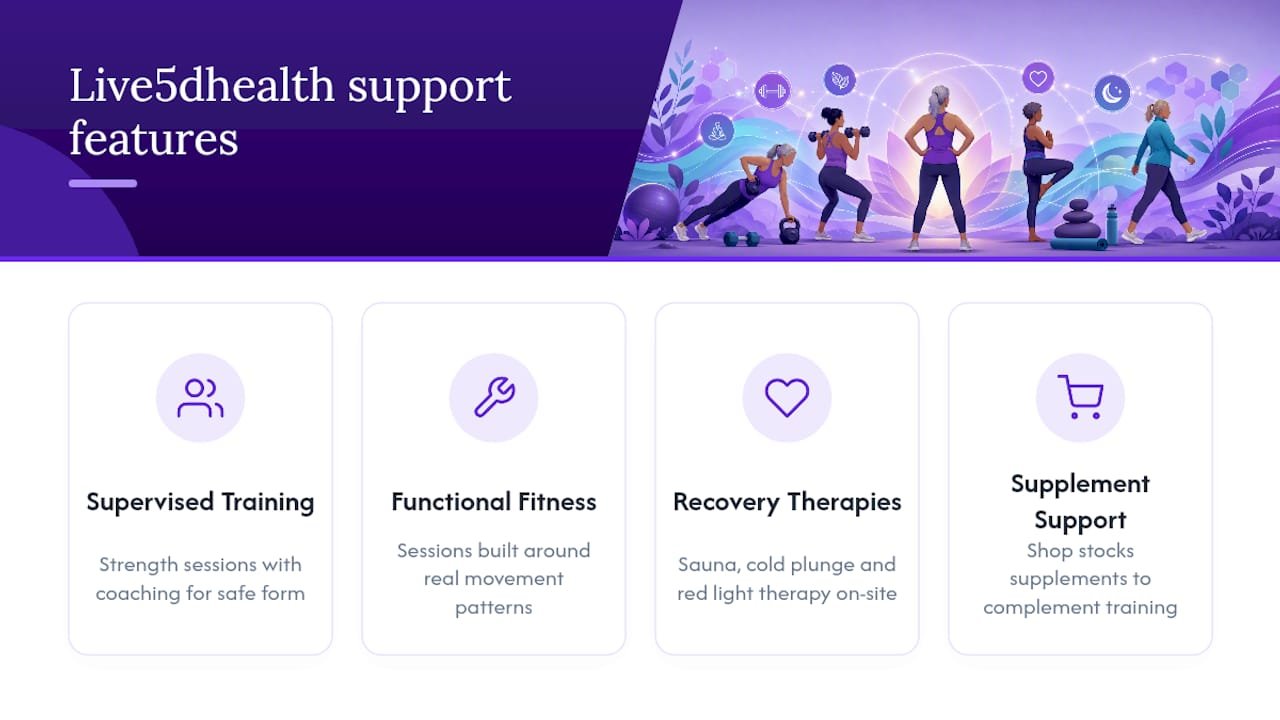
Live5dhealth is a wellness centre, gym and retreat in the west of Ireland built around exactly this kind of evidence-based approach to midlife fitness. Supervised strength sessions and functional-fitness coaching help you apply the frequency and intensity guidance above with proper form from day one, which matters most when you’re new to lifting heavier loads. Our functional fitness approach for women informs how sessions are structured around real movement patterns, not isolated machine work.
Recovery matters just as much as the lifting itself. Sauna, cold plunge and red light therapy on-site support the muscle repair and inflammation management that training depends on, and the online shop stocks supplements chosen to complement a resistance programme rather than replace one.
A trainer’s view on what actually moves the needle
Consistency beats intensity every time. Two priorities matter more than anything else: showing up for your sessions most weeks, and progressing loads safely rather than chasing quick wins that risk injury and derail momentum.
Meaningful change is achievable within weeks, not years, if you stay consistent. Where bone health, joint pain or past injury complicate things, working with a supervised programme removes the guesswork and keeps progress steady.
— Mark
Ready for supervised, personalised strength coaching?
Reading a programme is one thing. Having someone watch your squat depth, adjust your load week to week, and catch a form issue before it becomes an injury is another. Live5dhealth offers exactly that combination, supervised strength coaching alongside recovery therapies like sauna, cold plunge and red light treatment that help your body actually absorb the training stimulus rather than just accumulate fatigue.

This matters most if you’re managing osteoporosis, joint pain, or simply haven’t lifted weights before and want someone checking your technique rather than learning entirely from articles. Booking a tailored assessment means your programme reflects your actual bone density, strength baseline and any medical considerations, rather than a generic template. If recovery support is what you’re after between sessions, our luxury spa with sauna, steam and cold plunge in Boyle rounds out a complete approach to training and repair. Get in touch to book an assessment and start building a programme suited to where you are right now.
Primary sources and further reading
- PubMed: systematic reviews and meta-analyses on resistance training parameters (2025)
- Systematic review of strength exercises for menopause symptoms (PMC)
- University of Exeter: resistance training and physical function in menopause
- Mayo Clinic News Network: weightlifting and bone health in menopause
Sources
- PubMed: systematic reviews and meta-analyses (2025)
- The efficacy of strength exercises for reducing the symptoms of menopause: a systematic review (PMC)
- University of Exeter news: study on resistance training during menopause