
Sound can help your body shift towards calm, but no listening session has been shown to “reset” your vagus nerve. Calming music, humming and slow breathing are low-risk ways to support relaxation, and some studies see changes in heart rate variability (HRV) afterwards. Specific frequencies, “vagus tones” and bold promises are another matter. The evidence is thinner than the marketing suggests.
We work with wellness technologies every day at our centre in Boyle, County Roscommon, so we want you to know what is promising, what is unproven and how to try it safely. You can feel hopeful about sound as a gentle tool. You just should not expect it to do the job of medicine.
TL;DR
- “Vagus nerve sound therapy” covers very different things: calming music, filtered audio programmes, low-frequency vibration and clinical electrical stimulation. Only the last directly stimulates the nerve.
- Research on music and vagally mediated HRV is encouraging but patchy, with small studies and a high risk of bias.
- Humming, singing and slow, tranquil music are sensible, low-risk things to try. Choose what feels comfortable rather than a “magic” frequency.
- If you are in cancer treatment, have an implanted device or a heart-rhythm problem, talk to your clinician first. Sound never replaces oncology care.
Table of Contents
- What people mean by vagus nerve sound therapy
- What the research actually shows
- What this means for you
- Try it at home: a gentle five-minute routine
- If you are living with cancer
- Who should check first
- Our perspective
- Sound and light sessions at our Boyle centre
- How to judge any sound therapy claim
- FAQ
- Sources
What people mean by vagus nerve sound therapy
The vagus nerve is the long cranial nerve that carries signals between your brain and organs such as the heart and gut. It is a major part of the parasympathetic “rest and digest” system. Heart rate variability, the small beat-to-beat changes in your heart rhythm, is widely used as a non-invasive marker of vagal tone and autonomic flexibility.
When someone searches for sound therapy for the vagus nerve, they usually mean one of four things:
- Ordinary calming music or a sound bath. It may influence stress and autonomic measures indirectly, through attention, emotion and breathing.
- Filtered-auditory programmes, such as the Safe and Sound Protocol, which use processed music designed to cue a sense of safety.
- Vibroacoustic therapy, where low-frequency sound is felt as vibration through a chair, bed or mat.
- Clinical vagus nerve stimulation (VNS), where electrical stimulation is sometimes paired with tones. This is a medical procedure.
The review of non-invasive vagal neuromodulation makes the key point: these categories are not interchangeable, and only the last directly stimulates the vagus nerve. The others may nudge your autonomic state, but “nudge” is the honest word.
What the research actually shows
Music and vagally mediated HRV
A systematic review of music therapy and vagally mediated HRV included 28 studies. Calming music may increase vagally mediated HRV, but the studies varied a lot, had small samples and carried a high risk of bias. The authors point out that the studies measured HRV in different ways. That means the evidence is not strong enough to say that listening directly treats or “resets” the vagus nerve.
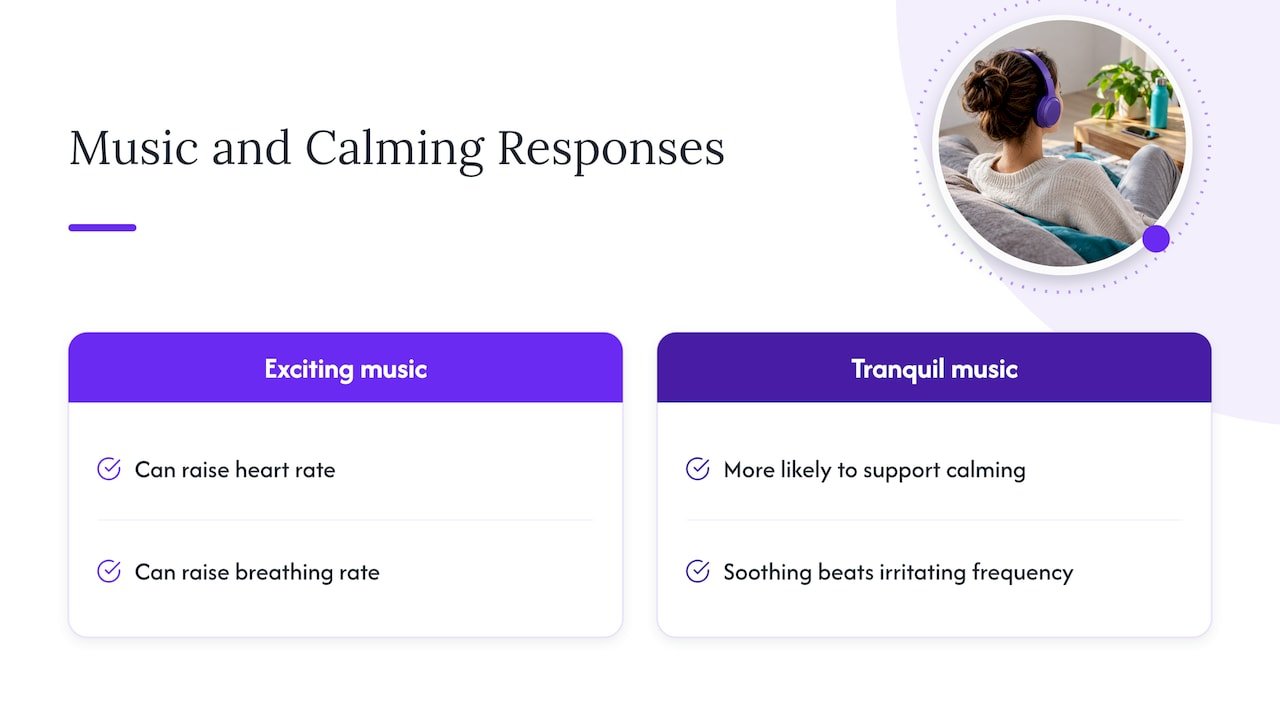
Context matters too. Koelsch and Jäncke’s review explains that the effect of music on heart rate and HRV depends on its emotional content: exciting music can raise heart and breathing rate, while tranquil music is more likely to support calming responses. In practice, a track that you find soothing beats a track with an impressive-sounding frequency that you find irritating.
Low-frequency vibration and the 40 Hz question
Vibration and low-frequency sound are often marketed as vagal stimulation. In a randomised crossover study of 24 participants, 40 Hz low-frequency vibration combined with nature sounds changed some HRV, stress and mood measures after exposure. However, differences between the active conditions and placebo were seldom significant. So a specific 40 Hz track cannot honestly be sold as proven vagus nerve therapy.
If you are curious about the wider light-and-sound field, we have summarised what the 40 Hz research shows in a separate guide.
Filtered music programmes
The Safe and Sound Protocol is popular in trauma-informed and autism-related settings. The 2025 review by Gitler and colleagues concludes that its evidence is preliminary and that large controlled trials are still needed. It is reasonable to call it investigational support. It is not proven vagal neuromodulation.
Where sound and the vagus nerve do meet
The strongest sound-paired evidence involves implanted devices. In a 2017 tinnitus pilot, 30 participants had VNS devices implanted and used the therapy at home for six weeks. Clinically meaningful improvement appeared in 50% of the paired-VNS group versus 28% of controls. It is a small, condition-specific study, and reviews still judge tinnitus evidence as limited. It tells us nothing about a relaxing playlist.
What this means for you
A fair summary looks like this:
| Approach | Directly stimulates the vagus nerve? | Evidence quality | Risk level |
|---|---|---|---|
| Calming music, sound bath | No, indirect at best | Small, varied studies | Low |
| Humming, singing, chanting | No, indirect at best | Practical guidance, limited trials | Low |
| Filtered music programmes | Not proven | Preliminary | Low to moderate; seek guidance |
| Low-frequency vibration | Not proven | Mixed, mostly nonsignificant vs placebo | Low to moderate |
| Clinical VNS with tones | Yes | Condition-specific | Medical procedure |
None of this makes sound pointless. Feeling calmer is a real and worthwhile outcome even if we cannot yet prove the pathway. It simply means you should judge a session by how you feel and function, not by a claim that your nerve has been “repaired”.
Try it at home: a gentle five-minute routine
Cleveland Clinic’s guidance on vagus nerve resets names humming, chanting, singing and listening to calming music with a steady rhythm as simple options. The likely benefit is relaxation and parasympathetic support, not a guaranteed physiological reset. Here is a routine that follows that spirit:
- Settle. Sit or lie somewhere comfortable. Let your shoulders drop.
- Breathe out slowly. Breathe in through your nose, then make the out-breath longer than the in-breath.
- Hum. On each out-breath, hum a low, easy note. Notice the vibration in your chest and throat.
- Add sound you like. Play slow, tranquil music or a soundscape at a low volume. Pick something you enjoy, not something that is merely “supposed” to work.
- Check in. After two to five minutes, notice your breathing, jaw and shoulders. Stop whenever you like.
You can build this into a bedtime wind-down. Our guide to evidence-backed sound therapy protocols for sleep goes into that, and binaural beats protocols cover the other popular format. If worry is the main driver, see sound therapy for anxiety and our wider piece on anxiety symptoms, causes and management. For an overview of group sessions, read what 19 studies found about sound baths.
Should you track it with a wearable?
Many wearables show an HRV score. Treat it as a contextual signal. Because music studies measure HRV so differently, a change on your watch is not proof that your vagus nerve has been repaired or that your disease risk has fallen. Sleep, caffeine, illness and exercise all move that number as well.
When to stop and get advice
Stop the session if sound brings on dizziness, anxiety, headache, ear pain or worsening tinnitus, and speak to your GP if symptoms persist. For a broader view of what to watch for after any sound or energy-style session, this article on when to stop and how to think about sound-related symptoms is a useful read.
If you are living with cancer
Sound can be a comfort during a hard time, but it is a relaxation and symptom-support tool, never a cancer treatment.
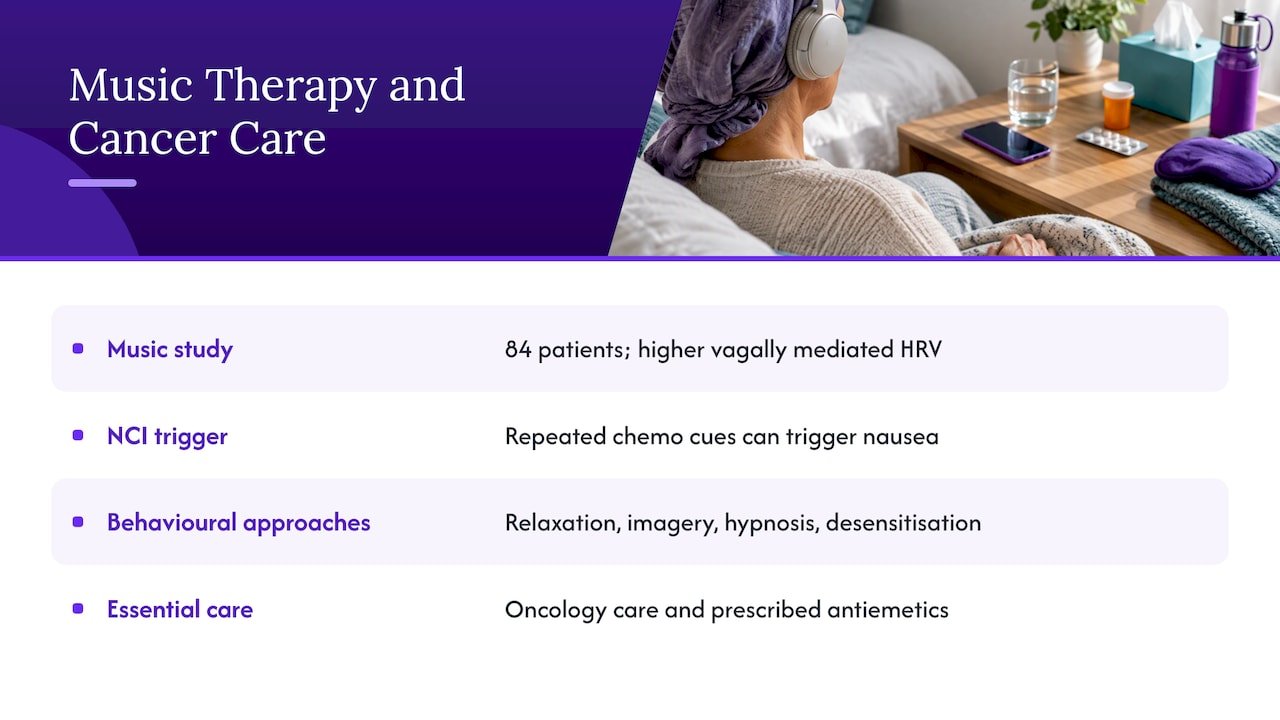
There is some supportive research. A randomised palliative-care study of 84 terminally ill patients found higher vagally mediated HRV in the music-therapy group. The National Cancer Institute also notes that sounds and treatment-room cues can become conditioned triggers for anticipatory nausea after repeated chemotherapy. It treats relaxation, guided imagery, hypnosis and desensitisation as behavioural approaches, while oncology care and prescribed antiemetics remain essential.
So a familiar track you have chosen yourself could sit alongside your treatment plan, ideally agreed with your oncology team. If you are having chemotherapy or radiotherapy, ask your oncologist or specialist nurse before adding any new therapy.
Who should check first
Listening to music and humming are safe for most people. Ask your GP or specialist before any approach that involves electrical stimulation, or ear or neck devices, particularly if you:
- have an implanted device such as a pacemaker or a vagus nerve stimulator
- have a significant heart-rhythm problem
- are in active cancer treatment
- have tinnitus, hearing loss or ear problems that vibration or loud sound could aggravate
- are pregnant, or unsure whether a device is suitable for you
Clinical vagus nerve stimulation is a supervised medical treatment. It is not the same thing as a sound session, however similar the vocabulary.
Our perspective
At Live5DHealth we have built our centre around a holistic approach that combines modern technology with ancient wisdom. That includes sound and light work, and we are enthusiastic about it. But we are equally firm about honesty.
Our view is simple. Sound is best treated as one part of a calm, supportive routine, alongside good sleep, movement, nourishing food, time outdoors and, where needed, medical care. We would rather tell you that the vagus-nerve claim is unproven than promise a result that nobody can guarantee. When clients ask us about “vagal tone”, we talk about how they feel: how deeply they sleep, how quickly they come down after a stressful day, how their body responds to a quiet room.
We also believe the setting matters. Warmth, quiet, unhurried time and a sense of safety do a lot of the work, whatever the technology. That is why we think about the whole visit, from arrival to rest afterwards, and why we encourage you to bring any questions about your health conditions to your own clinician first.
— Mark
Sound and light sessions at our Boyle centre
If you would like to experience guided sound in a calm setting, we offer Roxiva Sound and Light Brain Entrainment Therapy. You can read how Roxiva light and sound therapy works and book your session online. We do not claim it stimulates your vagus nerve. We offer it as a way to rest and unwind.
Many people pair it with other relaxing treatments:
- Sauna, steam and cold plunge spa, €30 one-off
- Red light therapy, €20 to €40 one-off
- Hyperbaric oxygen therapy, €80 to €120 one-off
- Holistic massage, with the research behind it explained
If you want a longer reset, our 3, 5 and 10-day wellness retreats give you time to slow down properly. You can also read about choosing a retreat in Ireland.
How to judge any sound therapy claim
Whether you meet an app, a practitioner or a video, a few questions cut through the noise:
- Does it say “stimulates the vagus nerve” without evidence? Only clinical VNS does that directly.
- Does it promise a specific frequency works? Studies use highly variable frequencies, music and delivery systems, and the 40 Hz trial found mostly nonsignificant differences against placebo.
- Does it claim to treat disease? Sound is support, not treatment.
- Does it suit you? The best track is the one that leaves you more relaxed, not tense.
- Does the practitioner ask about your health? A good one asks about medical conditions, devices and medication before starting.
FAQ
Does sound therapy really stimulate the vagus nerve?
Not directly, as far as current evidence shows. Calming music and humming may influence autonomic measures such as vagally mediated HRV indirectly, but the studies are small and varied. Only clinical electrical stimulation directly targets the nerve.
What is the fastest way to calm your body down?
Slow breathing with a longer out-breath is a simple place to start, and humming or listening to tranquil music can help you stay with it. Cleveland Clinic’s guidance lists these as low-risk options. The benefit is relaxation, not a guaranteed reset. If anxiety is persistent, speak to your GP.
Who should not try vagus nerve stimulation?
People with implanted devices, significant heart-rhythm problems or active cancer treatment should get medical advice before any electrical or ear and neck stimulation. Gentle listening and humming are different and carry little risk. Stop if you feel dizzy, get a headache, ear pain or your tinnitus worsens.
Is a 40 Hz or 528 Hz track proven to work?
No. A randomised crossover study of 40 Hz vibration found few and mostly nonsignificant differences against placebo. Choose music by how it makes you feel rather than by a number.
Can sound help during cancer treatment?
It may help with relaxation and coping, and a track you have chosen can ease anticipatory nausea triggers as part of a plan your clinician approves. It is not a treatment for cancer and does not replace antiemetics or oncology care.
Sources
- Harnessing non-invasive vagal neuromodulation: HRV biofeedback and SSP (review)
- Music therapy and vagally mediated heart rate variability: systematic review
- Effect of low frequency sound on heart rate variability: randomised crossover study
- Koelsch and Jäncke, music and the heart
- Cleveland Clinic: vagus nerve reset
- VNS paired with tones for tinnitus: pilot study
- Receptive music therapy in palliative care
- NCI: nausea and vomiting related to cancer treatment