

PEMF therapy has genuine, well-documented support as an adjunct for slow-healing fractures, particularly established non-unions, where it can meaningfully raise healing rates when used alongside standard orthopaedic care. Evidence for fresh, straightforward fractures and osteoporosis is promising but far less settled, and results depend heavily on device parameters and daily adherence. It’s never a standalone fix. Speak with your orthopaedic team before choosing a device, and treat PEMF as one piece of a bigger recovery plan.
TL;DR:
- PEMF therapy shows strong evidence for improving healing rates in non-union and delayed-union fractures, with success rates ranging from 45% to 85%.
- Effective protocols typically involve low single-digit to low double-digit Hertz frequencies, specific validated pulse parameters, and consistent daily use over several weeks to months.
- Adherence to recommended daily treatment duration significantly influences outcomes, with sporadic use diminishing potential benefits.
- PEMF devices for bone healing must be FDA-cleared and use validated settings; consumer wellness mats are not proven effective for fracture recovery.
- The strongest clinical support exists for slow-healing cases, while evidence for osteoporosis and straightforward fractures remains limited and promising but inconclusive.
Table of Contents
- How PEMF works at the cellular level to support bone repair
- What clinical trials and reviews say about fracture healing
- What frequency and intensity do studies actually use?
- Who is most likely to benefit from PEMF treatment for bone pain
- Is PEMF safe? Contraindications to know before starting
- How PEMF fits alongside standard fracture care
- What results and timelines to realistically expect
- Where the research still falls short
- A measured view on where PEMF actually earns its place
- Booking a PEMF consultation at Live5dhealth
- Sources
- FAQ
How PEMF works at the cellular level to support bone repair
Bone doesn’t heal because a magnetic field waves at it. It heals because that field nudges specific biological switches that were already there, waiting to be turned on. Pulsed electromagnetic field therapy delivers low-frequency electromagnetic pulses that pass through tissue and interact with cell membranes, and the downstream effects are where things get genuinely interesting.
The best-documented mechanism involves adenosine receptors sitting on the surface of bone and immune cells. When PEMF activates these receptors, it sets off a signalling cascade that includes the Wnt/β-catenin and BMP/TGF-β pathways, two of the master regulators your body uses to build new bone. Mechanistic and preclinical research shows this activation increases osteoblast activity, the bone-building cells responsible for laying down new tissue at a fracture site.
That extra osteoblast activity doesn’t happen in isolation. Alongside it, studies report:
- Increased collagen matrix synthesis, the scaffold that mineral crystals later attach to during bone formation
- Improved angiogenesis, meaning better blood vessel growth into the healing zone, which matters because a fracture site starved of blood supply heals poorly or not at all
- Changes in ion channel behaviour, with calcium, sodium, and potassium flux shifting in ways that appear tied to how cells signal and divide
- Knock-on effects on mitochondrial activity, which affects how much cellular energy is available for the demanding work of tissue repair
Pro Tip: If a clinic or product description mentions “cellular regeneration” without explaining which pathway it’s targeting, ask. A credible provider should be able to name adenosine receptors, Wnt/β-catenin, or BMP/TGF-β signalling specifically, not just gesture at “energy” in vague terms.
Here’s what makes this mechanistic picture unusually convincing compared with a lot of wellness technology: the signal is consistent across a wide range of study designs. In-vitro cell cultures, animal models, and human tissue samples all point toward the same handful of pathways being activated even when the physical parameters of the devices used (frequency, waveform, intensity) differ considerably between studies.
That consistency matters more than it might sound. A huge amount of confusion around PEMF therapy for healing comes from device marketing that blurs together dozens of different frequencies and claims they all do the same thing. They don’t, necessarily. But the underlying biological targets, adenosine receptors and the osteogenic pathways they trigger, keep showing up across the literature regardless of the exact protocol used, which is a reasonably strong signal that the mechanism itself is real, even if the optimal dosing is still being worked out.
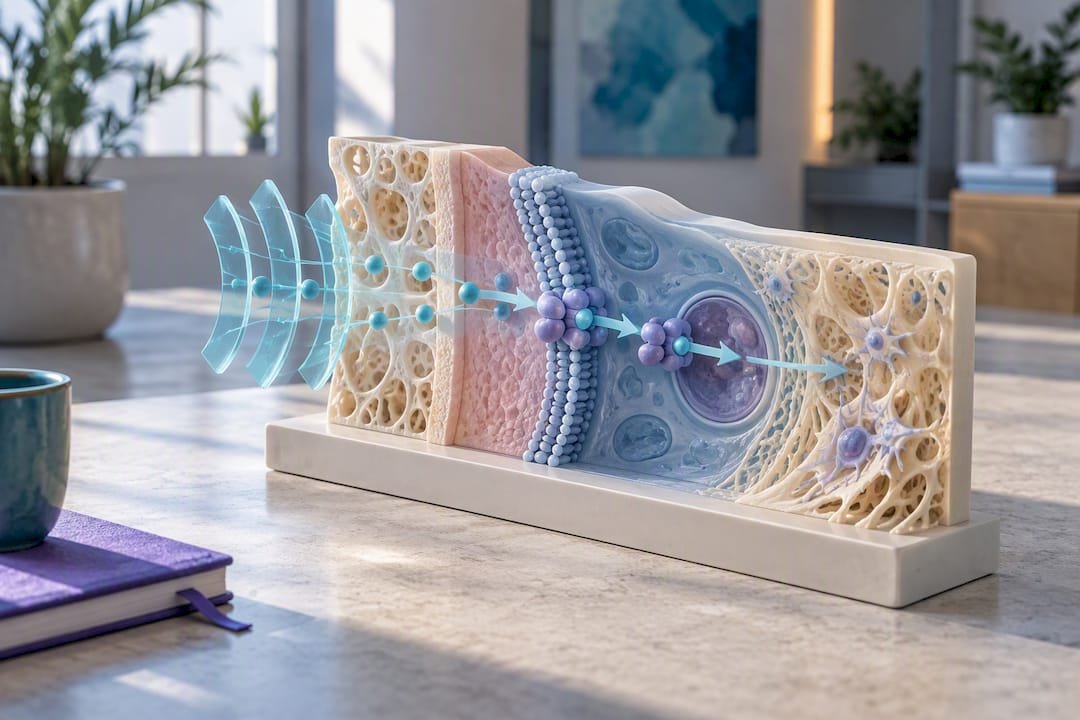
Where researchers still disagree is on magnitude and timing: how much osteoblast stimulation is enough, how long the effect needs to be sustained, and whether earlier exposure (during the inflammatory phase right after a fracture) produces different results than later exposure during the remodelling phase. Those questions are precisely why the parameter section further down this article matters so much. Understanding the mechanism tells you why bone regeneration with PEMF is biologically plausible. It doesn’t yet tell you the exact settings that maximise it, and that gap between “this pathway is real” and “this specific protocol is optimal” is where a lot of the clinical uncertainty in this field actually sits.
What clinical trials and reviews say about fracture healing
Mechanism is one thing. Whether PEMF actually shortens healing time or rescues a stalled fracture in real patients is the question that matters most, and the clinical evidence, while genuinely encouraging in places, is not uniform across every fracture type.
The clearest signal comes from non-union and delayed-union fractures, cases where a bone has stopped healing on its own, often months after the original injury. Systematic reviews and meta-analyses covering PEMF therapy for healing report a pooled healing rate risk ratio of approximately 1.22 (95% CI 1.10 to 1.35), meaning treated patients were noticeably more likely to achieve union than untreated controls. The effect is strongest in exactly the population that needs it most: bones that have already failed to heal through the normal biological timeline.
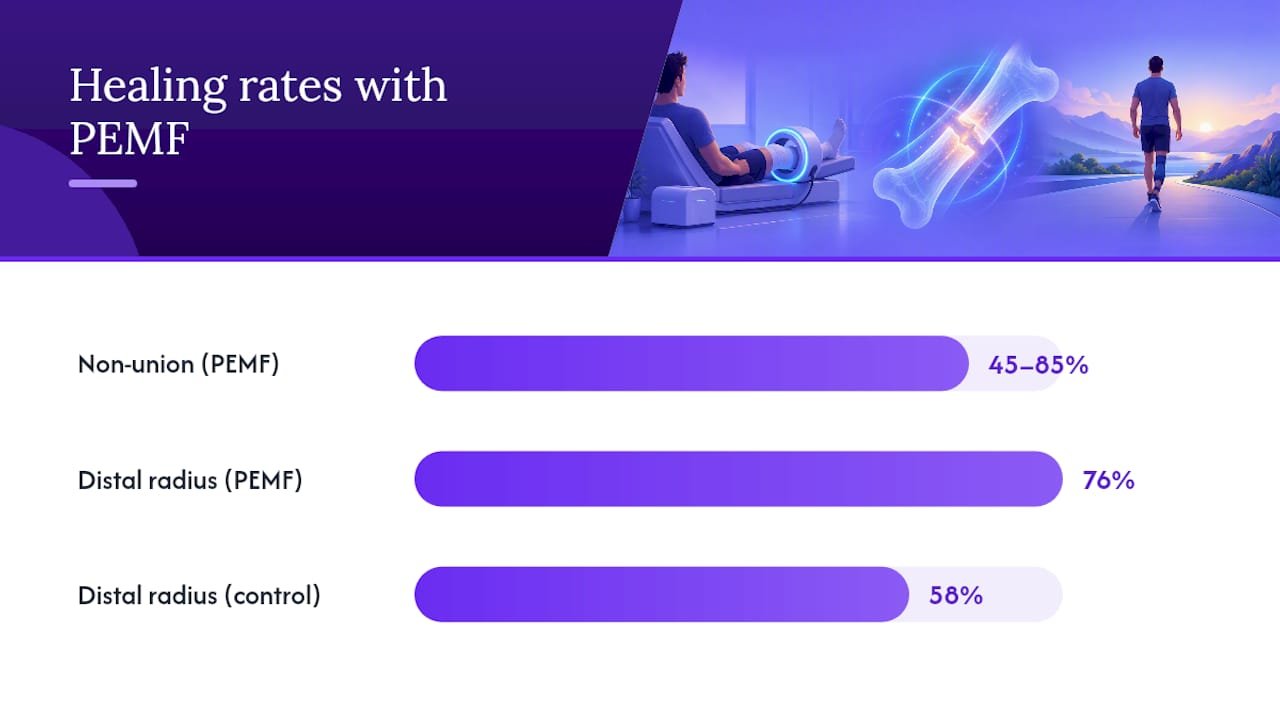
The numbers behind non-union recovery: reported success rates for PEMF in established non-unions range broadly, from roughly 45% to 85%, depending on the fracture site, the mechanical stability of the fixation, and how consistently the patient used the device. That spread isn’t a flaw in the research. It reflects how much patient selection and adherence genuinely change outcomes.
Fresh fracture evidence tells a slightly different story, one that’s promising rather than proven. A randomised trial of a fracture healing patch using PEMF in distal radius fractures found that patients treated early during immobilisation reached CT-confirmed union at four weeks 76% of the time, against 58% in the control group, and needed their cast removed sooner. That’s a meaningful difference in a fairly common fracture. But it’s one trial, on one fracture type, with a modest sample size, and translating that result to, say, a tibial shaft fracture or a hip fracture isn’t something the current evidence supports doing confidently.
A few other threads run through the clinical literature worth knowing:
- Regulatory history backs the technology’s legitimacy for specific indications: bone growth stimulators using PEMF principles have carried FDA clearance for non-union and spinal fusion adjunct use since the late 1970s and 1980s, making this one of the longer-standing electromagnetic therapies in orthopaedic practice
- Evidence quality is generally rated moderate for non-union applications and low to very low for many uses outside that specific indication, according to Cochrane’s evaluation of electromagnetic therapies across musculoskeletal conditions
- Heterogeneity between trials, in device type, frequency, daily duration, and how “healing” was even measured, remains the single biggest obstacle to drawing firm conclusions across the field
- Sample sizes in many positive trials are small, often in the dozens rather than the hundreds of participants, which limits how confidently results generalise
None of this means the evidence is weak across the board. It means the evidence is strongest exactly where you’d hope it would be: in the stubborn, slow-healing cases where conventional treatment alone has already fallen short. For osteoporosis and general bone density, the picture is murkier, and some trials combining PEMF with conventional medication report short-term improvements in bone turnover markers without clear long-term fracture prevention data to back them up. That’s a distinction worth holding onto rather than collapsing into a blanket “PEMF works for bones” claim, because the strength of support genuinely differs by indication.
What frequency and intensity do studies actually use?
Ask ten different PEMF device manufacturers what “the right frequency” is and you’ll likely get ten different answers, which is precisely the problem researchers keep flagging. Studies vary considerably in their protocols, and that variation is one reason results differ from trial to trial.
Published bone healing research tends to cluster around a handful of parameter ranges, though no single figure has been crowned universally optimal:
- Frequencies most commonly studied fall somewhere in the low single-digit to low double-digit Hertz range, though some device protocols extend higher depending on the specific waveform used
- Intensity levels in clinical devices are typically measured in Gauss or microTesla, calibrated well below levels associated with any known biological risk
- Daily exposure in trials showing positive results commonly ran for several hours per session, not a quick five-minute burst
- Treatment length in most non-union studies extended across multiple weeks to a few months, tracking alongside the natural bone remodelling timeline rather than a fixed short course
The distinction between medical-grade devices and consumer PEMF mats deserves real attention here, because it’s where a lot of people get misled. Cleveland Clinic’s clinical guidance is direct on this point: a general wellness mat sold for relaxation is not equivalent to a device with FDA clearance for bone stimulation, and the two should never be treated as interchangeable when the goal is fracture recovery.
Why does that gap matter so much biologically? Medical-grade bone stimulators use narrow, validated pulse parameters developed specifically to trigger the adenosine receptor and osteogenic signalling pathways described earlier. Shift the waveform, frequency, or intensity even slightly outside that validated range, and the biological response can change substantially or disappear altogether. A consumer device built for general relaxation was never tested against those specific bone-healing benchmarks, which means its effect on an actual fracture is simply unknown rather than proven safe or effective.
Adherence data reinforces why consistency matters as much as the settings themselves. Trials tracking daily usage report a dose-effect relationship: patients who used their device for the full recommended duration each day, across the full recommended treatment length, saw meaningfully better outcomes than those who used it sporadically. Skipping days, or stopping once symptoms improve rather than once imaging confirms union, appears to blunt the benefit considerably.
Pro Tip: Before starting any PEMF therapy for fracture recovery, ask your provider three direct questions: What frequency and intensity does this specific device use? Is it cleared for bone-healing indications specifically, or general wellness? How many hours per day, and for how many weeks, does the published research behind this device actually recommend? If a provider can’t answer clearly, treat that as a signal to look elsewhere. Anyone weighing up local options can review the practical detail in this guide to PEMF therapy in Ireland before booking a session.
Who is most likely to benefit from PEMF treatment for bone pain
Not every fracture is the same candidate for this therapy, and matching the right patient to the right indication is where a lot of the real clinical judgement happens.
- Established non-unions carry the strongest evidence base by a clear margin. If a fracture has stalled for months despite proper fixation, PEMF has the most consistent research support of any indication covered here, precisely because these are the patients the largest trials and meta-analyses have focused on.
- Fractures at elevated risk of non-union are the next tier, where PEMF is increasingly used proactively rather than as a rescue measure. Comminuted fractures, fractures with poor blood supply, or breaks in patients with known risk factors sometimes receive PEMF early, based on the reasoning that prevention beats waiting for a stall to develop.
- Fresh, straightforward fractures show promising but limited data, largely from smaller trials like the distal radius study mentioned earlier. It’s reasonable to discuss PEMF here with a clinician, but it shouldn’t be presented as a proven accelerant for every simple break.
- Osteoporosis and general bone density support sit at the more speculative end. Some short-term biomarker improvements have been observed, but robust long-term fracture-prevention data isn’t there yet, so PEMF should be framed as a possible adjunct rather than an osteoporosis treatment in its own right.
Patient-level factors shift these odds considerably, regardless of fracture type. Smoking status is one of the biggest: nicotine constricts blood vessels and demonstrably slows bone repair, which can undercut whatever benefit PEMF might otherwise provide. Age, metabolic health, and the mechanical stability of the fracture fixation all matter too. A patient with well-controlled diabetes, adequate vitamin D, and a securely fixed fracture is a genuinely different candidate to someone smoking heavily with an unstable fixation, even if both are technically in the same “delayed union” category on paper.
The honest answer to “should I try PEMF for this fracture?” almost always runs through a conversation with an orthopaedic specialist first, one who can weigh imaging, fixation stability, and your individual risk profile against what the evidence actually supports for your specific situation.
Is PEMF safe? Contraindications to know before starting
The safety profile for PEMF therapy is genuinely reassuring, which is part of why it has stayed in clinical use for decades. Reported device-related adverse events are low, and most trials note nothing more serious than mild, transient discomfort at the treatment site.
That said, “generally safe” doesn’t mean “safe for everyone”, and a handful of contraindications matter enough that they should be non-negotiable screening points before anyone starts treatment.
- Implantable cardiac devices, including pacemakers and defibrillators, are a widely recognised contraindication, since electromagnetic fields can potentially interfere with how these devices function.
- Pregnancy is generally treated as a precaution requiring specific clinical guidance, given the limited safety data specifically covering pregnant patients.
- Active infection at or near the treatment site warrants caution, as does any uncontrolled seizure history, since electromagnetic stimulation near the central nervous system needs careful individual assessment.
- Certain metal implants may need review depending on type and location, though this is more nuanced than a blanket exclusion and depends on the specific hardware involved.
None of these should be treated as a reason to self-diagnose your way out of therapy, nor a reason to assume you’re automatically fine. They’re exactly why clinician oversight, not a device manual, should be the final word on eligibility. A proper screening conversation before your first session should cover every implant you have, current pregnancy status if relevant, any seizure history, and a full list of current medications, because some interactions aren’t obvious until someone with the right training reviews them together.
Pro Tip: Write your screening answers down before your first PEMF appointment rather than trying to recall them on the spot. Implant type and model numbers, pregnancy status, seizure history, and current medications are easy to forget under time pressure, and a written note means nothing gets missed. A fuller breakdown of who should avoid PEMF and why sits in this guide to PEMF contraindications.
How PEMF fits alongside standard fracture care
PEMF works as an addition to good fracture management, not a substitute for it. That distinction shapes almost everything about how it should actually be used.
- Mechanical stability comes first. No amount of electromagnetic stimulation compensates for a poorly fixed or inadequately immobilised fracture. The bone needs a stable environment to heal in before any adjunctive therapy has a fair chance to help, which is why PEMF is layered on top of correct casting, fixation, or surgical stabilisation, never used instead of it.
- Nutrition and lifestyle factors do more heavy lifting than most people expect. Clinical guidance consistently prioritises adequate vitamin D status, sufficient protein intake, and smoking cessation as the primary drivers of healing speed, well ahead of any adjunct technology. Getting these basics right matters more than which PEMF device you choose.
- Complementary therapies often pair with PEMF in practice. Physiotherapy supports the mechanical loading bones need to remodel correctly, while hyperbaric oxygen therapy is sometimes used in selected slow-healing cases to improve oxygen delivery to compromised tissue. Readers curious about that particular pairing can find more detail on how HBOT accelerates bone healing.
- Follow-up imaging drives every real decision. Radiographic union, confirmed through X-ray or CT rather than how a patient feels, remains the gold standard for tracking progress. Expect follow-up scans at intervals your surgeon sets, typically every few weeks for slow-healing fractures, rather than relying on pain levels alone to judge whether treatment is working.
What results and timelines to realistically expect
Set your expectations by indication, not by hope. Non-union cases treated with PEMF show meaningfully improved healing rates in the pooled data, with that risk ratio of roughly 1.22 reported across meta-analyses, while fresh fracture trials like the distal radius study showed union rates climbing from 58% to 76% at the four-week mark.
What “faster” actually looked like in trial data: in the distal radius fracture study, PEMF-treated patients not only reached union sooner but had their cast removed earlier than the control group, a practical, tangible outcome beyond just imaging results.
Adherence remains the variable most within a patient’s control. Trials consistently link better outcomes to patients who used their device for the full daily duration and the full treatment length recommended, rather than stopping early once pain subsided. Fracture site matters too. Well-vascularised bones with stable fixation respond differently to bones in areas with naturally poorer blood supply, and no single timeline applies universally.
Clinicians judge success through a combination of markers, not any single test:
- Radiographic confirmation of bridging callus or full union on X-ray or CT
- Reduction in pain reported at the fracture site during normal activity
- Functional improvements, such as regained range of motion or weight-bearing capacity
- Progress relative to the expected healing window for that specific fracture type and patient profile
Where the research still falls short
Parameter heterogeneity is, without much competition, the single biggest limitation running through PEMF research. Studies use different frequencies, waveforms, intensities, and treatment durations, which makes it genuinely difficult to compare results across trials or declare one “correct” protocol.
That inconsistency has knock-on effects worth naming directly:
- Dose-response relationships aren’t standardised. Researchers broadly agree that more consistent daily use over a longer period tends to help, but the exact minimum effective dose for different fracture types hasn’t been pinned down with precision.
- Long-term bone density outcomes are under-studied, particularly for osteoporosis applications, where short-term biomarker changes have been observed without matching long-term fracture-prevention data to confirm their real-world significance.
- Certain populations are under-represented in trials, including older adults with multiple comorbidities and patients with complex or comminuted fractures, the exact groups where an effective adjunct would matter most.
- Real-world, pragmatic studies remain scarce compared with tightly controlled trials, meaning less is known about how PEMF performs outside a research setting with imperfect adherence and varied fixation quality.
This gap between mechanistic confidence and clinical certainty is worth sitting with rather than glossing over. The cellular story is coherent. The clinical story is genuinely encouraging for non-unions and cautiously promising elsewhere, but still incomplete. When you read manufacturer claims about a specific PEMF device, that distinction is the one to hold onto: ask whether the claim is backed by trial data on that indication specifically, or borrowed from the broader mechanistic literature and stretched to cover ground the trials haven’t actually tested.
A measured view on where PEMF actually earns its place
Most of what gets written about PEMF therapy for healing falls into one of two unhelpful camps: breathless enthusiasm that treats it as a bone-healing miracle, or blanket dismissal that ignores decades of legitimate orthopaedic use. Neither does the evidence justice.
What stands out most, working through this research, is how much the strength of the case depends on which question you’re asking. “Can PEMF help a non-union heal?” has a genuinely solid answer, with real risk ratios and real regulatory history behind it. “Can PEMF reverse osteoporosis?” does not, and anyone claiming otherwise is overreaching well beyond what current trials show.
PEMF is offered as one part of a broader recovery toolkit, sometimes sitting alongside hyperbaric oxygen therapy and other supportive modalities rather than as an isolated fix. Screening for contraindications, implants, pregnancy, seizure history, comes before any device touches a client, and outcomes are tracked against the same imaging and functional benchmarks that orthopaedic teams use elsewhere. The practical stance is straightforward: PEMF is worth considering seriously for slow or stalled fracture recovery, worth discussing cautiously for general bone health, and never worth pursuing as a replacement for proper fixation, nutrition, and orthopaedic follow-up. If you’re recovering from a fracture, that conversation belongs with your specialist first, and an evidence-aware adjunct provider second.
— Mark
Booking a PEMF consultation at Live5dhealth
If a stalled fracture or slow recovery has you weighing up PEMF as your next step, clinician-guided PEMF sessions may be available alongside complementary therapies like hyperbaric oxygen and red light therapy that support similar recovery goals.

A first consultation starts with a proper conversation, not a device being switched on the moment you walk in. Expect a review of your medical history, any implants or pacemakers, current medications, and, ideally, your existing fracture imaging so the team understands exactly what they’re working with before recommending anything.
To get the most from that first visit:
- Bring recent X-rays, CT scans, or your surgeon’s written notes on fixation and healing progress
- List every implant, pacemaker, or metal hardware you currently have, with model details if available
- Note current medications and any history of seizures or pregnancy
- Come with realistic questions about frequency, intensity, and expected session length for your specific case
PEMF at Live5dhealth is offered as an adjunct to your existing orthopaedic care, never a replacement for it, and a proper clinical assessment always comes before any treatment plan is agreed. You can explore the full range of therapies and book an initial consultation through the Live5dhealth booking page, or read more about what a session actually involves on the PEMF therapy Ireland service page.
Sources
- Pulsed Electromagnetic Field Stimulation of Bone Healing and Joint Preservation: Cellular Mechanisms of Skeletal Response
- PEMF therapy: overview and clinical guidance — Cleveland Clinic
FAQ
Does PEMF help heal broken bones?
Yes, particularly for non-union and delayed-union fractures, where meta-analyses report a healing rate risk ratio of roughly 1.22 compared with untreated cases. For fresh, straightforward fractures, evidence is promising but comes from smaller trials, so it should be discussed with your orthopaedic team rather than assumed automatically.
What is the best frequency for bone healing with PEMF?
There isn’t a single universally agreed frequency, because published research uses a range of protocols and reports positive results across several of them. What matters more than chasing one specific number is using a medical-grade device with validated, tested parameters rather than a general consumer wellness mat.
How do you speed up bone fracture healing?
Stable fixation, adequate vitamin D and protein intake, and stopping smoking remain the primary drivers of healing speed, well ahead of any adjunct therapy. PEMF can add measurable benefit on top of those fundamentals, particularly for slow-healing or stalled fractures, but it works best layered onto good conventional care rather than in place of it.
Can PEMF reverse osteoporosis?
No, current evidence doesn’t support that claim. Some small trials show short-term improvements in bone turnover markers when PEMF is combined with conventional medication, but long-term fracture-prevention data for osteoporosis specifically is still lacking.
Does Live5dhealth offer PEMF therapy for bone healing?
Yes, Live5dhealth provides clinician-guided PEMF sessions at its centre in Boyle, County Roscommon, alongside complementary therapies such as hyperbaric oxygen and red light therapy. Pricing isn’t published for PEMF sessions, so current details are available directly through the Live5dhealth booking page.