
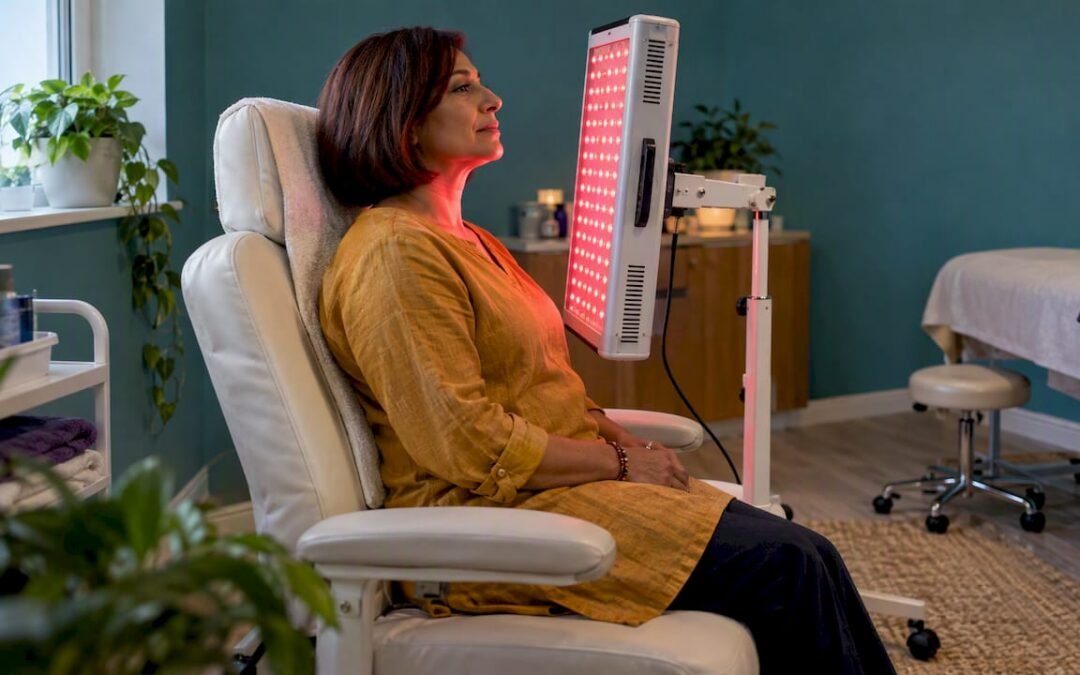
Red light therapy is being studied as a possible extra for autoimmune thyroid conditions such as Hashimoto’s, and a few small trials are encouraging. It is not a replacement for thyroid medication, and the evidence is still early. If you have an underactive thyroid, the safest way to explore it is alongside your prescribed treatment, with your GP or endocrinologist informed, and never over a thyroid nodule or a history of thyroid cancer without specialist advice.
TL;DR
- Small studies of low-level laser therapy (a form of photobiomodulation) in Hashimoto’s found lower levothyroxine needs in one trial, but a home LED study found no change in thyroid tests.
- Reviewers call it investigative, not standard care, and say larger sham-controlled trials are needed.
- Levothyroxine, with GP-monitored blood tests, remains the standard treatment for an underactive thyroid in Ireland.
- Avoid red light over the neck if you have thyroid nodules, a history of thyroid cancer, uncontrolled hyperthyroidism or photosensitivity, unless a specialist agrees.
- Red light can still be part of a wider wellness routine. Tell your doctor before you start.
Table of Contents
- Why red light is being studied for the thyroid
- What clinical studies have found
- Red light and thyroid medication
- Who should be careful or avoid it over the neck
- Eyes, settings and devices
- Supporting your thyroid alongside treatment
- Our perspective on red light and the thyroid
- Try red light at Live5DHealth
- A sensible way to start
- FAQ
- Sources
Why red light is being studied for the thyroid
Red light therapy uses low-level red and near-infrared light to deliver energy to tissue. The working theory is that light is absorbed by components inside the mitochondria, the “powerhouse of the cell”, which may support energy (ATP) production. A review of low-level laser therapy in autoimmune thyroiditis describes this mechanism and says the therapy may also reduce inflammatory responses and modulate the immune system.
That second point is why researchers looked at the thyroid. In Hashimoto’s thyroiditis, the immune system attacks the thyroid gland, and inflammation gradually reduces its ability to make hormone. A treatment that calms local inflammation and supports tissue repair is a reasonable thing to test.
If you want the cell biology in more depth, our piece on red light and mitochondria covers what we know about how cells respond to light.
What clinical studies have found
The honest picture is promising but thin. Here is what the main studies showed.
| Study | Who and how | What it found |
|---|---|---|
| 2013 randomised, placebo-controlled trial | 43 patients with autoimmune thyroiditis and hypothyroidism, low-level laser over the thyroid | After 9 months the laser group needed a significantly lower average levothyroxine dose than the placebo group |
| 2021 home LED study | LED device used daily on the neck for skin rejuvenation | No significant change in thyroid function tests or ultrasound after 16 weeks |
| 2026 review of photobiomodulation in chronic autoimmune thyroiditis | Pulls together small studies | Suggests potential for lower autoantibodies and levothyroxine requirements, but large sham-controlled trials are still needed |
Two things stand out. First, the positive trial used a laser applied by a clinician with defined settings, which is not the same as a general wellness panel. Second, the home LED study was designed to look at skin, not to treat the thyroid, and it showed the device did not disturb thyroid tests. That is reassuring in one sense and unhelpful in another: it does not show benefit either.
The 2026 review describes photobiomodulation as an investigative adjunct for autoimmune hypothyroidism rather than standard practice, and recommends specialist supervision. We think that is a fair summary, and it is how we would ask you to read every online claim, including the confident ones.
Red light and thyroid medication
If you are searching this because you hope to reduce your tablets, please read this section twice.
The HSE states that the main treatment for an underactive thyroid is levothyroxine, a replacement hormone that many people need to take for life. Your GP uses regular blood tests to check your hormone levels and adjust the dose. The 2026 review also identifies levothyroxine as standard care and PBM as an adjunct only.
In practice that means:
- Keep taking levothyroxine exactly as prescribed, even if you start red light sessions.
- Never lower or stop a dose yourself. Any reduction should come from your doctor after a blood test.
- Keep your scheduled thyroid blood tests. They are how your doctor knows whether anything has changed.
- Tell your GP or endocrinologist you are trying red light, so changes in your results make sense.
The American Thyroid Association makes a useful distinction on its page about complementary approaches in thyroid disease: standard care is care based on scientific evidence that a treatment is effective and safe, or has acceptable risks. Red light for the thyroid has not reached that bar yet, which is why we position it as something you add, not something you swap in.
Who should be careful or avoid it over the neck
This is the part of the topic where the details matter most. The 2026 review says the long-term safety of thyroid exposure is unknown and advises caution, ideally avoiding photobiomodulation in people with thyroid nodules or a history of thyroid malignancy until more safety evidence exists.
A doctor-reviewed guide on red light near neck nodules advises avoiding red light near the thyroid in these situations:
- Active thyroid cancer or a suspected malignancy
- Uncontrolled hyperthyroidism
- Photosensitivity disorders
- Use of photosensitising medicines
The same guide raises another point worth knowing: relief of discomfort could mask a growing nodule and delay a proper check. If you notice a lump, a change in your voice, or trouble swallowing, see your GP rather than treating it with light.
If you have a history of cancer, speak to your oncology team before any new therapy. Our list of who should not use red light therapy goes through the wider set of cautions, and our guide to red light therapy side effects covers what to watch for after a session.
We do not claim that red light treats any thyroid condition. What we can offer is a supervised, well-explained session on areas of the body your doctor is happy with.
Eyes, settings and devices
Some safety basics apply whoever you are.
Protect your eyes. Avoid looking directly into the light, especially if you are treating your neck or upper chest where the panel sits close to your face. Our red light eye safety guide sets out simple rules for sessions at home.
Settings matter. The 2022 review notes that wavelength, irradiation mode, power, exposure time, treatment area and the length of the course can all change the effect. That is why a trial result from a clinical laser cannot be copied by pointing a random panel at your neck. If you want to understand the numbers on a device, read about red light wavelengths and how to measure red light dosage.
Choose cleared equipment. If you decide on a home device, the same doctor-reviewed guide suggests medically cleared equipment (Class IIa or IIb), avoiding direct eye exposure, watching your skin for reactions, and telling your physician about any change in voice or swallowing.
Supporting your thyroid alongside treatment
People often ask how to “stimulate” the thyroid naturally. A safer way to put it is: how do I support my health while my thyroid is treated properly?
- Take levothyroxine as directed. The HSE advises taking it as prescribed and keeping to your blood test schedule.
- Check before adding supplements. The HSE advises avoiding kelp supplements while taking levothyroxine and checking with a healthcare professional about other medicines or supplements.
- Take iodine seriously. Iodine affects the thyroid in both directions. Our guides to iodine limits for thyroid health and safe use of iodine supplements explain why more is not better.
- Build recovery habits. Sleep, movement and stress management matter when you live with a chronic condition. Many of our members pair gentle light sessions with a sauna or contrast therapy.
If you have symptoms such as persistent tiredness, weight change, feeling cold, or low mood, ask your GP for a thyroid blood test. Those symptoms have many causes, and a test is the only way to know.
Our perspective on red light and the thyroid
We talk to a lot of women over 40 who come to us with a thyroid diagnosis and a sense that medication is only part of the story. We understand that. Fatigue, brain fog and sluggishness can persist even when the numbers look fine, and wanting to do more for yourself is a healthy instinct.
Here is how we see red light in that picture. The science on light and cells is real: light reaches mitochondria, and researchers are actively testing what that means for inflammation and tissue repair. The thyroid trials so far are small, but one randomised trial pointing to lower levothyroxine needs is a good reason for the research to continue. We would rather tell you that plainly than oversell it.
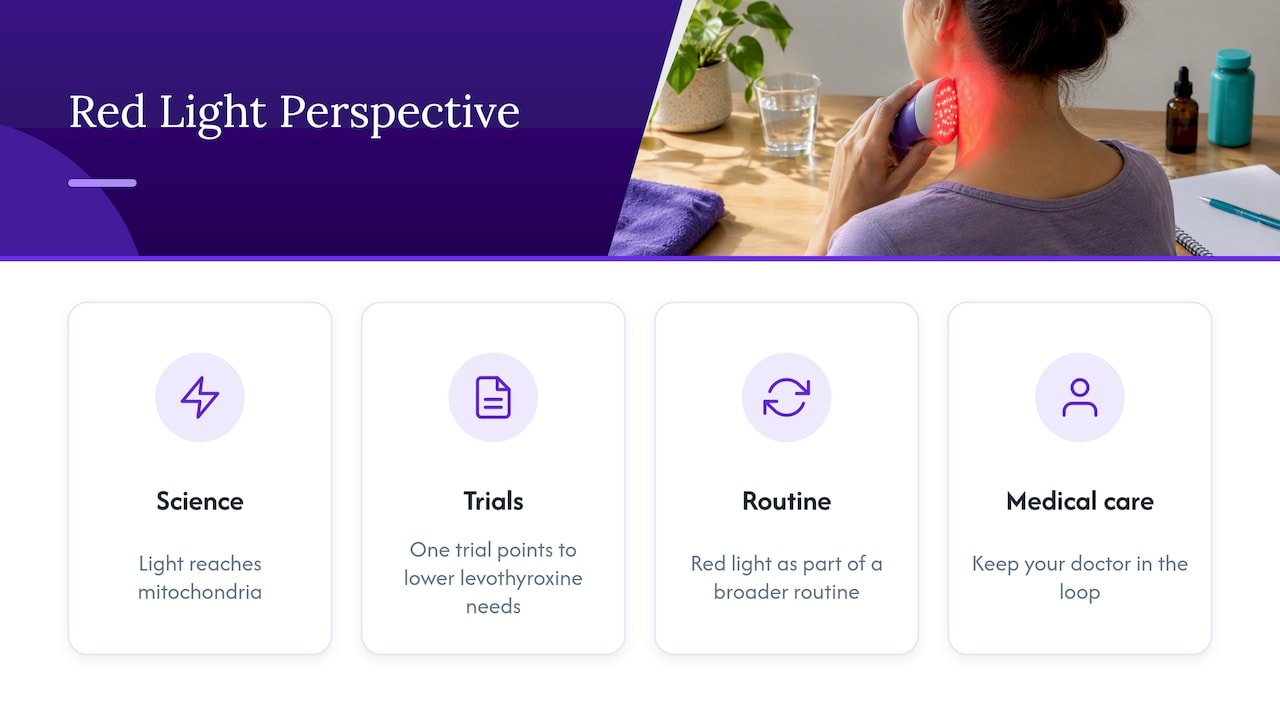
What we offer is a calm, well-run space to try red light as one part of a broader routine. Our approach is to combine advanced technology with time-tested ideas about rest and recovery, in a facility with clean, energised water throughout. We keep you in charge, we ask about your medical history, and we ask you to keep your doctor in the loop. For many members, that mix of structure, relaxation and consistent sessions is what makes them feel more like themselves.
Your best self awaits, and it is built on good care from your medical team plus the extras that help you enjoy the process.
— Mark
Try red light at Live5DHealth
Our red light therapy sessions in Boyle, County Roscommon, are priced at €20 to €40 per session. You can book a one-off session to see how you feel, and we will talk through areas to treat and areas to avoid before you begin.
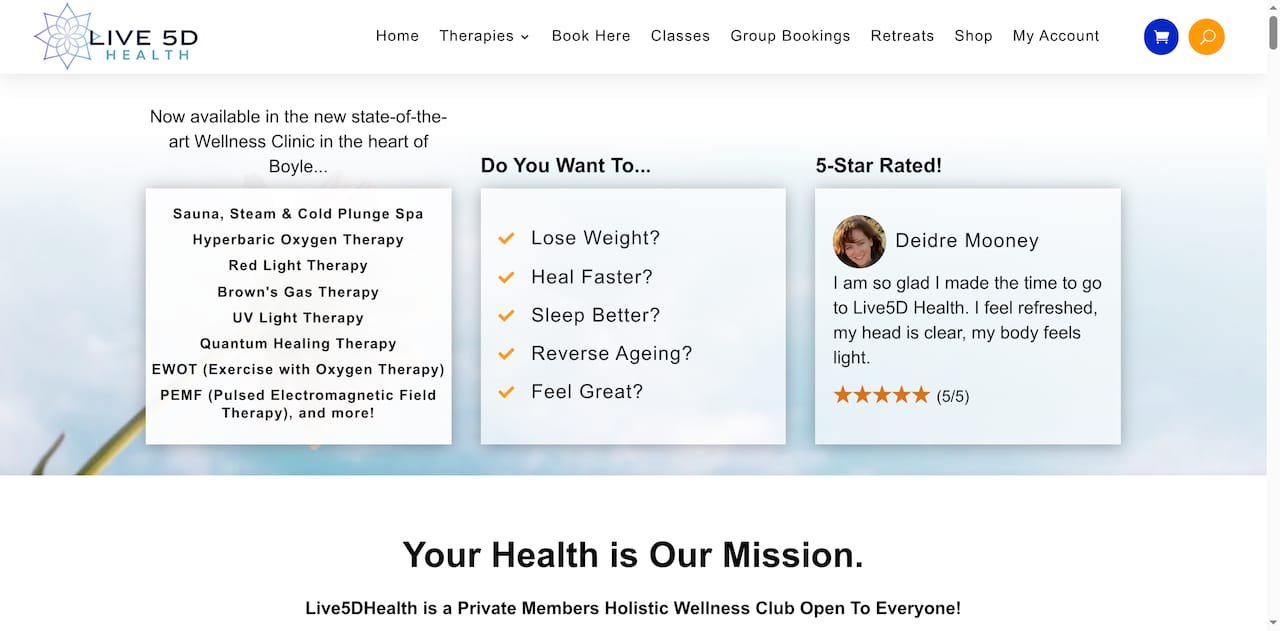
If you would like to make a day of it, you can add our sauna, steam and cold plunge spa for €30, or look at our 3, 5 and 10-day wellness retreats for a longer reset. Have questions first? Start from our home page and get in touch.
A sensible way to start
- Get your bloods up to date. Ask your GP for a recent TSH and, if relevant, antibody results, so you have a baseline.
- Tell your doctor. Mention you are trying red light and ask whether there is any reason to avoid the neck area.
- Start with a body area, not your neck. Many people begin on the back, legs or chest, where the cautions are fewer. Only treat the neck if your doctor is comfortable with it.
- Keep a simple diary. Note energy, sleep, mood and any skin reaction, and bring it to your next appointment.
- Be consistent and patient. Trials ran for weeks or months, not days. Judge by your blood tests and how you feel, not by one session.
- Reassess. If anything changes in your voice, swallowing or neck, stop and see your GP.
FAQ
Why is red light therapy said to be good for the thyroid?
The idea is that red and near-infrared light may support mitochondrial energy production and calm inflammation, which could help in autoimmune thyroiditis. Small trials have explored this, and one found lower levothyroxine needs after 9 months. Reviewers still say larger sham-controlled studies are needed.
Can red light therapy cure hypothyroidism or Hashimoto’s?
No. Hypothyroidism is treated with levothyroxine, which many people take for life according to the HSE. Red light has only been studied as an investigative add-on, so it should never replace your medication or blood tests.
Is it safe to use red light on the neck?
For many healthy adults it is generally considered low risk, but long-term thyroid exposure has not been well studied. Avoid the neck if you have thyroid nodules, a history of thyroid cancer, uncontrolled hyperthyroidism or photosensitivity, unless a specialist agrees. Always protect your eyes.
Can I use red light while taking levothyroxine?
Many people do, but tell your GP or endocrinologist first. Keep taking your tablets as prescribed and keep your scheduled blood tests so any change can be spotted and the dose adjusted by your doctor if needed.
How do I support my thyroid naturally?
The safest route is to take your medication correctly, attend blood tests, and check with a healthcare professional before adding supplements. The HSE specifically advises avoiding kelp while on levothyroxine. Sleep, gentle exercise and stress management support overall wellbeing.
Sources
- Low-Level Laser Therapy in the Treatment of Autoimmune Thyroiditis (2022 review)
- Low-level laser in the treatment of patients with hypothyroidism induced by chronic autoimmune thyroiditis (2013 trial)
- Use of a light-emitting diode device for neck skin rejuvenation (2021)
- Photobiomodulation therapy in chronic autoimmune thyroiditis (2026 review)
- HSE: Levothyroxine, a medicine for an underactive thyroid
- American Thyroid Association: Complementary and alternative medicine in thyroid disease
- Doctor’s note: red light safety near neck nodules