

Sometimes, but only in a narrow set of cases. Irish insurers pay for hyperbaric oxygen therapy (HBOT) when it is a medically necessary treatment, delivered at a facility on the insurer’s approved list and covered by your plan. Wellness sessions, where you book a chamber to support recovery, energy or general health, are paid for by you directly. At Live5DHealth in Boyle, a hyperbaric oxygen session is priced at €80 to €120, so you know the cost before you start. Below you will find how the cover works, what to ask your insurer and how to plan your care if you are a woman over 40 or are living with cancer.
TL;DR
- Insurers cover HBOT as medical treatment, not as a general wellness service. Cover depends on your plan, the condition and the facility.
- Ireland’s licensed medical uses of HBOT are specific, and insurers judge claims against medical necessity.
- Before any treatment, ring your insurer, ask about pre-authorisation and check your Table of Cover for excess and co-payments.
- If you have cancer, speak to your oncologist or GP before booking any hyperbaric session.
- Wellness sessions at Live5DHealth cost €80 to €120 each, with no insurance paperwork.
Table of Contents
- What “HBOT” means and why insurers treat it as medical
- How Irish private health insurance decides what to pay
- What the Vhi directory shows about HBOT
- Medical HBOT versus wellness HBOT
- HBOT, cancer and insurance
- What to check before you start: a step-by-step routine
- A worked example
- What wellness HBOT costs, and how to keep it affordable
- Our perspective
- Book your hyperbaric session in Boyle
- FAQ
- Sources
What “HBOT” means and why insurers treat it as medical
Hyperbaric oxygen therapy means breathing oxygen inside a chamber where the air pressure is higher than normal. The extra pressure lets your blood carry more oxygen to tissues. If you want the full explanation, our guide to what hyperbaric oxygen therapy is covers it step by step.
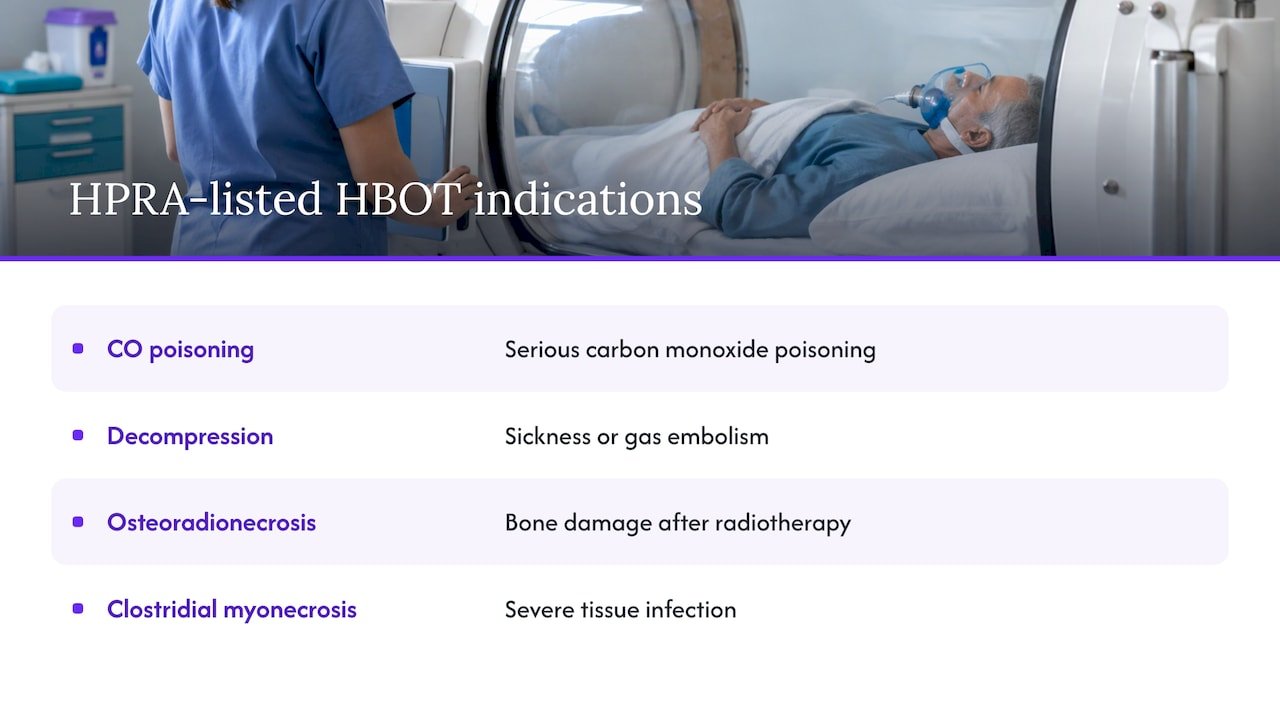
In Irish healthcare, HBOT has a defined place. The Health Products Regulatory Authority (HPRA), the state body that licenses medicines including medical oxygen, lists the licensed indications for hyperbaric oxygen: serious carbon monoxide poisoning, decompression sickness or gas embolism, supporting treatment of osteoradionecrosis (damage to bone after radiotherapy), and clostridial myonecrosis, a severe tissue infection. The same document says treatment is given by qualified staff in specialised centres.
That is the lens an insurer uses. Your policy is built to pay for treatment that is clinically needed, so claims are judged on diagnosis, referral and facility. General wellness use sits outside that framework, and it is a separate service you choose and pay for yourself.
How Irish private health insurance decides what to pay
Private health insurance in Ireland is regulated by the Health Insurance Authority. Its regulations page explains that the Health Insurance Acts 1994 to 2015 set four principles: lifetime community rating, open enrolment, lifetime cover and minimum benefit. The Authority also maintains the Definitive Hospital List and a Register of Health Insurance Contracts, so you can see what plans exist.
Those rules set a minimum, but each insurer’s own terms decide the detail. Irish Life Health’s Membership Handbook (October 2026) states that it covers medical care its medical advisers consider an established, medically necessary treatment at reasonable and customary cost. It also says clinical indicators must be met before a treatment is deemed medically necessary.
In plain terms, three tests apply:
- Is the treatment medically necessary for your diagnosis? A consultant or doctor needs to have recommended it for a recognised condition.
- Is the facility approved? Insurers list the places where they pay.
- Does your plan include it? Tables of Cover differ by plan and level.
What the Vhi directory shows about HBOT
The clearest public evidence on HBOT and Irish insurance comes from Vhi. Its Directory of Approved Medical Facilities, effective 17 June 2026, lists a Dublin treatment centre in Santry as a Private 1 facility with direct payment, flagged as a hyperbaric oxygen therapy provider. The directory tells members to call Vhi in advance on (056) 444 4444 to confirm cover at their chosen facility.
A second Vhi document, the directory with plan detail effective 1 June 2026, shows that cover for that facility varies by plan. It shows no cover on PublicPlus Care, and partial or full cover varying across PremiumCare, AdvancedCare, EnhancedCare and FirstCare.
The lesson is practical. HBOT cover exists in Ireland in a medical setting, it depends on the plan you hold, and the insurer expects a phone call first. Plans and directories are updated, so always read the current version. Vhi’s hospital terms, updated on 1 October 2025, say hospital benefit is payable for in-patient treatment in a participating hospital listed in its directory and covered by your plan.
Medical HBOT versus wellness HBOT
It helps to separate two paths, because they work differently.
| Medical HBOT | Wellness HBOT | |
|---|---|---|
| Why you go | A diagnosis where a doctor recommends it | You want to support recovery, energy and general wellbeing |
| Who arranges it | Your consultant, GP or the treating hospital | You, directly |
| Insurance | May be covered, depending on plan, facility and pre-authorisation | You pay per session |
| Paperwork | Referral, pre-authorisation, claim forms | Booking only |
| Typical timeline | Set by the treating team | You choose the pace |
If your doctor has recommended HBOT for one of the licensed medical conditions, your first call is to your insurer. If you are exploring HBOT as part of a wellness routine, you can book a session directly with us and know the price in advance.
HBOT, cancer and insurance
Many women searching this question are facing cancer or recovering from treatment. This is where careful, honest guidance matters most.
The one cancer-related use named in the HPRA document is supporting treatment of osteoradionecrosis, which is damage to bone that can follow radiotherapy. For that condition the HPRA lists daily sessions of 90 to 120 minutes at 2.0 to 2.5 atmospheres for around 40 days. That is a medical protocol delivered under clinical supervision, and it is the sort of case where an insurer asks for a consultant’s recommendation and may require pre-authorisation.
Safety comes first with any hyperbaric session. The HPRA document names untreated pneumothorax (a collapsed lung) as an absolute contraindication, and lists risks including barotrauma, oxygen toxicity at higher pressures, effects on the lungs and eyes, and anxiety about being enclosed. It asks for a benefit and risk evaluation for people with claustrophobia or coronary disease.
So if you have cancer or are in recovery:
- Tell your oncologist or GP you are considering HBOT and ask whether it suits your treatment plan and timing.
- Share your full history, including lung conditions, heart disease, any chest surgery and your current medicines.
- Read our hyperbaric therapy contraindications guide before you book.
- Ask your insurer separately about cover if the referral is medical.
We do not present hyperbaric oxygen as a treatment for cancer. Wellness sessions are a supportive choice that sits alongside the care your medical team provides.
What to check before you start: a step-by-step routine
Whether you hold Vhi, Irish Life Health or another plan, the routine is the same. The Irish Life Health handbook points to the key items.
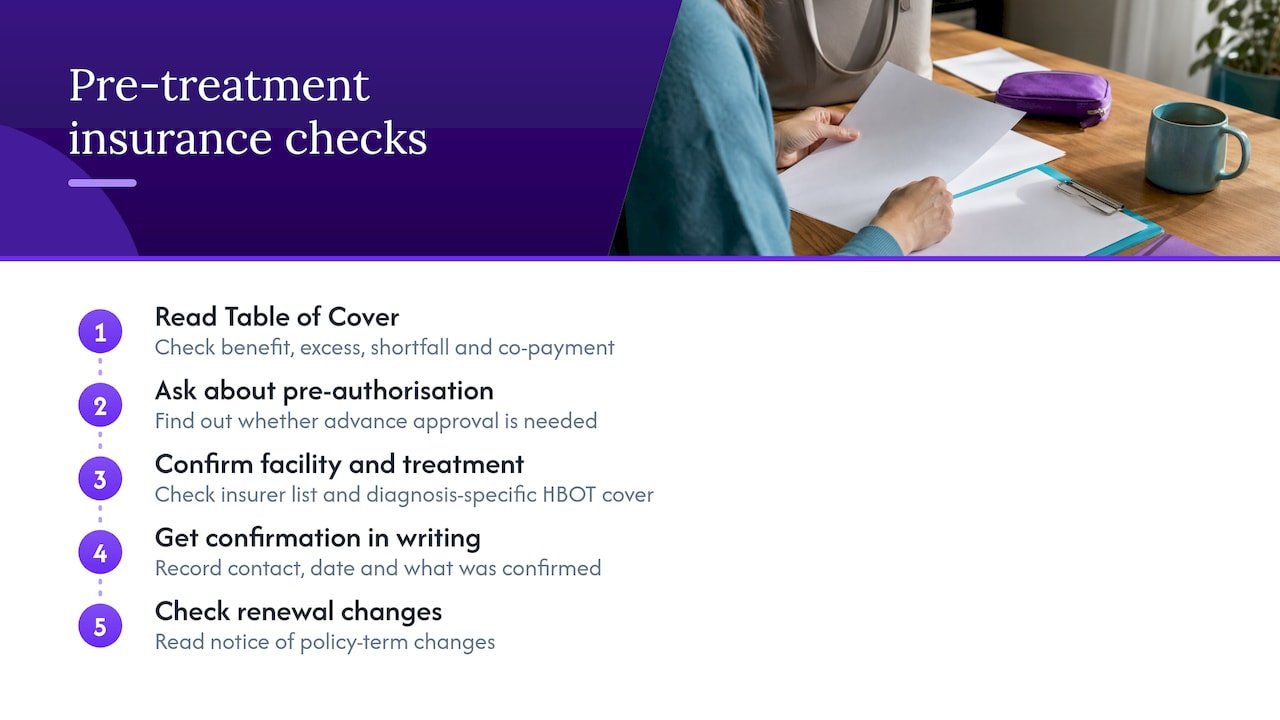
Step 1: Read your Table of Cover. Look for the benefit, any excess, shortfall or co-payment. These decide what you pay out of pocket even when treatment is covered.
Step 2: Ask whether pre-authorisation is needed. Pre-authorisation means the insurer agrees in advance that it will pay. Under Irish Life Health’s rules, as updated for policies renewing from 1 September 2025, the healthcare provider submits a written request. The insurer assesses it within 15 working days. The approval ends six months after it is granted, on a plan downgrade or when membership ends, whichever comes first.
Step 3: Confirm the facility and the treatment. Ask whether the specific facility is on the insurer’s list, and whether HBOT for your diagnosis is a covered treatment. Irish Life Health advises calling 01 562 5100 before treatment, with the facility, provider and procedure or treatment code details to hand.
Step 4: Get it in writing. Keep a record of who you spoke to, the date and what they confirmed.
Step 5: Check renewal changes. Under the Consumer Insurance Contracts Act 2019, insurers must tell you in plain language, no later than 20 working days before renewal, about any change to policy terms. Read that notice, because benefits can change between years.
A worked example
Imagine a woman in her fifties who has finished radiotherapy and whose consultant recommends HBOT for bone damage. She checks her Table of Cover, rings her insurer, and finds out the treating centre is on the approved list and that her plan covers it, subject to an excess. The centre sends the written pre-authorisation request. She is approved, and the approval is valid for six months. Her cost is the excess.
Now imagine a different woman, also in her fifties, who wants to support her energy and sleep during a busy, stressful year. No diagnosis is driving it, so there is nothing for an insurer to authorise. She books wellness sessions, at €80 to €120 each at our Boyle centre, and plans the number she wants around her budget. Both are sensible routes. They simply answer different needs.
What wellness HBOT costs, and how to keep it affordable
Our hyperbaric oxygen sessions are priced at €80 to €120. That range is what we publish, and you can see how it compares with other sessions in our guide to hyperbaric oxygen therapy costs in Ireland. A few ways to plan:
- Decide on a set number of sessions up front, and book them as a block of time rather than ad hoc.
- Read our advice on how to maximise results from hyperbaric oxygen therapy so each session counts.
- Combine your visit with other therapies on the same day. Our guide to combined wellness treatments explains what works well together.
- If you are coming with friends, ask about our group bookings.
Our perspective
Many of the women who contact us have already been through a great deal. They are looking for something that helps them feel stronger and more like themselves, and they want a straight answer about money.
Here is ours. Where HBOT is a medical treatment, your insurer is the place to start, and your consultant or GP guides that decision. Where you want to support your wellbeing, we offer hyperbaric oxygen in a calm, welcoming setting in Boyle, with the price published and nothing to claim back.
What we are proud of is the setting around the chamber. We bring together the most advanced collection of healing technologies in Ireland, including red light therapy, PEMF, EWOT and Ireland’s first Hydrogen Bar, with a sauna, steam room, cold plunge spa and clean, energised water throughout. Our holistic approach combines state-of-the-art technology and ancient wisdom, so your session is part of a wider experience of care.
Your best self awaits, and we would love to help you take the next step at your own pace.
Mark
Book your hyperbaric session in Boyle
If you are ready to try hyperbaric oxygen as part of your wellness routine, our Hyperbaric Oxygen Therapy page has the details and booking. Sessions are €80 to €120, and the same visit can include our spa, where the sauna, steam room and cold plunge are €30 as a one-off.

If you would like a longer stay, our 3, 5 and 10-day wellness retreats bring therapies, rest and nourishment together in one programme. Members also enjoy access to unique therapies and free energised water.
FAQ
Does Vhi cover hyperbaric oxygen therapy?
Vhi’s June 2026 directory lists a Dublin treatment centre as an HBOT provider with direct payment, and the plan-level directory shows cover varying by plan, with none on PublicPlus Care. Call Vhi on (056) 444 4444 before treatment to confirm what your plan pays.
Will insurance pay for HBOT if I want it for wellness?
Insurers pay for medically necessary treatment, so wellness use is a self-pay service. Our hyperbaric sessions are priced at €80 to €120, booked directly with us.
Is HBOT covered for cancer patients?
Cover depends on the diagnosis, your plan and a doctor’s recommendation. The licensed cancer-related use in Ireland is supporting treatment of osteoradionecrosis after radiotherapy. Speak to your oncologist or GP first, then your insurer.
What is pre-authorisation?
It is your insurer’s written agreement, before treatment, that it will pay. With Irish Life Health, your provider submits the request in writing, and the insurer assesses it within 15 working days. The approval ends after six months.
Do I need a doctor’s referral for wellness HBOT?
You can book wellness sessions with us directly. If you have a medical condition, a heart or lung problem, or you are in cancer treatment, talk to your GP or specialist first and read our contraindications guide.
Sources
- Health Insurance Authority: Regulations
- Irish Life Health Membership Handbook, October 2026
- Irish Life Health: changes for policies renewing from 1 September 2025
- Vhi Directory of Approved Medical Facilities, 17 June 2026
- Vhi Directory with plan detail, 1 June 2026
- Vhi Hospital Plans terms changes, 1 October 2025
- HPRA Summary of Product Characteristics, 30 April 2024
- Consumer Insurance Contracts Act 2019, revised to 12 May 2026