
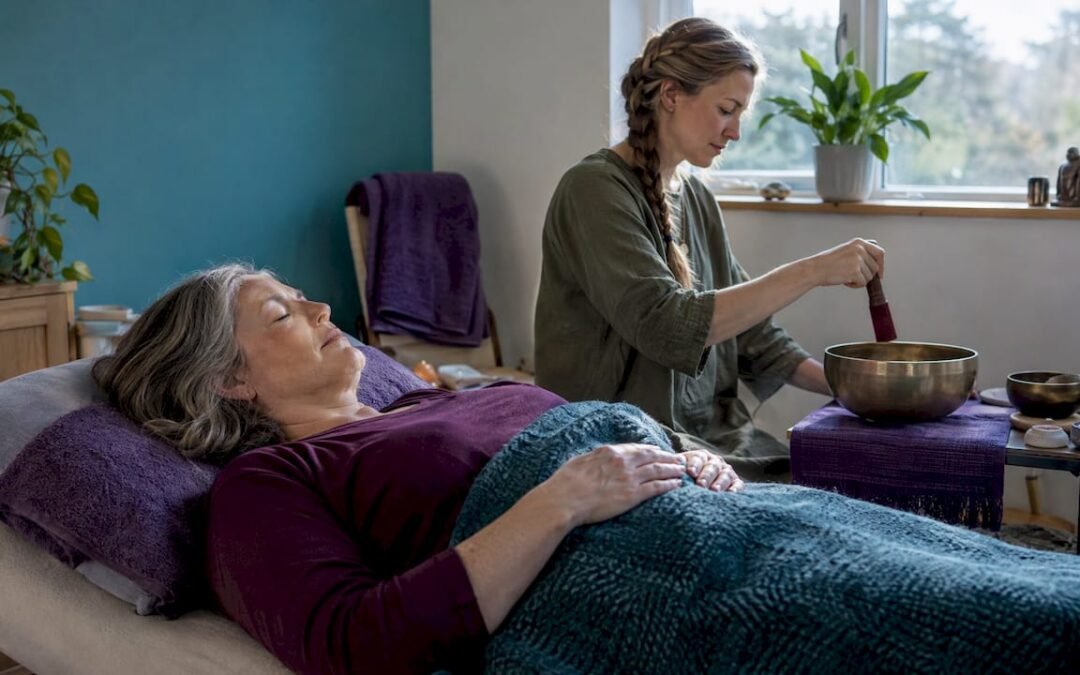
Sound healing gives a stressed nervous system something rare: a quiet hour in which you do not have to talk, explain or perform. Slow, steady sound, a dim room and guided breathing invite the body to settle, and for many women over 40, including those carrying the strain of a cancer diagnosis, that settling is the first step towards feeling safe again. At Live5dhealth in Boyle, County Roscommon, we offer Roxiva Sound and Light Brain Entrainment Therapy for exactly this kind of calming, restorative work.
This guide explains what sound healing is, what happens in a session, what the research says about music and sound for trauma symptoms, and how to start in a way that feels safe.
TL;DR
- Sound healing uses bowls, gongs, chimes, tuning forks and other steady sound to help the body shift from alert to calm, usually while you lie down and breathe slowly.
- Research on music interventions for post-traumatic stress is encouraging: in one 2024 review, 13 of 14 studies reported fewer PTSD symptoms.
- Sound works with the stress response and the nervous system, which is why many people use it as a gentle companion to talking therapies, not a replacement for them.
- If you are living with cancer, talk to your oncology team before adding any complementary therapy, and choose practitioners who are accredited or regulated.
- You can start small: one short session, a comfortable position and the freedom to stop at any point.
Table of Contents
- What sound healing for trauma actually is
- What happens in a sound healing session
- How sound may speak to the nervous system
- What the research says about sound, music and PTSD symptoms
- Different ways sound can support trauma recovery
- Choosing a practice that feels safe
- If you are living with cancer
- Our perspective
- Bring sound into your routine at Live5dhealth
- FAQ
- Sources
What sound healing for trauma actually is
Trauma is not only a memory. It is also a pattern in the body: a stress response that stays switched on long after the danger has passed. Racing heart, shallow breathing, poor sleep, tension in the jaw and shoulders, a feeling of being braced for something. Many women describe this after bereavement, difficult births, long-term caring, abusive relationships, medical emergencies or a cancer diagnosis and its treatment.
Sound healing is a group of practices that use sound and vibration to encourage the body out of that braced state. The tools vary: singing bowls, gongs, chimes, tuning forks, drums, recorded tones, or technology that pairs sound with light. What they share is a slow, predictable, non-verbal experience. You do not have to retell your story. You simply receive.
That is its appeal for people who find talking about difficult events exhausting, and it is also why we describe it as a supportive practice for wellbeing and nervous-system balance. It sits alongside professional care, never instead of it.
What happens in a sound healing session
Researchers who attended and studied sound baths describe a fairly consistent pattern. According to a 2024 academic study of sound baths, a typical session is an hour-long event in a calm, low-light, sanctuary-like space. The practitioner explains briefly what will happen, then leads a centering or grounding exercise with slow breathing. Waves of sound follow, from singing bowls, chimes, gongs and tuning forks, sometimes with the practitioner walking around the room with handheld instruments. When the sound ends, participants lie still for about five minutes before being guided back with gentle breathing or a closing ritual.
A few practical points are worth knowing before your first visit:
- You stay clothed and comfortable. Most people lie on a mat or reclining seat with a blanket.
- You choose your level of involvement. Eyes open or closed, deep breathing or natural breathing: all are fine.
- You can leave the experience at any time. Opening your eyes, moving your hands and feet and telling the practitioner how you feel are always allowed.
- Afterwards, take it slowly. Drink water, sit for a few minutes and avoid rushing straight into a busy day.
If you would like to understand the general benefits of sound baths and what practitioners recommend, our guide to sound bath benefits and practitioner tips goes through the studies in more detail.
How sound may speak to the nervous system
The nervous system has a threat-detection mode and a rest-and-restore mode. After trauma, the threat mode can become the default. Researchers describe this in PTSD as a stress-response loop that stays overactive: the amygdala, the brain’s alarm centre, responds more strongly, while the prefrontal cortex, which helps us regulate emotion, is less active. A 2022 paper on the neurobiology of music explains that music can stimulate neuroplasticity, help normalise the stress response and reduce dissociation, depression and anxiety. Its authors conclude that music has potential to help PTSD by lowering amygdala activity, improving hippocampal and prefrontal function and balancing the stress axis.
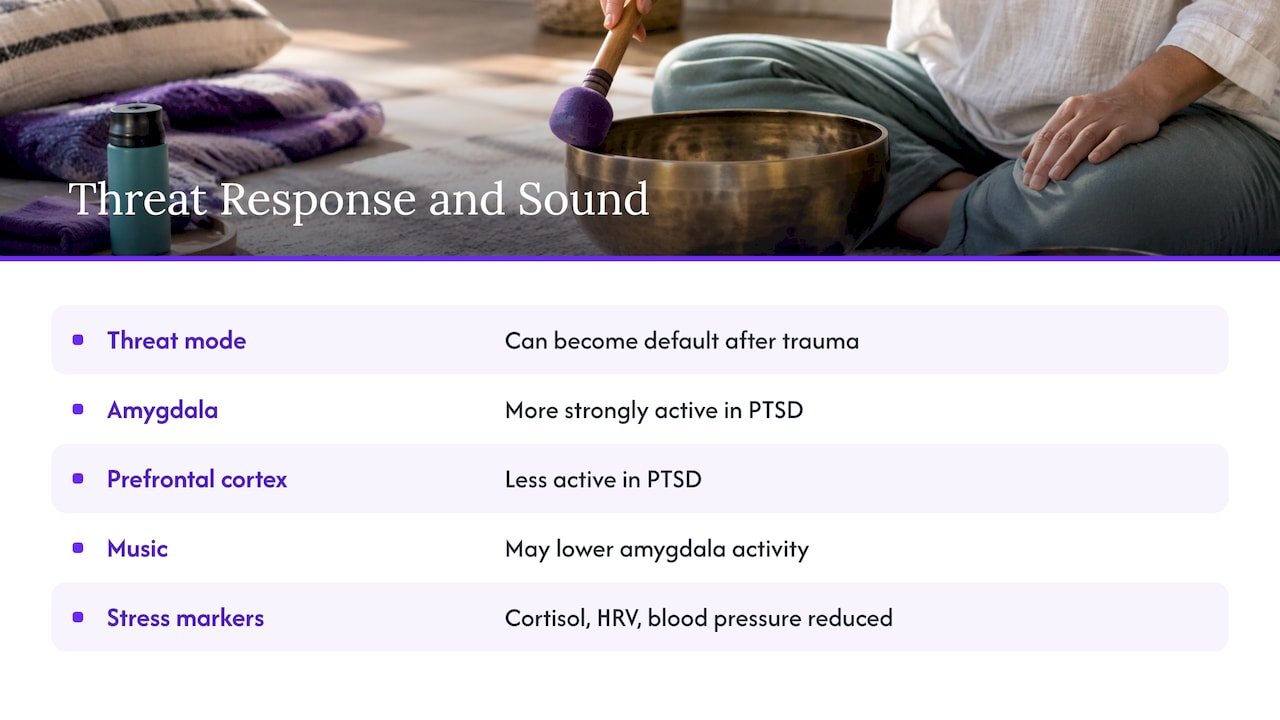
On the body side, a 2025 scoping review of 34 studies found that music, especially self-selected and classical pieces, reduced physiological stress markers including cortisol, heart rate variability and blood pressure. In plain terms: the right sound can help the heart slow and the body unclench.
That is why slow rhythm, repetition and a sense of being held by sound feel so soothing. If you want to go deeper on the body’s calming pathway, our article on vagus nerve sound therapy explains what the research supports. For worry and tension more broadly, see sound therapy for anxiety.
What the research says about sound, music and PTSD symptoms
Most of the formal evidence studies music-based interventions, which share many features with sound healing: rhythm, tone, vibration and deep listening. The picture is hopeful.
- Systematic review, 2024. A review of 14 studies of music interventions for adult PTSD symptoms found that 13 of 14 reported a decrease in symptoms, including five that used passive listening alone. The authors suggest that brief, self-directed listening delivered in affordable, flexible formats may be especially promising for people who cannot easily access longer therapist-led programmes.
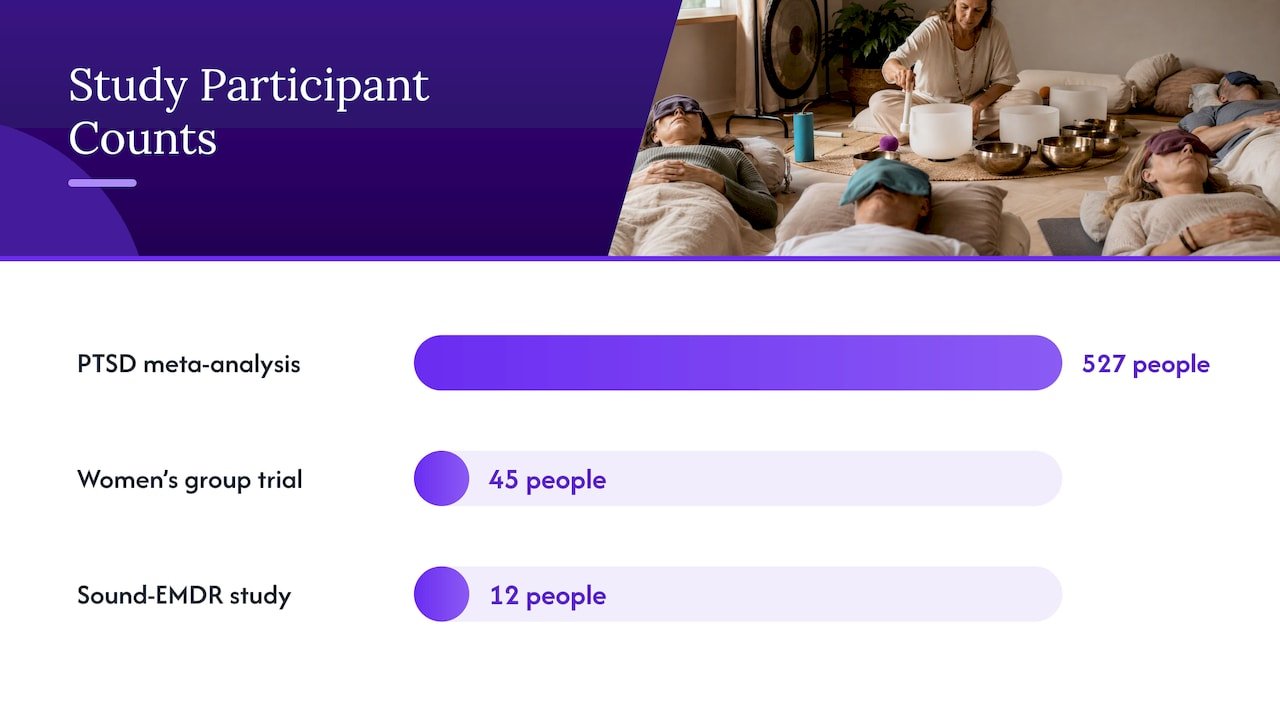
- Meta-analysis of nine randomised trials. Across 527 people with PTSD, music therapy added to usual care lowered post-treatment PTSD scores compared with inactive controls, and its effect was comparable to that of active comparison treatments.
- Group music and imagery for women. A doctoral randomised trial in Denmark’s Aalborg University programme gave 45 women with PTSD or complex PTSD twelve weekly sessions. Symptoms fell significantly with large effects that lasted at the three-month follow-up, alongside lower heart rate and skin reactivity and higher heart rate variability than the waitlist group.
- Sound added to EMDR. In a 2023 feasibility study of 12 people with trauma, EMDR enriched with synchronised sound stimulation was completed by all participants with no side effects, in an average of 8.5 sessions, fewer than the usual 12.
If you want to see how music-based approaches compare with other established options, this overview of evidence-based PTSD treatments sets out the main therapies side by side.
Two things stand out. First, the studies cover a range of formats, from listening alone to structured group programmes, so there is room to find what suits you. Second, the strongest results involve regular sessions over several weeks, which is a useful guide for anyone planning their own routine.
Different ways sound can support trauma recovery
A review of 36 articles on music-based trauma work described four broad approaches: stabilising, entrainment, expressive and performative. It is a handy map for choosing what feels right.
| Approach | What it feels like | Who it may suit |
|---|---|---|
| Stabilising | Calm, predictable sound that steadies breathing and heart rate | Anyone starting out or feeling overwhelmed |
| Entrainment | Rhythm or pulse that the body gently follows | People who like structure and a clear sensory focus |
| Expressive | Making or choosing sound to express feeling | People ready to connect with emotion |
| Performative | Sharing music with others | People rebuilding confidence and connection |
For most people beginning, stabilising and entrainment approaches are the natural place to start, because they ask nothing of you except to relax and receive. Our binaural beats guide and the page on light and sound therapy explain how rhythmic tones and light pulses are used to guide the brain towards calm.
Choosing a practice that feels safe
Feeling safe is the whole point, so build that in from the first minute.
- Start short. A single session, or even a shorter listening practice at home, lets you learn how your body responds.
- Pick the right setting. Look for a quiet, warm, softly lit space where you can see the exit and where the practitioner explains the plan beforehand.
- Choose sounds you like. The scoping review above found that self-selected music was particularly effective for lowering stress markers. If a gong feels too intense, ask for gentler tones.
- Keep your anchor. Feel your feet on the floor, keep a hand on your chest or open your eyes whenever you wish.
- Pause when you need to. Strong emotion, tears, warmth or sleepiness can all arise. Move at your own pace and tell the practitioner what you notice.
- Build a rhythm. Weekly or fortnightly sessions often suit the nervous system better than one-off experiences.
Sleep is often the first thing to improve when the body relaxes, so you may also enjoy our sound therapy sleep protocols.
When to involve a professional
Sound healing is a gentle companion to care. If you are living with flashbacks, panic, nightmares, thoughts of self-harm or anything that disrupts daily life, speak to your GP or a qualified trauma therapist, and use sound alongside that support. A music therapy post was first established in Ireland about 40 years ago, and Irish researchers have contributed to international trauma work, so Irish professionals in this field are well placed to guide you. If you are ever in crisis, contact your GP, emergency services or a crisis line straight away.
If you are living with cancer
Cancer and its treatment can leave a lasting imprint on the nervous system: scan anxiety, hospital memories, disrupted sleep and a body that no longer feels familiar. Many women find that a quiet hour of sound helps them feel at home in their body again.
Before you begin, follow the guidance of the Irish Cancer Society. In its position statement, it encourages patients to learn about the risks and benefits of complementary therapies and to discuss them with their oncology team in advance. It advises using practitioners who are accredited or regulated by a professional body and who understand possible interactions with cancer treatments. Sound healing is a wellbeing practice for comfort, relaxation and calm: it does not replace your treatment plan.
A simple routine works well:
- Tell your oncology team or GP you would like to try sound sessions.
- Share any treatment side effects with your practitioner, such as fatigue, sensitivity or port sites, so the session can be adapted.
- Choose a comfortable position, with pillows and blankets as needed.
- Notice how you feel afterwards and mention it at your next appointment.
Our perspective
We meet many women over 40 who have done everything right for their health and still feel wired, tired and unsafe in their own bodies. They have carried families, careers, grief and sometimes a cancer diagnosis. What they ask us for is rarely a dramatic intervention. It is rest that actually works.
That is why we bring sound and light into a wider, holistic setting. Our Roxiva Sound and Light Brain Entrainment Therapy sits alongside our sauna, steam room, cold plunge spa, red light therapy and holistic massage, so you can build a gentle routine that fits your energy and your pace. We believe the nervous system responds best to consistency, comfort and kindness, and a centre designed around all three gives it the best chance to settle.
Our approach combines state-of-the-art technology with ancient wisdom, because both have something to offer. The research on music and trauma is encouraging, and we think the most important ingredient is a space where you feel respected and unhurried.
Mark
Mark
Bring sound into your routine at Live5dhealth
If you are ready to experience guided sound and light in a calm setting, our Roxiva Sound and Light Brain Entrainment Therapy is available at our wellness centre in Boyle, County Roscommon. You can see the full list of sessions and book on our booking page.

Many guests pair their sessions with time in our sauna, steam room and cold plunge spa, which is priced at €30 per visit on our spa day page. If you would like a longer reset, our 3, 5 and 10-day total wellness retreats give you room to rest, recover and explore our therapies with time to spare. Groups of friends can arrange a visit through group bookings.
FAQ
Can sound healing help with trauma?
Many people find that slow, steady sound helps the body relax, and research on music interventions for PTSD symptoms is encouraging, with 13 of 14 studies in a 2024 review reporting fewer symptoms. We see sound healing as a supportive practice that works well alongside professional care.
How does sound healing affect the nervous system?
Rhythmic, soothing sound can help the body move from alert mode towards rest. Studies show that music can lower stress markers such as cortisol and blood pressure and improve heart rate variability, which are signs of a calmer system.
How many sessions should I try?
Start with one session to learn how your body responds. The more structured programmes in the research ran weekly over about twelve weeks, so a regular rhythm of sessions is a sensible goal if you enjoy it.
Is sound healing safe if I have cancer?
It is a gentle, relaxing practice, but the Irish Cancer Society encourages you to discuss any complementary therapy with your oncology team beforehand. Choose practitioners who are accredited or regulated and who understand cancer treatment, and tell them about your side effects.
Sources
- Sound Baths, Trauma Talk, and the Wellness Industry (2024)
- A Neurobiological Framework for the Therapeutic Potential of Music (2022)
- Music interventions for posttraumatic stress disorder: a systematic review (2024)
- Efficacy and acceptability of music therapy for PTSD, meta-analysis
- Effects of Sound Interventions on Mental Stress (2025)
- Auditory Personalization of EMDR Treatment (2023)
- Trauma-focused Group Music and Imagery with Women Suffering from PTSD
- Music, Rhythm and Trauma: A Critical Interpretive Synthesis (2020)
- Irish Cancer Society position statement on complementary and alternative therapies
- Music Therapy: What Psychologists Need to Know (2021)