
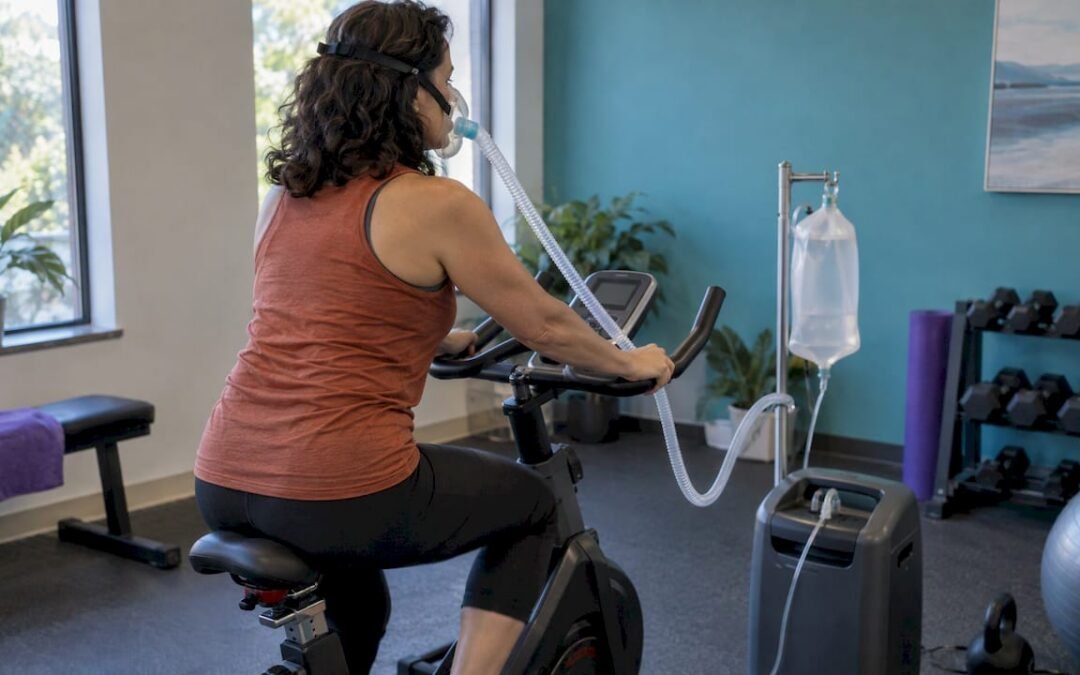
A commonly described EWOT protocol is simple: about 15 minutes of moderate exercise, such as cycling, while breathing high-concentration oxygen (around 90 to 95%) through a mask, three to five times a week. Intensity is kept moderate, with a short warm-up and cool-down. This guide explains each element, what the research does and does not show, and who should speak to a doctor before starting. If you are in Ireland and want to try EWOT under guidance, we explain how we approach it at our Boyle centre.
TL;DR
- EWOT means Exercise With Oxygen Therapy: light to moderate exercise while breathing oxygen-enriched air from a reservoir through a mask.
- Commonly described protocols use sessions of about 15 minutes, three to five times a week, at moderate effort.
- The research base is limited, so approach EWOT as a wellness support and set your expectations accordingly.
- Speak to your GP or specialist first if you have a heart or lung condition, are pregnant, or are going through cancer treatment.
- EWOT and hyperbaric oxygen therapy are different tools, with different schedules and purposes.
Table of Contents
- What EWOT is and what happens in a session
- The standard EWOT protocol, step by step
- What the evidence says
- EWOT and HBOT: how they differ
- Who should speak to a clinician first
- Perspective
- Combining EWOT with other therapies
- Try EWOT with us in Boyle
- Getting the most from your sessions
- FAQ
- Sources
What EWOT is and what happens in a session
EWOT stands for Exercise With Oxygen Therapy. Ordinary room air contains roughly 21% oxygen. In an EWOT session you breathe air that has been enriched, typically to somewhere between 90 and 95%, while you move. The idea is simple: exercise raises your circulation and your demand for oxygen, and enriched air is delivered at the moment you are using it.
The equipment is straightforward. An oxygen concentrator fills a reservoir bag. A high-flow mask connects to the bag and is designed to limit room air from getting in, with an outlet that lets the air you breathe out escape. You then exercise on a bike, a treadmill or a similar machine, at an effort you can sustain while breathing normally through the mask.
A typical visit looks like this:
- A short conversation about your health, medication and goals.
- Fitting of the mask and a check that the seal is comfortable.
- A gentle warm-up.
- The main block of moderate exercise on enriched oxygen.
- A cool-down and a few minutes to sit and drink water.
Nothing about this is a pressurised treatment. EWOT takes place at normal atmospheric pressure, which is the single biggest difference from a hyperbaric chamber, covered below.
The standard EWOT protocol, step by step
Protocols vary between providers and are described mostly in practitioner and wellness literature rather than in clinical guidelines. The figures below are the ones that appear most often, and they should be read as a common starting framework, not a prescription.
| Element | Commonly described range |
|---|---|
| Oxygen concentration | About 90 to 95%, often quoted as 93% |
| Session length | About 15 minutes, sometimes up to 30 |
| Frequency | Three to five sessions per week |
| Intensity | Moderate, often framed as roughly 50 to 80% of estimated maximum heart rate |
| Warm-up and cool-down | A few minutes each |
| Exercise type | Stationary bike, treadmill walking, or similar |
Oxygen concentration
The 90 to 95% range reflects what a concentrator can deliver. The mask and reservoir bag matter as much as the machine: if the mask leaks, you dilute the oxygen with room air and the session is closer to ordinary exercise.
Session length
Fifteen minutes is the figure most protocols settle on. The reasoning is practical: it is long enough to do meaningful aerobic work and short enough that you can keep a steady, comfortable pace. Some protocols extend to 30 minutes for fit, experienced exercisers, but longer is not automatically better.
Intensity
You will see two ways of describing effort. Gentler wellness protocols suggest staying at roughly 50 to 70% of your estimated maximum heart rate. Others work up towards 70 to 80%. Some performance-oriented protocols add short bursts of harder effort. If you are new to exercise, over 40, or returning after illness, start at the lower end and let your breathing be your guide: you should be able to speak a few words, not gasp.
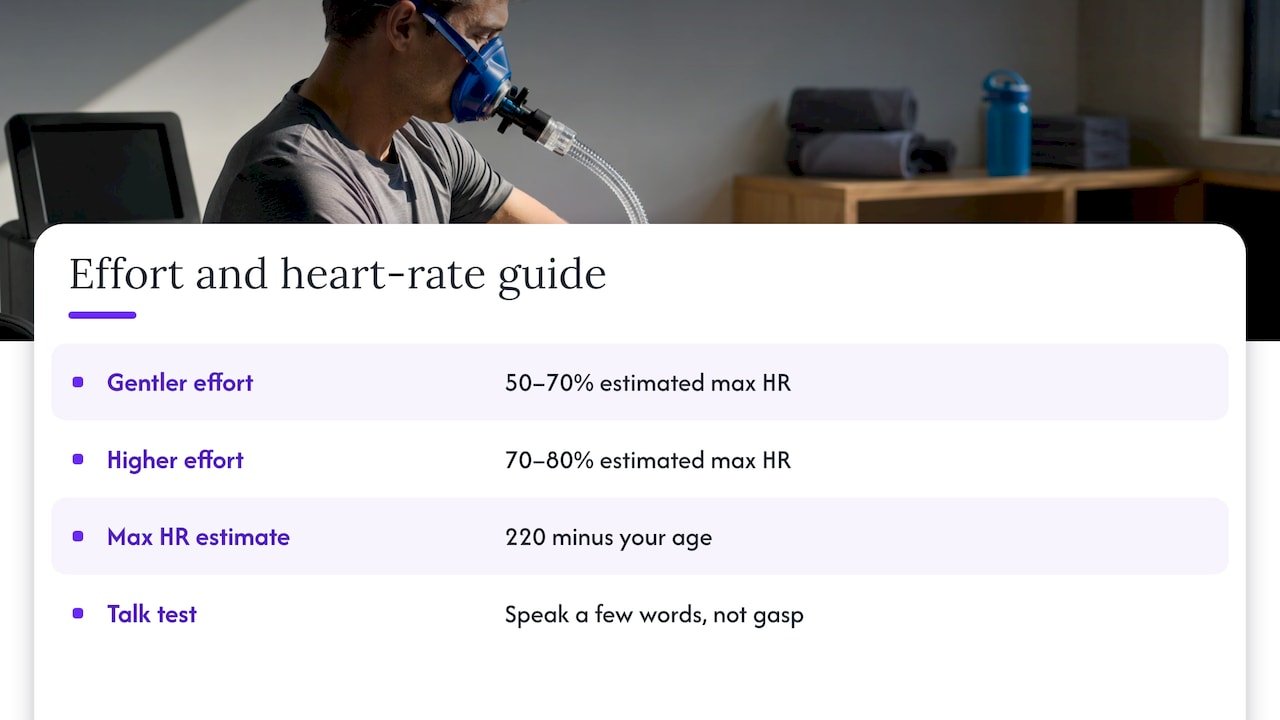
A rough estimate of maximum heart rate is often given as 220 minus your age, but it is only an estimate, and medication such as beta blockers changes how heart rate responds. That is a conversation for your GP.
Frequency and building up
Three sessions a week is a reasonable starting point for most people, moving to four or five only if you recover well. Rest days matter. If you feel unusually tired, dizzy or unwell the next day, drop back a step rather than pushing on.
A sample first four weeks
- Week 1: two or three sessions of 10 to 15 minutes, easy pace, mainly learning how the mask feels.
- Week 2: three sessions of 15 minutes at a steady, comfortable effort.
- Weeks 3 and 4: three sessions of 15 minutes, with a slightly higher effort in the middle if you feel good.
This is an illustration of gradual progression, not a medical plan. Your own plan should be shaped around your health and how you respond.
What the evidence says
Honest expectations make for a better experience, so here is where the science stands.
The physiological premise is sound: exercise increases blood flow, and breathing enriched oxygen raises the amount of oxygen available to be carried. But the research on whether this translates into extra benefit is limited. The most relevant controlled work comes from clinical groups rather than from healthy people following EWOT programmes. A systematic review of exercise training in hyperoxia in patients with COPD and coronary artery disease found no statistically significant differences in maximal power output, peak VO2 or six-minute walk distance between the hyperoxic and normal-air exercise groups.
In practice, that means three things:
- Claims about improved VO2 max from a structured EWOT programme are not established.
- Many people report that sessions feel energising or that exercise feels easier, and that experience is real for them, but it is individual and not guaranteed.
- EWOT is best seen as a complement to a sensible routine of movement, sleep and nutrition, not a replacement for medical care.
If you want a more detailed look at what is and is not supported, we have written a separate piece on EWOT benefits and what the evidence actually supports. If you are an athlete thinking about a fair test, our guide to trialling EWOT with a matched A/B approach sets out how to compare sessions properly.
On the wider research landscape, scientists are also looking closely at cellular energy and mitochondrial signalling, such as MOTS-c retrograde signalling. It is a reminder of how much about the body’s energy systems is still being studied, and why we encourage measured expectations.
EWOT and HBOT: how they differ
People often ask whether EWOT is as good as hyperbaric oxygen therapy. The honest answer is that they are different tools for different purposes, and they are not interchangeable.
| EWOT | HBOT | |
|---|---|---|
| Pressure | Normal atmospheric pressure | Raised pressure inside a chamber |
| Activity | You exercise during the session | You rest in the chamber |
| Oxygen delivery | Mask and reservoir bag | Chamber environment, often with a mask or hood |
| Typical use | Wellness and exercise support | Clinical uses in medicine, plus wellness programmes |
| Schedule | Short sessions several times a week | Condition-specific courses |
HBOT schedules are condition-specific. Sessions generally run for around 60 to 90 minutes and may be given once or twice a day, with acute-condition courses often around 10 days and chronic conditions sometimes requiring 30 days or more. That is a very different rhythm from a 15-minute EWOT session.
HBOT also has its own side effects to be aware of. Middle ear barotrauma is the most common, and a practical clinical guide to hyperbaric oxygen reports it in up to 42% of patients. That is why a proper introduction, equalising technique and screening matter.
If you want to understand the pressurised side in more depth, our guides explain what hyperbaric oxygen therapy is, what to expect from an HBOT treatment and what pressurised oxygen does to your body. For a wider view, see how oxygen therapy differs by type.
Who should speak to a clinician first
EWOT is generally described as well tolerated. The most common reports are mild lightheadedness or a feeling of warmth. Even so, concentrated oxygen is not something to treat casually, and some situations call for medical guidance before you begin.
Heart and lung conditions
If you have a lung condition that causes your body to retain carbon dioxide, such as some forms of chronic lung disease, or a significant or unstable heart condition, speak to your GP or specialist first. The Irish Thoracic Society’s guidelines on administering oxygen therapy state that medical oxygen is a drug and should be prescribed, with the prescription specifying target oxygen saturation, flow rate, delivery device and whether use is continuous or as required. They also call for caution with patients whose carbon dioxide is chronically raised. Those guidelines address acute hospital care, but the principle is useful for anyone: oxygen deserves respect.
Pregnancy
If you are pregnant, discuss it with your midwife or obstetrician before trying EWOT.
Cancer and cancer treatment
If you are living with cancer or having treatment, talk to your oncologist before you try EWOT. Interactions between high oxygen levels and certain treatments need careful consideration, and some medicines are specifically relevant, which is covered in our piece on EWOT contraindications. On the hyperbaric side, a 2025 clinical review notes that evidence is insufficient for treating malignancy or sensitising tumours to radiotherapy, and that active malignancy is generally considered a contraindication, so your oncology team should be part of any decision about oxygen-based therapies.
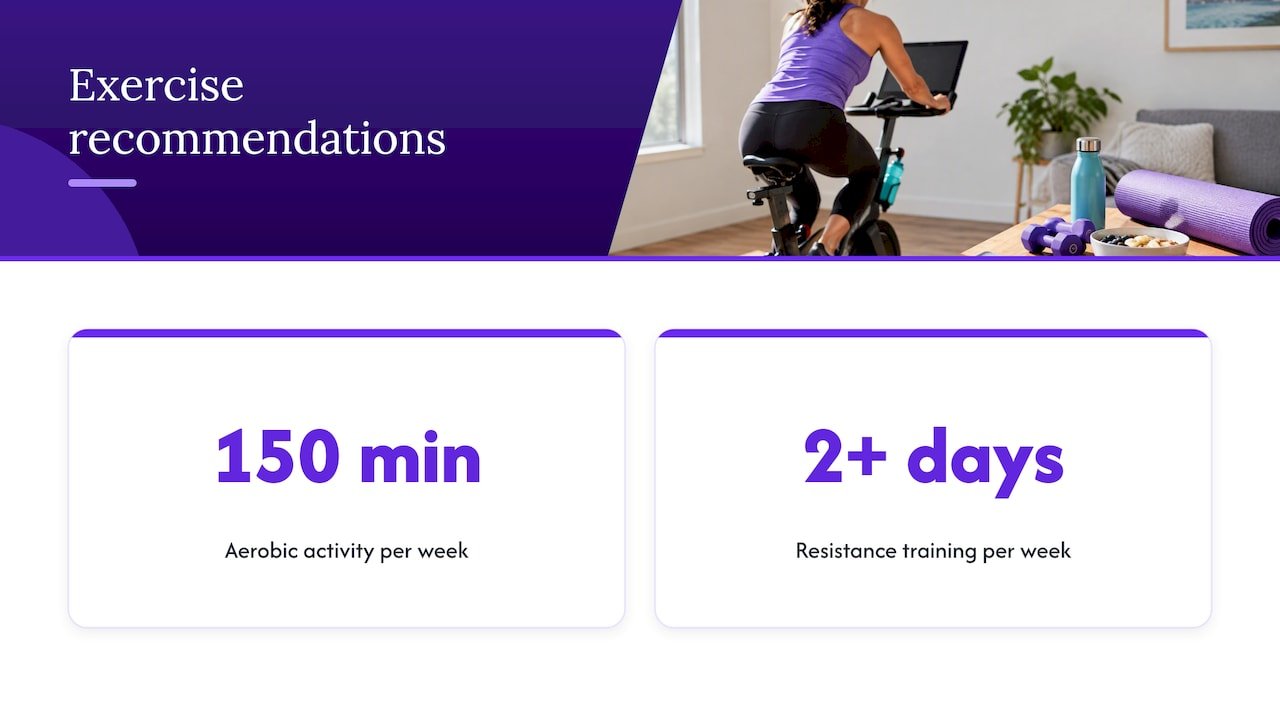
The encouraging part is that movement itself is well supported. A consensus statement on exercise for cancer survivors found exercise generally safe and concluded that specified doses of exercise can improve several cancer-related health outcomes. The earlier recommendations aimed for at least 150 minutes of aerobic activity a week and resistance training on two or more days, with testing and adjustments based on health status. Ask your care team what level of activity suits you. If they are happy for you to exercise, ask specifically whether adding enriched oxygen is appropriate.
Women over 40
Age alone is not a barrier, and many women over 40 find that regular, moderate exercise is exactly what helps them feel stronger. What matters is your heart health, your blood pressure, any medication you take and how long it has been since you exercised regularly. If any of that is unclear, a quick GP check is a good first step. Start gently, keep the effort moderate and build gradually.
Practical safety habits
- Stop and tell the person supervising you if you feel dizzy, short of breath, or unwell.
- Never use oxygen near flames, sparks or heat sources. Oxygen-enriched air increases fire risk, and equipment should be used in a suitable, supervised space.
- Drink water before and after.
- Do not exercise through chest pain or palpitations.
- Keep your doctor informed about any new routine.
Perspective
Over the years we have watched people arrive at our centre curious about oxygen, and the best results in how people feel come from treating it as one part of a bigger picture.
At Live5DHealth we believe in a holistic approach that combines modern technology with long-standing wisdom. EWOT fits that thinking well because it asks you to do something active, not just lie back and receive a treatment. You move, you breathe deliberately, and you pay attention to your body.
What we encourage is a considered start. Begin at a comfortable effort, keep sessions short, build gradually and look after the basics around them: sleep, hydration, good food and clean, energised water, which we provide throughout our facility. Many of our visitors combine EWOT with other therapies we offer, such as red light therapy, the sauna and steam room, or hyperbaric oxygen, and they plan the order and the spacing with our team rather than trying everything at once.
We are also clear about what EWOT is. It is a wellness support with a sound physiological idea behind it, and the research is still developing. That is exactly why guidance matters, and why we want you to feel confident and well informed before your first session.
Mark
Combining EWOT with other therapies
EWOT does not have to stand alone. People who like a structured routine often pair it with other treatments across a week, not in a single visit. Examples include:
- Red light therapy for skin and general wellbeing sessions, which pairs naturally with a lighter training week. See our red light therapy dosage guide for how treatment is measured.
- Sauna, steam and cold plunge for relaxation and recovery after a session. If you are in cancer treatment, read our sauna safety guide for chemotherapy and ask your oncologist first.
- Hyperbaric oxygen therapy as a separate, pressurised experience. Our overview of hyperbaric therapy combined with other wellness treatments explains how people sequence these.
- PEMF and holistic massage for people who want a calmer, restorative element in their week.
A sensible rule is to introduce one new element at a time. That way you can tell how you respond to each and adjust accordingly.
Try EWOT with us in Boyle
At Live5DHealth in Boyle, County Roscommon, we offer Exercise with Oxygen Therapy alongside one of the broadest collections of wellness technologies in Ireland. You will be welcomed by a team who talk through your health, your goals and your pace before you start.

If you are exploring oxygen-based therapy more widely, our hyperbaric oxygen therapy sessions are priced at 80 to 120 EUR, and our sauna, steam and cold plunge spa is 30 EUR. To ask about EWOT or to plan a session, visit our booking page or explore our full range of therapies. If you are looking for a longer experience, our 3, 5 and 10-day wellness retreats bring several therapies together in one programme.
Getting the most from your sessions
A few habits make a noticeable difference to how EWOT feels and how consistent you can be:
- Check the fit. A well-sealed mask matters. Say so if it feels loose or uncomfortable.
- Choose an exercise you enjoy. A bike is the most common choice because it is stable and easy to control.
- Keep a simple log. Note the date, duration, effort and how you felt that day and the next. After a few weeks, patterns become clear.
- Be consistent, not extreme. Regular moderate sessions beat occasional heroic ones.
- Pair it with the basics. Sleep, protein, hydration and rest days all affect how you feel far more than any single therapy.
- Review after a month. Ask whether you feel any different, whether you enjoy the sessions, and whether to continue, adjust or change approach.
If you want to talk through the options before you book, our team can help you choose a pace that suits your fitness and health.
FAQ
How long should an EWOT session be?
Most commonly described protocols use about 15 minutes of moderate exercise, with a few minutes of warm-up and cool-down either side. Some experienced exercisers go up to 30 minutes. If you are new to it, start shorter and build up gradually.
How often should you do EWOT?
Three to five sessions a week is the range most often described. Beginners usually do better starting with two or three and allowing rest days. If you feel unusually tired afterwards, reduce the frequency before increasing the effort.
Is EWOT as good as HBOT?
They are different therapies and not interchangeable. HBOT uses a pressurised chamber and is given in condition-specific courses, while EWOT delivers enriched oxygen at normal pressure during exercise. Which one suits you depends on your goals and health, and your doctor can advise.
Does EWOT increase VO2 max?
That has not been established. A review of exercise training in enriched oxygen in people with COPD and coronary artery disease found no significant differences in peak VO2 compared with normal-air exercise. Regular moderate exercise remains the best-supported way to build fitness.
Is EWOT safe if I have cancer?
Speak to your oncologist before trying it. Exercise is generally considered safe and helpful for many people with cancer, but high-concentration oxygen can interact with certain treatments. Your care team can tell you whether it is appropriate for your situation.
Sources
- The Effects of Exercise Training in Hyperoxia Compared to Normoxia (ACSM, 2020)
- Hyperbaric oxygen therapy: A practical guide (PMC, 2025)
- Exercise Guidelines for Cancer Survivors: Consensus Statement (PMC, 2021)
- Irish Guidelines on the Administration of Oxygen Therapy (Irish Thoracic Society, 2017)
- MOTS-c mitochondrial-derived peptide